Capítulo 1
The Happiness Rebellion: Challenging Society's Blueprint for Your Life
Have you ever wondered why, despite following all the "right" steps in life, happiness still feels elusive? In his provocative book "Happy Ever After," behavioral scientist Paul Dolan challenges the very foundation of what society tells us will make us happy. As a professor at the prestigious London School of Economics who proudly maintains his working-class identity, Dolan's work has resonated with celebrities like Melinda Gates and influenced corporate wellness programs worldwide. The book sparked heated debates when released in 2019, with The Guardian calling it "a demolition job on the myths we tell ourselves about happiness." Through a blend of personal anecdotes, cutting-edge research, and sharp social commentary, Dolan exposes how our pursuit of wealth, marriage, education, and other prescribed life paths often leads us away from genuine happiness rather than toward it. What if everything you've been taught about creating a good life is actually making you miserable?
Capítulo 2
The Narrative Traps That Hold Us Captive
We live surrounded by prescriptive stories about how we should live - what Dolan calls "social narratives." These aren't just casual suggestions but powerful forces with an element of "oughtness" and social sanctions for those who deviate. These narratives function like invisible scripts, guiding our behavior and judgments without our conscious awareness.
Dolan organizes these narratives into three meta-categories: Reaching (wealth, success, education), Related (marriage, monogamy, children), and Responsible (altruism, health, volition). These stories persist across generations because they align with our innate motivations for resource accumulation, belonging, and self-enhancement. But there's something more insidious at work - these narratives typically reinforce existing power structures and social hierarchies.
Consider the author's own experience at a festival panel discussion, where he was criticized for "playing the working-class hero" and swearing during his presentation. The critic insisted that as an LSE professor, Dolan should modify his behavior to match academic stereotypes. This encounter perfectly illustrates how social narratives create expectations about how people in certain roles should behave.
Such stereotypes can deter working-class students from pursuing higher education, as they fear having to suppress their authentic selves to fit in. Despite universities making strides to accept more working-class students, many avoid elite institutions because they don't want to feel alienated from their backgrounds. This is the insidious power of narrative traps - they can prevent people from pursuing paths that might otherwise bring them fulfillment.
The fundamental problem is that we evaluate these narratives by abstract ideals rather than by how they make people feel. Being a "high achiever" might sound good but feel terrible-and if it feels bad, should it really be glorified? Instead of following multiple constraining narratives, Dolan proposes one overarching standard: the real experiences of real people. This removes stigma from those unwilling or unable to follow prescribed "one size fits all" approaches to life.
Capítulo 3
The Wealth Paradox: When More Money Makes You Less Happy
The relationship between wealth and happiness is far more complicated than most people realize. While poverty certainly causes misery, the happiness benefits of increased income diminish significantly after reaching about $50,000-$75,000 annually. Data from the UK's Office for National Statistics reveals that earning less than 400 weekly increases one's chance of being among the most miserable 1%. However, the American Time Use Survey shows that those earning over $100,000 report no more happiness than those earning under $25,000 and actually experience less purpose in their daily activities.
This challenges the common narrative that more money invariably leads to greater happiness. The truth is that misery decreases with income up to about $50,000 but shows no significant reduction beyond that point, suggesting "just enough" money is optimal for well-being rather than maximum accumulation.
What makes this relationship even more complex is how social comparisons affect our happiness. We primarily make upward comparisons to those earning more, which typically decreases our satisfaction with our own income. Research shows our happiness is more affected by our perception of where we stand financially compared to reference groups than by our actual position. The most psychologically impactful comparisons are to people similar in age living in our area, rather than general neighbors.
This comparison drive can lead to financial trouble. Studies show increased bankruptcy filings among neighbors of lottery winners who try to "keep up" with their suddenly wealthy peers. Status-seeking consumption has flourished since the Industrial Revolution, defined by three elements: limited supply, visibility, and a weak price-quality relationship.
Housing represents our largest status purchase, combining absolute value with positional benefits. Despite economic crashes, over 85% of Britons and 56% of Americans view homeownership as essential. Studies show peer influence significantly impacts satisfaction from homeownership - the more your friends value it, the happier you'll be owning. People prefer having relatively larger homes than absolute size - choosing 3,000 sq ft homes when neighbors have 2,000, rather than 4,000 sq ft homes when neighbors have 6,000. This positional competition creates an unsustainable arms race where approximately half of housing expenditure benefits come from relative, not absolute, advantages.
A "just-enough" approach to wealth is challenging but liberating. Once basic needs are met, constant worrying can stop. The wealth narrative stigmatizes contentment, labeling those satisfied with what they have as "lazy" or "unambitious." We should instead celebrate those who devote time to social causes rather than personal wealth accumulation.
Capítulo 4
The Success Trap: When Achievement Costs Your Happiness
The success narrative, particularly around careers and jobs, is deeply ingrained in society. About two-thirds of young Americans consider a successful, high-paying career as "very important" or "one of the most important things" in their lives - with this belief now stronger among young women than men.
Being unemployed significantly damages life satisfaction, with effects that never fully recover even after finding work again. Multiple periods of unemployment leave permanent scars on confidence and sense of job security. Interestingly, higher national unemployment rates make employed people less happy (due to job insecurity) but unemployed people happier (through social comparison).
However, high-status jobs don't necessarily create happiness - surveys show 87% of florists report being happy compared to just 64% of lawyers. Similarly, chief executives earn more but aren't more satisfied than their secretaries. Clergy, farmers and fitness instructors report higher happiness than their salaries might suggest, likely due to their sense of purpose. Jobs involving nature, visible results, positive social interactions, and autonomy tend to generate more happiness than prestigious but demanding professions.
The Reaching narrative pushes us toward longer working hours despite evidence that happiness and purpose peak at 21-30 hours per week. As incomes rise, we focus more on potential income lost by not working, treating time strictly as money. Long hours have become status symbols among elites - Apple CEO Tim Cook boasts about emailing colleagues at 4:30 a.m. and being first in, last out. Since the 1970s, higher earners have increasingly worked longer hours than those with lower incomes, contradicting Keynes' prediction of increased leisure time.
Working-class people face systematic discrimination in elite professions. Private school applicants are held to lower academic standards than state school graduates when applying for prestigious jobs. Even when working-class individuals "make it" into elite professions like law, medicine, and finance, they earn about 17% less than middle-class colleagues - a gap comparable to the gender pay gap but receiving far less attention.
The myth of social mobility deserves questioning: we'll always need both low and high-skilled jobs, so we should improve conditions for all rather than fixating on escaping certain professions. The jobs considered "aspirational" often pay more but make people miserable, and social mobility typically refers only to economic status, not better social relationships. Working-class kids who gain social status often lose friends, networks and identity. Most problematically, the myth of mobility suggests anyone can succeed with hard work, propping up existing inequalities while setting unrealistic expectations.
Capítulo 5
The Education Paradox: When Knowledge Diminishes Joy
The education narrative is perhaps the most widely accepted of all - with universities worldwide increasing from 500 in 1945 to over 10,000 today. In the UK, university attendance has grown from one in seven people in the late 1980s to nearly one in two now. While this expansion is widely considered positive, the evidence challenges whether education beyond basic levels meaningfully improves happiness.
Economically, university graduates earn about 200,000 more over their lifetimes than non-graduates. Despite tuition costs around 50,000, education appears financially worthwhile. However, education also provides immediate experiential benefits and costs. At elite institutions like Oxford, two-thirds of students miss lectures due to sleep deprivation and 44% feel constantly stressed, while 40% of Cambridge English students report depression diagnoses.
Surprisingly, happiness generally decreases as education increases, with those holding professional or doctoral degrees reporting the least happiness. Similarly, sense of purpose also tends to decrease with more education. Higher education offers only minimal protection against feelings of misery.
Intelligence and happiness have a complicated relationship. A 2012 review of 23 studies across 10 nations found no relationship between intelligence and happiness. Intelligence appears to follow a "just enough" pattern - lower childhood IQ increases risk of mental health problems, but excessive intelligence can also be harmful. A Swedish study found male students with excellent school performance were four times more likely to develop bipolar disorder later in life.
One reason education might not strongly correlate with happiness is that working-class people lose their social networks and identities as they become better educated. People who are socially mobile risk losing their sense of identity while climbing the social ladder, and the implication that "moving up" suggests something wrong with their origins can promote shame. Studies show working-class students are more likely to pursue further education when their schoolmates receive the same opportunity, allowing them to maintain their social networks.
Despite evidence showing collaborative learning approaches enhance attainment, education in the UK and US predominantly encourages independent working and competition over cooperation. This preference for individualism disadvantages working-class students whose values are more group-based and less individualistic. Elite universities like Yale emphasize qualities aligned with middle-class experiences of competence, asking applicants to "stand out" rather than demonstrate cooperation or community problem-solving.
Capítulo 6
The Marriage Myth: When "I Do" Doesn't Deliver Happiness
The fairytale ending "they fell in love, got married, and lived happily ever after" remains deeply ingrained in our culture. Marriage is still viewed as a life achievement, with over 90% of Germans considering a long-lasting marriage very important regardless of their happiness level.
Once we find a partner, we expect them to provide everything from sexual fulfillment to household help. This expectation damages relationships. People who believe in soulmates tend to be less committed when facing difficulties, as if disagreements confirm incompatibility. Those believing in romantic destiny are more anxious and less forgiving.
Dolan distinguishes between passionate love (early-stage lust resembling addiction) and companionate love (deep commitment after passion subsides). Brain scans show passionate love activates similar regions as cocaine use and money anticipation. It can reduce pain perception but also causes anxiety, sleeplessness, and jealousy. Thankfully, passionate love only lasts 1-2 years, with hormone levels changing significantly. When relationships last longer, companionate love develops as passion declines. The social narrative problem is expecting both passionate and companionate love simultaneously and indefinitely, setting unrealistic expectations.
Our wedding obsession has become a social media spectacle, with costs rising as couples showcase their love to virtual friends. Ironically, spending more on weddings correlates with higher divorce rates - couples spending over $20,000 are twice as likely to divorce as those spending $10,000, while those spending under $1,000 are half as likely.
Does marriage actually improve happiness? German longitudinal data shows heightened life satisfaction only during the year before and after the wedding. Long-term effects are modest, with nearly equal numbers ending up less satisfied as more satisfied. Some happiness differences between married and single people stem from reverse causality - happier people are more likely to marry.
Over two in five UK marriages end in divorce, typically preceded by a miserable separation period. Contrary to our expectations, happiness rebounds significantly after divorce papers are signed as uncertainty gives way to planning for a better future. We tend to overestimate how long distress will last following breakups, and fear of being single often keeps people trapped in unsatisfying relationships.
Society consistently stigmatizes single people despite evidence challenging the "married is best" narrative. Research shows people automatically attribute negative traits like "depressive," "lonely" and "shy" to singles while assuming married people are happier - even when presented with evidence to the contrary. Remarkably, those who choose singlehood face even harsher judgments than those seeking marriage. Singles face workplace discrimination, financial penalties, and social marginalization. Yet singles themselves often uphold the marriage myth, with only 4% recognizing they're being stigmatized.
Capítulo 7
Beyond Monogamy: When Exclusivity Doesn't Equal Happiness
While attitudes toward premarital sex have relaxed, views on monogamy remain strict, with about 70% of women and 63% of men in the UK considering infidelity "always wrong" - percentages that have actually increased since 1990. Americans are even more opposed, with 84% finding affairs morally unacceptable. The narrative that monogamy is the only acceptable arrangement remains largely unchallenged.
Sexual desire naturally diminishes in long-term relationships as partners become familiar as family. Yet the dominant narrative insists desire should continue unabated. Google searches reveal "sexless marriage" is searched 3.5 times more often than "unhappy marriage" and 8 times more than "loveless marriage," highlighting this disconnect.
Evolutionary biologists suggest sexual variety evolved to prevent inbreeding in ancestral environments. While social monogamy exists in about 3% of mammals, it's typically accompanied by "extra-pair copulation." Complete monogamy as a default arrangement exists in only one species: owl monkeys, who mate just once yearly.
Sexual infidelity is widespread despite difficulties gathering accurate data. UK estimates suggest at least one-third of men and one-quarter of women have at least one affair during marriage. Research challenges traditional gender narratives about sexual desire. A BBC study of over 200,000 participants across 53 nations found women's sex drive is more variable than men's - a biological rather than cultural difference.
People having affairs report feeling guilty but also describe positive experiences: feeling wanted, increased self-esteem, "feeling alive," and sexual satisfaction. Gender differences exist in motivation: men are more influenced by "pull factors" (attraction to someone new) while women respond more to "push factors" (dissatisfaction with current relationship).
Consensual non-monogamy (CNM) offers an alternative approach to relationships, with about 5% of UK heterosexuals identifying as part of such arrangements. Research suggests CNM relationships feature high levels of trust, honesty, intimacy and satisfaction with lower jealousy compared to traditional relationships. The unique benefits include diversified need fulfillment, variety in non-sexual activities, and personal growth through exploring individual identities.
Monogamy works for some people some of the time, but not for everyone all the time. We must recognize basic human desires while thoughtfully managing them - not as justification for philandering, but as acknowledgment of human nature. Challenging the monogamy narrative could reduce social costs for those who don't fit conventional expectations.
Capítulo 8
The Parenthood Paradox: When Children Don't Bring Joy
After following the conventional life narrative of falling in love, marrying, and maintaining monogamy, society expects children as the final step to full adulthood. While biological imperative drives species survival, this shouldn't pressure individuals who don't want children or stigmatize those who can't have them.
While biological instinct and species preservation drive many to have children, there is no universal "biological imperative" that applies to everyone. Research shows maternal instinct isn't innate in all women, as birth rates fluctuate with cultural shifts. With planetary overpopulation, universal procreation would actually threaten species survival.
Despite social pressure, increasing numbers choose to remain childless after careful deliberation. The time commitment of parenting is substantial, and the childfree can redirect this time to other meaningful pursuits - 42% of charitable foundations are created by people without children, who also donate more time and money to charity in later life. Financial considerations matter too - raising a child to age 21 in the UK costs approximately 250,000, creating significant strain particularly for working-class families.
Environmental impact presents perhaps the most compelling yet under-discussed reason for remaining childless. Research shows having one fewer child reduces carbon footprint by 9,441 tonnes - twenty times more effective than adopting six major environmental habits combined.
Despite the dominant narrative that children should make us happy, the reality is more complex. Research consistently shows people without children are at least as satisfied with their lives as parents. Longitudinal studies reveal that parenthood's positive effects on life satisfaction are often offset by financial costs, with higher income serving as a buffer. Having more than two children correlates with decreased life satisfaction. Parents, especially mothers, face higher rates of depression, anxiety and stress. Experience sampling reveals childcare ranks 12th in enjoyment out of 16 common activities - less pleasurable than eating or exercising, though it does provide purpose.
How should you raise children to maximize their happiness? Unfortunately, we lack definitive experimental data. Communication quality profoundly impacts development. One study found middle-class children heard 215,000 words weekly versus just 62,000 for working-class peers. By age three, class factors explained 36% of vocabulary variance.
Once a child is born, a two-way communication system forms between parent and child. Despite social pressure to maintain family connections, children shouldn't feel obligated to stay in contact with harmful parents. Society harshly judges those who cut ties with parents while tolerating similar breaks from harmful partners. This dynamic creates a perverse incentive structure where parents have little motivation to improve their behavior when contact remains unconditional.
Capítulo 9
Rethinking Altruism: When Good Deeds Need Selfish Motives
The narrative trap of pure altruism is illustrated through Jack and Jill, who both donate 2% of their 30,000 salaries to charity. Jack publicizes his giving widely and basks in recognition, while Jill donates anonymously. Though many might consider Jill more virtuous, Dolan argues this hierarchy of altruism based on motivation is misguided. We should focus on impact rather than motive, as judging self-interest in charitable acts discourages overall philanthropy.
External recognition significantly motivates charitable behavior, though we're often unaware of how much status influences our generosity. Studies show people perform better when their charitable acts are public, and donations increase in environments where both highest and lowest donors are publicized. The author contrasts the celebrated Sunday Times Rich List with the lesser-known Philanthropy 50, suggesting society should elevate altruism as a status marker.
Even anonymous givers like Jill gain internal rewards from their generosity. Research consistently shows giving makes people happier - givers are 43% more likely to report being "very happy" than non-givers, and volunteers show lower depression and mortality rates. The "warm glow" of giving has been established as a causal relationship, with studies showing people randomly assigned to spend money on others report greater happiness than those spending on themselves.
The narrative of pure altruism is not just wrong but harmful. We're neither sacrificial saints nor self-interested sinners - we're reasonable people who engage in activities benefiting both ourselves and others. Studies show volunteers with self-oriented motives (like career advancement) stick with volunteering longer than those claiming purely community-focused reasons.
While feeling others' pain motivates us to help, empathy's "spotlight effect" focuses our attention narrowly, making us innumerate, parochial, and short-sighted when choosing causes. We respond more generously to identifiable victims (like a single starving child named Rokia) than to statistics about millions suffering. Empathy is also biased toward those similar to us and fails with those distant in time, explaining our inaction on climate change despite its impact on future generations.
For helping those closest to us, empathy makes our actions both more likely and enjoyable. But for distant others, detached compassion proves more effective. The Effective Altruism movement uses evidence to determine the most efficient ways to reduce global suffering. While empathy motivates many to give who otherwise wouldn't, calculated compassion directed at evidence-based interventions creates greater net benefit.
Capítulo 10
Beyond Free Will: When Choice Is Just An Illusion
The final social narrative examined is that we act volitionally with considerable free will over our choices. This assumption underpins judgments about behavior and adherence to social narratives. However, human behavior is increasingly understood through four determining factors: genetic influences, social environments, decision contexts, and randomness.
Genetics profoundly influences our lives, from appearance to cognition. Research shows genes present the most significant influence on academic achievement, with studies finding at least half the difference in children's exam performance attributable to DNA differences. Happiness also has genetic components, with studies of adoptive families suggesting happiness transfers from parents to children largely through genetics rather than environment.
Socioeconomic status dramatically shapes life outcomes. In the US, each 1% increase in parents' income position correlates with a 0.7% higher likelihood of college enrollment, regardless of where on the income scale. Poverty's stresses adversely affect biology, reducing brain surface area, increasing obesity risk, and disrupting neural development through trauma exposure - 90% of juvenile offenders in the US have experienced childhood trauma.
Our decisions are heavily influenced by contextual factors we're unaware of. Research shows a quarter-second lag between making choices and becoming consciously aware of them. Our "system 1" brain processes respond automatically to situational stimuli, making thousands of effortless decisions daily. Environmental factors like lighting can unconsciously affect behavior - dim lighting increases creativity but reduces honesty, while bright environments improve honesty.
Much of life is determined by randomness, though we're reluctant to acknowledge it. From birth circumstances to academic performance, luck plays a crucial role. In the UK and US, children born later in the school year face significant disadvantages, processing information with less developed brains than older classmates.
We resist attributing outcomes to luck because it strips away our sense of control. In a Berkeley study, Monopoly players given obvious advantages (extra money, dice, bonuses) attributed their wins to personal skill rather than the rigged game. This self-delusion can be beneficial - concentration camp survivors who maintained areas of perceived independence were more likely to survive. Believing in free will correlates with better job performance, increased motivation, and prosocial behavior.
While personal belief in free will benefits individuals, applying this belief to others harms social justice. The "anyone can succeed through hard work" narrative ignores systemic inequalities. Society overrewards talent - determined entirely by genes, environment and luck - while undercompensating the unlucky. Though we believe effort is freely chosen, even our work ethic may be determined by genetics and early socialization.
We can reconcile seemingly contradictory beliefs about free will by focusing on impact. Even if behavior ultimately stems from genetic and environmental influences, we can still hold people accountable for their effects on others. This approach works regardless of one's position on free will. Recognizing limited volition liberates us from harsh self-judgment while encouraging responsibility for harm we cause, rather than hiding behind "I didn't mean it."
Capítulo 11
Breaking Free From Society's Happiness Blueprint
Social narratives can trap us in ways we often fail to notice, and even when recognized, they're difficult to challenge. Though initially alluring, narratives don't guarantee lasting happiness or work equally well for everyone. Living by stringent guidelines removes what little volition we possess. We must look beyond preconceived notions of a good life and recognize there's no universal prescription for living well.
Focusing on happiness helps overcome narrative-driven biases. Our experiences matter more than the stories we tell about them. Rather than blindly following or rejecting social narratives, we must learn when to hold and when to fold them based on our unique circumstances. While big decisions like career choices matter, happiness exists in moment-to-moment experiences - the "small stuff" we're often told not to sweat.
Social media has magnified the importance of achieving according to dominant narratives by making our successes visible to millions. It allows us to construct carefully curated identities that portray who we want to be rather than who we are. Data shows miserable people use social media platforms more frequently than happy people. However, social media can also foster anti-narrative groups like "becoming minimalist" and "Childfree Choice" that counterbalance prevailing narratives.
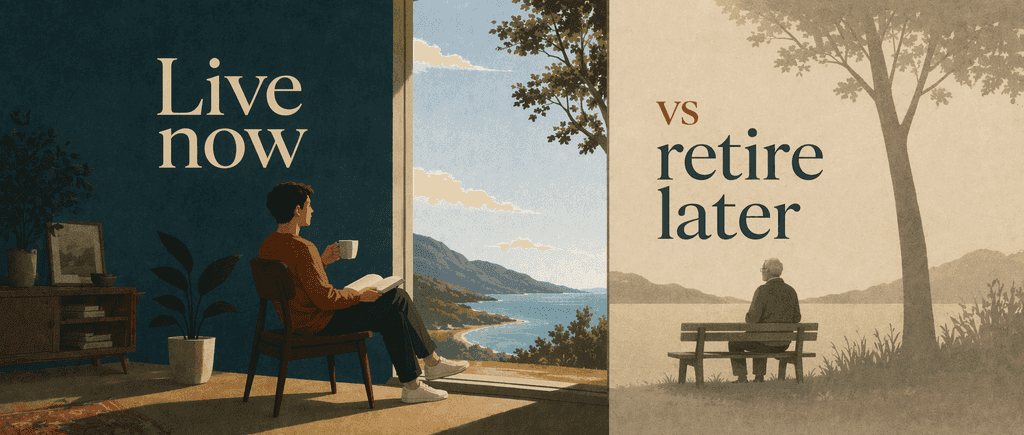
For those who feel obligated to fit in, you shouldn't be chastised for wanting to behave inconsistently with social narratives. We each must decide when to conform and when to stand out, living in ways that minimize our misery while accounting for our impact on others. Sometimes this means conforming to elements of the Reaching, Related and Responsible narratives - but certainly not for all of us all the time.
As Dolan concludes, "We should respect those who forsake social narratives that aren't for them. Here's to escaping the myth of the perfect life, and to being Happy Ever After."