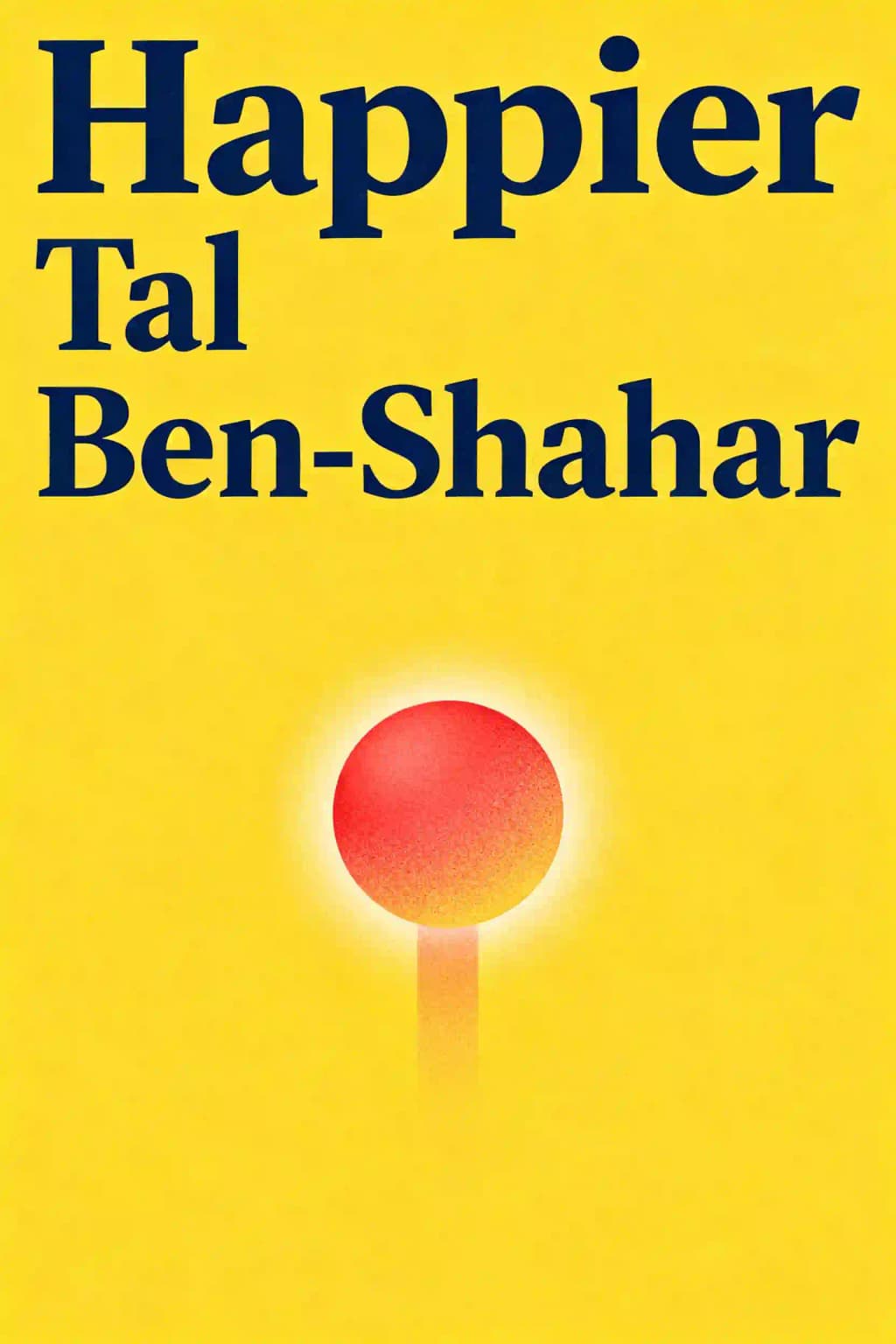
Harvard's most popular course transformed into a book - "Happier" reveals Tal Ben-Shahar's revolutionary approach to happiness as a learnable skill. Challenging conventional wisdom, it offers practical rituals for aligning your life with true meaning beyond material wealth.
Tal Ben-Shahar, bestselling author of Happier: Learn the Secrets to Daily Joy and Lasting Fulfillment, is a Harvard-trained positive psychology expert and global authority on well-being. A former Harvard professor, his groundbreaking courses on Positive Psychology and Leadership became the most popular in the university’s history, attracting over 1,400 students per semester. His work bridges academic rigor with practical strategies, focusing on themes like resilience, mindfulness, and purposeful living.
Ben-Shahar’s other bestselling books, including Being Happy and Choose the Life You Want, have been translated into 25+ languages, solidifying his status as a leading voice in personal development. A sought-after speaker for Fortune 500 companies and institutions, he co-founded the Happiness Studies Academy to advance research-based well-being education.
His insights have been featured on The Daily Show with Jon Stewart, CNN, and TED platforms. Happier remains a cornerstone of modern positive psychology, praised for blending scientific research with actionable advice. The book’s enduring impact is reflected in its global reach, with millions of copies sold and adaptations into corporate training programs worldwide.
Happier explores the science of well-being through positive psychology, challenging the myth that success alone brings happiness. Tal Ben-Shahar introduces the SPIRE framework—Spiritual, Physical, Intellectual, Relational, and Emotional well-being—to cultivate resilience and purpose, especially during adversity. The book combines research, philosophy, and actionable exercises to help readers build lasting fulfillment.
This book is ideal for individuals seeking practical strategies to improve mental health, navigate life’s challenges, or understand positive psychology. It’s particularly valuable for professionals, students, and anyone feeling overwhelmed by societal pressures or personal setbacks.
Yes—the book distills Harvard’s most popular course into relatable insights, blending academic rigor with accessible advice. Its focus on actionable rituals (e.g., gratitude journaling) and critiques of perfectionism make it a standout guide for sustained happiness.
SPIRE represents five pillars of well-being:
This framework builds resilience against adversity.
Ben-Shahar argues that happiness is the “ultimate currency”—not wealth or status. He debunks the “rat race” mindset, showing how short-term sacrifices for future success often backfire. Instead, aligning daily actions with intrinsic values fosters enduring fulfillment.
These emphasize proactive growth and rejecting external validation as the sole measure of worth.
Unlike generic advice, Happier merges academic research (e.g., Pareto Principle applications) with philosophical insights. It avoids overly simplistic “quick fixes,” focusing instead on systemic habit changes, making it closer to Atomic Habits than The Secret.
Some argue the book oversimplifies complex mental health issues or relies too heavily on anecdotal evidence. However, its emphasis on incremental progress and rejecting perfectionism addresses these concerns constructively.
Ben-Shahar’s strategies counterbalance constant connectivity by prioritizing mindfulness and offline relationships. For example, he advocates tech-free rituals to reduce anxiety and enhance present-moment joy—a response to rising digital-era dissatisfaction.
For deeper dives into resilience, pair with Grit by Angela Duckworth or The Happiness Hypothesis by Jonathan Haidt. Ben-Shahar’s The Pursuit of Perfect also expands on overcoming toxic perfectionism, a theme touched on in Happier.
The book reframes failure as a natural step toward growth, urging readers to embrace “permission to be human.” By integrating setbacks into the SPIRE framework, it teaches resilience without toxic positivity.
Its focus on mental health adaptability resonates in post-pandemic recovery and amid modern stressors like burnout. The SPIRE model’s flexibility makes it applicable to career transitions, relationship struggles, or global crises.
Siente el libro a través de la voz del autor
Convierte el conocimiento en ideas atractivas y llenas de ejemplos
Captura ideas clave en un instante para un aprendizaje rápido
Disfruta el libro de una manera divertida y atractiva
Happiness leads to success, not the other way around.
Happiness becomes contagious.
Pursuing happiness directly creates a paradox.
Happiness levels are malleable, not fixed.
Make the best of things that happen.
Desglosa las ideas clave de Happier en puntos fáciles de entender para comprender cómo los equipos innovadores crean, colaboran y crecen.
Experimenta Happier a través de narraciones vívidas que convierten las lecciones de innovación en momentos que recordarás y aplicarás.
Pregunta cualquier cosa, elige tu estilo de aprendizaje y co-crea ideas que realmente resuenen contigo.

Creado por exalumnos de la Universidad de Columbia en San Francisco
"Instead of endless scrolling, I just hit play on BeFreed. It saves me so much time."
"I never knew where to start with nonfiction—BeFreed’s book lists turned into podcasts gave me a clear path."
"Perfect balance between learning and entertainment. Finished ‘Thinking, Fast and Slow’ on my commute this week."
"Crazy how much I learned while walking the dog. BeFreed = small habits → big gains."
"Reading used to feel like a chore. Now it’s just part of my lifestyle."
"Feels effortless compared to reading. I’ve finished 6 books this month already."
"BeFreed turned my guilty doomscrolling into something that feels productive and inspiring."
"BeFreed turned my commute into learning time. 20-min podcasts are perfect for finishing books I never had time for."
"BeFreed replaced my podcast queue. Imagine Spotify for books — that’s it. 🙌"
"It is great for me to learn something from the book without reading it."
"The themed book list podcasts help me connect ideas across authors—like a guided audio journey."
"Makes me feel smarter every time before going to work"
Creado por exalumnos de la Universidad de Columbia en San Francisco

Obtén el resumen de Happier como PDF o EPUB gratis. Imprímelo o léelo sin conexión en cualquier momento.
What if everything you believed about happiness was backward? Most of us operate under a simple assumption: achieve success first, then happiness will follow. Get the promotion, find the relationship, reach the milestone-and joy will be waiting on the other side. Yet research tells a different story. Studies tracking lottery winners and newly tenured professors reveal a troubling pattern: major life victories create only brief happiness spikes before people return to their emotional baseline. Harvard students who were ecstatic about acceptance letters often find themselves stressed and miserable once enrolled. The truth inverts our entire approach. Happiness doesn't follow success-it precedes it. When we elevate our baseline happiness, even slightly, we become more creative, productive, and engaged. We build stronger relationships, develop resilience, and our wellbeing becomes contagious, rippling outward through our communities. This reframes happiness from indulgence to strategic necessity, from luxury to fuel. But here's the paradox: pursuing happiness directly often backfires. Research shows that people who obsess over happiness end up less happy. The solution lies in pursuing happiness indirectly through its core elements, like viewing sunlight through a prism rather than staring directly at the sun. True happiness isn't a single emotion but what can be called "wholebeing"-a holistic state encompassing five interconnected dimensions captured in the acronym SPIRE.
Spiritual wellbeing means living mindfully and purposefully, connecting to something larger through meditation, nature, or meaningful work. Physical wellbeing encompasses sleep, nutrition, and recovery - the foundation of sustained energy. Intellectual wellbeing involves curiosity and engaging with new ideas. Relational wellbeing focuses on nurturing deep connections, from intimate partnerships to community. Emotional wellbeing requires honoring all feelings rather than suppressing them. These elements form an interconnected web where strengthening one reinforces the others - mindfulness improves physical energy, intellectual growth deepens relationships. Research shows happiness levels are malleable, not fixed. A daily five-minute meditation might seem insignificant, but over months it substantially improves emotional regulation and stress management. The science of happiness won't eliminate suffering, but it reduces "second-level suffering" - the additional pain from rejecting difficulties or failing to appreciate what we have. Things don't happen for the best, but we can make the best of what happens.
Spiritual wellbeing requires finding meaning in daily activities and being fully present. Research shows people view work in three ways: as a job (for money), a career (for advancement), or a calling (as meaningful). Those who see their work as a calling report greater satisfaction, regardless of profession - janitors and hairdressers experience this just as doctors can. The shift happens through reframing. Create a "calling description" instead of a job description. Preparing a lecture becomes engaging with ideas to help others flourish. Washing dishes becomes creating space for family connection. Mindfulness meditation - present-moment awareness without judgment - offers another pathway. Eight weeks of practice improves mood, reduces anxiety, and physically alters brain structure. Practicing twice weekly yields the same benefits as daily practice because mindfulness extends beyond formal sitting. By choosing presence in ordinary moments, we transform the mundane into the sacred.
Mind and body form one inseparable system. The "facial feedback hypothesis" shows that simply smiling or frowning generates corresponding feelings. This unity matters profoundly for managing stress, which has reached pandemic levels. Yet stress itself isn't the enemy-like weight training that breaks down muscles, stress triggers growth when paired with adequate recovery. Recovery operates at three levels. Micro-recovery means fifteen-minute breaks every two hours or thirty seconds of deep breathing. Mid-level recovery includes full days off and seven to nine hours of sleep. Macro-recovery involves extended breaks-camping trips, reading retreats, or simply doing nothing for days or weeks. Physical activity proves crucial for wellbeing, yet disappears first during busy periods. Ironically, exercise becomes most vital during stressful times. Just thirty minutes of aerobic activity three times weekly matches psychiatric medication's effect on depression. Cambridge research shows people who stand every twenty to thirty minutes are measurably happier. The key is the "five-minute takeoff"-committing to just five minutes of activity, which typically leads to continuation because motivation follows action, not vice versa.
Living solely for physical needs creates unhappiness-the challenge is using our intellect to enhance wellbeing. Education often stifles natural curiosity, but it never disappears; it simply lies dormant. Everyone is curious about something; the key is discovering what and how. Questions act like flashlights, illuminating specific areas while leaving others dark. Instead of only examining problems, ask what's working well. While speed-reading processes information efficiently, slow-reading-deeply engaging with texts-offers profound benefits. Deep learning provides joy, allowing us to luxuriate in brilliant minds while developing transferable cognitive skills. To cultivate intellectual wellbeing, embrace failure. Parents who never let their baby fall prevent walking; avoiding failure prevents growth. Thomas Edison didn't fail-he found ten thousand ways that won't work. Overcoming perfectionism requires self-compassion and a growth mindset. Intellectual wellbeing isn't about finding final answers but embracing the process of questioning and discovery.
Harvard's nearly century-long study reveals that quality relationships-not money or success-best predict happiness and physical health. Connection depth matters more than relationship type, whether with partners, friends, family, or colleagues. Yet despite claiming relationships as priorities, we chronically underinvest in them. Giving powerfully strengthens bonds. While spending on ourselves creates temporary happiness spikes, spending on others produces lasting wellbeing. However, balance proves crucial. The Dalai Lama emphasizes that caring based solely on sacrifice doesn't last-it must also nourish you. Instead of choosing between "selfish" and "selfless," embrace "selfulness," caring for both yourself and others. Conflicts present growth opportunities. All successful relationships eventually face fundamental value clashes. When gridlocked, couples can break up, stay together emotionally disconnected, or grow through struggle. Growth requires holding onto yourself while holding onto the relationship-striving to know and be known despite discomfort. This vulnerability creates true intimacy.
Painful emotions aren't just natural-they're necessary signs of being alive. "Permission to be human" means allowing yourself to feel all emotions, including painful ones. When we reject feelings, they intensify; when we accept them, they pass more quickly. Research confirms that people who fully experience emotions recover better than those suppressing them. Here's the paradox: blocking painful emotions also obstructs pleasurable ones since all feelings flow through the same pipeline. Active acceptance means embracing emotions while choosing appropriate responses. Learning to observe emotions helps separate us from them-shifting from "I am sad" to "I have sadness." Gratitude proves particularly powerful. Visualize what you're grateful for rather than going on autopilot. Celebrate small wins-research shows reflecting on daily progress boosts productivity and satisfaction. Try writing a gratitude letter explaining your appreciation to someone and ideally reading it to them. During a difficult period, the author's barber Avi shared how he'd once pursued flying lessons, convinced that soaring through clouds would fill an inner emptiness. After obtaining his license, he discovered true fulfillment came from "the little things that are right here"-Sunday pancakes with his children, classical music while cleaning his shop, Mediterranean sunsets, and meaningful conversations with clients. You are whole-a spiritual being capable of purpose, a physical being designed to move, an intellectual being wired for curiosity, a relational being with capacity to love, and an emotional being capable of experiencing the full spectrum. Small, consistent actions create significant positive changes. Your happiness is contagious, spreading through social networks up to three degrees of separation. The question isn't whether you can become happier-it's whether you'll choose to begin today.