Capítulo 1
When Economics Meets Reality: A Path Through Hard Times
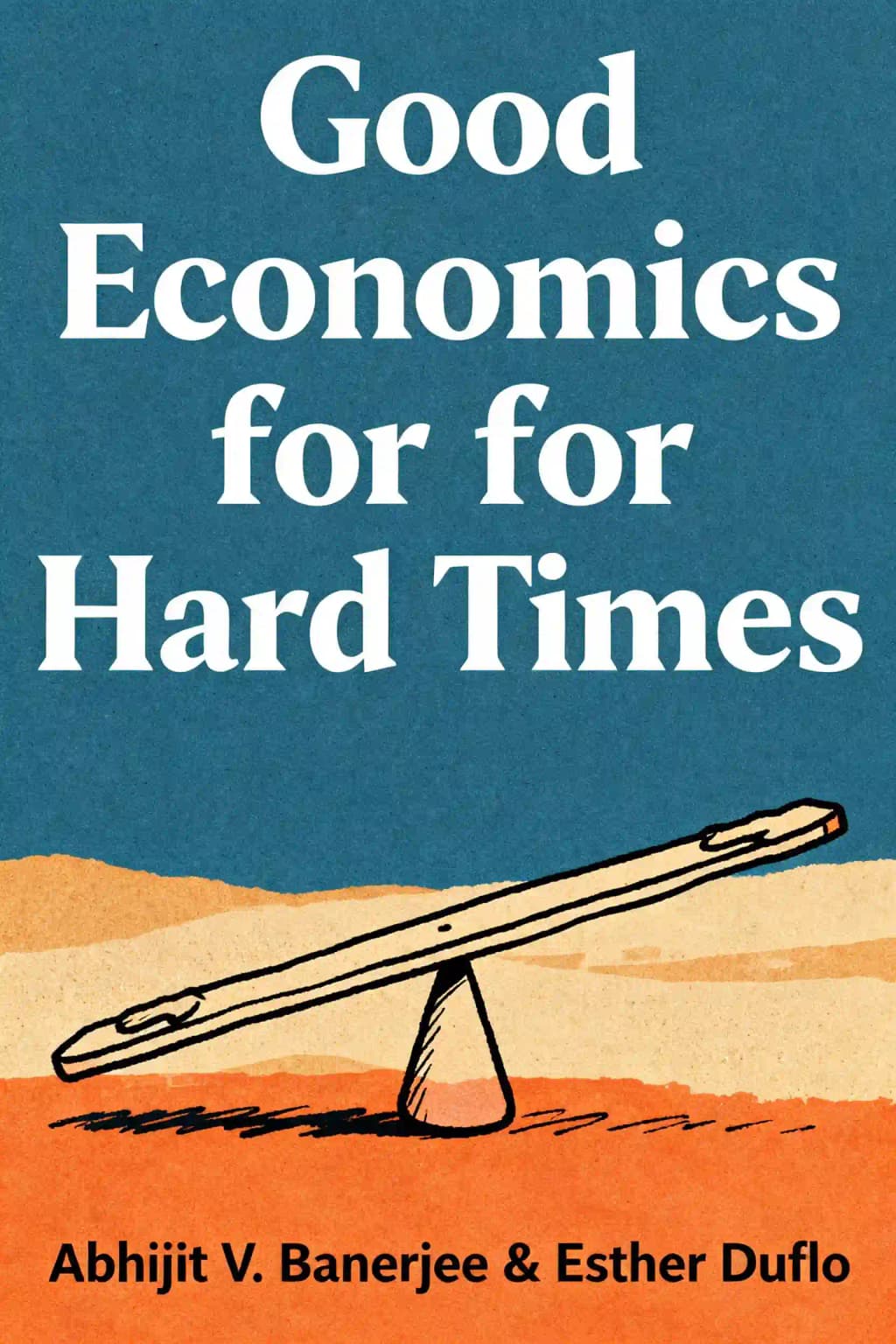
In a world where economic debates increasingly resemble tribal warfare, "Good Economics for Hard Times" arrives as a refreshing voice of reason. Nobel Prize-winning economists Abhijit Banerjee and Esther Duflo cut through ideological fog with evidence-based insights that challenge conventional wisdom. The book has become required reading in policy circles worldwide, with Barack Obama naming it one of his favorite books and Bill Gates praising its "brilliant analysis of complex issues." What makes this work stand apart is how it transforms dry economic concepts into accessible wisdom about issues we face daily-immigration, trade, inequality, and technological disruption. As polarization deepens globally, Banerjee and Duflo's commitment to facts over ideology offers something increasingly rare: a path toward common ground based on what actually works rather than what we wish would work.
Capítulo 2
Beyond Tribal Economics: Finding Common Ground in Divided Times
We live in an era of unprecedented polarization where political discourse has deteriorated into tribal warfare. Most Democrats view Republicans as bigoted, while Republicans see Democrats as spiteful. A third of Americans would be disappointed by cross-party marriages in their family. This tribalization extends far beyond politics to fundamental questions about how society should function.
As social scientists, Banerjee and Duflo position themselves as potential bridge-builders in these divided times. Yet the space for reasoned conversation is rapidly shrinking, even as economic challenges mount: slowing global growth, trade wars, fraying social contracts, and rising inequality. These pressing questions require nuanced answers beyond tweet-length simplifications.
Economists should be valuable voices in these debates, but public trust in the profession remains dismally low-just 25% in both the UK and US, barely above politicians and far below nurses or weather forecasters. This trust deficit appears in how dramatically public opinion differs from economic consensus on issues like tariffs, immigration benefits, and technological change.
The authors argue that economics must reclaim its role as a practical, evidence-based discipline rather than an ideological battlefield. They advocate for a more humble approach that acknowledges the complexity of human behavior and the limitations of economic models. Good economics, they suggest, means being willing to change your mind when evidence contradicts theory-something increasingly rare in our polarized discourse.
This approach means acknowledging when markets fail, when government intervention is necessary, and when neither has all the answers. It means recognizing that people don't always behave as rational economic actors but are influenced by dignity, community, and meaning beyond material self-interest. Most importantly, it means testing ideas against real-world evidence rather than clinging to ideological purity.
Capítulo 3
Migration Myths: What the Evidence Really Shows
Immigration dominates political discourse in wealthy nations despite representing just 3% of global population-unchanged since 1960. Public perception vastly overestimates both immigrant numbers and their reliance on government support. In surveys across six countries where immigration drives politics, citizens consistently overestimate immigrant populations by 2-3 times their actual size.
Politicians exploit and amplify these fears. Marine Le Pen falsely claimed 99% of immigrants were adult males (actual: 58%) and that 95% relied on government support (actual: only 45% weren't in the labor force). These tactics work because they tap into seemingly self-evident economic logic: poor people will naturally migrate to richer countries, increasing labor supply and driving down wages.
But this simplistic reasoning ignores complex migration realities. People don't migrate primarily for economic opportunity but to escape violence and instability. Iraq, Syria, and Yemen produce more refugees than much poorer countries like Liberia or Mozambique because normal life has collapsed there. As British-Somali poet Warsan Shire writes: "No one leaves home unless home is the mouth of a shark."
Most surprising is how little immigration impacts native workers' wages. David Card's influential study of the 1980 Mariel boatlift, when 125,000 Cubans suddenly arrived in Miami increasing its labor force by 7%, found no negative wage effects on natives. Despite extensive debate, most subsequent studies examining similar unexpected migration events consistently show minimal adverse impacts.
Why doesn't standard supply-demand theory apply? Several factors explain this counterintuitive outcome. Immigrants increase consumer demand, creating jobs that offset supply-side effects. They typically perform tasks natives avoid, reducing service costs and enabling more native workers (especially skilled women) to enter the workforce. Employers reorganize production to use immigrant labor effectively, creating complementary roles for natives who often upgrade to more complex positions.
The real migration paradox isn't excessive movement but rather people's reluctance to relocate despite clear economic benefits. Studies in Bangladesh found that even when offered cash incentives to migrate during seasonal hunger periods, most villagers refused. Those who did migrate earned substantial income but often didn't repeat the journey despite proven benefits. This reveals that knowledge of opportunities isn't the constraint-something deeper holds people back.
Migration represents a plunge into uncertainty rather than calculable risk, making people particularly reluctant to attempt it. The fear of failure is a substantial disincentive, as most people want to protect their self-image as intelligent and capable. This explains why migrants tend to be those with either a special drive or substantial overconfidence.
Capítulo 4
Trade's Broken Promises: Why Markets Aren't Always Magic
While economists overwhelmingly support free trade, public opinion remains skeptical. When surveyed about Trump's steel and aluminum tariffs, only 37% of Americans disagreed with the policy compared to 65% of economic experts who strongly opposed it. This disconnect stems from economists' failure to acknowledge trade's complex impacts on communities and individuals.
The elegant theory of comparative advantage-that countries should specialize in what they're relatively best at producing-predicts that opening trade should increase GDP in all countries, reduce inequality in poor countries, and potentially increase inequality in rich countries. Yet evidence often contradicts these predictions. When developing countries like Mexico, Colombia, Brazil, India, Argentina, Chile, and China opened to trade, inequality consistently increased rather than decreased as theory predicted.
The fundamental problem is that trade theory assumes resources flow smoothly to their most productive uses, but reality shows this rarely happens. Labor markets are "sticky"-people don't move even when economic conditions suggest they should. When trade competition arrives, the response is often to hunker down rather than reallocate resources efficiently. Workers get laid off, wages decline, and profits shrink, but the anticipated efficiency improvements don't materialize.
The "China shock"-China's manufacturing export share growing from 2.3% to 18.8% between 1991-2013-devastated specific American regions. Communities producing goods where China excelled suffered severe manufacturing job losses with no compensating gains in other sectors. Unlike standard trade theory predictions, workers didn't relocate to unaffected areas-they remained jobless in declining communities. The total employment decline often exceeded direct manufacturing losses as reduced local spending triggered downward economic spirals.
Industrial clustering, while economically advantageous, magnifies these impacts when entire regional economies collapse simultaneously. These shocks trigger devastating downward spirals: laid-off workers spend less at local businesses; housing values collapse; credit tightens; shops and restaurants close; tax bases erode; and infrastructure deteriorates. The resulting ghost towns become unattractive for new investment.
Trade theorists acknowledged some would be hurt by free trade, claiming winners could compensate losers-but this rarely happens in practice. Autor, Dorn, and Hanson found affected regions received only $58 per adult in additional government transfers for every $549 lost in income. Instead of meaningful assistance, disability insurance grew significantly, with one in ten displaced workers joining disability rolls-a one-way street out of employment that strips workers of dignity.
The authors don't advocate protectionism but argue for more robust adjustment assistance. The Trade Adjustment Assistance program was conceptually sound but severely underfunded. Recent research shows TAA-retrained workers initially sacrifice $10,000 in earnings but gain $50,000 more over the next decade. For older workers who can't easily retrain or relocate, we should consider subsidizing firms in trade-affected regions to maintain employment until retirement eligibility.
Capítulo 5
Prejudice and Polarization: The Economics of Identity
The rise of populist leaders has normalized expressions of racial prejudice in politics. In the US, strong white identity predicted Trump support better than economic anxiety. This political rhetoric legitimizes public expressions of bigotry, revealing how racial animus often transcends logical consistency.
Since the 2016 election, America's dominant narrative has shifted from mistrust of African Americans to open rage against immigrants, extending beyond economic resentment to portraying them as existential threats. Ironically, states with fewest immigrants show greatest anti-immigrant sentiment, with nearly half of residents in places like Wyoming and Alabama believing immigrants threaten American values.
Economic explanations for bigotry include intimidation for economic gain, signaling group loyalty, and statistical discrimination. Statistical discrimination occurs when people make judgments based on group characteristics rather than individual traits. This explains police disproportionately stopping black drivers or employers assuming black applicants have criminal records when that information is unavailable.
Discrimination often becomes self-reinforcing through self-fulfilling prophecies. Claude Steele's experiments demonstrated "stereotype threat"-black students performed worse on tests labeled as measuring intellectual ability but not when the same test was described as a problem-solving task. Similarly, women did better on math tests when told gender differences didn't apply.
Once we acknowledge that beliefs and preferences are context-dependent, many puzzles become clearer. Nobel Prize-winner Jean Tirole and Roland Benabou developed the concept of "motivated beliefs"-our beliefs about ourselves are shaped by emotional needs, as we feel terrible when we disappoint ourselves. We avoid information that would force us to confront moral ambiguities and rationalize negative thoughts about others by blaming them.
Our deeply held opinions often form through arbitrary processes. In Kahneman and Thaler's famous experiment, students randomly given mugs or pens valued their items two to three times higher than those who didn't receive them. Even more dramatically, students' bids for products were heavily influenced by the last two digits of their social security numbers-those with higher numbers bid 200-350% more for identical items than those with lower numbers.
People naturally associate with others like themselves-what sociologists call homophily. This creates "echo chambers" where like-minded individuals reinforce each other's views without exposure to alternative perspectives. Political polarization has reached unprecedented levels, with nearly 50% of Republicans and over 30% of Democrats reporting feeling "unhappy" at the prospect of their children marrying across party lines, compared to just 5% in 1960.
The solution lies in creating opportunities for collaborative contact between groups. A clever cricket league study in India showed that players on mixed-caste teams made more cross-caste friendships and selected teammates based on talent rather than caste. However, competition undermined these benefits; teams assigned to play against other-caste teams were less likely to form cross-caste friendships than those playing their own caste.
Capítulo 6
Growth's Puzzles: Why Prosperity Remains Elusive
The thirty years between WWII and the 1973 OPEC crisis saw unprecedented economic growth in Western nations. US GDP per capita grew at 2.5% annually, while Europe experienced even more dramatic gains-France's GDP quadrupled between 1942-1972. This "Glorious Thirty" was driven by remarkable labor productivity increases, with the majority coming from technological progress and production efficiencies.
But in 1973, everything changed. Over the next twenty-five years, productivity grew at only a third of its previous rate. A brief productivity surge starting in 1995, driven by computing power, faded quickly. Since 2004, GDP growth in both the US and Europe have reverted to the sluggish pace of 1973-1994. This new slowdown seems paradoxical given Silicon Valley's constant innovations-personal computers, smartphones, machine learning-yet these apparent breakthroughs haven't translated into economic growth.
Two Northwestern University economic historians represent opposing views on future growth. Robert Gordon pessimistically predicts meager 0.8% annual growth for the next twenty-five years, seeing technological stagnation everywhere. Joel Mokyr, conversely, envisions bright prospects driven by international competition in science and technology. Their stark disagreement highlights economists' poor track record in predicting growth.
The authors suggest it may be time to abandon economics' obsession with growth, especially in rich countries where improving quality of life matters more than growing richer. GDP's fundamental limitation is that it only values priced and marketed activities. When someone takes time off work for leisure, GDP decreases though welfare increases. When trees are cut down, GDP counts labor and wood but ignores lost shade and beauty.
Growth theories assume resources flow smoothly to their most productive uses, but reality shows productive and unproductive firms often coexist in developing economies. In Kerala, India, before cell phones, fishermen would land at the nearest beach to sell their catch, resulting in wasted fish at some beaches while customers went without at others. When cell phone connectivity arrived, fishermen called ahead to find beaches with many customers and few boats. Waste disappeared, prices stabilized, and everyone benefited.
Labor markets in developing countries suffer from their own inefficiencies. In India, 26% of males between twenty and thirty with at least ten years of education weren't working in 2009-10, while only 1.3% of those under thirty with less education were unemployed. These educated young people hold out for "good jobs"-typically government positions with security and benefits-rather than accepting available private sector work.
Many important successes in improving human welfare have come from direct policy focus on specific outcomes rather than growth alone. Even very poor countries with modest growth rates have achieved dramatic reductions in child mortality through targeted interventions like newborn care, vaccination, and malaria prevention. The malaria story exemplifies this approach: after deaths peaked at 1.8 million in 2004, they declined by 75% by 2016, largely due to widespread distribution of insecticide-treated bed nets.
Capítulo 7
Climate Crisis: Balancing Present Needs with Future Survival
Climate change presents an unavoidable challenge when considering economic growth. The scientific consensus is clear that human activity drives climate change, requiring significant carbon emission reductions to avoid catastrophe. To limit warming to 2C, CO2 equivalent emissions must decrease 25% by 2030 and reach zero by 2070; for the 1.5C target, cuts of 45% by 2030 and zero by 2050 are needed.
This challenge is fundamentally inequitable-rich countries generate most emissions while poor countries bear the greatest costs. When emissions are attributed to consumers rather than producers, North Americans generate 22.5 tons of CO2e per person annually, Western Europeans 13.1, Chinese 6, and South Asians just 2.2. This creates the "50-10 rule": 10% of the world's population contributes roughly 50% of emissions, while the least-polluting 50% contributes just over 10%.
Climate change impacts vary dramatically by geography and wealth. While northern countries may initially welcome warming, poor countries near the equator face devastating consequences. India, which historically experienced just five days annually with temperatures above 35C, could face seventy-five such days by century's end without climate policy, while the typical American will experience only twenty-six.
Technology's power to mitigate climate impacts reveals stark global inequalities. In the United States, mortality from extreme heat has dropped sixfold since the 1920s-30s, primarily due to air conditioning-now in 87% of American homes versus just 5% of Indian ones. This technological divide makes air conditioning not a luxury but a life-saving necessity in warming climates.
India's climate stance evolved from outright refusal to the Paris Agreement commitments, but its reluctance to act more aggressively highlights the perceived trade-off between current economic growth and future climate stability. The Stern Review optimistically suggests we can "decarbonize" while maintaining economic growth, estimating it would cost roughly 1% of world GDP annually to stabilize emissions.
While rich countries can sacrifice inessential energy consumption, developing nations face a more complex challenge. For most Indians, increased energy consumption isn't luxury but necessity to escape unpleasant and dangerous living conditions. Yet there's a cruel irony-the pollution created by development is killing the very people it aims to help. Air pollution has become a massive public health hazard in developing nations, with several Indian cities topping the list of most polluted globally.
The Green New Deal attempts to bridge climate action with economic justice by linking green infrastructure to job creation. The authors argue carbon taxes can be made politically viable by ensuring proceeds are redistributed to lower-income households. The richest countries can easily afford to help the world's poor consume more while producing fewer emissions. If costs are primarily borne by the wealthiest while the planet benefits, there's no reason to hesitate.
Capítulo 8
Automation Anxiety: Finding Dignity in a World of Robots
Kurt Vonnegut's first novel "Player Piano" depicts a dystopian world where machines have rendered most humans jobless. Though written in 1952, it resonates today as AI and automation threaten to displace workers across industries. McKinsey reports 45% of US jobs are at risk of automation, with the OECD estimating 46% of workers in member countries face similar risks.
Unlike previous technological revolutions that eventually created new jobs, early evidence suggests the current automation wave may be different. A study found that each new industrial robot reduces employment by 6.2 workers with no offsetting gains in other sectors. This automation particularly hurts less-educated workers, pushing them from mid-skill jobs to low-skill tasks, exacerbating inequality trends since the 1980s.
The authors challenge the dismissive view of Luddites as blind progress-resisters by noting they weren't entirely wrong. While their specific jobs did vanish, the promised economic benefits took decades to materialize-real blue-collar wages in Britain nearly halved between 1755-1802, only recovering 1755 levels by 1820. This period of technological advancement coincided with intense deprivation.
Most concerning are "so-so" automation technologies that displace workers without significantly raising productivity. Despite talk of technological singularities, most R&D today focuses on automating existing tasks rather than creating new products that would generate jobs. Americans across political lines agree on limiting automation, with 85% supporting restricting it to dangerous jobs only.
By the 1980s, the US and UK faced slowing growth while feeling competitive pressure from Europe and Japan. This national anxiety led to dramatic policy shifts under Reagan and Thatcher, who implemented lower tax rates, deregulation, welfare cuts, and union-busting. These changes were justified by trickle-down economics-the theory that enriching the wealthy would eventually benefit everyone.
1980 marked a dramatic turning point in inequality. After fifty years of decline, the income share of America's richest 1% began a relentless climb, rising from about 8% in 1979 to nearly matching its 1928 peak of 24% by 2017. Meanwhile, wages stagnated for average American workers, with real wages for the least educated actually falling 10-20% since 1980, contradicting trickle-down predictions.
From an economic efficiency standpoint, nothing prevents governments from implementing highly progressive tax schedules with extremely high top marginal rates. Denmark proves that high taxes don't necessarily drive away capital or wealthy citizens. The obstacle is political-as the rich accumulate more wealth, they gain more resources to influence politics and preserve their advantages.
People's sense of self-worth is deeply tied to their relative position in social groups, making inequality directly impact well-being. A Norwegian experiment demonstrated this when tax records went online in 2001, making income comparisons easy-the poor became sadder while the rich grew happier once everyone could see exactly where they stood.
Capítulo 9
Rebuilding Trust: Toward a More Humane Economics
Markets cannot be relied upon to deliver outcomes that are just, acceptable, or even efficient. Government intervention is necessary to help people in a "sticky economy" and to prevent the lives of rich and poor from diverging irremediably. While taxation can help reduce inequality at the top, broader social policy innovations require additional resources that cannot come solely from the ultra-rich.
The United States collects only 27% of GDP in tax revenue, seven points below the OECD average. Even raising taxes on the wealthy to Danish levels would leave overall US tax revenue well below countries like Denmark, France, and Sweden (43-46% of GDP). A 2% wealth tax on Americans with assets above $50 million would raise just 1% of GDP over ten years.
Many Americans remain deeply skeptical of government intervention, with only 23% trusting the government "always" or "most of the time" in 2015. This skepticism creates a major constraint on helping those who need it most-often because those same people distrust government solutions.
Our obsession with government corruption stems partly from the offensive idea of officials living comfortably on taxpayer money. Fighting corruption carries its own costs. Italy's centralized procurement system Consip, created to prevent corruption, ended up costing the government more than the previous system. Officials used it to protect themselves from corruption accusations, even when cheaper options existed elsewhere.
America has reached an impasse. Forty years of unfulfilled economic promises have bred widespread distrust, particularly of government. The wealthy's growing influence, combined with their carefully cultivated anti-government sentiment, has made tax increases politically impossible while convincing even socially-minded young people that government work is "uncool." Yet ironically, the only viable solution requires expanding government's role.
The tension between providing assistance and preserving dignity forms the core challenge of social policy design. Universal basic income (UBI) has become popular among Silicon Valley entrepreneurs, economists, and some politicians. UBI proposes giving everyone a substantial guaranteed income regardless of need, with figures like $1000 monthly suggested for the US.
The main obstacle to Universal Basic Income is simple: cost. A $1,000 monthly payment to every American would total $3.9 trillion annually-about $1.3 trillion more than all existing welfare programs combined, equivalent to the entire federal budget or 20% of the US economy.
American welfare policy needs reform amid growing public discontent. A UBI funded by increasing taxes from 26% to 31.2% of GDP could provide $3,000 annually per person ($12,000 for a family of four)-half the poverty line but significant for lower-income Americans. However, UBI alone won't address the deeper crisis of lost dignity and purpose. Most people want meaningful work-87% in the authors' survey said they wouldn't stop working with a $13,000 UBI.
A more realistic approach is increasing budgets for labor-intensive public services like elder care, education, and childcare-sectors where automation's productivity gains remain limited. Humans retain advantages in these fields requiring empathy and social skills, which robots cannot easily replace. These sectors could absorb significant government funding while producing social value and providing meaningful, stable employment.
Capítulo 10
Economics for Human Flourishing
Economics envisions a world of constant dynamism-people changing jobs, businesses being born and dying, production shifting between countries. In this vision, opportunities abound for those willing to seize them. But reality works differently. The Bangladeshi villager starves rather than risk moving to the city; the educated Ghanaian waits at home for promised opportunities; South American factories close without new businesses replacing them.
This same stickiness affects developed regions too. When businesses close in Boise and reopen in Seattle, workers often can't afford to move-nor do they want to abandon their communities, memories, and social connections. As good jobs vanish and local economies decline, anger mounts, producing phenomena like Trump, Bolsonaro, and Brexit.
The last forty years have seen remarkable change-communism's fall, China's rise, global poverty halved twice over, inequality's explosion, dramatic health improvements, technological revolutions, and political upheavals. Much of this change was driven by policy choices based on economic thinking-both good and bad. Good economics gave us free bed nets that cut childhood malaria deaths by half; bad economics justified tax cuts for the rich while squeezing welfare programs.
The authors conclude that economics must return to its roots as a moral science concerned with human flourishing. This means recognizing that people value dignity, community, and meaning alongside material prosperity. It means acknowledging when markets fail and when government intervention is necessary. Most importantly, it means testing ideas against evidence rather than clinging to ideological purity.
As we face unprecedented challenges from climate change, technological disruption, and political polarization, we need economics that serves humanity rather than abstract theories. By combining rigorous evidence with moral clarity, we can build economic systems that deliver both prosperity and dignity-good economics for our hard times.