Capítulo 1
Discovering Your Life's Sweet Spot: Where Passion Meets Purpose
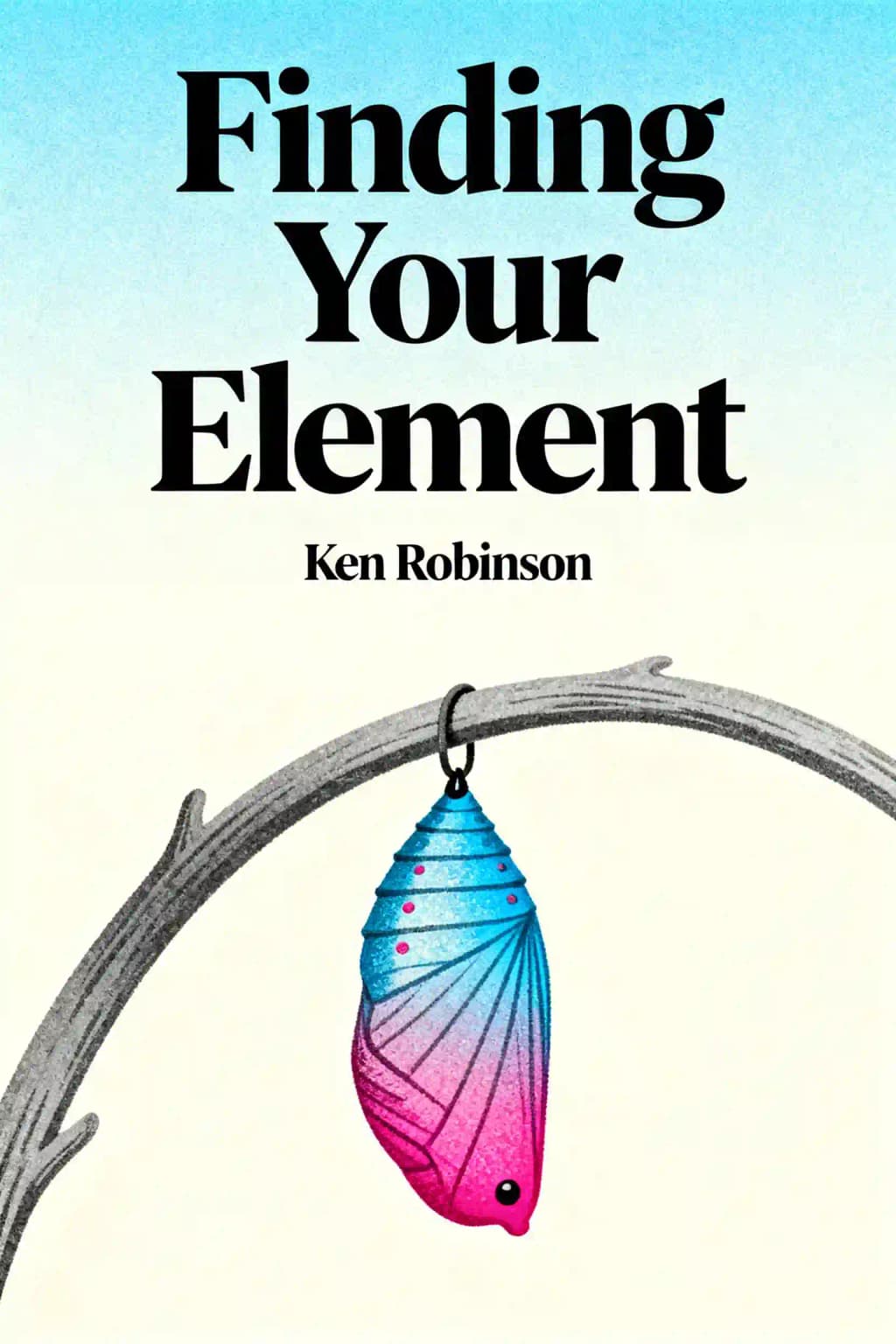
Have you ever felt that nagging sense that you're not living the life you were meant to live? That somewhere out there exists a version of yourself that is more fulfilled, more energized, and more authentically you? This feeling isn't uncommon-in fact, it's what drove Ken Robinson to write "Finding Your Element," a book that has resonated with millions worldwide, including celebrities like Oprah Winfrey who featured Robinson's work in her SuperSoul conversations. The book has become a cultural touchstone in our achievement-oriented society, offering a refreshing counterpoint to conventional wisdom about success. Since its publication, it has inspired countless people to reinvent their lives, from corporate executives who left six-figure salaries to pursue teaching to retirees who discovered artistic talents they never knew they possessed. At its core, Robinson's message is both simple and profound: finding your Element-that intersection where natural talent meets personal passion-is not a luxury but a necessity for a life well-lived.
Capítulo 2
The Personal Journey to Your Element
Finding your Element is a deeply personal quest that requires both inward exploration and outward action. Robinson's own journey illustrates this beautifully. As a quiet, introspective child who loved making things and solving puzzles, nothing suggested he would develop an international reputation as a dynamic public speaker. Yet at thirteen, when his brother asked him to introduce a comedy act at a family wedding, Robinson discovered something unexpected about himself-he could face an audience. Through high school plays and college presentations, he found that once on stage, he relaxed quickly and actually enjoyed the experience.
This transformation reveals something fundamental about being in your Element: your sense of time changes. An hour feels like minutes when you're doing what you love, while minutes feel like hours when you're not. Being in your Element energizes you; not being in it drains you.
The journey to your Element involves two complementary explorations. The inward journey requires examining what lies within you-your talents, passions, and attitudes. The outward journey involves exploring opportunities in the world around you. You perceive the external world through your inner one, making sense of it through your ideas, values, and attitudes. Finding your Element requires exploring both worlds through three essential processes.
First, you must "turn down the noise" of modern life. In our distraction-filled world, creating time and space to be alone is essential. Digital technologies constantly draw us outward rather than inward, flooding us with information. Meditation offers one path to quiet the mind's constant chatter-the mental static that interferes with deeper consciousness. Like calming a lake's surface to see its depths, meditation helps reduce mental turbulence, reconnecting you with your essential self.
Second, finding your Element may require changing your perspective. As Anais Nin said, "I don't see the world as it is: I see it as I am." Your own assumptions may be your biggest obstacle-beliefs that you have no special aptitudes or passions, that you're not good at something you'd love to try, that you'll fail and look foolish, or that it's too late to try something new.
Finally, you must "give it a try." To discover what lies within, you must look outside yourself by trying new activities, visiting new places, and meeting new people. Put yourself in the path of new opportunities and test yourself in different circumstances. You'll never know your capabilities without exploration.
Capítulo 3
Three Fundamental Principles of Finding Your Element
Despite the highly personal nature of finding your Element, three fundamental principles apply to everyone.
First, your life is unique. Biologically, you carry the traces of countless ancestors whose chance meetings led to your existence-one life among an estimated 80 billion humans throughout history. You've inherited characteristics, aptitudes, and temperaments that combine in ways unique to you. Culturally, your life is shaped by the time, place, and circumstances of your birth and upbringing. Finding your Element means understanding both your biological inheritance and reflecting on your cultural circumstances.
Second, you create your own life. Despite your history and circumstances, you're never locked into your past because of your uniquely human powers of imagination and creativity. While we share much with other living beings, humans differ in our ability to imagine things not present to our senses. Through imagination, we can look to the past, empathize with others, and anticipate the future. As George Kelly says, "No one needs to be a victim of their own biography." Or as Jung puts it, "I am not what has happened to me, I am what I choose to become."
Third, life is organic, not linear. Very few people in middle age correctly anticipated the lives they've actually led. Life is a constant process of improvisation between your interests and personality on one hand and circumstances and opportunities on the other. Though resumes impose linear narratives on our lives to make them seem planned and deliberate, most lives are really uncertain processes of tacking and weaving. David Ogilvy's path from Scottish stove salesman to Amish farmer to Madison Avenue legend exemplifies how we create our lives from disparate elements in unpredictable ways.
Capítulo 4
Discovering Your Natural Aptitudes
Finding your Element means discovering where your natural aptitudes meet your passions. Aptitudes are the natural talents you were born with-part of your biological constitution. Some appear early in life; others remain hidden until the right opportunity arises.
We all have natural aptitudes-activities that come easily to us while others don't. Some people instinctively understand tools and mechanics, while others connect naturally with people or have an eye for design. These natural inclinations reveal our unique capabilities and point toward our potential Element.
There's a crucial distinction between aptitudes and abilities. Aptitudes are your raw potential, while abilities develop when you apply and refine those natural talents. Humans have a natural aptitude for language, but speaking requires cultural exposure. Similarly, musical talent needs cultivation. Finding your Element requires both aptitude and the commitment to develop abilities through practice-it's the union of nature and nurture.
Many of your aptitudes may remain undiscovered simply because you've never had the opportunity to explore them. Venezuela's El Sistema program demonstrates this brilliantly-transforming a nation with no orchestral tradition into one with 400,000 children learning classical music. Founded by economist Jose Antonio Abreu in 1975 with just eleven students, this program has revealed musical talents in children from impoverished backgrounds who would never otherwise have discovered these abilities.
You can certainly have multiple Elements as your talents mature and interests evolve. Elizabeth Payne's journey illustrates this perfectly. From childhood, she knew she wanted to be an artist. An unexpected opportunity arose when her high school art teacher fell ill and an English teacher entered her artwork into a college costume design competition. Surprisingly, her artistic aptitude transferred perfectly to costume design, and she won the competition four consecutive years. After working in various theaters, Elizabeth discovered yet another aptitude when she took a teaching position and found she was "a born teacher" with natural aptitude for helping others learn.
Capítulo 5
Recognizing Hidden Talents
Discovering your aptitudes requires first knowing what they are, which isn't always straightforward. Many people have undiscovered talents simply because they've never had the opportunity to explore them. Like minerals beneath the earth's surface, latent talents may lie hidden until circumstances reveal them.
Our self-assessments are often limited by our experiences-how would you know if you're good at sailing if you've never been in a boat? Or playing violin if you've never held one? Finding your Element requires openness to possibilities in unexplored fields, as demonstrated by Sam, a Malaysian teen who discovered her extraordinary aptitude for street dancing only after seeing a television competition. Despite previous unsuccessful attempts at various activities, Sam found her passion and talent in this unexpected form, transforming from withdrawn and irritable to driven and purposeful.
Cultural constraints and educational systems that emphasize narrow definitions of intelligence often prevent people from discovering their true aptitudes. Matthew Lee's story illustrates this perfectly-he discovered an extraordinary talent for magic after college graduation, despite having already established himself as a successful web designer. When practicing magic, he would lose all sense of time, working through the night to perfect his techniques. Though he quickly developed professional-level skills, he faced significant resistance in Singapore, where magicians weren't taken seriously. His wife initially objected to his career shift, and he kept his profession secret from his parents for years.
Formal education often impedes the discovery of natural aptitudes in two critical ways. First, most educational systems operate with an extremely narrow view of what constitutes ability, primarily focusing on academic aptitudes like verbal and mathematical reasoning while equating intelligence with IQ. Second, they frequently disregard the diverse ways individuals actually learn. This limited perspective results in schools giving low status to "non-academic" subjects like visual and performing arts, physical education, and practical or vocational programs.
Your perceived aptitudes may be more about how you were taught than your actual abilities. We all learn differently, yet schools often teach all subjects through verbal presentation and written exercises, failing to accommodate visual, kinesthetic, and other learning styles. Ken's daughter Kate believed she was terrible at chemistry until a dedicated teacher recognized her potential and adapted her teaching approach. Kate not only excelled but came to love chemistry, even considering it for college study.
Capítulo 6
The Passion Component: What Do You Love?
Finding your Element isn't just about identifying what you're good at-you must also love it. Many people do things they excel at but don't enjoy. The word "passion" evolved from the Greek "paskho" meaning "to suffer" or "endure," but now represents deep personal attraction and fulfillment. While English uses "love" broadly, ancient Greek distinguished between different types: agape (goodwill for humanity), eros (romantic love), storge (natural affection between family and close friends), and philia (friendship and attraction to activities). Philia-the root of words like "bibliophile"-best describes the love we feel when in our Element.
Finding your Element requires understanding two interconnected types of energy: physical energy (related to bodily health) and spiritual energy (connected to motivation, mood, and sense of purpose). While physical energy depends on proper nutrition, exercise and rest, your spiritual energy-your unique life force-affects your physical state regardless of bodily condition. Doing what you love may leave you physically tired but spiritually energized, while activities you dislike can drain your spirit even when physically undemanding.
Randy Parsons' story exemplifies this spiritual fulfillment. He abandoned his guitar dreams after high school, believing he'd never be a rock star. He took jobs in law enforcement but felt incomplete-until a powerful shower vision showed him building guitars for famous musicians. Despite no formal training, he spent two years obsessively teaching himself in his basement, then opened a repair shop. After connecting with master luthier Boaz and learning ancient techniques, Randy established Parsons Guitars, now internationally renowned with clients including Jack White and Jimmy Page. His story demonstrates how finding your true passion creates spiritual fulfillment: "You gotta find that thing that you love so much that you're gonna be the best at it."
We exist in two worlds: our internal consciousness and the external world of others. Our "self" experiences a continuous flow of thoughts, feelings and sensations across different states of consciousness. While mind refers to our internal thoughts and feelings, and personality describes our disposition toward ourselves and the world, consciousness encompasses our fundamental awareness of being alive. Our true spirit often lies deeper than the preoccupations of mind and personality.
Capítulo 7
The Pursuit of Authentic Happiness
Robinson explores the relationship between happiness and finding your Element, noting that while most people claim to want happiness, evidence suggests the majority aren't actually happy. Despite rising affluence, people appear less happy than decades ago. Dan Baker observes that happiness in modern America has become scarcer even as wealth has increased. Nearly half of American adults lack enthusiasm for life, depression rates are soaring (with WHO predicting depression will be the second leading cause of death globally by 2020), and suicide rates have increased, especially among young people.
Many misconceptions about happiness exist in our "if only" statements-believing we'd be happy if we won the lottery, had a better job, or changed our appearance. While money matters for meeting basic needs, having excessive wealth doesn't reliably create happiness. Despite America being the world's richest country, it ranks among the least happy. Studies show GDP growth doesn't correlate with increased life satisfaction. As psychologist Dan Gilbert notes, "money brings a little happiness for a short time," and many wealthy individuals report that money creates more problems than it solves.
Happiness isn't material but spiritual-an internal state of well-being. Sonja Lyubomirsky defines it as "the experience of joy, contentment and well-being combined with a sense that life is good and worthwhile." Unlike fleeting pleasures from good fortune, true happiness comes from within. Dr. Andrew Weil explains that emotional well-being requires creating conditions within our control, noting his own deepest happiness came from "knowing that I was the person I was supposed to be"-essentially, being in his Element.
Happiness isn't constant cheerfulness. Martin Seligman, founder of Positive Psychology, identifies three elements of authentic happiness: positive emotions, engagement (flow), and meaning. While the first two can be solitary pursuits, meaning comes from serving something bigger than yourself. Viktor Frankl, who survived Nazi concentration camps, developed logotherapy based on the principle that finding meaning drives every life. He identified three ways to discover meaning: creating work or doing deeds, experiencing something or encountering someone, and choosing our attitude toward unavoidable suffering.
Your happiness is determined by three main factors: your circumstances (10%), your biological disposition (50%), and your behavior (40%). Surprisingly, material circumstances like wealth contribute minimally to happiness. Your biological inheritance plays a much larger role, giving you a natural "happiness set point" to which you tend to return regardless of life events. The good news is that through your daily intentional activities-the 40% you control-you can significantly increase your happiness. Finding your Element is a crucial part of this process.
Capítulo 8
The Power of Attitude in Finding Your Element
Finding your Element isn't just about aptitude and passion-it's about attitude. While some people encounter external obstacles like circumstances, culture, or finances, many barriers are internal: comfort with the status quo, fear of risk, or self-doubt. To find your Element requires understanding what obstacles truly stand in your way and developing the self-belief and determination to overcome them.
Our perception shapes our reality-as Shakespeare wrote in Hamlet, "There is nothing either good or bad but thinking makes it so." We all see the world through different filters formed by our cultures, unique experiences, and personalities. Understanding your disposition and attitude is crucial to finding your Element.
Jef Lynch's story demonstrates how attitude can overcome seemingly insurmountable barriers. Despite lacking formal qualifications, Jef built an impressive career through passion and initiative. He wrote books that sold globally, understood emerging automotive computer technology, and secured free equipment from Tektronix by demonstrating its potential applications. His story illustrates that perceived barriers often exist only in our minds. As Jef says, "I don't see the barriers that other people see."
Carol Dweck's research identifies two fundamental mindsets that dramatically affect achievement. The fixed mindset believes qualities like intelligence and talent are innate and unchangeable, creating an obsessive need to constantly prove oneself. People with this mindset worry about failure and rejection, viewing aptitudes as "a hand you're dealt." By contrast, the growth mindset believes abilities develop through effort and experience. While people have different genetic starting points, the growth mindset recognizes that "experiences, training and personal effort take them the rest of the way." This perspective aligns with current scientific understanding that nature and nurture dynamically interact, with new experiences creating new neural pathways.
Sometimes finding your Element means challenging conventional wisdom and others' expectations. Mimi Weddell exemplifies this perfectly. At 65, when most contemplate retirement, she launched her acting career after her husband's death. Over the next three decades, she appeared in ten films, made television appearances, and became the subject of the documentary "Hats Off." Despite her late start in an industry that favors youth, Weddell maintained rigorous audition schedules and exercise routines, inspiring countless others to pursue their dreams regardless of age. Her philosophy was simple yet powerful: "Rise above it is what one does... You dance as you walk through life. If you don't dance, for heaven's sake, you don't lift up from this Earth."
Capítulo 9
Finding Your Tribe: The Power of Community
Though you're uniquely individual, many others likely share your interests and passions. Finding your "tribe"-groups of like-minded people who share your Element-can provide affirmation, guidance, collaboration, and inspiration. These tribes may be large or small, virtual or in-person, diverse across generations and cultures, and you may belong to several simultaneously. What defines a tribe is shared passion.
Being in your Element isn't just about what you do, but also about enjoying the culture and tribes connected to it. Robinson shares personal examples: though he enjoyed directing plays as a student, he never felt drawn to professional theater life. Similarly, while his brother Neil thrived as a professional soccer player, his other brother John had the talent but disliked the culture and pursued other interests instead. Finding your tribe means connecting with communities that resonate with your values and personality, not just your skills.
Like companion planting in gardening, where certain plants flourish when grown together, members of compatible tribes help each other thrive. Finding your tribe validates your interests and relieves isolation. Neroli Makim's story illustrates this-growing up in isolation on an Australian cattle station, she developed creative skills that remained her passion even after experiencing broader society. After trying conventional jobs that felt "oppressive," she realized creativity was her Element and built a career sharing it with others through her company, books, art exhibitions, and speaking engagements.
Tribes can provide powerful mentorship. When Ken's son James developed a deep interest in Buddhism at thirteen, he wanted to visit a Buddhist temple. Despite living in rural England, they discovered the Forest Hermitage just miles from their home. James became part of this community, taking his first precepts in Pali and developing his interests deeply through the abbot's guidance. This experience illustrated how tribes validate personal commitments, provide mentorship, and how resources can manifest in unlikely places when you actively seek them.
Tribes emerge wherever common interests align, serving as foundations, support systems, or touch points for sharing interests. Working together, tribes achieve more than individuals alone by stimulating creativity and possibility-what Robinson calls "the alchemy of synergy." Finding your tribe can tremendously inspire you to push your own boundaries. The New Nordic Cuisine movement exemplifies this-when Claus Meyer united Scandinavian chefs behind a manifesto to elevate their cuisine to world-class standards. Despite competing for the same customers, chefs like Rene Redzepi collaborated to build something greater, transforming Copenhagen into a culinary destination.
Capítulo 10
Creating Your Future: What's Next?
If you've contemplated your aptitudes, passions, attitudes, and current situation, moving forward requires remembering three core principles: your life is unique and shouldn't duplicate others'; you create your own life and can recreate it using imagination and possibility; and your life is organic, not linear-you don't need to plan the entire journey, just the next steps. You must start from where you are, tuning into your true north and following your energy.
Sometimes moving forward means returning to paths you thought you'd left behind. Dr. Jeffrey Myers, now a renowned pathologist, began as a passionate rock musician with no interest in medicine. After deciding he wouldn't make it in music, he studied biology and built an extraordinary career in pathology that he loves. Years later, after attending a Jeff Beck concert, Myers returned to his musical Element, buying a guitar and forming a band with colleagues. His experience shows you may have multiple Elements and sometimes the next step forward is retracing a path you abandoned.
Whatever your circumstances, you always have options. You can choose to think, feel and act differently regardless of external conditions. The key is to take the next step by looking inward and following where your spirit points. A heavy spirit often signals you're not in your Element, as photographer Chris Jordan discovered during his miserable eleven years as a corporate lawyer. Though he feared leaving law, he eventually realized the greater risk was not living authentically. Despite financial struggles after quitting, Jordan persevered with photography, ultimately finding success with his "Running the Numbers" series that went viral.
Finding your Element doesn't mean you're locked into it forever. Many people discover multiple Elements or evolve their passions over time. Martha Stewart transitioned from modeling to creating a lifestyle empire. Janet Robinson moved from teaching to becoming CEO of The New York Times Company. Taryn Rose shifted from orthopedic surgery to designing comfortable, fashionable shoes, becoming a celebrated entrepreneur. Your Element can change as you discover new aspects of yourself.
Often people avoid discovering "what's next" because their current situation, while not fulfilling, feels safe-providing income, respect, and perceived success. Sometimes it takes having your world turned upside down to discover your true passion, as happened with Mark Frankland after losing his job. His story illustrates that overcoming obstacles isn't about seeing the entire path but taking one step at a time-"Life is like eating an elephant; you need to do it one mouthful at a time."
Capítulo 11
Living a Life of Passion and Purpose
Finding your Element requires taking risks and embracing possibilities. As Martin Luther King said, "Take the first step in faith. You don't have to see the whole staircase, just take the first step." Though our lives are brief in cosmic terms, we face a fundamental choice: to enjoy our journey or merely endure it. Mark Twain advised: "Twenty years from now you will be more disappointed by the things that you didn't do than by the ones you did do. So throw off the bowlines. Sail away from the safe harbor. Catch the trade winds in your sails. Explore. Dream. Discover."
Bronnie Ware, who worked in palliative care, discovered that dying patients commonly expressed five major regrets: not living true to themselves, working too hard, not expressing their feelings, losing touch with friends, and not allowing themselves to be happier. These insights suggest important lessons: honor your dreams while your health allows, simplify your lifestyle to create space for what truly matters, speak honestly about your feelings, and value relationships over material success.
Ralph Waldo Emerson wrote, "What lies behind us and what lies before us are tiny matters compared to what lies within us." Finding your Element means discovering what lies within you and transforming what lies before you. Like a flower bud that must eventually open, suppressing your potential ultimately becomes more painful than the risk of blossoming. Human talents take many diverse forms, and recognizing your own dreams and the conditions you need to fulfill them is essential to becoming who you can truly be.
The journey to your Element is not about finding some magical destination where all problems disappear. Rather, it's about discovering that sweet spot where your natural talents meet your personal passions-where you feel most yourself, most inspired, and most connected to both your own potential and to others. It's about creating a life that doesn't just look successful from the outside, but feels meaningful from within. And perhaps most importantly, it's about recognizing that this journey doesn't end-it evolves as you do, offering new possibilities for growth, connection, and contribution throughout your entire life.