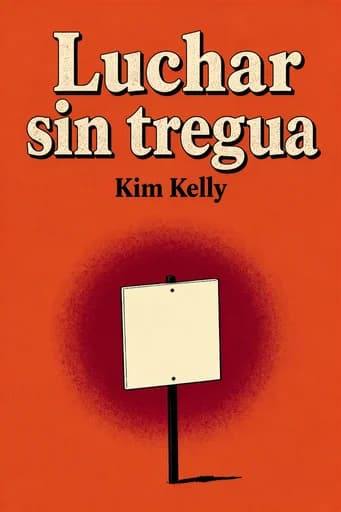
Unearthing forgotten labor heroes, Kim Kelly's award-winning chronicle - named Best Book by The New Yorker and Esquire - arrived during 2022's union resurgence. AFL-CIO President Liz Shuler calls it "thought-provoking" for its radical truth: every untold struggle is America's story.
Kim Kelly is the author of Fight Like Hell: The Untold History of American Labor and an independent journalist renowned for her incisive labor reporting. As a labor columnist for Teen Vogue, her writing has appeared in The New York Times, The Washington Post, and other major publications, where she amplifies stories of workers' rights and social justice. Her background includes serving as a heavy metal editor at Vice, lending a distinct cultural perspective to her analysis of systemic inequities.
Fight Like Hell is a groundbreaking work of non-fiction labor history that centers marginalized voices—including women, people of color, LGBTQIA individuals, and incarcerated workers—in America’s labor struggle.
Kelly’s firsthand reporting and advocacy for union movements directly inform the book’s urgent examination of workplace justice and collective resilience. Praised as "essential reading" and a "thought-provoking must-read" by AFL-CIO leadership, the book has galvanized renewed interest in labor activism amid contemporary economic reckonings.
Fight Like Hell: The Untold History of American Labor chronicles the marginalized voices and unsung heroes of the U.S. labor movement. Journalist Kim Kelly documents struggles from Reconstruction-era freed Black women to modern incarcerated workers, revealing how oppressed groups shaped labor rights. The book emphasizes intersectional battles—disability rights, sex worker protections, and Indigenous labor fights—while exposing systemic oppression by police, courts, and corporations.
Kim Kelly is an award-winning labor journalist, Teen Vogue columnist, and third-generation union member from New Jersey. A former metal music editor at Vice (where she helped unionize staff), she's written for The New York Times, The Nation, and ACLU. Her lived experience with limb difference informs her focus on disability justice in labor.
This book is essential for activists, historians, and workers seeking an inclusive labor history. It resonates with marginalized communities—LGBTQIA+, disabled, incarcerated, and immigrant workers—whose stories it centers. Union organizers and social justice advocates will gain actionable insights from its accounts of grassroots mobilization.
Absolutely. Kelly balances rigorous research with vivid storytelling, spotlighting overlooked figures like Indigenous miners and disabled laborers. Though thematic organization causes minor chronological jumps, her passionate prose and focus on ongoing struggles make it a vital, inspiring resource for understanding labor’s unfinished battles.
Kelly dedicates chapters to erased contributors: Black enslaved miners, Asian American fieldworkers fighting indentured servitude, and queer labor leaders in the civil rights movement. She details how sex workers organized Stripper Strikes, while disabled activists like Ida Mae Stull overcame exclusion in coal mining.
Some note repetitive "rah-rah" phrasing and structural hiccups—like lauding Stull as a "first" before acknowledging Black women miners predated her. However, reviewers praise Kelly’s sincerity and nuanced acknowledgment of unions’ exclusionary histories.
The book spans 150+ years, from Reconstruction-era Black labor organizing to 2020s movements like the Starbucks union drive. It connects historical wins (40-hour workweeks, child labor laws) to modern struggles at Amazon warehouses and beyond.
Kelly draws direct parallels: Depression-era garment worker strikes mirror today’s wage theft battles, while 19th-century police crackdowns on protests echo in modern union-busting tactics. Each chapter ends by examining current campaigns continuing these fights.
Kelly analyzes unions’ dual legacy: vital victories (workplace safety laws) versus exclusion of marginalized groups. She highlights progressive unions like the IWW while critiquing those that perpetuated racism or sexism—emphasizing that solidarity must be intersectional.
Unlike top-down narratives, it centers farm laborers, domestic workers, and prisoners. Kelly blends academic rigor with "blood and guts" storytelling, using original reporting to humanize figures like suffragist Frances Perkins. The book’s focus on criminalized labor is particularly groundbreaking.
As a disabled union member, Kelly prioritizes accessibility and lived experience. Her journalistic work with incarcerated workers (for ACLU) and music subcultures informs the book’s emphasis on diversity and countercultural resistance.
Siente el libro a través de la voz del autor
Convierte el conocimiento en ideas atractivas y llenas de ejemplos
Captura ideas clave en un instante para un aprendizaje rápido
Disfruta el libro de una manera divertida y atractiva
Is this freedom? To my mind it is slavery.
These dead bodies were the answer.
I am a working girl
essential workers became a household term yet remained among society's most vulnerable
Fight Like Hell couldn't be more timely.
Desglosa las ideas clave de Fight Like Hell en puntos fáciles de entender para comprender cómo los equipos innovadores crean, colaboran y crecen.
Experimenta Fight Like Hell a través de narraciones vívidas que convierten las lecciones de innovación en momentos que recordarás y aplicarás.
Pregunta cualquier cosa, elige tu estilo de aprendizaje y co-crea ideas que realmente resuenen contigo.

Creado por exalumnos de la Universidad de Columbia en San Francisco
"Instead of endless scrolling, I just hit play on BeFreed. It saves me so much time."
"I never knew where to start with nonfiction—BeFreed’s book lists turned into podcasts gave me a clear path."
"Perfect balance between learning and entertainment. Finished ‘Thinking, Fast and Slow’ on my commute this week."
"Crazy how much I learned while walking the dog. BeFreed = small habits → big gains."
"Reading used to feel like a chore. Now it’s just part of my lifestyle."
"Feels effortless compared to reading. I’ve finished 6 books this month already."
"BeFreed turned my guilty doomscrolling into something that feels productive and inspiring."
"BeFreed turned my commute into learning time. 20-min podcasts are perfect for finishing books I never had time for."
"BeFreed replaced my podcast queue. Imagine Spotify for books — that’s it. 🙌"
"It is great for me to learn something from the book without reading it."
"The themed book list podcasts help me connect ideas across authors—like a guided audio journey."
"Makes me feel smarter every time before going to work"
Creado por exalumnos de la Universidad de Columbia en San Francisco

Obtén el resumen de Fight Like Hell como PDF o EPUB gratis. Imprímelo o léelo sin conexión en cualquier momento.
Labor history is often presented as a parade of burly men in hard hats, but the real story is far richer and more diverse. In "Fight Like Hell," Kim Kelly reveals how the rights we take for granted-weekends, eight-hour workdays, safety regulations-weren't gifts from benevolent employers but victories won through collective action, often led by society's most marginalized. This isn't just about union contracts and picket lines; it's about human dignity and the courage to demand better in the face of overwhelming power. The struggle for worker justice has always been intertwined with broader movements for civil rights, gender equality, and social transformation. As we navigate today's changing workplace landscape, these forgotten stories offer both inspiration and practical lessons in solidarity.
The Lowell "mill girls" of the 1830s-America's first female industrial workforce-created reading circles, published a journal, and organized for better conditions. Under Sarah Bagley's leadership, they exposed how fourteen-hour workdays led to tuberculosis and permanent health damage. "The whip which brings us to Lowell is necessity," she wrote. "Is this mind it is slavery." In 1866, newly emancipated Black washerwomen formed the South's first labor union, demanding uniform rates. Their most notable victory came in 1881 Atlanta, during the International Cotton Exposition. Starting with twenty women in a church basement, they grew to three thousand strong. When threatened with excessive fees, they countered by demanding control of the hand-laundering industry. Faced with the prospect of dirty linens during their showcase event, Atlanta's leaders yielded. The Brotherhood of Sleeping Car Porters, founded by A. Philip Randolph in 1925, exemplifies how Black workers' labor struggles intertwined with civil rights. Pullman porters endured degrading conditions, forbidden from eating with passengers or sleeping during overnight shifts. Yet the steady income helped create a Black middle class, and the Brotherhood's influence extended beyond workplace issues into the broader civil rights movement.
Sometimes it takes disaster to spark transformation. In early 20th century New York, immigrant women toiled in dangerous sweatshops until 23-year-old Clara Lemlich interrupted a union meeting, declaring "I am a working girl" and calling for an immediate general strike. Her passionate appeal inspired 20,000 women to walk off their jobs in what became "the Uprising of the 20,000." Despite this action, the Triangle Shirtwaist Factory refused all demands-until March 25, 1911, when fire engulfed the building. With doors locked and inadequate exits, horrified onlookers watched women jump to their deaths. The fire killed 146 workers and sparked national outrage. Yet factory owners escaped justice, actually profiting from insurance payouts while settling with victims' families for just $6 per life lost. One witness to this horror was Frances Perkins, who would later become America's first female cabinet member. As Labor Secretary under FDR, she created fundamental protections millions still rely on today, later saying the New Deal began the day she "smelled the smoke and saw the bodies of those young women workers burn."
Throughout labor history, employers tried exploiting racial, ethnic, and gender divisions to prevent worker solidarity. In Detroit's auto plants, Arab and Black workers united against harsh conditions, culminating in the 1973 wildcat strike when workers discovered their union dues funded Israeli bonds during the Arab-Israeli War. Hawaii's sugar plantations attempted to create ethnic divisions by recruiting workers from different countries. This failed during the 1946 Great Sugar Strike when the ILWU successfully united workers across ethnic lines. The Marine Cooks and Stewards Union evolved from a whites-only organization into a pioneer of interracial solidarity and LGBTQIA inclusion. Their slogan "It's anti-union to red-bait, race-bait, or queen-bait" reflected their progressive stance, with members organizing drag show fundraisers and embracing queer culture. The partnership between Randolph and Bayard Rustin, a gay Black activist, proved transformative for civil rights. In 1968, Rustin supported Memphis sanitation workers protesting unsafe conditions after two workers died. Dr. King joined this struggle, delivering his "Mountaintop" speech before his assassination. The workers' eventual victory demonstrated how economic and racial justice movements are inherently connected.
During the Depression, Black domestic workers gathered on "the Bronx Slave Market" street corners, accepting below-market rates for cleaning work. Journalist Marvel Cooke went undercover among this "paper bag brigade," earning just $3.40 for a day's labor, concluding that workers needed legislative protection and unionization. Dorothy Lee Bolden, a domestic worker since age nine, became a pioneering organizer. Guided by her neighbor Martin Luther King Jr. in Atlanta, she cleverly used bus rides-domestic workers' main social time-to build community and discuss working conditions. Her National Domestic Workers Union required only $1 and voter registration for membership, linking labor rights to political power. Her efforts helped triple Atlanta domestic workers' wages within two years. The struggle continues today. Following a PBS expose on sexual violence in the janitorial industry, workers' Ya Basta ("Enough Is Enough") campaign secured significant legislative protections for vulnerable workers, many of them immigrants.
The League of the Physically Handicapped, formed by six disabled New Yorkers in 1935, challenged discriminatory hiring through a nine-day sit-in, demanding "We don't want charity. We want jobs!" Their actions compelled the WPA to hire over fifteen hundred disabled workers. The 1977 504 Sit-in became the longest peaceful federal building occupation in U.S. history, lasting 28 days. Supported by the Black Panthers and machinists' union, protesters fought for anti-discrimination regulations in federally funded programs. Yet challenges persist, notably the subminimum wage provision allowing employers to pay disabled workers pennies per hour. These "sheltered workshops," supported even by labor advocate Frances Perkins, often exploit rather than train workers, highlighting how progress can still leave vulnerable workers behind.
Kelly's narrative brings labor history into the present day, highlighting how the COVID-19 pandemic exposed deep inequities for "essential workers" who were simultaneously the most vulnerable and least protected. As vaccines arrived and employers reverted to exploitation, workers responded with unprecedented resistance. The fall of 2021 saw so many labor actions that the term "Striketober" entered the public lexicon, with workers at Nabisco, Kellogg's, John Deere, and many others channeling pandemic-era "fury and outrage" into solidarity. What emerges from this sweeping history is a profound understanding that labor rights have never been freely given-they have always been fought for and won through collective action, often at tremendous personal cost. As we face new challenges in today's rapidly changing economy-from gig work to automation to climate transition-these stories remind us that the tools for creating a more just workplace have always been the same: solidarity, collective action, and an unwavering belief that all workers deserve dignity. The struggle continues, but as the United Farm Workers' slogan reminds us: "Si, se puede"-Yes, we can.