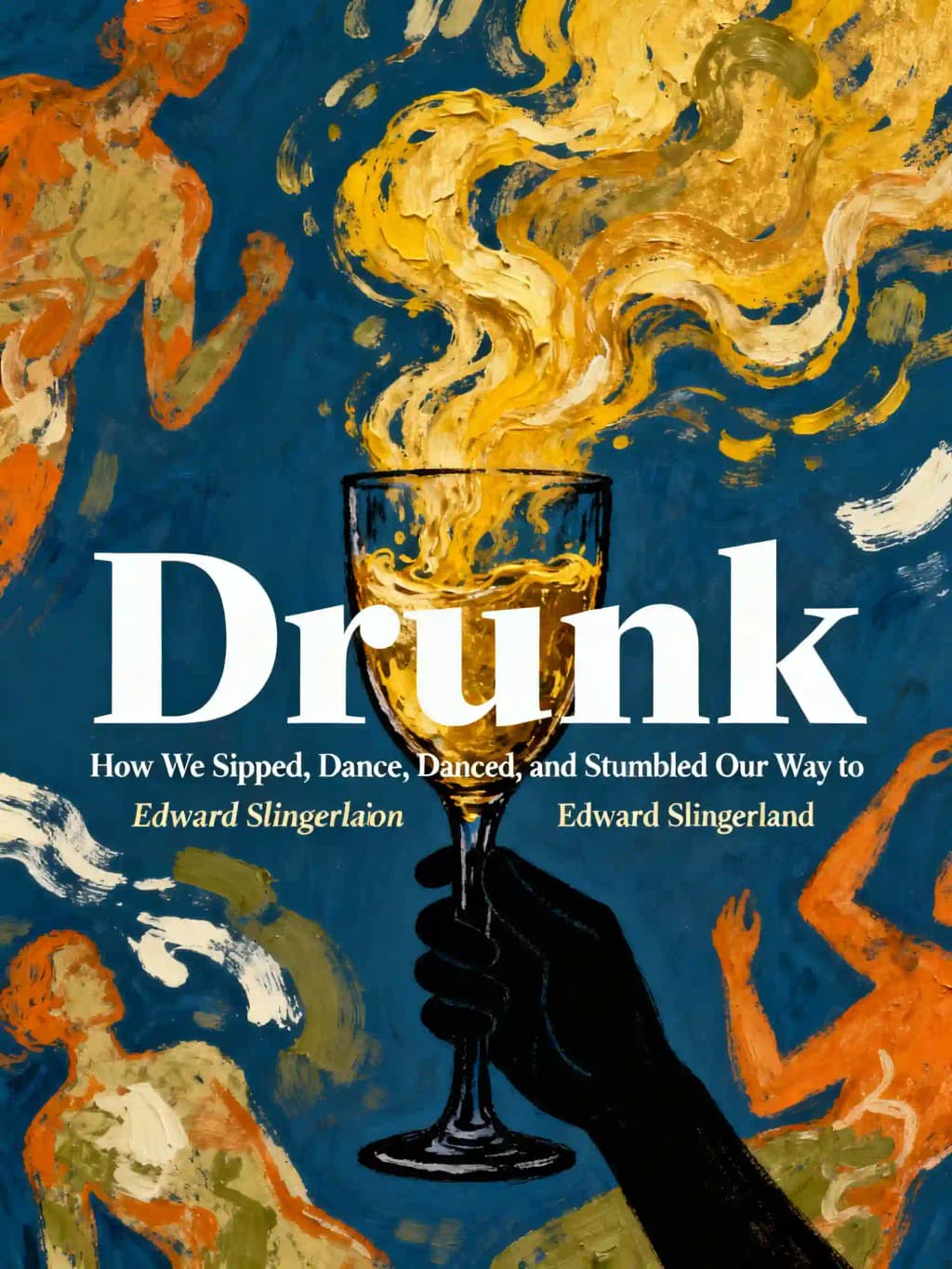
Discover why alcohol isn't just a vice but humanity's secret weapon. Slingerland's interdisciplinary masterpiece reveals how drinking shaped civilization by enhancing creativity and building trust. Wine expert Natalie MacLean calls it revolutionary - could our collective buzz actually explain how societies thrive?
Edward Slingerland, author of Drunk: How We Sipped, Danced, and Stumbled Our Way to Civilization, is a Distinguished University Scholar and Professor of Philosophy at the University of British Columbia, specializing in cognitive science, evolutionary psychology, and early Chinese thought. A Fellow of the Royal Society of Canada and recipient of the Daniel M. Wegner Theoretical Innovation Prize, his work bridges humanities and science to explore human behavior.
Drunk examines alcohol’s paradoxical role in fostering creativity and social cohesion throughout history, drawing on his expertise in cultural analysis and embodied cognition. Slingerland’s acclaimed trade books include Trying Not to Try, which merges ancient philosophy with modern psychology, and his research has been featured in Time, Nature, and TED Talks.
A frequent contributor to global science-humanities dialogues, his books combine rigorous scholarship with accessible storytelling. Drunk was a finalist for the Science Writers and Communicators of Canada Book Award and has been translated into 12 languages, cementing Slingerland’s reputation as a leading voice in understanding humanity’s evolutionary quirks.
Drunk explores alcohol’s pivotal role in human evolution, arguing that intoxication enhanced creativity, reduced stress, and fostered cooperation—key factors in building early civilizations. Edward Slingerland combines archaeology, neuroscience, and history to show that alcohol wasn’t an evolutionary mistake but a social catalyst, enabling tribal humans to trust strangers and collaborate on a large scale.
This book appeals to readers interested in anthropology, social psychology, or the cultural history of intoxicants. It’s ideal for those curious about how human behavior shapes society, offering insights for both casual readers and academics. Fans of interdisciplinary science writing will appreciate its blend of humor, case studies, and rigorous research.
Yes—Slingerland’s provocative thesis challenges conventional views of alcohol, presenting compelling evidence that intoxication was crucial to human progress. The book balances scholarly depth with engaging storytelling, featuring Vikings, fruit flies, and ancient rituals to illustrate its claims. Its fresh perspective makes it a standout in studies of human social evolution.
Edward Slingerland is a philosophy professor at the University of British Columbia and a distinguished scholar of religion and early Chinese thought. His prior book, Trying Not to Try, was acclaimed by The Guardian and Brain Pickings. In Drunk, he merges interdisciplinary research to decode humanity’s relationship with intoxication.
By suppressing the prefrontal cortex (PFC), alcohol lowers inhibitions and boosts endorphins, making people more open and trusting. This “chemical handshake” facilitated bonds between strangers, enabling large-scale collaboration. Slingerland cites examples like Viking feasts and Japanese salarymen bonding over drinks, showing how intoxication dissolved social barriers critical for civilization.
The “chemical handshake” refers to alcohol’s ability to enhance social bonding by reducing prefrontal cortex activity, which lowers social anxiety and increases empathy. This biochemical process released early humans from rigid self-control, allowing genuine emotional expression and trust-building—key steps in forming complex societies.
Yes—while emphasizing alcohol’s historical benefits, Slingerland acknowledges its dangers, including addiction and violence. He contrasts alcohol’s role in social cohesion with its capacity to fuel conflict, using examples like Viking raids. The book advocates for balanced, mindful consumption rather than outright rejection of intoxication.
Slingerland highlights Göbekli Tepe, where beer brewing may predate agriculture, and Roman bacchanals that strengthened political alliances. He also examines Japanese post-work drinking rituals and ancient Chinese wine-based diplomacy, showing how alcohol permeated global cultural practices to enable cooperation.
Unlike anecdotal accounts, Drunk offers a scientifically rigorous thesis framed by evolutionary biology and neuroscience. It diverges from purely social histories by arguing intoxication was biologically essential for human survival, making it a unique blend of anthropology, psychology, and genetics.
Some critics suggest Slingerland overstates alcohol’s necessity, noting that agriculture and trade might have emerged without it. Others argue he downplays non-alcoholic intoxicants’ roles. However, most praise his evidence-rich approach for reframing intoxication as a catalyst rather than a vice.
Yes—Slingerland advocates for intentional, communal drinking to harness alcohol’s bonding benefits while mitigating risks. He suggests structured rituals (e.g., shared toasts) to replicate ancient practices that reinforced social ties without excess. The book emphasizes moderation and context over abstinence.
The book cites sex-starved fruit flies and blind cave fish consuming fermented berries to show that attraction to alcohol predates humans. These examples underscore intoxication’s deep evolutionary roots, linking animal instincts to human social strategies.
Siente el libro a través de la voz del autor
Convierte el conocimiento en ideas atractivas y llenas de ejemplos
Captura ideas clave en un instante para un aprendizaje rápido
Disfruta el libro de una manera divertida y atractiva
Humans are the 'social insects of the primate world.'
The prefrontal cortex is actually the enemy of cooperation.
People love to drink.
Humans display 'neoteny'-retaining juvenile characteristics into adulthood.
Desglosa las ideas clave de Drunk en puntos fáciles de entender para comprender cómo los equipos innovadores crean, colaboran y crecen.
Experimenta Drunk a través de narraciones vívidas que convierten las lecciones de innovación en momentos que recordarás y aplicarás.
Pregunta cualquier cosa, elige tu estilo de aprendizaje y co-crea ideas que realmente resuenen contigo.

Creado por exalumnos de la Universidad de Columbia en San Francisco
"Instead of endless scrolling, I just hit play on BeFreed. It saves me so much time."
"I never knew where to start with nonfiction—BeFreed’s book lists turned into podcasts gave me a clear path."
"Perfect balance between learning and entertainment. Finished ‘Thinking, Fast and Slow’ on my commute this week."
"Crazy how much I learned while walking the dog. BeFreed = small habits → big gains."
"Reading used to feel like a chore. Now it’s just part of my lifestyle."
"Feels effortless compared to reading. I’ve finished 6 books this month already."
"BeFreed turned my guilty doomscrolling into something that feels productive and inspiring."
"BeFreed turned my commute into learning time. 20-min podcasts are perfect for finishing books I never had time for."
"BeFreed replaced my podcast queue. Imagine Spotify for books — that’s it. 🙌"
"It is great for me to learn something from the book without reading it."
"The themed book list podcasts help me connect ideas across authors—like a guided audio journey."
"Makes me feel smarter every time before going to work"
Creado por exalumnos de la Universidad de Columbia en San Francisco

Obtén el resumen de Drunk como PDF o EPUB gratis. Imprímelo o léelo sin conexión en cualquier momento.
Imagine Mark Zuckerberg sealing a multi-billion dollar acquisition not with signatures on contracts, but with shots of tequila. This isn't just Silicon Valley eccentricity - it's an echo of humanity's oldest social technology. For thousands of years, from ancient Chinese emperors to medieval European guilds, alcohol has served as the lubricant of human connection. Our seemingly irrational love affair with intoxication isn't a design flaw but rather a sophisticated adaptation that helped transform selfish primates into civilization-builders. With over 2.4 billion active consumers globally, alcohol remains humanity's most widely used psychoactive substance. Archaeological evidence - from 20,000-year-old cave carvings to 9,000-year-old Chinese pottery with chemical traces of primitive wine - reveals just how deep this relationship runs. Why would evolution preserve a seemingly self-destructive behavior? The answer lies in alcohol's unique ability to temporarily disable our prefrontal cortex, enhancing creativity, alleviating stress, building trust, and enabling the cooperation that civilization requires.
We humans occupy an extraordinary ecological niche. Unlike other animals focused on physical survival, our greatest challenge is navigating human relationships. We're defined by the "Three Cs" - we're creative, cultural, and communal beings. Our creativity partly stems from our extended childhood development, with our prefrontal cortex remaining immature until our early twenties, allowing for exceptional mental flexibility. Our cultural capacity means we build incrementally on previous knowledge, collectively creating technological marvels no individual could produce alone. Most challenging is our communal nature - we're "the social insects of the primate world," capable of remarkable cooperation yet still carrying selfish, backstabbing ape tendencies. If we designed the perfect drug for enhancing human sociality, it would temporarily disable the prefrontal cortex, induce happiness, last just hours, be easily produced, taste good, and promote bonding. Alcohol fits these requirements perfectly. Unlike drugs that work as "pharmacological scalpels" targeting specific brain circuits, alcohol acts more like a "pharmacological hand grenade" affecting nearly everything. Its solubility in both water and fat allows quick absorption and easy crossing of cell membranes. Initially stimulating - releasing dopamine, serotonin, and endorphins - alcohol then becomes depressing, enhancing inhibitory GABA receptors while suppressing excitatory glutamate. This biphasic effect creates an ideal social lubricant: first making us outgoing, then gradually slowing us down, while our livers continuously break down ethanol, temporarily disabling our prefrontal cortex without lasting consequences.
"Wine is the horse of Parnassus that carries a bard to the skies," declared an ancient Greek proverb, capturing the timeless link between intoxication and inspiration. From Chinese poets' "Written While Drunk" series to Norse mythology's "mead of inspiration," cultures worldwide have recognized alcohol's creative power. Modern studies confirm this connection, showing intoxicated subjects outperform sober ones on creative problem-solving tasks through inspiration rather than methodical reasoning. Drunk participants mind-wander more frequently - ideal conditions for creative insight. This explains why Google maintains whiskey rooms for coding teams facing challenges, seeking what programmers call the "Ballmer Peak" - that narrow blood alcohol content sweet spot where coding ability supposedly peaks. Alcohol's creativity boost amplifies in group settings, where it opens minds and lowers communication barriers. Economist Michael Andrews demonstrated this by studying American Prohibition, finding a 15% annual reduction in new patents in previously "wet" counties - suggesting alcohol-fueled social gatherings drive innovation.
Trust-based relationships are crucial for human cooperation yet vulnerable to hypocrisy-where someone can fake commitment without paying costs. We've evolved sophisticated abilities to evaluate others' trustworthiness through micro-facial expressions, voice tone, and body language, making these assessments within 100 milliseconds. We instinctively rely on emotional expressions because they operate independently of conscious control, bypassing the prefrontal cortex's calculated self-interest. Since lying requires effort while honesty flows effortlessly, alcohol impairs cognitive control in social settings, making deception more difficult. This explains why "in vino veritas" appears across cultures. From ancient China to Greece, Rome, and Viking societies, intoxication has functioned as a truth serum. No political agreement in ancient China occurred without carefully calibrated alcohol; Germanic tribes consulted on important matters only during feasts. Intoxication allows us to cognitively disarm, laying our prefrontal cortices on the table like a handshake demonstrates we carry no weapons.
The traditional narrative suggests agriculture preceded alcohol production. However, evidence increasingly supports "beer before bread" theories-that human desire for intoxication actually drove agricultural development. Archaeological sites like Gobekli Tepe reveal alcohol-fueled feasting millennia before settled agriculture. Chemical analysis of stone vessels shows traces of fermented beverages, while wild cereal remains suggest early humans collected grains primarily for fermentation rather than nutrition. At Shubayqa 1 in Jordan, researchers found evidence of bread/beer production dating back 14,400 years-at least 4,000 years before systematic agriculture. This pattern appears consistently across cultures and continents. In the Americas, archaeological evidence shows teosinte (primitive maize) was cultivated 9,000 years ago-poorly suited for flour but excellent for chicha beer. These findings reshape our understanding of civilization's origins: our ancestors' desire for intoxicants that temporarily suppress prefrontal cortex activity may have been the catalyst for settled agricultural life and complex societies.
While alcohol fosters social connection, it also threatens social order. Across civilizations, alcohol has been viewed ambivalently - essential for diplomacy yet potentially destructive. Alcoholism affects 1.5-5% globally, causing 88,000 annual US deaths and costing the economy $249 billion. Two developments have intensified alcohol's dangers: distilled spirits and private consumption. For most of alcohol's 9,000-year history, humans consumed only weak beers and wines in socially regulated settings. Traditional safeguards existed worldwide: Greek symposium hosts controlled wine dilution; Japanese Shinto rituals included monitoring intoxication levels. Modern drinking has become dangerously disconnected from these traditions. Practical moderation strategies include using smaller glasses, alternating with non-alcoholic drinks, and treating spirits as a separate, more dangerous substance. Southern European cultures offer protection through integrating moderate drinking with meals, while America's relationship with alcohol creates what anthropologist Jason Chrzan calls a "cultural trifecta almost perfectly designed to encourage abuse among youth."
Jesus's first miracle-turning water into wine at a wedding-highlights alcohol's fundamental connection to human sociality. Our desire for alcohol isn't an evolutionary mistake but an adaptation serving important social functions throughout history. Alcohol's cognitive effects elegantly address the challenge of getting selfish, suspicious primates to connect with strangers. While non-alcoholic alternatives sometimes work, we must acknowledge that occasional excess serves a purpose in human society. Well-timed collective intoxication forges powerful group bonds at weddings, religious ceremonies, and cultural festivals. We should move beyond both "evolutionary hijack" theories that view drinking as merely maladaptive and outdated moral judgments about intoxication. Today's technocratic climate often deems anything that doesn't increase lifespan or productivity as categorically bad. Yet as the ancient Homeric hymn to Dionysus teaches, few recognize him as a god, but only those who do retain their humanity. Embracing intoxication's role in human life-while respecting its power and dangers-is essential to maintaining our full humanity. In a world obsessed with efficiency, we need to remember that controlled abandonment has been crucial to human social life for millennia.