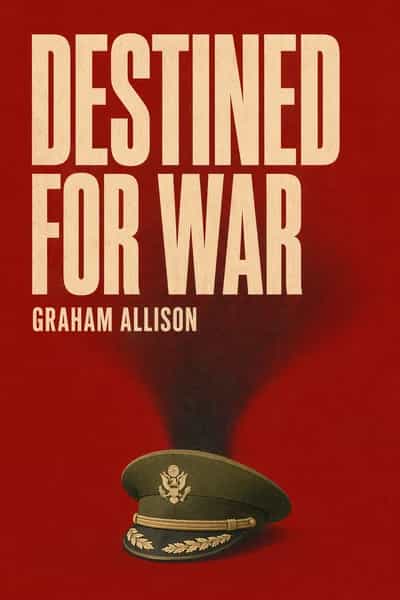
Will America and China go to war? Graham Allison's geopolitical masterpiece examines history's power transitions, where 12 of 16 cases ended in bloodshed. Required reading in both Washington and Beijing, President Biden calls Allison "one of the keenest observers of international affairs around."
Graham Allison, the acclaimed Harvard scholar and international security expert, is the author of Destined for War: Can America and China Escape Thucydides’s Trap?, a groundbreaking exploration of geopolitical tensions between rising and established powers.
As a founding dean of Harvard’s Kennedy School and former U.S. Assistant Secretary of Defense under President Reagan, Allison merges decades of policymaking experience with academic rigor to dissect the “Thucydides’s Trap” framework—a concept central to understanding historical and modern great-power rivalries. His expertise in nuclear security and global diplomacy, honed through advisory roles across multiple presidential administrations, underpins the book’s analysis of U.S.-China relations.
Destined for War became a national bestseller, shortlisted for the Lionel Gelber Prize and named a Best Book of the Year by the Financial Times and The Times. President Joe Biden praised Allison as “one of the keenest observers of international affairs,” reflecting the book’s influence in policymaking circles. Translated into over 20 languages, it remains essential reading for understanding 21st-century geopolitics, with its insights cited in major media outlets like the New York Times and Boston Globe.
Destined for War explores the "Thucydides Trap," a historical pattern where rising powers (like China) clash with established ones (like the U.S.), often leading to war. Graham Allison analyzes 16 historical cases—12 ending in conflict—and applies lessons to modern U.S.-China tensions, arguing that war isn’t inevitable but requires strategic diplomacy to avoid.
Graham Allison is a Harvard political scientist and former U.S. defense advisor, known for his work on nuclear terrorism and foreign policy. His expertise in historical case studies and international relations underpins Destined for War’s analysis of great-power dynamics.
Policymakers, students of international relations, and anyone interested in U.S.-China relations will benefit. The book offers a framework for understanding systemic risks in power transitions, making it relevant for strategists and general readers seeking historical context.
Yes. The book combines rigorous historical analysis with urgent policy insights, making it a seminal work on U.S.-China relations. Its blend of academic depth and accessibility has garnered praise from scholars and policymakers alike.
The Thucydides Trap describes the structural stress when a rising power threatens to displace an established one, often leading to war. Named after the ancient Greek historian, it cites conflicts like Athens vs. Sparta and WWI-era Germany vs. Britain as key examples.
Allison examines 16 cases, focusing on Athens-Sparta, WWI, and the Cold War. Four cases where war was avoided—including the U.S.-Soviet standoff—highlight strategies like diplomatic flexibility and mutual economic interdependence.
Allison argues China’s rapid rise mirrors historical challengers, creating fear in the U.S. He warns against miscommunication, proxy conflicts, and inflexible alliances, urging dialogue and confidence-building measures to mitigate risks.
Critics argue the Thucydides Trap oversimplifies complex histories and undervalues economic interdependence. Some question if U.S.-China competition is as zero-sum as depicted, noting areas of cooperation.
Allison advocates for “competitive coexistence,” combining deterrence with diplomacy. Key strategies include crisis communication channels, economic ties, and redefining alliances to reduce accidental escalation.
Unlike theoretical texts, Allison uses narrative-driven case studies to make systemic risks tangible. It’s often compared to Kissinger’s On China but focuses more on historical patterns than policy memoirs.
With U.S.-China tensions persisting over trade, Taiwan, and tech dominance, Allison’s warnings about unintended escalation remain critical. The book provides a lens to interpret ongoing strategic competition.
Siente el libro a través de la voz del autor
Captura ideas clave en un instante para un aprendizaje rápido
When a rising power threatens to displace a ruling power, alarm bells should sound: danger ahead.
In 12 of 16 cases over the past 500 years in which a rising power has threatened to displace a ruling one, the result was war.
Let China sleep; when she wakes, she will shake the world.
This is the biggest player in the history of the world.
Power grows out of the barrel of a gun.
Pregunta cualquier cosa, elige tu estilo de aprendizaje y co-crea ideas que realmente resuenen contigo.

Creado por exalumnos de la Universidad de Columbia en San Francisco
"Instead of endless scrolling, I just hit play on BeFreed. It saves me so much time."
"I never knew where to start with nonfiction—BeFreed’s book lists turned into podcasts gave me a clear path."
"Perfect balance between learning and entertainment. Finished ‘Thinking, Fast and Slow’ on my commute this week."
"Crazy how much I learned while walking the dog. BeFreed = small habits → big gains."
"Reading used to feel like a chore. Now it’s just part of my lifestyle."
"Feels effortless compared to reading. I’ve finished 6 books this month already."
"BeFreed turned my guilty doomscrolling into something that feels productive and inspiring."
"BeFreed turned my commute into learning time. 20-min podcasts are perfect for finishing books I never had time for."
"BeFreed replaced my podcast queue. Imagine Spotify for books — that’s it. 🙌"
"It is great for me to learn something from the book without reading it."
"The themed book list podcasts help me connect ideas across authors—like a guided audio journey."
"Makes me feel smarter every time before going to work"
Creado por exalumnos de la Universidad de Columbia en San Francisco

Obtén el resumen de Destined for War como PDF o EPUB gratis. Imprímelo o léelo sin conexión en cualquier momento.
Two centuries ago, Napoleon warned, "Let China sleep; when she wakes, she will shake the world." Today, that prophecy has come to life with startling clarity. China has not only awakened but risen with unprecedented speed, creating what Harvard scholar Graham Allison identifies as the most dangerous geopolitical dynamic of our time: Thucydides's Trap. Named after the ancient Greek historian who observed that the rise of Athens and the fear it instilled in Sparta made war "inevitable," this pattern has played out repeatedly throughout history. Allison's research reveals that in twelve of sixteen cases where a rising power challenged a ruling one over the past 500 years, the result was war. With China's meteoric rise threatening America's position as global hegemon, we face a similar peril today. The book has become required reading among political and military leaders worldwide, with Henry Kissinger calling it "a must-read for anyone interested in the future of global politics." As Xi Jinping and successive American presidents navigate this treacherous terrain, understanding this dynamic becomes not just academically interesting but potentially civilization-saving.
When CIA Director David Petraeus met Singapore's founding father Lee Kuan Yew in 2011, he received a stark assessment: "The size of China's displacement of the world balance is such that the world must find a new balance. It is not possible to pretend that this is just another big player. This is the biggest player in the history of the world." The transformation of China's economic position relative to the United States defies imagination. In 1980, China's GDP was a mere 7% of America's; by 2015, it had grown to 61%. Chinese exports, once just 8% of US levels, now exceed American exports by 51%. China's foreign reserves have exploded from 16% of America's to an astounding 3,140%. Since 1980, China's economy has doubled every seven years, growing at 10% annually-far outpacing America's historical growth rate of 4% during its own rise. For Americans accustomed to global primacy, China's economic ascendance triggers a national identity crisis. When the IMF reported in 2014 that China had surpassed the United States as the world's largest economy measured by purchasing power parity (PPP), many Americans refused to believe it. Yet by this standard measure-which the CIA calls "the best available starting point for comparisons of economic strength"-China now accounts for 18% of world GDP compared to just 2% in 1980. Despite Western media's focus on China's "slowdown," the critical question remains: slowing compared to whom? Since the Great Recession, China's growth has declined from 10% to 6-7% annually, but global growth has been cut nearly in half. The "recovering" US economy has averaged just 2.1% growth, while the EU and Japan have grown at 1.3% and 1.2% respectively. One incandescent fact remains: since the Great Recession, 40% of all global growth has occurred in just one country: China. The physical manifestation of this growth is equally staggering. In 1980, American visitors to China found a country seemingly plucked from the distant past-vast, rural, unchanging, with 88% of its billion citizens surviving on less than $2 a day. Today's transformation would be unrecognizable to those visitors. Beijing's once-empty streets now hold six million cars. The fishing village of Shenzhen has become a mega-city of ten million. As Kevin Rudd describes, this represents "the English Industrial Revolution and global information revolution combusting simultaneously and compressed into not 300 years, but 30." China's construction pace defies Western imagination. By 2005, China was building the equivalent of Rome every two weeks. Between 2011 and 2013, China used more cement than America did in the entire twentieth century. Chinese firms build 30-story skyscrapers in 15 days and have constructed the equivalent of Europe's entire housing stock in just 15 years. Beyond infrastructure lies human development: poverty rates have plummeted from 90% to under 3%, average income has risen from $193 to over $8,100, and life expectancy has doubled to 76 years. China has lifted over half a billion people out of extreme poverty-"the greatest leap to overcome poverty in history."
A generation ago, China ranked at the bottom of most international education and innovation metrics. Today, after two decades of determined investment in human capital, it rivals or outperforms the United States. On the 2015 PISA test, China ranked sixth in mathematics while the US ranked thirty-ninth. Chinese high school graduates enter engineering and computer science programs with a three-year advantage in critical thinking skills over American counterparts. Tsinghua University has surpassed MIT as the world's top engineering school, and China graduates four times as many STEM students annually as the US (1.3 million vs. 300,000). The impact is evident across China's economy. Its share of global value-added in high-tech manufacturing jumped from 7% to 27% between 2003 and 2014, while America's declined from 36% to 29%. In 2015, Chinese filed almost twice as many patent applications as Americans-over one million in a single year. China will likely surpass the US in R&D spending by 2019. While intellectual property theft remains significant, China is increasingly innovating on its own. Since 2013, the world's fastest supercomputer has been Chinese, and China now has more of the world's 500 fastest supercomputers than the US. Its top machine is five times faster than America's best and was built entirely with domestic processors. This technological prowess extends to military capabilities. Following Mao's dictum that "power grows out of the barrel of a gun," China has leveraged its economic growth to modernize its military, spending 2 percent of GDP on defense since the late 1980s. This has allowed military capabilities to expand eightfold, with a current defense budget of $146 billion (or $314 billion in PPP), second only to the US. China has developed asymmetric responses to counter American advantages, creating missiles that can target aircraft carriers and antisatellite weapons that can destroy billion-dollar satellites for a fraction of the cost. According to a 2015 RAND Corporation study, by 2017 China will have achieved "advantage" or "approximate parity" in six of nine areas of conventional capability, forcing American leaders to confront the limits of American power in Asia. While Hillary Clinton once suggested the concept of balance of power was obsolete, Lee Kuan Yew disagreed, arguing it remains fundamental but has evolved to emphasize economic power over military might. China has mastered this new form of competition, called "geoeconomics"-using economic instruments to achieve geopolitical goals. As the largest trading partner for over 130 countries, China wields enormous economic leverage, accounting for 15 percent of ASEAN's total trade compared to America's 9 percent.
To understand the danger we face, we must return to Thucydides's insight about the Peloponnesian War: "It was the rise of Athens and the fear that this instilled in Sparta that made war inevitable." This dynamic-which Allison labels "Thucydides's Trap"-has haunted international relations for millennia. Before the Persian invasion of 490 BCE, Sparta had dominated Greece for over a century. The ultimate military culture, Sparta organized its entire society around creating perfect warriors-taking boys at age seven for military training, requiring men to live in barracks until thirty, and promoting values of courage and discipline above all else. Athens, by contrast, was an open trading society that had begun experimenting with democracy. Following their combined victory against Persia, Athens experienced a remarkable renaissance, building a maritime empire from its defensive alliance network. Its economy flourished through trade, its navy grew unrivaled, and its cultural achievements soared, funded by gold from its expanding empire. These powers represented stark contrasts: conservative Sparta preserved the status quo while innovative Athens constantly pushed boundaries. As an Athenian diplomat bluntly stated, "It has always been the law that the weaker should be subject to the stronger." Though initially Sparta's military superiority wasn't threatened, some Spartan leaders proposed preemptive strikes as Athens's influence grew. The spark igniting conflict came when Corinth, a key Spartan ally, clashed with neutral Corcyra over the settlement of Epidamnus. After initially losing, Corinth rapidly expanded its navy to 150 ships. Terrified Corcyra appealed to Athens for help, presenting Athens with a strategic dilemma: aiding Corcyra might violate the peace treaty and antagonize Corinth, but doing nothing risked allowing Corinth to seize Corcyra's fleet, shifting naval power toward Sparta. Thucydides identified three primary drivers that led Athens and Sparta to war: interests, fear, and honor. Beyond objective national interests like sovereignty and survival, fear colored perceptions as ruling Sparta's anxieties fueled misperceptions while rising Athens's confidence encouraged risk-taking. Honor-encompassing a state's sense of itself and entitlement to respect-grew with Athens's power. As these factors intertwined, they produced repeated confrontations neither side could avoid.
The most ominous parallel to today's US-China relationship may be the Anglo-German rivalry that led to World War I. By 1900, Britain had acquired an empire spanning every continent-truly "an empire on which the sun never set." As the birthplace of the Industrial Revolution, Britain had become "the workshop of the world," accounting for nearly a quarter of global manufacturing and trade by 1880. It served as both "policeman and banker to the world," the first true superpower. Yet anxieties about Britain's future surfaced even during Queen Victoria's 1897 diamond jubilee. Rudyard Kipling's contemplative poem "Recessional" raised the disquieting prospect of imperial decline. The "croakers" had reason for concern. Britain's struggles in the Boer War revealed military weaknesses, while rivals were rapidly closing Britain's industrial lead. Germany's rise represented a simple yet profound challenge: a rapidly developing nation whose path to global prominence was blocked by what it perceived as an unjust and covetous incumbent power. Following Bismarck's unification of German states, the country emerged as an economic, military, and cultural phenomenon dominating Europe. By 1914, Germany's population was 50% larger than Britain's, its economy had become Europe's leading powerhouse, and it had surpassed Britain in manufacturing output. Despite these achievements, many Germans felt shortchanged, believing they deserved colonial possessions like other "World Powers" such as America, Russia, and Britain. Kaiser Wilhelm II embodied this combustible mix of resentment and ambition, declaring through his foreign minister that Germany demanded "our place in the sun." The naval race between these powers proved particularly dangerous. Admiral Tirpitz's ultimate goal was a German navy "equally as strong as England's." He believed that even a smaller fleet could be a significant "political power factor" against an overstretched Britain. His "risk theory" held that if Germany's fleet became strong enough to seriously damage the Royal Navy, this would deter British attacks. Britain responded strategically by ending its "splendid isolation," signing alliances with Japan, France, and Russia to create the Triple Entente. Admiral Fisher reorganized the Royal Navy to concentrate against Germany's fleet, declaring: "Our only probable enemy is Germany." As the naval race intensified, Britain and Germany experienced mutual invasion panics. Lloyd George proposed tax hikes for naval construction, asserting that naval supremacy was "essential not only to our national existence, but to the vital interests of Western civilization." Despite British attempts at firmness and diplomatic realignments, Germany became increasingly strident in its claims of victimhood and impending disaster. The war resulted more from miscalculation than ignorance. Leaders recognized war could devastate their societies, but rational struggles over predominance created tectonic stress where statesmen deemed war preferable to perceived national destruction.
To understand China's trajectory, we must understand Xi Jinping's vision, which can be summarized in one line: to "Make China Great Again." China's worldview stems from its uniquely long sense of history, where modern leaders invoke millennium-old strategic principles. Classical Chinese foreign policy consisted of three key tenets: regional dominance, recognition of China's inherent superiority by neighbors, and orchestration of "harmonious co-existence." Unlike Western powers, China traditionally expanded through cultural osmosis rather than missionary zeal, maintaining international hierarchy without military conquest. This dominance ended abruptly in the nineteenth century with defeats by Western powers, beginning with the Opium Wars and culminating in what Chinese call the "century of humiliation"-foreign occupation, exploitation, and national shame that only ended when Mao declared in 1949 that "The Chinese people have stood up!" Xi Jinping was born a "princeling" as the son of Vice Premier Xi Zhongxun, but his privileged life shattered when Mao arrested his father during Xi's childhood. After graduating from prestigious Tsinghua University, Xi worked his way up the Party hierarchy, eventually emerging as heir apparent to President Hu. Initially assumed to be another uncharismatic consensus-builder like his predecessors, Xi instead rapidly consolidated power as "Chairman of Everything," taking more than a dozen titles and positioning himself to potentially remain in power beyond traditional term limits. Xi has painted a bold vision of the "China Dream" and is mobilizing supporters to execute an ambitious agenda advancing on four fronts: revitalizing the Communist Party by cleansing it of corruption; reviving Chinese nationalism to instill pride; engineering a third economic revolution through structural reforms; and rebuilding China's military to "fight and win." When Xi Jinping has nightmares, he sees Mikhail Gorbachev. Xi frequently asks colleagues why the Soviet Union collapsed, concluding Gorbachev made three fatal errors: relaxing political control before reforming the economy, allowing the Communist Party to become corrupt and hollow, and "nationalizing" the military rather than keeping it loyal to the Party. Beyond cleansing corruption, Xi must articulate why the Party deserves to govern China. His answer is a renewed sense of national identity that a billion Chinese can embrace with pride. While Mao subordinated Chinese identity to global communist ideology, Xi is reinventing the Party as successor to imperial mandarins-guardians of a proud civilization with a historical mandate to rule. As China integrates Asia economically and physically through initiatives like the One Belt, One Road project, America's post-WWII position becomes increasingly untenable. While Chinese leaders recognize America's historical role in enabling Asian stability and China's rise, they believe the time has come for America to step back. As Xi told Eurasian leaders: "It is for the people of Asia to run the affairs of Asia."
Despite their many differences, the United States and China share extreme superiority complexes. Each sees itself as exceptional-literally without peers. While Muhammad Ali's "I am the greatest" captures American swagger, China's conception of itself as the unique link between humans and heaven may be even more immodest. Chinese exceptionalism is perhaps more sweeping than its American counterpart. Traditional China saw itself as the center of the civilized universe, with only "barbarism" beyond. These contrasting worldviews reflect fundamental differences: Americans value freedom above all, while Chinese prioritize order; Americans view government as a necessary evil, while Chinese see it as a necessary good; Americans distrust authority, while Chinese embrace hierarchical harmony. American and Chinese approaches to governance, legitimacy, and world order reveal profound civilizational differences. Americans see government as a necessary evil that must be checked by separation of powers, while Chinese view strong central government as essential for order and prosperity. For Americans, legitimacy comes from democratic consent; for Chinese, it derives from performance. The US promotes democracy as universal, while China lets others admire but doesn't export its values. These differences extend to their perspectives on time (America's 250-year history versus China's five millennia), problem-solving (Americans seek quick fixes while Chinese manage long-term processes), and inclusion (America's immigrant openness versus China's ethnic exclusivity). In international relations, Americans promote a "rules-based order" that Chinese see as American-made rules they must obey. Chinese strategic thinking differs fundamentally from American approaches. It embraces realpolitik unencumbered by ideological constraints, takes a holistic view where everything connects, and emphasizes psychological warfare over military confrontation. Rather than seeking decisive battles, Chinese strategy focuses on patient accumulation of advantage-like the game of weiqi (go) versus chess-gradually surrounding rather than directly confronting opponents.
The chapter examines how war between the US and China might occur despite both sides' desire to avoid it. Like forest fires, wars typically start from accidental sparks rather than deliberate arson, with background conditions determining which sparks ignite conflict. Modern accelerants include antisatellite weapons and cyberweapons that could disable critical military and civilian infrastructure. These technologies create dangerous "use-it-or-lose-it" dynamics where each side has incentives to strike first. Cyberattacks that disrupted communication would intensify the fog of war, creating confusion that multiplies chances of miscalculation. Mundane incidents could ignite major conflict. Consider American warships operating near Chinese-controlled islands in disputed waters: if a US destroyer collided with and sank a Chinese vessel during routine operations near Mischief Reef, Beijing would face difficult choices. A moderate response might involve blocking the destroyer's departure and demanding surrender of its crew. From America's perspective, however, surrendering sailors in international waters would undermine maritime law principles and signal weakness to allies. US responses-sending aircraft, deploying carriers, or forward-positioning bombers-could appear threatening to Beijing, especially amid public outrage. Each side's attempts at proportionate responses could spiral uncontrollably. US strikes on Chinese island bases might seem measured to Washington but would be seen as attacks on sovereign territory by Beijing. China's "blinding" counterattacks on US satellites and command systems would appear to Americans as preparation for strikes on carriers. Taiwan represents another flashpoint. If China were to violently suppress protests in Hong Kong, breaking its "One Country, Two Systems" promise, Taiwanese pro-independence sentiment could surge. An American president's declaration of commitment to Taiwan's defense could break from the long-standing "strategic ambiguity" policy, emboldening Taiwan to apply for UN membership and reject the "1992 Consensus" on One China. Conflict between America and China could also ignite through third-party allies, as nearly happened in 2010 when North Korea sank South Korea's Cheonan warship. Japan represents a particularly dangerous flashpoint, especially regarding the disputed Senkaku Islands (Diaoyu in Chinese) in the East China Sea.
While war between the United States and China is possible, it is not inevitable. History offers at least four cases where rising and ruling powers successfully navigated potential conflicts without war. In the late fifteenth century, Portugal dominated ocean trade routes until Spain emerged as a rival maritime power. After Columbus's successful voyage for Spain in 1492, both nations feared costly conflict over newly discovered territories. They appealed to Pope Alexander VI, who drew a dividing line through the Western Hemisphere, allocating lands west to Spain and east to Portugal. This arrangement, formalized in the 1494 Treaty of Tordesillas, established "spheres of conquest" that prevented war between the powers for nearly a century. After German reunification in 1989, what Thatcher and Mitterrand feared came true-Germany's economic strength gave it the dominant political voice on the Continent. Yet Germany remained embedded in European institutions, creating what scholar Helga Haftendorn called a "Europeanized Germany" rather than a "German Europe." Despite economic dominance, Germany remained militarily neutered, protected by America's security guarantee and nuclear umbrella. As America rose from Civil War ashes to economic colossus by 1900, its population doubled Britain's and its economy grew to twice Britain's size. Despite tense Anglo-American relations after their acrimonious separation, Britain chose accommodation when confronting America's growing power. When President Cleveland threatened war over a Venezuelan territory dispute, Britain yielded to arbitration. First Sea Lord Jacky Fisher bluntly told his superiors that Britain should "use all possible means to avoid war" with America because "under no conceivable circumstances could we escape an overwhelming and humiliating defeat." The Soviet-American Cold War stands as a rare American victory in the post-WWII era, ending not with nuclear apocalypse but with the Berlin Wall's fall and the Soviet Union's collapse. Americans today find it hard to imagine the USSR as a serious challenger, yet in 1964, economist Paul Samuelson's popular textbook predicted Soviet GNP would overtake America's by the mid-1980s. After WWII, American leaders developed an unprecedented strategic leap-inventing "cold war" as combat by every means except direct military confrontation. The Cold War's central lesson for US-China relations is uncomfortable but undeniable: once two states possess invulnerable nuclear arsenals, hot war becomes unjustifiable. Both nations must integrate this fact into their policies, compromising in ways they'd otherwise find intolerable and restraining actions that could escalate to all-out war. US-Chinese economic relations have created "mutual assured economic destruction" (MAED). As China's largest export market and America as China's largest creditor, war would devastate both economies. Unlike pre-WWI economic ties, today's supply chains are so integrated that virtually everything sold in America contains Chinese components. China has made a "cosmic bet" on an open global marketplace and secure shipping lanes-both vulnerable to American disruption.
The rise of China demands not just a new "China strategy" but serious reflection. This challenge requires a multiyear, multiminded effort comparable to the four-year debate that shaped America's Cold War strategy. There is no "solution" for the dramatic resurgence of a 5,000-year-old civilization with 1.4 billion people-only a chronic condition that must be managed over a generation. America's current "engage but hedge" strategy toward China permits everything and prohibits nothing. The State and Treasury Departments "engage" by welcoming China into international institutions while overlooking persistent cheating, while Defense and intelligence communities "hedge" by maintaining military superiority and planning for potential conflict. This strategy assumes China will follow Germany and Japan's path, accepting its place in the American-led order and eventually becoming democratic. But as Lee Kuan Yew observed, this strategy has two fatal flaws: China won't become a democracy (which "would cause it to collapse"), and unlike Germany and Japan, China was never defeated, occupied, and reconstructed by America. To stimulate strategic thinking, four potential alternative approaches deserve consideration. Accommodation means adapting to power shifts by adjusting relations with competitors. Britain's approach to America in the late nineteenth century exemplifies ad hoc accommodation, gracefully yielding on issues like Venezuelan territorial disputes. For China, the US might consider trading Taiwan commitments for concessions in the South China Seas, or withdrawing troops from South Korea in exchange for denuclearization of the North. The US and China could agree to a quarter-century hiatus on certain competitive domains while pursuing advantage elsewhere. Like Nixon-Kissinger detente with the Soviets, this approach would provide breathing space for domestic priorities. Potential agreements include freezing South China Sea disputes, limiting cyberattacks to specific domains, or forbidding interference in each other's politics. While rejecting Xi's proposed "new form of great power relations" that would recognize China's sphere of influence, America could propose its own conception. Following Reagan's hypothetical about Martian invasion with Gorbachev, the US could identify "mega-threats" that compel cooperation: nuclear Armageddon, nuclear anarchy, global terrorism, and climate change. On these issues, shared vital interests outweigh differences. History shows that destiny deals the hands, but men play the cards. Thucydides disagreed with Greek playwrights who believed in predetermined fate, instead showing how different choices by Athenians could have produced different outcomes. Similarly, World War I wasn't inevitable-Bismarck might have maintained Germany's alliance with Russia. The Cuban Missile Crisis demonstrates how Kennedy's willingness to override advisers' urgings and give Khrushchev time to consider options helped avert nuclear war. The greatest national security threat to both America and China lies in their domestic failures. America's democracy shows fatal symptoms: a dysfunctional capital, poisonous partisanship, legalized corruption, an attention-deficit electorate, and sensationalist media. China faces its own governance crisis as technology makes its current system obsolete. If both nations prioritized their domestic challenges, they might find that "sharing the twenty-first century in Asia" isn't their most serious problem. As Shakespeare noted, our destiny lies "not in our stars, but in ourselves."