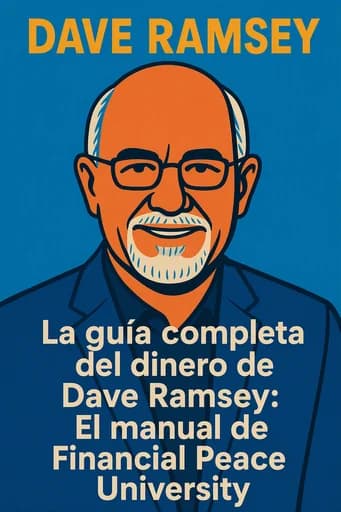
Dave Ramsey's revolutionary guide transforms financial chaos into clarity. As the cornerstone of Financial Peace University, this bestseller has helped countless Americans escape debt using the famous "Baby Steps" method. Even financial advisors swear by its practical wisdom - could your financial freedom be just 331 pages away?
David Lawrence Ramsey III, bestselling author of Dave Ramsey's Complete Guide to Money, is a nationally recognized personal finance expert and radio host whose Bible-based principles have guided millions toward debt-free living.
A former real estate investor who rebuilt his wealth after bankruptcy, Ramsey founded Ramsey Solutions (originally The Lampo Group) to teach practical money management strategies, emphasizing budgeting, emergency funds, and debt elimination.
His flagship show, The Dave Ramsey Show, reaches over 18 million weekly listeners, and his other New York Times bestsellers like The Total Money Makeover and Financial Peace Revisited established his reputation as America’s trusted voice on financial literacy. An evangelical Christian, Ramsey frequently references Proverbs 22:7 to advocate against debt, blending faith with actionable advice.
His work has been featured on 60 Minutes, The Oprah Winfrey Show, and Fox Business Network. With a net worth exceeding $200 million, Ramsey’s strategies have been embraced by households nationwide, and his Financial Peace University program has become a cornerstone of personal finance education.
Dave Ramsey's Complete Guide to Money provides a comprehensive roadmap for personal finance, covering budgeting, debt elimination, investing, insurance, mortgages, and philanthropic giving. It combines Ramsey’s signature "Baby Steps" framework with actionable strategies for achieving financial stability, making it a practical handbook for managing money effectively.
This book is ideal for beginners seeking foundational financial literacy or readers wanting a consolidated resource for Ramsey’s teachings. It’s less valuable for those who’ve already completed Financial Peace University or memorized his Total Money Makeover principles.
Yes, it’s praised for its clear, step-by-step advice on escaping debt and building wealth. Reviews highlight its practicality, with real-life examples showing how Ramsey’s methods lead to financial freedom.
The Baby Steps are a 7-step plan:
Ramsey advocates paying off smallest debts first to build momentum, then progressing to larger ones. This behavior-focused approach prioritizes psychological wins over mathematical optimization, helping individuals stay motivated.
The book recommends starting with a $1,000 starter emergency fund (Baby Step 1), then expanding to 3–6 months of expenses after becoming debt-free (Baby Step 3). This buffers against unforeseen financial crises.
Ramsey advises investing 15% of household income into retirement accounts like Roth IRAs or 401(k)s once debt-free. He emphasizes long-term growth through diversified mutual funds.
Giving is a core principle, even during debt repayment. Ramsey argues generosity fosters gratitude and aligns with his belief that financial success should benefit others.
While both outline the Baby Steps, Complete Guide to Money expands on topics like insurance, mortgages, and bargaining strategies. It’s broader in scope, whereas Total Money Makeover focuses strictly on the step-by-step plan.
Some argue Ramsey’s debt snowball method isn’t mathematically optimal, as prioritizing small debts over high-interest ones may cost more long-term. However, supporters counter that behavioral success outweighs pure math.
The 331-page book takes roughly 6–8 hours for most readers. For quicker insights, summaries like Blinkist’s 15-minute version offer key takeaways.
Dave Ramsey is a bestselling personal finance expert, radio host, and CEO of Ramsey Solutions. Known for his no-nonsense advice, he’s helped millions achieve financial peace through books, courses, and public speaking.
Siente el libro a través de la voz del autor
Convierte el conocimiento en ideas atractivas y llenas de ejemplos
Captura ideas clave en un instante para un aprendizaje rápido
Disfruta el libro de una manera divertida y atractiva
Personal finance is 80% behavior and 20% head knowledge.
Live like no one else, so later you can live like no one else.
You must gain control over your money or the lack of it will forever control you.
Act your wage.
Desglosa las ideas clave de Dave Ramseys Complete Guide To Money The Handbook Of Financial Peace University en puntos fáciles de entender para comprender cómo los equipos innovadores crean, colaboran y crecen.
Experimenta Dave Ramseys Complete Guide To Money The Handbook Of Financial Peace University a través de narraciones vívidas que convierten las lecciones de innovación en momentos que recordarás y aplicarás.
Pregunta cualquier cosa, elige tu estilo de aprendizaje y co-crea ideas que realmente resuenen contigo.

Creado por exalumnos de la Universidad de Columbia en San Francisco
"Instead of endless scrolling, I just hit play on BeFreed. It saves me so much time."
"I never knew where to start with nonfiction—BeFreed’s book lists turned into podcasts gave me a clear path."
"Perfect balance between learning and entertainment. Finished ‘Thinking, Fast and Slow’ on my commute this week."
"Crazy how much I learned while walking the dog. BeFreed = small habits → big gains."
"Reading used to feel like a chore. Now it’s just part of my lifestyle."
"Feels effortless compared to reading. I’ve finished 6 books this month already."
"BeFreed turned my guilty doomscrolling into something that feels productive and inspiring."
"BeFreed turned my commute into learning time. 20-min podcasts are perfect for finishing books I never had time for."
"BeFreed replaced my podcast queue. Imagine Spotify for books — that’s it. 🙌"
"It is great for me to learn something from the book without reading it."
"The themed book list podcasts help me connect ideas across authors—like a guided audio journey."
"Makes me feel smarter every time before going to work"
Creado por exalumnos de la Universidad de Columbia en San Francisco

Obtén el resumen de Dave Ramseys Complete Guide To Money The Handbook Of Financial Peace University como PDF o EPUB gratis. Imprímelo o léelo sin conexión en cualquier momento.
What if losing everything was the best thing that ever happened to you? Dave Ramsey discovered this paradox in his twenties when bankruptcy stripped away his millionaire status and forced him to confront an uncomfortable truth: his financial disaster wasn't about bad luck or market conditions-it was about behavior. This revelation sparked a journey that would eventually help over one million families escape financial chaos. The counterintuitive wisdom he uncovered? Personal finance is 80% behavior and only 20% head knowledge. Even celebrities like Blake Lively and Ryan Reynolds have publicly credited his approach for maintaining financial stability despite Hollywood's temptations. His grandmother's simple formula-spend less than you make, avoid debt, save for emergencies-sounds almost laughably basic. Yet in a culture addicted to instant gratification and normalized debt, this message has become revolutionary. The path to financial freedom isn't paved with complex investment algorithms or insider secrets. It's built on intentional behavior change, one decision at a time.
Most people tackle finances simultaneously-paying debt, saving for retirement, funding college, and building wealth all at once. The Baby Steps method rejects this scattered approach for laser-focused sequential progress. Baby Step 1 establishes $1,000 in savings ($500 if income is under $20,000)-often the hardest step because it requires genuine behavior change. This starter fund buffers against life's curveballs that would otherwise trigger credit card debt spirals. Baby Step 2 unleashes the debt snowball: list all debts smallest to largest, then attack the smallest with ferocious intensity while making minimum payments on others. Why smallest first instead of highest interest? Because personal finance is about behavior modification, not mathematical optimization. Paying off that $500 credit card before the $20,000 student loan creates psychological wins that fuel momentum. Each eliminated debt frees up its payment to roll into the next-like a snowball gathering mass downhill. Baby Step 3 expands savings to 3-6 months of expenses. Baby Step 4 invests 15% into retirement. Baby Step 5 adds college funding, Step 6 accelerates mortgage payoff, and Step 7 focuses on wealth building and generous giving. This sequential approach harnesses focus-scattered sunlight produces nothing, but focused rays start fires.
When a woman's truck needed $1,000 in repairs, she had $12,000 in savings but panicked-until Ramsey said, "Just fix the car." Her relief revealed a disconnect: she hadn't connected having emergency savings with actually using it. Your emergency fund isn't a museum piece-it's insurance you pay yourself. The starter $1,000 fund (Baby Step 1) buffers you while attacking debt. The full 3-6 months of expenses (Baby Step 3) protects against job loss or economic downturns. Keep it liquid in a money market account-it's not an investment, it's chaos insurance. Beyond emergencies, sinking funds transform planned purchases. Need $4,000 furniture in 18 months? Save $211 monthly, then walk in with cash and negotiate. The discipline of consistent saving-$100 monthly from age 25 to 65 at 12% return-creates over $1.1 million. Not exciting, but devastatingly effective.
Money fights cause 57% of divorces in North America, yet when handled properly, money becomes marriage's strongest foundation. Every marriage contains a "Nerd" who enjoys budgeting and a "Free Spirit" who finds detailed planning suffocating. The solution? Monthly Budget Committee Meetings where both spouses actively participate. Nerds prepare a draft but allow Free Spirits to modify it. Free Spirits must attend and provide mature input-never just "Whatever you want to do, honey." The goal is genuine partnership, not dictatorship. Singles face different challenges without built-in accountability. Time poverty and loneliness drive unplanned spending through dining out and entertainment. The antidotes? A written budget and an accountability partner who asks hard questions. Parents must recognize that someone will teach their children about money-either intentionally by parents or accidentally by predatory lenders. Kids need four principles: work (money comes from effort), saving (delaying gratification), spending (experiencing the joy of buying with saved money), and giving (discovering that generosity brings the most fulfillment). Teaching these lessons early creates lifelong financial competence.
Business professionals manage budgets at work daily, yet somehow fail to bring that discipline home. Without tracking money flowing in and out monthly, financial progress remains impossible. A budget isn't about restriction - it's about intention. It doesn't mean you can't order pizza; it means planning for pizza! Your first budget won't work. Accept this now. You'll forget expenses and misjudge category amounts. By the third month, things smooth out. Every month before the month begins, create a zero-based budget where income minus all planned expenses equals zero. Every dollar gets assigned a job: giving, saving, or spending. Priority one: cover the Four Walls - food, shelter, clothing, and transportation. These basics come before everything else, even credit card payments. About 25% of financial counseling clients are current on credit cards but behind on mortgages! Never risk your home to keep credit card companies from calling. Managed money goes farther. Almost everyone who starts budgeting feels like they got a raise because accounting for every dollar eliminates the little expenses that devour money like moths eating fabric.
Debt is history's most successfully marketed product. The credit industry has hooked Americans while making them feel special. We've reversed our natural instincts-in stores, we say "No thanks, just looking!" but with credit cards, we beg for approval. This wasn't always normal. Our great-grandparents considered debt sinful. Everything changed in 1950 with Diner's Club, followed by BankAmericard in 1958 (later Visa). In 1970, only 15% of Americans had credit cards. Today, 77% have at least one, averaging seven per person. Baby Step 2 attacks all debt (except your mortgage) using the debt snowball. List debts smallest to largest by balance-not interest rate. Attack the smallest while making minimum payments on others. When one's eliminated, roll that payment into the next. Quick wins provide emotional fuel more valuable than mathematical optimization. While working the snowball, temporarily stop retirement savings, even 401(k)s with employer matches. This frees up money and motivates completion. Most families finish within eighteen months.
Financial freedom isn't reserved for trust fund babies-it's available to anyone willing to change their behavior. The journey centers on spending less than you make, eliminating debt, building emergency cushions, and investing consistently. The Baby Steps transform overwhelming goals into manageable milestones. The debt snowball creates momentum. The emergency fund provides peace during crises. The budget ensures every dollar has purpose. Smart insurance protects what you've built. Consistent investing creates wealth that eventually works harder than you do-the Pinnacle Point where investments earn more than your job pays. But the most transformative aspect isn't the wealth you accumulate-it's the person you become. Discipline transforms character. Delayed gratification builds strength. Generosity creates fulfillment that consumption never delivers. In a culture selling happiness through purchases, choosing a different path requires courage. Your financial future isn't determined by past mistakes or current circumstances-it's determined by decisions you make starting today. The question isn't whether the path works. The question is: will you walk it?