How do we look?
the body, the divine, and the question of civilization
Resumen de How do we look?
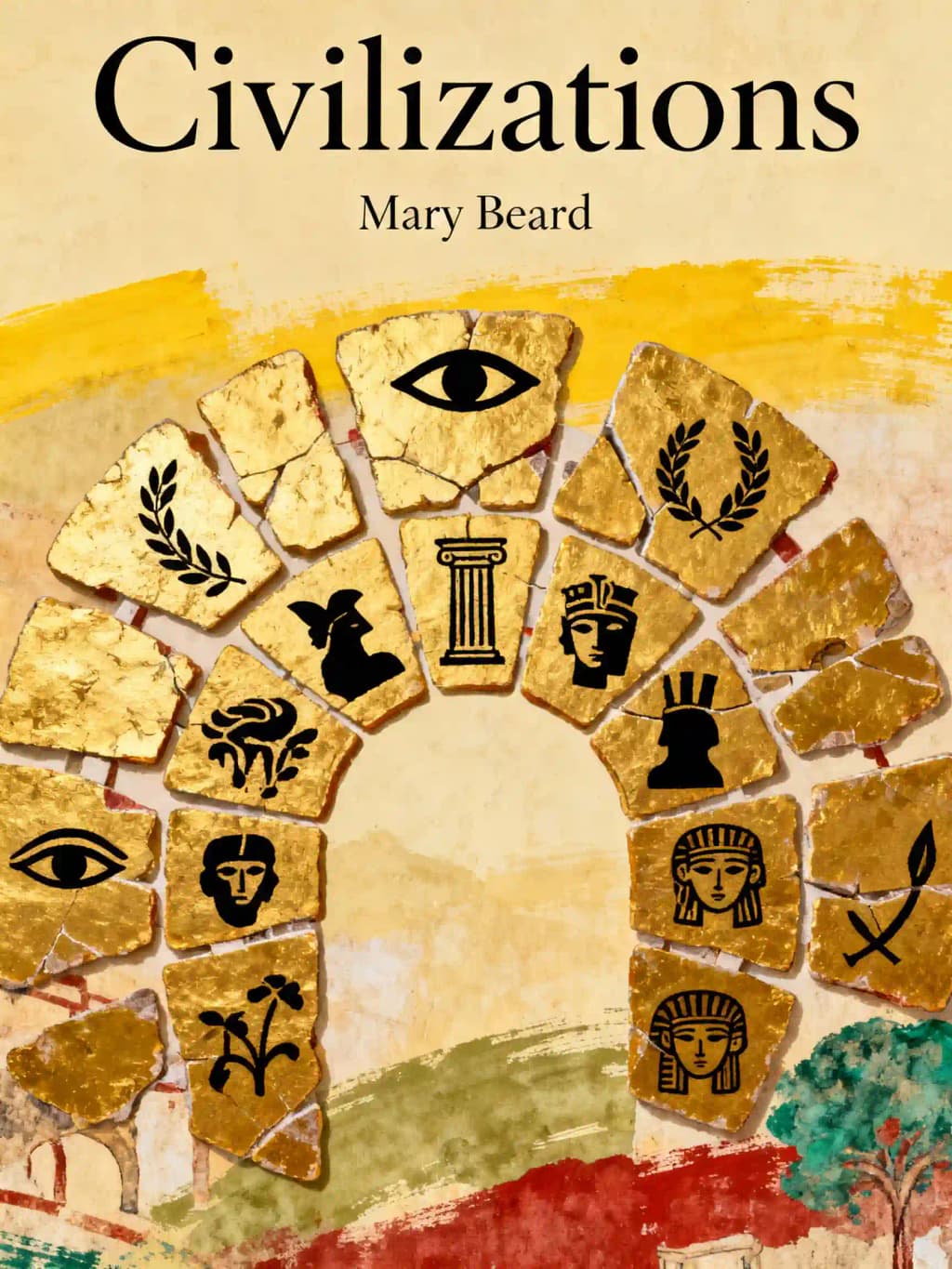
Mary Beard's "Civilizations" shatters Eurocentric history, revealing how art shaped global power across cultures. This BBC companion masterpiece challenges what it means to be "civilized" - why did Dame Beard's fresh perspective on ancient monuments make scholars rethink history's traditional narratives?
Temas clave en How do we look?
- visual representation
- artistic propaganda
- divine iconography
- human form
- cultural identity
Citas de How do we look?
Art has always been a mirror to society.
Art not only mirrors society but also shapes it.
The canvas of human experience awaits our contributions.
Personajes en How do we look?
- Mary BeardAuthor and historian exploring art and expression
- Ramses IIAncient Egyptian ruler depicted in colossal art
- Qin Shi HuangFirst Emperor of China buried with an army
- MichelangeloArtist who painted the Sistine Chapel frescoes
- Jacques-Louis DavidPainter of The Coronation of Napoleon
Descargar resumen de How do we look?
Obtén el resumen de How do we look? como PDF o EPUB gratis. Imprímelo o léelo sin conexión en cualquier momento.
Preguntas Frecuentes Sobre Este Libro
Civilisations by Mary Beard explores the evolution of Western civilization through art, culture, and societal norms, spanning ancient Greece, Rome, and beyond. The book examines how art reflects ideological shifts, power structures, and human creativity, with chapters dedicated to topics like Greek philosophy, Roman architecture, and the role of women in antiquity.
History enthusiasts, art lovers, and readers interested in classical studies will find this book compelling. Beard’s accessible style makes it suitable for both academics and casual readers seeking insights into how civilizations shape—and are shaped by—art, politics, and culture.
Yes, for its fresh perspective on Western civilization’s artistic legacy. Beard challenges Eurocentric narratives, weaving together lesser-known stories—like women’s roles in antiquity—with iconic cultural achievements. The book’s blend of scholarly rigor and engaging prose makes it a standout in historical literature.
Key themes include the interplay of art and power, the evolution of social norms, and marginalized voices in history. Beard emphasizes how civilizations use art to project authority (e.g., Egyptian pyramids) and how cultural artifacts reveal shifting values, such as Renaissance art’s humanist ideals.
Unlike SPQR’s focus on Roman history, Civilisations adopts a broader lens, analyzing art’s role across multiple societies. It shares Beard’s signature blend of academic depth and narrative flair but diverges by prioritizing visual culture over political chronology.
Beard highlights Greece’s contributions to philosophy, democracy, and drama but critiques its exclusion of women from public life. She examines artifacts like the Parthenon frieze to show how art reinforced societal hierarchies and ideals of beauty.
The book dissects Rome’s architectural innovations (e.g., aqueducts), legal systems, and literary legacy. Beard argues that Roman art, from Augustus’ statues to Ovid’s poetry, served as propaganda, legitimizing imperial power while reflecting everyday life.
Art acts as a “mirror to society,” revealing beliefs and tensions. Beard analyzes examples like Chinese terracotta warriors and Reformation-era iconoclasm to show how civilizations express divinity, authority, and identity through creative works.
While primarily focused on the West, Beard briefly contrasts European traditions with global examples, such as Buddhist Indian sculptures and Mesoamerican rituals. These comparisons underscore shared human impulses to create and commemorate.
Some scholars argue the book oversimplifies complex histories or underrepresents non-Western cultures. Others praise its accessibility but note gaps in addressing colonialism’s impact on artistic exchange.
Beard highlights women’s erasure from historical narratives, using Greek vase paintings and Roman portraiture to question how gender roles were enforced. A recurring theme is the tension between female visibility in art and their marginalization in society.
Its focus on art as a primary historical source sets it apart. Instead of chronologies, Beard decodes symbols—like Renaissance depictions of Biblical figures in contemporary clothing—to reveal how societies reinterpret their past.
The book expands on themes from Beard’s Civilisations TV episodes, offering deeper analysis of artifacts and contexts. It serves as a companion for viewers wanting to explore the series’ ideas in written form.