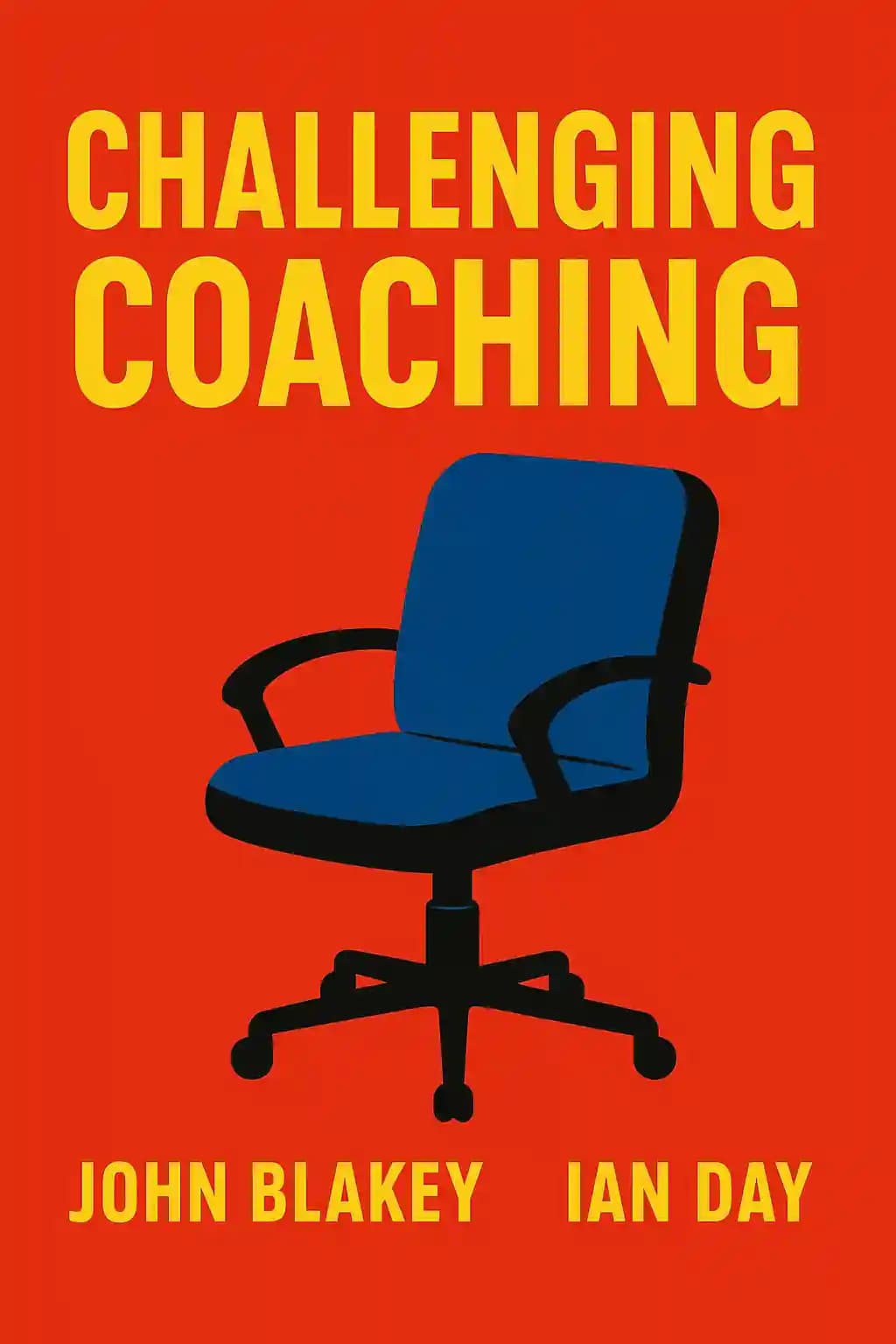
Challenging Coaching shatters traditional coaching paradigms with its revolutionary FACTS model, ranked in the top three coaching books by "Ready to Manage." Endorsed by coaching legend Sir John Whitmore, it dares you to enter the "zone of uncomfortable debate" where true organizational transformation happens. Are you brave enough?
John Blakey and Ian Day, co-authors of Challenging Coaching: Going Beyond Traditional Coaching to Face the FACTS, are renowned leadership experts and pioneers in transformative executive coaching.
Blakey, a Doctor of Business Administration and former FTSE 100 executive, combines corporate leadership experience with elite sports coaching insights, having guided Olympic teams and Premier League clubs. Day brings decades of organizational development expertise, creating frameworks used across industries. Their book revolutionized coaching methodologies by advocating assertive accountability in leadership development, bridging corporate and high-performance sports contexts.
Blakey further solidified his authority through The Trusted Executive (CMI Book of the Year finalist) and Force for Good, establishing him as a thought leader in purpose-driven leadership. Both authors’ work has been featured in Forbes, BBC News, and The Sunday Times, while their coaching models are implemented by organizations like the NHS, British Airways, and UNICEF. Challenging Coaching became a UK bestseller, inspiring over 130 CEOs across 22 countries and remaining essential reading in leadership programs worldwide.
Challenging Coaching redefines traditional coaching by advocating a bold, provocative approach to unlock transformative results. It introduces the FACTS model—Feedback, Accountability, Courageous Goals, Tension, and Systems Thinking—to push clients beyond comfort zones, align personal growth with organizational needs, and drive sustainable performance. The book combines case studies, dialogues, and exercises to help coaches tackle uncomfortable but necessary conversations.
This book is ideal for executive coaches, business leaders, and leadership development professionals seeking to elevate their impact. It’s also valuable for peak performance enthusiasts aiming to foster resilience in high-pressure environments. Readers will learn to balance empathy with directness, making it essential for those navigating complex organizational challenges.
Yes, Challenging Coaching offers actionable strategies for driving lasting change. Its emphasis on the FACTS model provides a structured yet flexible framework, backed by real-world examples from CEOs and sports coaches. The book’s focus on “uncomfortable debate” makes it a standout resource for practitioners aiming to bridge personal and organizational goals.
The FACTS model is the book’s core framework:
Unlike passive, non-directive approaches, Challenging Coaching prioritizes assertive dialogue and organizational alignment. It encourages coaches to respectfully confront limiting beliefs, challenge agendas, and prioritize systemic impact over individual preferences—making it ideal for modern, fast-paced business environments.
Case studies in the book demonstrate its effectiveness in Fortune 500 companies and elite sports.
John Blakey is an award-winning CEO coach and thought leader at the Chartered Management Institute. Ian Day specializes in leadership development. Together, they’ve coached 120+ CEOs and authored Challenging Coaching—a seminal work praised for reshaping executive coaching practices.
Some traditionalists argue its confrontational style risks damaging client relationships. However, proponents highlight its evidence-based results in transforming bottom-line performance. The book addresses these concerns by emphasizing respectful tension and adaptability.
By fostering accountability and systems thinking, the framework helps teams:
These lines underscore the book’s ethos of embracing tension for transformational outcomes.
In an era of AI disruption and remote work, its focus on adaptability and systems-aware leadership remains critical. The FACTS model equips coaches to address hybrid team dynamics, ethical AI integration, and global sustainability challenges.
Yes, the authors offer workshops and downloadable exercises through their website. These resources help practitioners implement the FACTS model, with templates for courageous goal-setting and feedback frameworks.
Siente el libro a través de la voz del autor
Convierte el conocimiento en ideas atractivas y llenas de ejemplos
Captura ideas clave en un instante para un aprendizaje rápido
Disfruta el libro de una manera divertida y atractiva
It's time to break some golden rules.
Comfortable conversations rarely lead to transformative results.
Sustainable breakthroughs only happen by working through discomfort.
They're willing to risk momentary discomfort for long-term transformation.
Desglosa las ideas clave de Challenging Coaching en puntos fáciles de entender para comprender cómo los equipos innovadores crean, colaboran y crecen.
Experimenta Challenging Coaching a través de narraciones vívidas que convierten las lecciones de innovación en momentos que recordarás y aplicarás.
Pregunta cualquier cosa, elige tu estilo de aprendizaje y co-crea ideas que realmente resuenen contigo.

Creado por exalumnos de la Universidad de Columbia en San Francisco
"Instead of endless scrolling, I just hit play on BeFreed. It saves me so much time."
"I never knew where to start with nonfiction—BeFreed’s book lists turned into podcasts gave me a clear path."
"Perfect balance between learning and entertainment. Finished ‘Thinking, Fast and Slow’ on my commute this week."
"Crazy how much I learned while walking the dog. BeFreed = small habits → big gains."
"Reading used to feel like a chore. Now it’s just part of my lifestyle."
"Feels effortless compared to reading. I’ve finished 6 books this month already."
"BeFreed turned my guilty doomscrolling into something that feels productive and inspiring."
"BeFreed turned my commute into learning time. 20-min podcasts are perfect for finishing books I never had time for."
"BeFreed replaced my podcast queue. Imagine Spotify for books — that’s it. 🙌"
"It is great for me to learn something from the book without reading it."
"The themed book list podcasts help me connect ideas across authors—like a guided audio journey."
"Makes me feel smarter every time before going to work"
Creado por exalumnos de la Universidad de Columbia en San Francisco

Obtén el resumen de Challenging Coaching como PDF o EPUB gratis. Imprímelo o léelo sin conexión en cualquier momento.
In the world of executive coaching, a quiet revolution is brewing. While traditional approaches emphasize rapport and safe spaces, John Blakey and Ian Day argue that today's leaders need something more-coaches willing to challenge them directly. Their controversial approach, "Challenging Coaching," arrives when traditional methods face increasing scrutiny. As Sir John Whitmore notes in the foreword, "It's time to break some golden rules." The methodology has sparked heated debate, with some practitioners crying heresy while others quietly encourage pushing boundaries. High-profile business leaders have embraced this approach, recognizing that in complex environments, comfortable conversations rarely produce transformative results. The book's central premise is both simple and profound: meaningful growth happens at the edge of discomfort, not within the boundaries of what feels safe. In today's high-stakes business world, leaders don't just need a sympathetic ear-they need someone brave enough to tell them when the emperor has no clothes.
Traditional coaching emphasizes supportive techniques like rapport-building and active listening. While these create psychological safety, they risk colluding with the coachee's worldview and missing business goals. The support-challenge matrix reveals four environments: low support/low challenge (apathy); high challenge/low support (defensiveness); low challenge/high support (the ineffective "cozy club"); and high challenge/high support ("the loving boot") - the optimal condition for growth. The real magic happens in the "Zone of Uncomfortable Debate" (ZOUD) where tension builds and elephants in the room can be addressed. Like marathon runners pushing through "hitting the wall," breakthroughs occur when working through discomfort to reach core issues. Effective coaches calibrate their approach based on circumstances, trust levels, and organizational context. They accept momentary discomfort for long-term transformation, recognizing that high-potential individuals can handle strong debate. The question isn't whether to challenge, but how and when to do it with the right balance of support.
Traditional coaching, influenced by Rogers' person-centered therapy, faces limitations in today's complex business environment. The FACTS coaching model challenges three conventional pillars: nondirective approach, individual agendas, and prioritizing rapport. It introduces five principles: passionate curiosity, trust in future potential, letting go of status, clear contracts, and speaking truth while facing facts. These principles support the FACTS components: **F - Feedback**: Providing challenging insights that balance recognition with honest assessment. **A - Accountability**: Holding people responsible without blame at personal, contractual, and systemic levels. **C - Courageous Goals**: Pushing beyond incremental objectives to inspire courage. **T - Tension**: Creating constructive pressure that drives performance without burnout. **S - Systems Thinking**: Maintaining awareness of broader ethical and organizational contexts. This framework builds upon traditional coaching after trust is established. It serves experienced coaches, business leaders adopting coaching styles, and HR professionals ready for more challenging approaches. When applied skillfully, FACTS coaching creates conditions for breakthrough rather than incremental performance.
Feedback represents the courage to speak truth. Coaches witness coachees' actions in a "laboratory of learning" where transformation occurs, yet many avoid challenging feedback, fearing negative reactions. FACTS feedback becomes more challenging as trust develops, with coaches willing to risk rapport for necessary conversations. The six-stage model for delivering coaching feedback includes observation, preparation, describing impact, inviting input, reflection, and action planning. Unlike traditional approaches, FACTS feedback considers organizational stakeholders and broader business impacts. Accountability means accounting for activities, accepting responsibility, and disclosing results transparently. The FACTS approach identifies three levels: personal accountability (coachee's actions), contractual accountability (honoring coaching agreements), and systemic accountability (responsibility to role, ethics, and stakeholder impact). When Peter, a managing director planning a reorganization, reveals his intention to withhold information despite valuing "openness," his coach challenges this contradiction. Through accountability-focused questioning across personal, relationship, and organizational levels, the coach helps Peter develop an approach honoring both his values and stakeholder needs - demonstrating how FACTS coaching maintains accountability while respecting complex business realities.
While SMART goals provide structure, they often lack emotional power. Transformative goals should inspire excitement, fear, and wonder - qualities requiring courage to pursue. Compare "increase sales by 10%" to "close our largest deal ever," or "be promoted within three years" to becoming something entirely different. Like a caterpillar becoming a butterfly, coaching's highest purpose isn't teaching incremental skills but creating environments for natural transformation. Setting courageous goals involves: dreaming without constraints, publicly declaring the goal for accountability, and committing to a meaningful first step. This approach elevates coaching from developmental to transformational. The performance-tension curve shows three zones: the low-tension "rustout" zone of boredom; the high-tension burnout zone where stress overwhelms; and the middle "peak performance zone" where optimal tension drives motivation. Executive coaches must calibrate each coachee's optimal tension level - increasing challenge when sessions feel too comfortable, or providing more support when stress becomes counterproductive. The true test is whether coaches prioritize serving the coachee over their own comfort, willing to endure discomfort to optimize the coachee's performance.
Systems thinking views everything as interconnected, with relationships between elements determining outcomes. Though established in business, it remains underutilized in coaching. Four key concepts apply: suboptimization (individual goals undermining organizational objectives), emergence (small changes triggering significant outcomes), fractals (individual behaviors reflecting organizational patterns), and leverage points (minimal interventions producing large changes). Coaches navigate complex systems through sensitive listening for global awareness, systems-centered questions considering multiple stakeholder perspectives, and voicing intuitive moments when "the system itself" speaks through them. The FACTS approach extends beyond coaching into leadership. The player-coach concept bridges being a "doer" and manager, allowing leaders to apply FACTS principles throughout their day - whether delegating, managing performance, or negotiating with clients - simultaneously driving results and developing people. FACTS coaching also has broader philosophical implications. Society is moving from dependence (low freedom/low responsibility) to independence (high freedom/low responsibility). Traditional coaching supports this transition with freedom as its goal. However, we risk embracing "blind freedom" without responsibility. FACTS coaching facilitates the shift from independence to interdependence by balancing individual freedom with collective responsibility.
The FACTS approach balances yin and yang energies in coaching. Traditional coaching emerged as predominantly yin (receptive, nurturing) within yang-dominated (directive, action-oriented) business environments. As business evolves toward sustainability and emotional intelligence, coaching must incorporate yang interventions like FACTS to remain relevant. Effective coaching integrates both energies at their transformative interface. Yin appears in deep listening and creating safe spaces, while yang manifests in challenging assumptions and driving accountability. The FACTS model complements traditional supportive coaching, enabling dynamic responses to different situations. This balance resembles an artistic dance rather than a scientific equation, with coaches developing wisdom to determine the right approach for maximum impact. The skilled coach shifts between energies fluidly, like a martial artist adapting to their opponent's movements. Our complex world needs coaches brave enough to challenge with compassion and leaders willing to embrace discomfort for transformation. The most profound growth happens when someone cares enough to tell us what we need to hear rather than what we want to hear - the essence of challenging coaching.