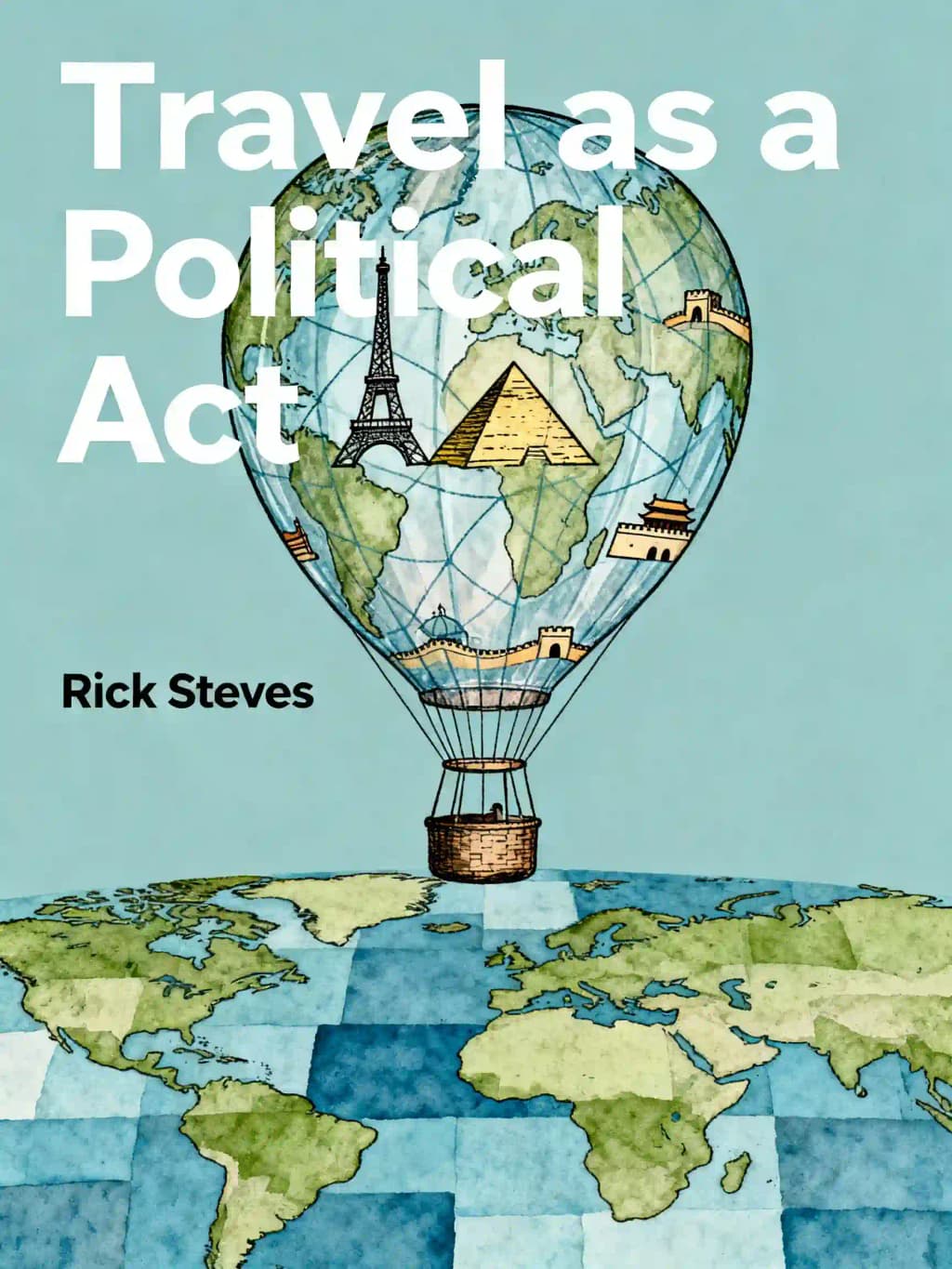
Travel As a Political Act
Overview of Travel As a Political Act
Discover how travel transforms perspectives in Rick Steves' thought-provoking manifesto. Beyond sightseeing, this 4.09-rated cultural guide challenges readers to engage deeply with local communities. All royalties support Bread for the World - would you dare to travel beyond your comfort zone?

Key Themes in Travel As a Political Act
- cross-cultural empathy
- global citizenship
- challenging cultural assumptions
- peace through tourism
- comparative social values
Quotes from Travel As a Political Act
Travel challenges truths we thought were self-evident.
We must decide to become cultural chameleons.
The actual risk of terrorism for American travelers is minuscule.
We often mistake fear for actual danger.
The lesson: take pluralism seriously.
Characters in Travel As a Political Act
- Rick StevesAuthor and travel philosopher
- Pero CarevicDubrovnik host and survivor of the 1991 siege
- AtaturkTurkish leader mentioned as a cultural icon
About the Author
About the Author of Travel As a Political Act
Rick Steves, bestselling author of Travel as a Political Act and America’s foremost authority on European travel, combines his decades of exploration with a mission to promote cultural understanding through immersive experiences.
A University of Washington graduate in European history and business, Steves transformed his passion for budget travel into a multimedia empire, including over 50 guidebooks like Europe Through the Back Door (now in its 39th edition), a long-running PBS series, and a tour company serving 30,000 travelers annually.
His work emphasizes the transformative power of travel to challenge perspectives and foster global citizenship, themes central to Travel as a Political Act. Known for his accessible tone and advocacy for thoughtful tourism, Steves’ insights reach millions through his public television shows, radio podcasts, and Edmonds-based travel center.
His guidebooks dominate the U.S. travel market, with translations available in seven languages, solidifying his reputation as a trusted voice in culturally conscious exploration.
Download Summary of Travel As a Political Act
Get the Travel As a Political Act summary as a free PDF or EPUB. Print it or read offline anytime.
FAQs About This Book
Travel as a Political Act argues that thoughtful travel fosters global understanding and combats xenophobia by immersing travelers in diverse cultures. Rick Steves shares stories from Europe, Central America, Asia, and the Middle East, urging readers to view foreign experiences as tools for reevaluating their own societal norms. The book emphasizes how travel can address modern challenges like climate change and nationalism by broadening perspectives.
This book suits travelers seeking meaningful cultural engagement, socially conscious readers interested in global issues, and anyone reevaluating their worldview. Steves targets Americans open to challenging ethnocentric biases through immersive travel experiences. Its blend of personal anecdotes and political commentary appeals to fans of ethical tourism and cross-cultural dialogue.
Yes, for its unique blend of travel guidance and political advocacy. While some sections include platitudes about cultural openness, Steves delivers actionable insights on overcoming fear-driven narratives and engaging with contentious global topics. Critics praise its timeliness in addressing polarization, though readers seeking pure travel tips may find its ideological focus unconventional.
- Cultural humility: Steves advocates learning from local perspectives rather than imposing outsider judgments.
- Confronting fear: He disputes exaggerated travel risks, calling fear "for people who don’t get out much".
- Political engagement: Travel becomes activism by supporting ethical economies and humanizing "othered" communities.
Unlike his traditional guidebooks like Europe Through the Back Door, this work prioritizes ideological exploration over logistical travel advice. It expands on themes from his TV series by linking cultural immersion to societal change, offering a philosophical counterpart to his practical itineraries.
Some reviewers note occasional oversimplification of complex geopolitical issues and repetitive calls for open-mindedness. However, most praise Steves for balancing optimism with realism—acknowledging challenges like Iran’s "sinister side" while highlighting its people’s hospitality.
Steves frames travel as a counterforce to isolationist policies by fostering empathy across borders. He argues experiencing environmental practices abroad (e.g., Europe’s green cities) can inspire sustainable activism at home, while cultural exchanges diminish "us vs. them" mentalities.
- “Fear is for people who don’t get out much”: Challenges risk-averse travel myths.
- “The most beautiful souvenir… a broader perspective”: Summarizes the book’s core thesis.
- “Travel wallops ethnocentricity”: Advocates humility through cultural contrasts.
Amid rising global tensions and climate crises, Steves’ message counters divisive rhetoric by demonstrating how interpersonal connections during travel can bridge ideological divides. Updated chapters on Ethiopia and Guatemala reinforce its urgency.
Drawing on 50+ years guiding tours and writing guidebooks, Steves blends firsthand anecdotes with historical context. His Edmonds-based business roots and advocacy for experiential learning inform the book’s practical-yet-idealistic tone.
Case studies include post-Iranian Revolution cultural insights, Central American economic solidarity tours, and European models of social welfare. Newer editions add perspectives from Ethiopia’s highlands and Guatemala’s Indigenous communities.
Steves encourages supporting immigrant-owned businesses, engaging politically after returning home, and questioning media narratives about “dangerous” regions. The book transforms travel from leisure into a tool for grassroots global citizenship.