Kapitel 1
Rethinking Our Relationship with Children
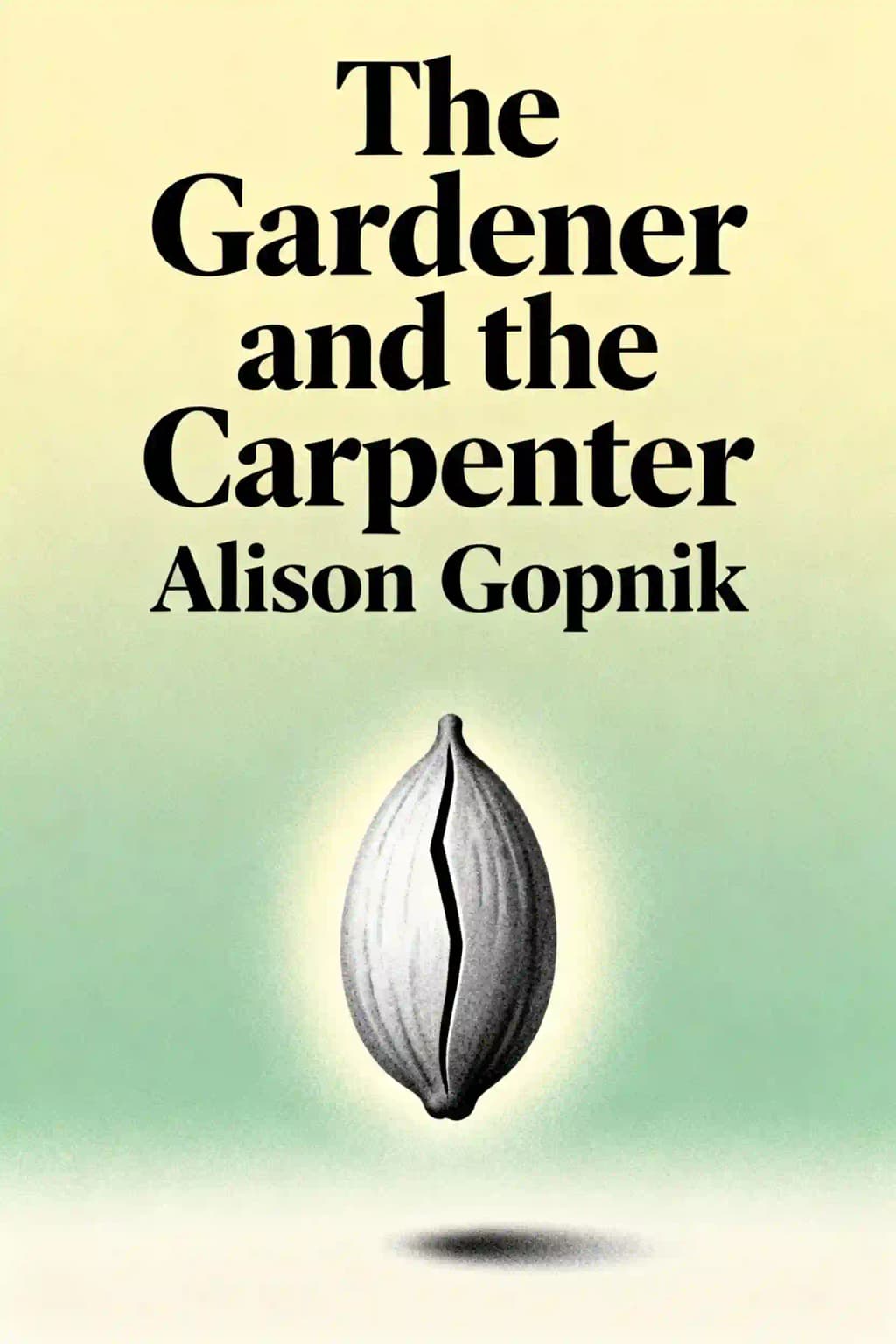
Imagine a world where parenting isn't about shaping children into predetermined adults, but rather creating fertile soil for them to flourish in unexpected ways. This revolutionary perspective forms the heart of developmental psychologist Alison Gopnik's "The Gardener and the Carpenter," a book that has fundamentally transformed how we understand childhood and caregiving. Since its 2016 publication, the book has become required reading in psychology programs nationwide and sparked fierce debates among parents caught between traditional authority-based parenting and permissive approaches. Gopnik's work has influenced prominent figures from tech innovator Melinda Gates to filmmaker Ken Burns, who cited the book as inspiration for his documentary on childhood development. What makes this work particularly compelling is how it marries cutting-edge science with ancient wisdom, challenging our modern obsession with parenting as a technical skill while offering a more profound alternative.
Kapitel 2
The Parenting Paradox: When Love Becomes Work
The word "parenting" first appeared in America in 1958 and only became common in the 1970s. This linguistic shift reflects a profound change in how we view our relationship with children. The modern middle-class approach treats raising children as goal-directed work aimed at producing successful adults-what Gopnik calls the "carpenter" model, where parents attempt to shape raw material into a predetermined final product.
This transformation coincided with significant social changes: smaller families, greater mobility, and older first-time parents. Throughout most of human history, people grew up in large extended families with many children, gaining extensive childcare experience before having their own. They observed not just parents but grandparents, aunts, uncles, and cousins caring for children. As these traditional sources of wisdom disappeared, parenting guides emerged to fill the gap.
The irony is striking: America, the epicenter of parenting expertise, provides less institutional support for children than any other developed country, with the highest rates of infant mortality and child poverty in the developed world. The parenting industry promises expertise through countless how-to books, fueling parental guilt and forcing impossible choices between career and family.
This approach has made life worse for both children and parents. Parents experience unprecedented anxiety and guilt, while children suffer under hovering expectations. Like the shift from cooking traditions to nutrition science, parenting represents a transformation from experience to expertise, from spontaneous care to management plans. And just as diet books proliferated alongside obesity rates, the abundance of parenting books signals their collective ineffectiveness.
From an evolutionary perspective, parent-child relationships define us as humans, but parents aren't designed to shape children's lives. Rather, they provide protected spaces where children can develop new ways of thinking and acting. While parents deeply influence children by providing stability and care, there's little evidence that specific parenting decisions reliably determine adult outcomes.
Kapitel 3
The Evolutionary Purpose of Childhood's Mess
Why invest so much in raising children if specific caregiving approaches don't determine outcomes? The answer lies in disorder. Children are inherently messy, and this messiness-what scientists call variability, stochasticity, or randomness-has profound evolutionary value.
Evolution itself demonstrates the merits of mess. Random biological variation leads to adaptation, and some species have evolved "evolvability"-the ability to generate varied individuals. Humans produce particularly diverse children, each with unique temperaments and abilities, allowing our species to adapt to unpredictable environments.
For example, having both risk-taking and cautious children benefits humanity as a species. Conservative strategies work best in stable times, while risk-taking becomes crucial during change. By producing varied children, humans ensure survival across different circumstances.
This evolutionary strategy creates an inherent tension between exploration and exploitation. Computer scientists recognize this trade-off: exploring possibilities enables innovation and adaptation, but you must also act decisively in your current environment. One solution is alternating between exploration and exploitation periods-particularly effective is starting with exploration before moving to exploitation.
But how do you survive while exploring? The answer: childhood. Protected childhood allows exploration; adulthood enables exploitation. Caregiving and childhood are two sides of the same coin-children need care to explore safely.
Humans are uniquely exploratory, adapting to diverse environments and creating new ones through imagination and creativity. It's no coincidence we have the longest childhood of any species-this extended period of protected immaturity gives us time to explore. Children's messiness contributes directly to human evolvability, with variability and exploration peaking during childhood.
Young brains are physically designed for exploration-having twice as many neural connections as adult brains, with greater plasticity but weaker links. As we age, frequently used connections strengthen while unused ones disappear-young brains explore; old brains exploit.
Each generation of children represents noise and disorder that shakes up established patterns, creating new possibilities. This reframes parenthood-being a parent differs fundamentally from "parenting." Our unconditional commitment to each child, regardless of temperament, allows for continued variation. This dedicated love gives children space to be intellectually messy, to explore before exploiting, to let their ideas rather than themselves face elimination.
Kapitel 4
The Evolutionary Origins of Human Childhood
The traditional image of human evolution-primitive men hunting mammoths-contrasts sharply with a more accurate picture: a grandmother taking her toddler grandson to a farmers' market. The boy charms everyone he meets, explores his surroundings, tastes new foods, responds to music, and interacts with multiple caregivers.
Recent anthropology suggests this second scene better captures our evolutionary past. While hunting mattered, our most significant evolutionary changes likely involved relationships between caregivers and babies rather than hunters and prey. Extractive foraging-finding ingenious ways to access food sources-may have contributed as much to human success as hunting. Equally important was sharing that food with helpless young and teaching them which foods to seek or avoid.
Human childhood is substantially longer than our closest primate relatives-chimps are mobile by 3-4 months and sexually mature by 8-9 years, while humans typically don't have babies until around 18. We're dependent for at least 1.5 times longer than chimps, with forager children not providing as much food as they consume until about age 15.
This extended childhood correlates with larger brains, greater intelligence, and increased learning abilities. Like "altricial" birds such as crows and parrots (who are exceptionally intelligent but take longer to become independent), humans invest enormous energy in our young while they develop complex skills. Our brains are most active and energy-hungry in early childhood, with a four-year-old using 66% of their calories for brain development.
Our specially evolved learning abilities are not like specific "modules" or a Swiss Army knife with specialized tools, but more like a flexible hand capable of doing many things. The human child's mind, working with caregivers, is the most powerful learning device in the universe. Broad learning abilities led to better methods for cooking, foraging, hunting, and nurturing children.
Learning creates feedback loops where small advantages snowball across generations-children who learn tools better have more tools, which helps them raise children who learn even more tools. But progress requires innovation, not just imitation.
Humans evolved to adapt to change itself-unpredictable climate variations, nomadic lifestyles that exposed us to new environments, and shifting social structures from foraging to agriculture to industrialization. The key adaptation was variability itself. By allowing natural variation in children's temperaments, development, and learning, and by exposing them to diverse caregivers with different skills, we increased our chances of survival in changing environments.
Kapitel 5
The Triple Threat of Human Care
Our human love for children is distinctively shaped by our evolutionary history and informs other kinds of human love. Unlike other primates, humans have a "care triple threat": pair-bonding between adults who jointly raise children, grandmothering by females who live past menopause to care for their grandchildren, and alloparenting where we care for children who aren't our own.
Human pair-bonding is distinctive among mammals, shared with only about 5% of species. It correlates strongly with paternal investment-fathers helping care for babies. Our evolution shows physical evidence of this shift: compared to other great apes, human males have smaller testicles, less size difference between sexes, and different finger-length ratios.
The biology of bonding shows fascinating connections between parental and partner love. In prairie voles, high levels of oxytocin and vasopressin enable pair-bonding, unlike their promiscuous meadow vole relatives. In humans, oxytocin relates to trust, commitment, and attachment, with women experiencing floods of it during labor. Importantly, caring behaviors themselves produce these chemicals, creating positive feedback loops of affection.
Human menopause presents an evolutionary riddle. From an evolutionary perspective, it's unusual that women live decades beyond their reproductive years-a trait shared only with killer whales among mammals. The "grandmother hypothesis" proposed by Kristen Hawkes suggests that grandmothers contributed substantially to early human children's welfare, making menopause evolutionarily advantageous. Her detailed studies of forager groups show grandmothers may contribute more high-calorie food than hunters through "extractive foraging" of nuts and honey.
Beyond material contributions, grandmothers provide intellectual resources, child-rearing experience, and practical advice. They also serve as cultural repositories, connecting children to generations of knowledge through songs, stories, and traditions.
Humans are designed to care for children even when they aren't related to them. Sarah Blaffer Hrdy argues human evolution involved a move toward "cooperative breeding" with "alloparents"-other people taking on child care responsibilities. In contemporary foraging societies, the "village" includes older siblings, cousins, aunts, and even other mothers who sometimes breast-feed each other's babies.
The paradox of loving children lies in our unconditional commitment to particular individuals regardless of their traits or challenges. This specificity seems counterintuitive-why love just this baby and not all babies? This seemingly irrational commitment may reflect an evolutionary strategy addressing the "prisoner's dilemma"-how can altruism emerge when self-interest seems more rational?
Kapitel 6
Learning Through Observation: The Art of Imitation
As Wordsworth observed, even the youngest children mimic the most trivial details of adult behavior. This imitation is particularly significant for cultural evolution. Children don't just superficially copy actions; they demonstrate deep understanding of the purpose and meaning behind those actions.
While imitation might seem like a simple, automatic process, the popular "mirror neuron" explanation is misleading. These neurons fire both when an animal acts and when it observes similar actions, but they cannot explain complex human behaviors like imitation, empathy, and language.
Imitation helps children learn two crucial things: how objects work and how people work. Human evolutionary advantage came from mastering physical tools and psychological tools-both requiring causal knowledge.
In experiments with 24-month-olds, children showed sophisticated imitation abilities. When shown a toy car that made another toy light up when bumped against one box but not another, toddlers immediately imitated the effective action, not the ineffective one. Remarkably, they wouldn't learn the same cause-effect relationship when the car moved by itself without human action.
Children imitate intentional actions, not accidental ones. They reproduce what actors want to accomplish rather than exact movements. Eighteen-month-olds seeing someone use their head to activate a box (because their hands were wrapped) will use their own hands instead-understanding the goal rather than mimicking the specific action.
Sometimes children actually outperform adults at learning. In "blicket detector" experiments, four-year-olds remained open to multiple possibilities when presented with ambiguous evidence, while Berkeley undergraduates stubbornly stuck with the obvious explanation even when shown contradictory evidence.
This reflects a fundamental difference between children and adults. Children excel at considering unlikely possibilities, while adults rely heavily on prior knowledge. It's the "explore" versus "exploit" tension-children naturally explore weird and wonderful options while adults efficiently stick with what's most likely to work right now.
While children can be remarkably efficient learners, they also "overimitate"-copying unnecessary actions adults perform. This isn't mindless copying but sophisticated social learning. When experimenters presented themselves as experts versus clueless, children only overimitated the expert. By default, children assume adults are teaching them something important, even when the actions seem unnecessary.
This sensitivity makes perfect sense in the context of rituals-actions that serve social rather than practical functions. From tea ceremonies to wedding customs, rituals don't make ordinary causal sense but communicate identity and group membership. Even very young children recognize rituals and meticulously reproduce every detail.
Kapitel 7
The Power of Language and Stories in Children's Learning
While many animals learn through trial and error, and some smart species like crows and primates learn through observation, humans have a uniquely powerful additional learning method: language. Through listening, reading, and screens, we learn about things too distant, large, small, or ancient to observe directly.
Recent research explores how children decide whom to trust when learning from others' testimony. When presented with conflicting information-like two people calling an unusual object by different names-toddlers under two typically trust familiar caregivers over strangers.
Remarkably, children's specific attachment relationships influence these trust decisions. Four-year-olds who had been secure babies trusted their mothers over strangers when either could be right, but trusted strangers when they were likely more accurate. Formerly avoidant children trusted strangers and mothers equally, while formerly anxious children trusted mothers even when they were likely wrong.
As children develop, they become increasingly sophisticated in evaluating testimony. Three-year-olds can detect confidence, preferring information from speakers who sound more certain. Four-year-olds consider knowledge, trusting informed speakers over ignorant ones. By five, children recognize domain expertise, preferring doctors on medical matters and engineers on mechanical ones.
Children learn not just about the real world through listening, but also about fictional and magical realms. Storytelling appears to be a fundamental human activity. Despite the bewildering mix of reality and fantasy in children's literature-from familiar cats and dogs to talking rabbits in blue jackets-even young children distinguish between fact and fiction remarkably well.
The endless "why" questions from three-year-olds aren't just attention-seeking behavior-recent studies confirm children genuinely want answers and explanations. Children don't just passively absorb information; they actively solicit it and make fine discriminations based on how people communicate. Preschoolers ask nearly seventy-five questions per hour-hundreds of thousands in their early years.
Why questions are particularly challenging to answer well, yet they serve a crucial purpose. Tania Lombrozo argues that "why" questions help children understand the world more deeply by uncovering causal relationships. Good explanations connect particular events to broader patterns, enabling children to draw conclusions about new situations.
Children develop "essentialism"-the tendency to view categories as deep, innate, and permanent-from surprisingly subtle language cues. Even preschoolers believe natural categories have invisible essences that remain constant despite surface changes. Language patterns, especially "generic" statements like "Birds fly" or "Girls like dolls," powerfully reinforce essentialist thinking.
Kapitel 8
Play: The Serious Work of Childhood
Play presents a paradox-it's universally recognized as beneficial for children, yet by definition it's an activity without goals. If play makes children smarter or more focused, why not pursue those outcomes directly?
Five characteristics define play across species: it accomplishes nothing practical; it has distinctive patterns distinguishing it from real activities; it's fun and voluntary; it only happens when basic needs are met; and it follows a pattern of repetition with variation.
Rough-and-tumble play creates parenting dilemmas, especially for those with nonviolent values watching their children seemingly "beat the hell out of one another." Yet science supports children's intuition that such play signifies friendship. In humans, early roughhousing correlates with better social competence later on.
Young rats also engage in play-fighting, allowing scientists to systematically study how play influences brain development. Play-deprived rats can perform the same actions as play-experienced rats but lack the ability to respond appropriately in social contexts-they know the steps but can't master the dance. Rats that play develop different brain structures with greater plasticity, maintaining their ability to change even as adults.
Beyond rough-and-tumble social play, animals and children also play with objects. Even tiny babies explore new toys by mouthing, shaking, and manipulating them. Experiments show rats raised in "enriched" environments with many objects develop better brains-larger, with more connections and larger frontal areas-than those in sterile cages.
Human children play with gadgets in ways that function as structured experimentation. Laura Schulz's MIT studies show preschoolers systematically exploring new objects to understand their properties. Four-year-olds given Pop-Beads and a "blicket detector" would carefully pull beads apart to test which ones activated the machine. When beads were glued together, they ingeniously tested each end separately.
Children begin pretending around age one, with this activity peaking at three or four. Pretend play appears across all cultures, even where parents discourage it. Archaeological evidence shows children have been pretending for thousands of years with toys like dolls and miniature utensils.
Pretending connects to counterfactual thinking-considering alternative possibilities-which is central to human learning. In experiments, children who were better at pretending were also better at answering counterfactual questions, regardless of their general cognitive abilities.
While pretending doesn't necessarily improve academic skills, it significantly enhances children's understanding of other people's minds-what psychologists call "theory of mind." This ability to understand others' desires, perceptions, emotions, and beliefs develops dramatically between 18 months and five years. Children who pretend more, especially those with imaginary companions, perform better on false-belief tests that measure understanding of others' mental states.
Kapitel 9
From Exploration to Mastery: The Transformation of Learning
Children undergo a striking transformation around age six, shifting from the wild creativity of preschoolers to the sober rationality of eight-year-olds. While younger children's evolutionary task is wide exploration, school-age children begin mastering specific cultural skills, especially social ones, within the safety of adult care.
Historically, mastery learning occurred through apprenticeship rather than formal schooling. While preschoolers play at adult skills, school-age children begin genuinely mastering them through a distinctive cycle: watching masters, attempting simplified versions, receiving critique, and gradually tackling more complex elements.
This apprenticeship model often involves grueling practice-like the Zen swordsman story of Matajuro or the journalist learning news writing through harsh editorial rejection. Though demanding, this approach effectively builds mastery through repeated practice and expert feedback.
Ironically, modern schools often relegate apprenticeship-style learning to "extracurricular" activities like sports and music, while academic subjects are taught through abstract instruction. This disconnect explains why many children excel at athletics but struggle with academics-they're experiencing fundamentally different learning approaches.
Schools emerged with the industrial revolution to teach technical skills like reading, writing and arithmetic-artificial but necessary abilities that enable broader learning. The challenge lies in leveraging children's natural learning capacities to master these unnatural skills.
Children naturally exhibit wide variation in temperaments, interests and abilities-an evolutionary advantage that creates flexibility and robustness in communities. Yet schooling treats this variability as a disadvantage, even pathologizing children who don't fit institutional demands.
School demands extreme forms of focused attention that many children struggle to develop. In the past two decades, ADHD diagnoses have nearly doubled, with one in five American boys diagnosed by seventeen and millions receiving medication. Research revealed a direct link between the introduction of high-stakes testing policies and dramatic increases in ADHD diagnoses, particularly among poor children in public schools.
Some of childhood's most crucial learning happens outside classrooms-during lunch, recess, and bus rides-as children transition from caregiver-centered lives to peer-centered ones. School-age children transform from the "family romance" of their preschool years to the cooperative social networks that will dominate adult life. Their play shifts from exploring individual minds to organizing social groups through games with rules.
Kapitel 10
Children and Technology: Beyond Fear and Nostalgia
The chapter opens with a parable about "the Device"-seemingly a cautionary tale about modern technology addiction, but revealed to be about books. This clever misdirection introduces parental concerns about how new technologies like smartphones, social media, and the internet will affect children's minds.
Reading demonstrates how humans adapt to technological innovation. Though our brains didn't evolve to read, we've repurposed brain areas designed for other functions to process written language. The shapes of letters mirror the patterns primates use to recognize objects, with "T" shapes indicating object edges that monkeys might grab.
Socrates actually feared writing would destroy memory and critical dialogue-and he was right about those specific changes, though most would agree the benefits outweighed the drawbacks. Importantly, new media reshape but rarely eliminate older forms of communication.
We're witnessing another dramatic technological shift as screens replace pages. Children learn to navigate smartphones before they can read printed words. These digital native brains will develop differently from ours, just as reading brains differ from illiterate ones. But predicting these changes is difficult-technologies that truly reshape society are often met with exaggerated anxiety before becoming mundane parts of life.
Adults and children experience technological change differently. For adults, the internet feels fragmented because learning new technology requires conscious, effortful attention-our prefrontal cortex controls limited cholinergic transmitters that help us learn. Young brains work differently, with widespread cholinergic transmitters that don't depend on deliberate attention. Children naturally learn from everything new and surprising.
Many effects attributed to technology are minor variations magnified by our perception. Danah Boyd's research shows teenagers use social media to do what adolescents have always done: establish peer communities, distance from parents, flirt, gossip, and rebel. They turn to virtual spaces partly because physical spaces like lover's lanes are less accessible in modern suburbs.
The truly transformative aspect of the internet may be how it expands our social circle beyond the roughly hundred people our psychology evolved to handle. While city dwellers learned to ignore strangers physically, the web connects us to millions without providing equivalent filtering mechanisms. We're using village psychology to navigate planetary connections.
Technology exemplifies the central paradoxes of parenting: providing children stability while accepting we can't control their futures. The cultural ratchet depends on both tradition and innovation. As caregivers, we create structured environments that allow children to be unpredictable and transformative. We pass on our traditions precisely so children can adapt them for their own time.
Kapitel 11
The Gardener's Wisdom: A New Vision of Caregiving
The best metaphor for understanding our relationship to children is an old one: caring for children is like tending a garden, and being a parent is like being a gardener.
In the parenting model, being a parent resembles carpentry-shaping material into a predetermined final product, with success measured by precision and control. But gardening creates a protected space for plants to flourish despite inevitable frustrations and surprises. Our greatest horticultural triumphs come when gardens escape our control-when plants unexpectedly thrive in unplanned places.
A good gardener creates fertile soil sustaining an ecosystem of diverse plants with different strengths and weaknesses. Unlike a chair, a garden constantly changes with circumstances. This varied, flexible system proves more robust than the most carefully tended hothouse bloom.
Gardening involves heartbreak, but the only garden without risk would be artificial. Our job as parents isn't to shape specific kinds of children but to provide protected spaces of love and stability where unpredictable kinds of children can flourish-not telling them how to play but giving them toys; not making them learn but letting them learn.
From an evolutionary perspective, consciously trying to shape children is both futile and counterproductive. We can't know what unprecedented challenges future generations will face, so molding children in our current image might prevent adaptation.
The evolutionary picture of child-caregiver relationships differs dramatically from the "parenting" model. Humans evolved adaptations leading a wider range of adults to care for children: pair-bonding, grandmothering, and alloparenting. These relationships emerge from the act of caring itself.
These adaptations created new emotional connections not just between adults and children, but among all caregivers. These emotions involve striking specificity and deep, long-term commitment.
This emotional reality contradicts the parenting picture. If parenting aimed to shape a particular kind of child, we wouldn't focus exclusively on just our child. If our goal were producing specific kinds of adults, we'd simply find children most likely to become such adults and train them. What makes us love a child isn't something about the child-it's something about us. We don't care for children because we love them; we love them because we care for them.