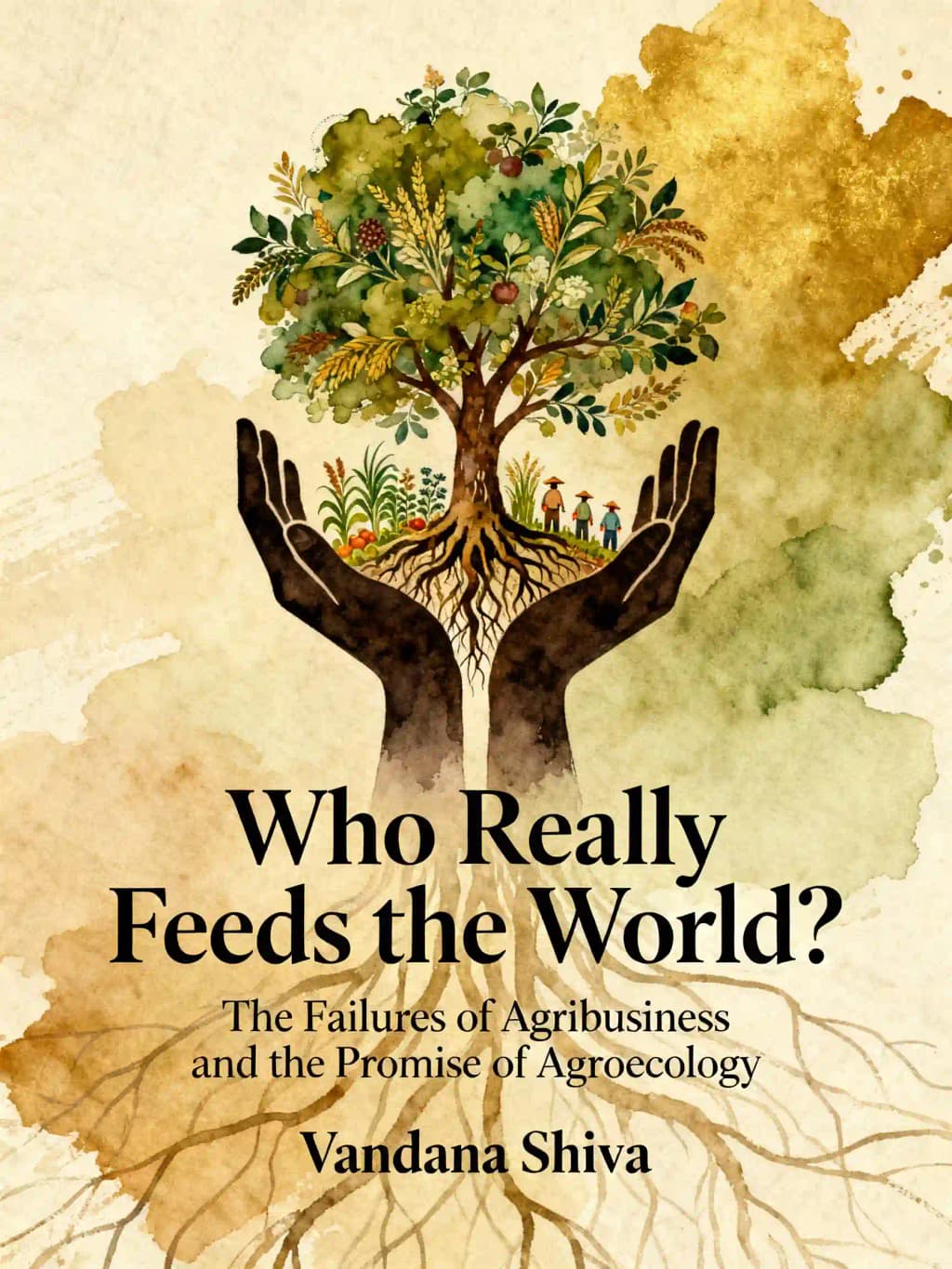
Who Really Feeds the World?
The Failures of Agribusiness and the Promise of Agroecology
Overview of Who Really Feeds the World?
Vandana Shiva's revolutionary manifesto exposes how corporate agriculture fails humanity while small farmers - primarily women - actually feed 70% of the world. Endorsed by environmental leaders and sparking global seed-saving movements, this book reveals the shocking truth about who controls your dinner.

Key Themes in Who Really Feeds the World?
- agroecological farming
- corporate food monopoly
- seed sovereignty
- industrial agriculture critique
- soil biodiversity preservation
Quotes from Who Really Feeds the World?
Soil isn't just dirt-it's a complex living system.
No technology that destroys soil life can truly feed the world.
One in every four mouthfuls of food depends on pollinators.
After World War I, explosives manufacturers repurposed their nitrogen fixation facilities.
Characters in Who Really Feeds the World?
- Vandana ShivaAuthor, physicist, and environmental activist
- Sir Albert HowardFather of organic farming and agricultural expert
- Dr. John Augustus VoelckerColonial expert who studied Indian farming systems
About the Author
About the Author of Who Really Feeds the World?
Vandana Shiva, an acclaimed environmental activist and physicist, is the author of Who Really Feeds the World? The Failures of Agribusiness and the Promise of Agroecology, a pivotal work in sustainable agriculture and food sovereignty. Shiva is a leader in ecological ethics and anti-GMO advocacy, holding a Ph.D. in the philosophy of science. She founded Navdanya, a movement championing biodiversity and organic farming.
Her career spans decades of grassroots activism, including involvement in the Chipko forest conservation movement. Shiva's expertise shapes global dialogues on climate justice and agroecology. Notable for works such as Staying Alive and Soil Not Oil, Shiva critiques industrial agriculture while promoting regenerative practices.
She serves on the International Forum on Globalization and has received the Right Livelihood Award (“Alternative Nobel Prize”) and the Sydney Peace Prize. Her insights have been featured in Time and TED Talks, underscoring the urgency of transitioning to equitable food systems. Translated into over 20 languages, her books redefine environmental stewardship, with Who Really Feeds the World? hailed as a manifesto for small farmers and ecological resilience.
Download Summary of Who Really Feeds the World?
Get the Who Really Feeds the World? summary as a free PDF or EPUB. Print it or read offline anytime.
FAQs About This Book
Who Really Feeds the World? critiques industrial agribusiness for exacerbating hunger and environmental harm, arguing that agroecology—a system prioritizing biodiversity, small-scale farming, and ecological balance—offers a sustainable solution. Vandana Shiva highlights the role of seed diversity, women’s contributions to food production, and the failures of chemical-dependent monocultures.
This book is essential for environmentalists, policymakers, farmers, and anyone interested in food justice or sustainable agriculture. It appeals to readers seeking alternatives to corporate-driven farming models and those concerned about climate change, biodiversity loss, and equitable food systems.
Yes—Shiva’s decades of research and activism provide a compelling case for reimagining food production. While some critique the book’s repetitive style, its insights into agroecology’s potential to address hunger and ecological crises make it a vital read for understanding global food challenges.
Agroecology emphasizes farming in harmony with ecosystems, using biodiversity, traditional knowledge, and localized systems. Unlike industrial agriculture, which relies on monocultures, synthetic chemicals, and genetic modification, agroecology prioritizes soil health, small farmers, and equity.
Shiva argues women are central to food security, as they historically steward seed diversity, manage small farms, and uphold traditional agricultural practices. Industrial agribusiness often marginalizes their contributions, exacerbating inequality and ecological damage.
The book condemns the Green Revolution for promoting chemical fertilizers, patented seeds, and monocultures, which degraded soils, reduced biodiversity, and trapped farmers in debt. Shiva advocates returning to Indigenous practices and seed sovereignty to rebuild resilient food systems.
Seed saving preserves genetic diversity and empowers farmers to avoid corporate-controlled GMOs. Shiva links seed sovereignty to food security, arguing that agroecology depends on open-pollinated, locally adapted seeds rather than patented varieties.
Shiva opposes GMOs, stating they intensify corporate control over agriculture, harm biodiversity, and fail to address hunger. She argues GMOs prioritize profit over ecological health and often worsen farmers’ economic vulnerability.
Some readers find the book repetitive or overly ideological, while others question its data presentation. However, its core arguments—advocating agroecology and condemning industrial agriculture—are widely praised for their clarity and urgency.
Industrial agriculture’s reliance on fossil fuels, deforestation, and synthetic chemicals exacerbates climate change, Shiva argues. Agroecology reduces emissions by enhancing soil carbon, eliminating chemical inputs, and decentralizing food production.
The book advocates transitioning to agroecology, supporting small farmers, preserving seed diversity, and localizing food systems. Shiva stresses policy shifts to prioritize ecological health over corporate profits.
Like Soil Not Oil and Earth Democracy, this book ties ecological justice to systemic change. However, Who Really Feeds the World? specifically targets industrial agriculture’s failures, offering agroecology as a tangible alternative.