Kapitel 1
When Sight Becomes Blindness, What Do We See?
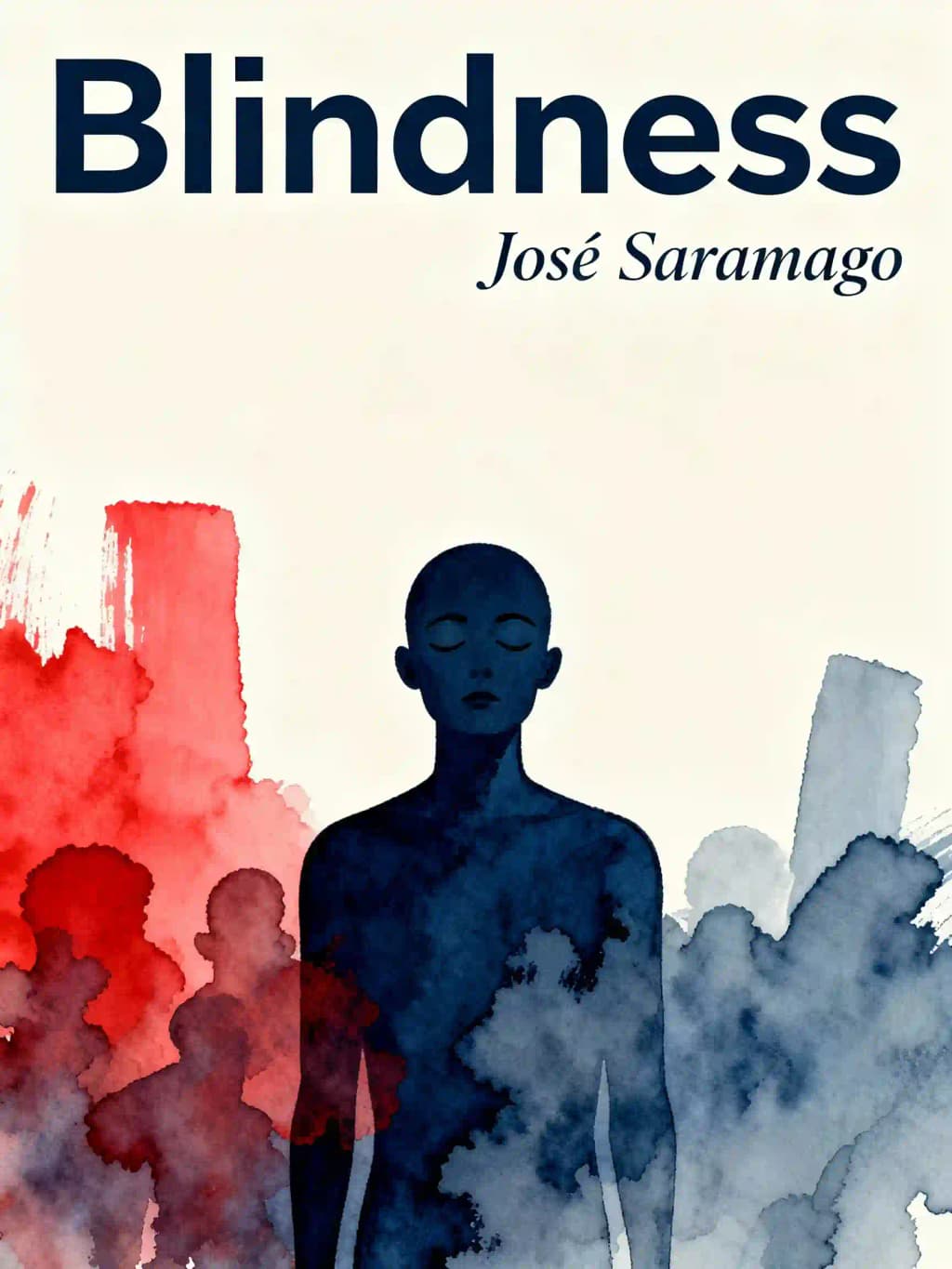
What if you suddenly went blind, not in darkness, but in a sea of milky whiteness? Jose Saramago's "Blindness" takes us into this terrifying scenario, exploring humanity's fragility when stripped of vision. This Nobel Prize-winning novel has captivated millions since its 1995 publication, including celebrities like David Bowie who cited it as one of his favorite books. The allegorical tale transcends mere storytelling, becoming a profound meditation on society's moral blindness even when physically able to see. Saramago's distinctive style-long paragraphs without quotation marks or traditional dialogue breaks-creates an immersive experience that mirrors the disorientation of his characters. The book's cultural impact has been immense, inspiring Fernando Meirelles' 2008 film adaptation and countless academic analyses examining its relevance to social collapse, moral responsibility, and human resilience in crisis.
Kapitel 2
The First Wave: When Blindness Strikes
It begins with a traffic light. A man sits in his car, waiting for the green signal when suddenly he's plunged into what he describes as a "milky sea" of whiteness. This isn't the darkness we associate with blindness but rather an overwhelming, impenetrable whiteness - like being submerged in a luminous fog that obscures everything. A good Samaritan-who will later steal his car-helps him home, where he stumbles around his apartment, breaking a vase and cutting himself before collapsing in exhaustion. His movements become tentative, his hands outstretched like fragile antennae seeking safe passage through a suddenly hostile environment.
This strange "white blindness" spreads with terrifying speed, moving through the city like an invisible tide. The car thief goes blind after walking just thirty paces from the stolen vehicle, karma striking with swift and ironic justice. An ophthalmologist examining the first blind man's case finds nothing physically wrong with his eyes - no retinal damage, no optic nerve issues, nothing to explain the complete loss of vision - yet by nightfall, the doctor himself succumbs to the mysterious condition. A girl with dark glasses at a hotel tryst, a hotel maid cleaning rooms, a pharmacist's assistant counting pills - one by one, ordinary people engaged in mundane daily activities find themselves suddenly engulfed in whiteness, their routines shattered by this inexplicable affliction.
What makes this epidemic particularly insidious is its invisibility and the panic it generates. Those affected show no physical symptoms - their eyes appear perfectly normal under examination, the pupils react to light, the corneas remain clear. Yet the blindness proves highly contagious, spreading through mere proximity or visual contact, like a visual virus that infects through the act of seeing itself. It's as if seeing someone with the condition condemns you to join them in their white prison, creating a cascade of blindness that ripples through the population with devastating efficiency.
The psychological impact is immediate and profound. The characters struggle with fundamental questions about identity and self as they're stripped of their visual connection to the world. The first blind man's embarrassment and disorientation manifests in small, heartbreaking ways - his inability to find his own bathroom, the shame of spilling food down his shirt. The doctor's professional devastation comes not just from his own blindness but from watching his ability to heal others slip away. The car thief's immediate punishment for his moral transgression serves as a stark metaphor for justice, while also highlighting how quickly society's moral framework can unravel in the face of catastrophe.
As the epidemic spreads, we witness the dissolution of social order through the eyes of those who can no longer see. Each new case adds another layer to the mounting crisis, transforming a personal tragedy into a collective nightmare that threatens to engulf the entire city in its brilliant white void.
Kapitel 3
Quarantine: The Asylum Experiment
The government's response to the epidemic is swift and brutal. The Minister of Health, fearing uncontrollable contagion, orders all the blind and those who've had contact with them to be quarantined in an abandoned mental asylum. "Like ships during cholera outbreaks forced to remain at sea for forty days," the infected are isolated "until further notice"-a deliberately vague timeframe that could mean forty days or forty years.
The asylum becomes a microcosm of society under extreme pressure. Two wings separate the confirmed blind from those merely exposed, with armed soldiers guarding the perimeter and delivering meager food rations. The doctor and his wife-who has feigned blindness to stay with her husband-are among the first arrivals. They find themselves in a building with peeling gray paint, filthy latrines, and a kitchen reeking of bad cooking. The doctor's wife, secretly still sighted, becomes our witness to the degradation that follows.
As more blind people arrive, the asylum fills with confusion and despair. The inmates develop systems to locate their beds, distribute food, and maintain some semblance of order. "Unless we organize ourselves in earnest," one woman insists, "hunger and fear will take over here." Her prophecy proves tragically accurate as conditions deteriorate rapidly.
The asylum becomes a laboratory revealing how quickly social structures collapse when basic needs go unmet. Without functioning plumbing, the latrines become unusable cesspools. Without cleaning supplies, filth accumulates everywhere. Without adequate food, tensions rise over distribution. The inmates struggle to maintain their humanity while surrounded by mounting evidence of their animal nature.
Isn't this what we fear most about disaster-not just physical suffering, but the dissolution of the social contract? The asylum scenes force us to confront uncomfortable questions about how thin the veneer of civilization might be. When the basic structures of society disappear, what remains of our humanity? The doctor's wife tries to preserve dignity through organization: "If we cannot live entirely like human beings, at least let us do everything in our power not to live entirely like animals."
Kapitel 4
Power and Exploitation: The Tyranny of the Blind
Within this confined space, a new social order emerges-one based on raw power rather than moral authority. A group of blind thugs, led by a man with a gun, seizes control of the food supply. They establish themselves in Ward Three, strategically positioning themselves between the food storage and other wards. They first demand payment in valuables-money, jewelry, watches-for distributing rations, creating an artificial economy based on extortion. When these material resources are exhausted, they make a more horrifying demand: "Bring us women."
This moment marks the asylum's complete moral collapse, revealing how quickly civilized behavior can deteriorate under extreme circumstances. The wards debate this degrading ultimatum in hushed, shame-filled conversations. Some men, driven by hunger and desperation, shamefully suggest women should volunteer for everyone's survival, while others protest but offer no alternative solutions. A woman asks pointedly what the men would do if the thugs had demanded male bodies instead. The silence that follows speaks volumes about gendered power dynamics that persist even in blindness, highlighting how crisis situations often amplify existing social inequalities.
The systematic exploitation unfolds with disturbing efficiency. Women from each ward are forced to walk the dark corridors to the thugs' quarters, where they endure systematic rape and humiliation. The doctor's wife, cursed with sight, witnesses these atrocities but initially feels paralyzed by the weight of her secret ability. One woman dies from the brutality, while others return traumatized but forge a silent solidarity, supporting each other through their shared suffering. Their resilience becomes both a source of strength and a damning indictment of their circumstances.
The power structure in the asylum reveals uncomfortable truths about human nature and institutional breakdown. Those with weapons control those without; those willing to exploit others gain advantage over those constrained by moral boundaries. Yet Saramago doesn't present this as inevitable-rather, he shows how specific circumstances - isolation, scarcity, fear, and the breakdown of social order - enable tyranny to flourish. The asylum becomes a microcosm of larger societal failures.
The thugs' organization is particularly chilling in its methodical approach. They develop detailed rotation systems, keeping meticulous records (remarkably in braille), and establishing rules for their criminal enterprise. Their administrative efficiency mirrors historical atrocities where bureaucracy facilitated mass suffering. They maintain a "perverse sense of order," carefully tracking "what has been done and what remains to be done," demonstrating how systems of oppression often hide behind a facade of organization and procedure.
The doctor's wife, bearing the burden of sight, eventually takes decisive action. Using scissors she had secretly kept, she kills the thugs' leader, an act that is both morally complex and necessary for survival. This violence triggers a chain of events leading to the asylum's destruction by fire. When later questioned about the killing, she responds with simple, devastating clarity: "Someone had to do it, and there was no one else." Her actions raise questions about the nature of justice and the moral cost of resistance in extreme circumstances.
Kapitel 5
The Collapse of Civilization: A World Gone Blind
As the epidemic spreads beyond the asylum's walls, society crumbles with frightening speed and totality. The soldiers tasked with maintaining quarantine succumb to blindness themselves, abandoning their posts in panic and confusion. When a devastating fire erupts in the asylum - started by a desperate inmate trying to cook - the chaos provides an opportunity for escape. The inmates emerge into a world transformed beyond recognition, where blindness has become the universal condition, erasing the distinction between guards and prisoners, the powerful and the powerless.
The city they enter has devolved into a landscape of abandonment and decay. Streets have become labyrinths of crashed vehicles, their drivers having gone blind mid-journey, causing multi-car pileups that will never be cleared. Office buildings stand as hollow monuments to a defunct way of life, their computers still humming but useless without seeing eyes to read their screens. Hospitals have become places of heightened terror, with blind doctors feeling their way through corridors, unable to perform surgeries or even properly diagnose patients. Museums' priceless artifacts gather dust in darkness, their beauty rendered meaningless in a world without sight. The airwaves, once filled with news and entertainment, fall into eerie silence as radio personalities go blind during broadcasts, their final words trailing into confused silence.
The infrastructure of modern civilization collapses like dominoes. Power plants shut down as blind operators can no longer monitor crucial systems, plunging cities into darkness that now affects everyone equally. Water treatment facilities fail, leaving taps dry or trickling contaminated water. Without sanitation services, streets become open sewers. The stench becomes so overwhelming that people navigate by smell, learning to avoid the worst areas where waste has accumulated into toxic pools. Food distribution networks disintegrate entirely - supermarkets are stripped bare within days, their sophisticated supply chains rendered useless when truck drivers can no longer see the roads.
New social structures emerge from necessity, based on mutual survival rather than traditional bonds. Groups form organically, usually around those who can offer some practical skill - former nurses, those with good spatial memory, or individuals who've quickly adapted to navigating by sound. These groups establish territories in ground-floor commercial spaces, avoiding the death traps that multi-story buildings have become. The elderly and children, particularly vulnerable in this new world, are often adopted by these ad-hoc families. Some groups develop sophisticated systems of clicks and calls to identify members and warn of dangers.
The financial system's collapse reveals the fragility of abstract wealth. Banks become scenes of tragedy as people desperately try to withdraw money they can no longer see or count. Bank vaults, once symbols of security and wealth, become makeshift shelters for groups of the blind, who protect their territory with complex passwords and tactical signals, guarding worthless paper money and gold they can no longer spend. Some former bankers continue to recite exchange rates and stock prices in a futile attempt to maintain normalcy.
This catastrophic breakdown forces a stark realization about modern civilization's dependence on vision. Everything from written language to digital interfaces, traffic signals to agricultural systems, requires sight to function. Without it, humanity's most sophisticated achievements become useless or hazardous obstacles. The world's blind population must now navigate a built environment that has become actively hostile to their condition, forcing them to develop new ways of existing in spaces designed for a sense they no longer possess.
Kapitel 6
Survival Strategies: Finding Humanity in Darkness
Amid this collapse, the doctor's wife leads her small group-her husband, the first blind man and his wife, the girl with dark glasses, the old man with the black eyepatch, and the boy with the squint-in developing strategies for survival. They form a makeshift family bound by shared experience rather than blood.
Their physical formation while traveling-two rows of three people connected by knotted cloth strips-symbolizes their interdependence and adaptation. Unlike vulnerable single-file arrangements that could be broken by aggressive groups, this formation provides greater security. The doctor's wife carefully conceals her sight, ensuring she speaks "like a blind person" despite being able to see.
They establish a home base in the doctor's apartment, which miraculously remains locked and relatively clean. Their first night there becomes a ritual of restoration-removing filthy clothes, finding clean replacements, sharing a meager meal by lamplight, and drinking precious bottled water from crystal glasses. This ceremony of civilization amid chaos represents their refusal to surrender their humanity.
Water becomes particularly symbolic of renewal. When fierce rain falls, the women wash naked on the balcony, laughing "like children playing blind man's buff" as they embrace as "three graces beneath the falling rain." This cleansing ritual restores not just physical cleanliness but a sense of joy and connection that transcends their desperate circumstances.
Food gathering becomes the doctor's wife's primary responsibility, as she alone can navigate the city safely. She applies her grandmother's wisdom-"Keep what is of no use at the moment, and later you will find what you need"-collecting overlooked items like dried beans and chickpeas that require cooking but provide sustainable nutrition. Her foresight and adaptability keep the group alive when others starve.
The group develops rituals that preserve their connection to pre-blind civilization. The doctor's wife reads aloud from books, providing entertainment and intellectual stimulation. They maintain standards of cleanliness despite difficulties. They bury their dead with dignity rather than leaving bodies exposed. These acts of civilization amid barbarism define their resistance to complete degradation.
What's remarkable about their survival is how it depends on both practical adaptation and emotional connection. New relationships form-the girl with dark glasses and the old man with the black eyepatch become an unlikely couple, united by mutual care rather than physical attraction. The boy with the squint finds surrogate parents. Even the dog of tears, who attaches himself to the doctor's wife, becomes an essential member of their community.
Kapitel 7
The Burden of Sight: Witnessing Without Power
Throughout the novel, the doctor's wife carries a unique burden-she alone can see in a world of blindness. This ability, which might seem advantageous, becomes a source of profound moral anguish as she witnesses horrors she cannot prevent.
Her sight forces her to confront the full visual reality of their degradation. She sees the filth accumulating in the asylum, the brutality of the rapes, the decomposing bodies in streets, and the blindfolded religious statues in an abandoned church. These images haunt her in ways the blind are spared. When she watches blind people relieving themselves in a garden, she weeps at their degradation, though they themselves cannot see it.
Her sight also creates ethical dilemmas about intervention. Should she reveal her ability to see, potentially becoming "everyone's slave" as her husband warns? Should she use her advantage to steal food or weapons? Should she kill to protect her group? Each decision forces her to balance self-preservation against moral responsibility.
The doctor's wife's unique position raises profound questions about witnessing. Is seeing without the power to change what you see a gift or a curse? She expresses this dilemma directly: "How can I keep looking at these miseries and not help?" Yet her help is limited by her need to conceal her sight and by the sheer scale of suffering around her.
Her killing of the thugs' leader represents both the power and burden of sight. Only she could target him precisely with scissors to the throat; only she had to witness the blood spurting from his severed arteries. Afterward, she collapses in tears, whispering "I've killed a man," feeling "suddenly old" yet knowing she would kill again if necessary.
Perhaps most poignantly, the doctor's wife struggles with guilt over circumstances beyond her control. When she discovers blind people trapped in a supermarket basement-having fallen down stairs while seeking food and been trapped when others closed the door-she blames herself for inadvertently leading them there. Her husband must remind her not to burden herself with "imaginary guilt" when she already supports six "useless mouths."
This burden of witnessing without sufficient power to help mirrors our own position as readers or as privileged observers of global suffering. We see tragedies unfold-war, famine, environmental destruction-yet often feel powerless to meaningfully intervene. The doctor's wife's struggle becomes our own: How much responsibility do we bear for what we see but cannot change?
Kapitel 8
Philosophical Dimensions: Blindness as Metaphor
Beyond its narrative power, "Blindness" functions as a rich philosophical allegory exploring multiple dimensions of human experience. The white blindness itself operates as a multifaceted metaphor that resists simple interpretation.
The characters themselves debate the meaning of their condition. "Fear can cause blindness," says the girl with dark glasses. Another responds, "Never a truer word... we were already blind the moment we turned blind, fear struck us blind, fear will keep us blind." The old man with the black eyepatch asks philosophically, "How many blind persons are needed to make a blindness?" These questions suggest blindness represents not just physical limitation but psychological and social conditions.
The novel repeatedly contrasts physical blindness with moral or spiritual blindness. When the doctor's wife discovers religious statues with their eyes covered in a church, she confronts the profound irony-perhaps the parish priest decided "that when the blind people could no longer see the images, the images should not be able to see the blind either." This mutual blindness between humanity and divinity suggests a spiritual crisis deeper than physical affliction.
The characters' game of "last sights" reveals how blindness transforms their relationship with memory and identity. Each describes what they saw at the moment vision disappeared-the first blind man at a traffic light, the doctor reading an ophthalmology book, the girl with dark glasses in a hotel room. One man describes seeing a surreal painting combining elements from Dutch, Spanish, English and Italian masters before going blind-suggesting art itself couldn't protect him from the white sickness.
Language and communication undergo radical transformation in blindness. Without visual cues, words take on heightened importance yet also reveal their limitations. The blind writer who continues working despite his condition explains, "Blind people do not need a name, I am my voice," suggesting identity itself changes when reduced to non-visual elements. Yet he still writes, feeling the impressions his pen makes on paper, preserving language even when it cannot be read.
Perhaps most profoundly, the novel explores how blindness alters our understanding of human nature. The girl with dark glasses articulates this mystery: "Inside us there is something that has no name, that something is what we are." This unnamed essence-beyond visual appearance, social role, or material possession-becomes the core of identity when all external markers disappear.
Kapitel 9
Recovery and Revelation: Seeing with New Eyes
As suddenly as it began, the white blindness begins to disappear. The first blind man regains his sight while the doctor's wife reads aloud, crying out with joy, "I can see!" One by one, others follow-the girl with dark glasses, the doctor, and eventually people throughout the city. The epidemic ends as mysteriously as it started.
This recovery brings celebration but also uncertainty. The characters must reintegrate into a world forever changed by collective trauma. Some relationships formed in blindness-like that between the girl with dark glasses and the old man with the black eyepatch-continue despite the return of sight, suggesting deeper connections have formed beyond visual attraction.
When the doctor's wife asks why they became blind, her husband offers the novel's central insight: "I don't think we did go blind... I think we are blind... Blind people who can see, but do not see." This paradox-that physical sight doesn't guarantee true seeing-forms the philosophical heart of the novel. The doctor's wife earlier expressed this idea when lamenting that "the worst blind person was the one who did not want to see."
The recovery of physical sight thus becomes not just restoration but revelation-an opportunity to see the world with greater awareness after experiencing its absence. The characters have been transformed by their journey through blindness, gaining insights impossible to those who have never lost their vision.
In the novel's final moment, the doctor's wife looks out the window at the celebrating city and momentarily fears she might go blind. But when she lowers her eyes, "The city was still there." This simple observation carries profound weight-the visible world persists, but her relationship to it has fundamentally changed. Having witnessed humanity at its worst and its most resilient, she now sees with eyes that truly understand the fragility and wonder of the visible world.
Saramago leaves us with this challenge: to recognize our own blindness even while blessed with sight. How often do we look without seeing, observe without understanding, witness without acting? The white blindness may be fictional, but the moral blindness it represents remains our constant companion. Only by acknowledging this blindness can we begin to truly see.