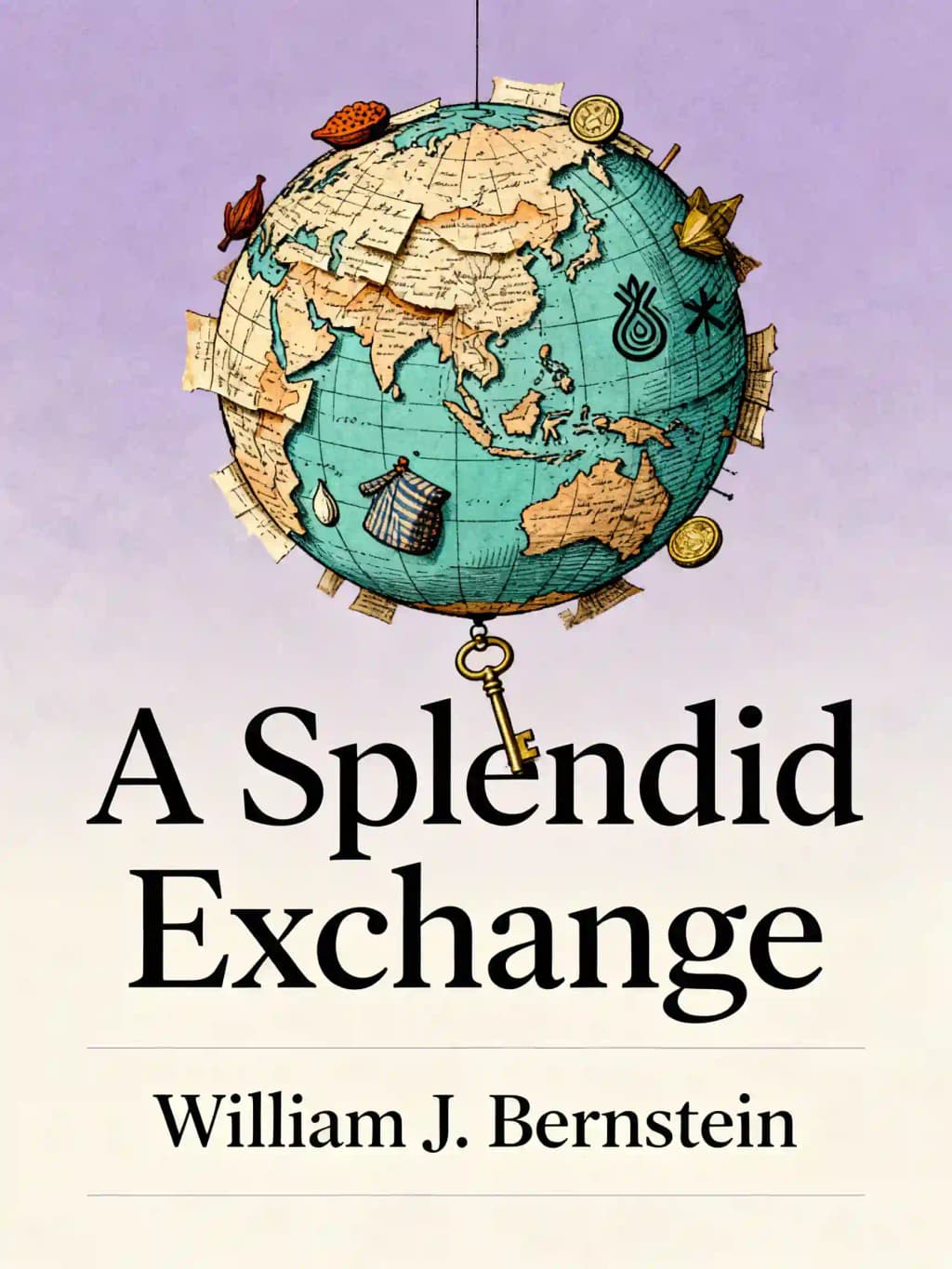
A splendid exchange
how trade shaped the world
Overview of A splendid exchange
Journey through 5,000 years of commerce that shaped civilizations, sparked innovations, and connected continents. Bernstein's masterpiece reveals how trade - not just war or religion - has been humanity's most transformative force. What ancient silk route secrets still influence today's global economy?

Key Themes in A splendid exchange
- maritime trade routes
- strategic choke points
- commodity history
- globalization origins
- transportation technology
Quotes from A splendid exchange
Trading offered better prospects than subsistence farming.
The Peloponnesian War ultimately turned on control of these straits.
Islam's commercial foundations are unmistakable.
Maritime routes, though relatively faster and safer than land journeys, were floating cesspools of disease.
Characters in A splendid exchange
- William J. BernsteinAuthor and historian of global trade
- ElagabalusRoman Emperor who wore expensive Chinese silk
- LysanderSpartan admiral who cut off Athenian grain routes
About the Author
About the Author of A splendid exchange
William J. Bernstein, author of A Splendid Exchange: How Trade Shaped the World, is a renowned financial theorist, neurologist, and bestselling writer on economic history and investment strategy.
A co-founder of Efficient Frontier Advisors and 2017 recipient of CFA Institute’s James R. Vertin Award, Bernstein merges rigorous academic research with accessible storytelling to explore global trade’s transformative role across civilizations.
His expertise spans finance and history, with prior works like The Four Pillars of Investing and The Birth of Plenty establishing him as a leading voice in asset allocation and economic growth analysis.
Bernstein’s contributions to The Wall Street Journal and Money Magazine, alongside his peer-reviewed financial research, underscore his authority in bridging historical context with modern portfolio theory. His "Coward’s Portfolio" framework remains widely cited by investors seeking balanced risk management.
A Splendid Exchange has been praised for its sweeping narrative of commerce’s impact on globalization, reflecting Bernstein’s signature blend of scholarly depth and engaging prose.
Download Summary of A splendid exchange
Get the A splendid exchange summary as a free PDF or EPUB. Print it or read offline anytime.
FAQs About This Book
A Splendid Exchange explores 5,000 years of global trade history, from ancient spice routes to modern WTO negotiations. Bernstein reveals how trade fueled economic growth, spread cultures, and unintended consequences like pandemics and inequality. The book ties historical patterns to today’s digital commerce, emphasizing trade’s dual role as both a catalyst for progress and a source of conflict.
History enthusiasts, economics students, and professionals in global business will find this book invaluable. It appeals to readers seeking to understand trade’s historical roots and its impact on modern issues like globalization, supply chains, and geopolitical tensions. Policymakers and entrepreneurs gain insights into balancing profit with ethical trade practices.
Yes. Bernstein’s blend of narrative storytelling and rigorous analysis offers a comprehensive yet engaging look at trade’s transformative power. Critics praise its depth in linking past trade dynamics to contemporary challenges, making it essential for understanding global economics. The book’s exploration of trade’s “duality” (prosperity vs. exploitation) adds nuanced perspective.
The medieval spice trade drove Europe’s economy, with profits exceeding 100% for merchants selling cinnamon, pepper, and nutmeg. Demand for these luxuries funded exploration, colonialism, and early corporate monopolies like the Dutch East India Company. Bernstein highlights how spice routes laid groundwork for today’s interconnected markets.
Trade routes unintentionally spread pandemics, like the Black Death via Silk Road merchants. Bernstein notes how smallpox devastated Indigenous Americans post-Columbus, reshaping demographics and economies. These examples underscore trade’s capacity to accelerate both progress and catastrophe.
Bernstein contrasts mercantilism’s state-controlled monopolies (e.g., England’s East India Company) with Adam Smith’s free-trade advocacy. He argues monopolies stifled competition, while deregulation later spurred innovation. This framework mirrors modern debates over corporate power versus market openness.
- Trade is ancient: Began with Mesopotamian agriculture.
- Spices fueled colonialism: Europe’s obsession funded empires.
- Disease follows exchange: From plagues to smallpox.
- Ethical trade balances growth and equity: Historical exploitation warns against unchecked globalization.
Bernstein draws parallels between past and present, like the 19th-century steam engine’s impact versus today’s e-commerce revolution. He warns that digital trade, while increasing accessibility, risks repeating historical patterns of inequality without ethical oversight.
Some reviewers argue Bernstein overemphasizes trade as an “instinctive” force while downplaying grassroots resistance to exploitative systems. Others note minimal coverage of pre-Columbian African and Asian trade networks, leaving gaps in its global narrative.
Bernstein credits Muslim traders (7th–15th centuries) with advancing logistics, including paper-based systems and integrated routes from Asia to Europe. Their innovations enabled long-distance commerce, influencing later European mercantile practices.
- Spices: Symbolize luxury’s power to drive exploration.
- Smallpox: Represents trade’s unintended consequences.
- East India Company: Exemplifies monopolistic exploitation versus free-market ideals.
Unlike narrow academic texts, Bernstein blends scholarly research with vivid storytelling akin to Charles Mann’s 1493. It offers broader scope than Pietra Rivoli’s The Travels of a T-Shirt, linking ancient and modern trade while addressing ethical dilemmas.