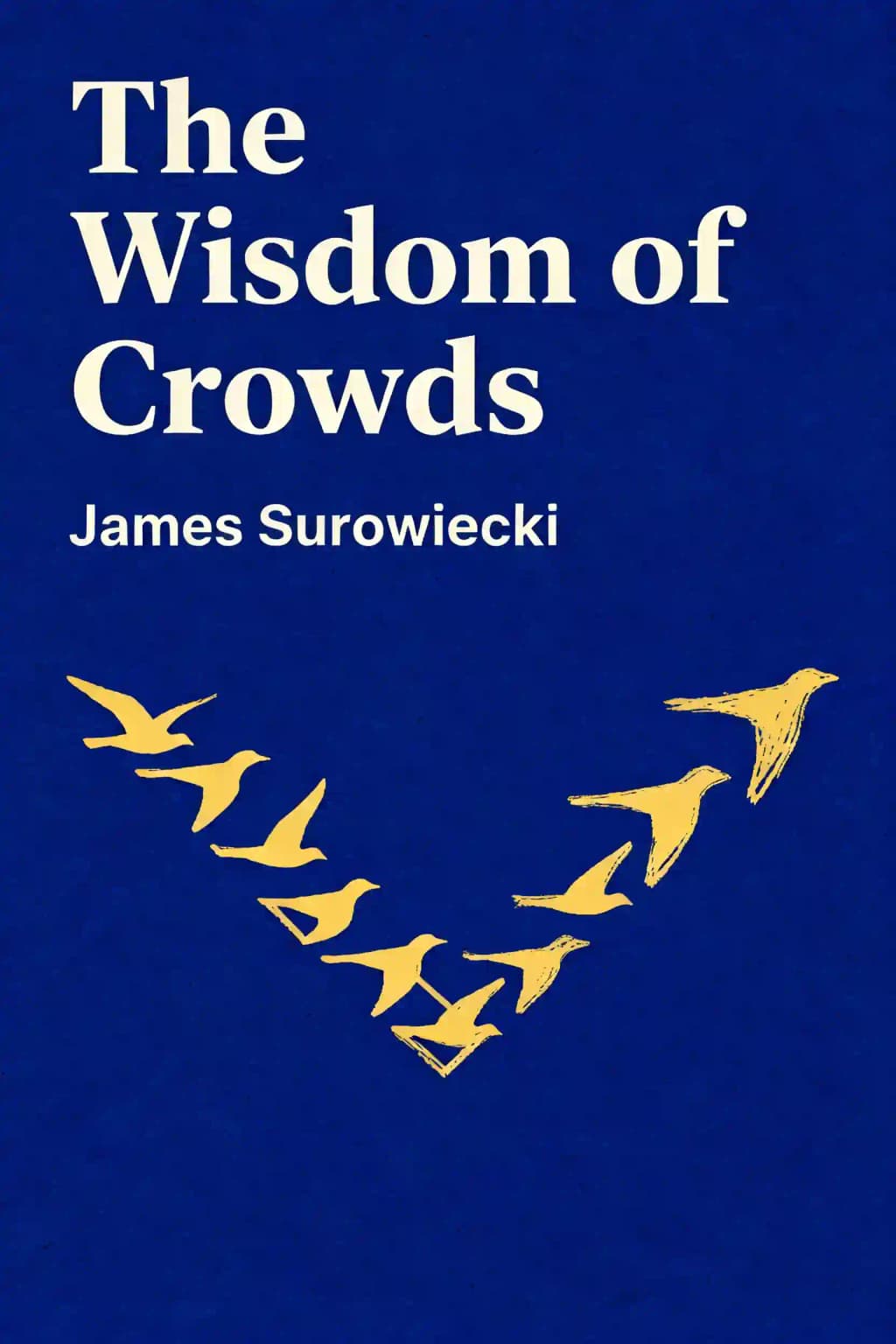
The Wisdom of Crowds
Overview of The Wisdom of Crowds
In "The Wisdom of Crowds," Surowiecki reveals how collective decisions often outperform individual experts. Cited by Simon Sinek and embraced across business and tech, this counterintuitive gem shows why your next breakthrough might depend on asking everyone - not just the smartest person in the room.

Key Themes in The Wisdom of Crowds
- collective intelligence
- aggregation of information
- cognitive diversity
- decentralized decision-making
- prediction markets
Quotes from The Wisdom of Crowds
Groups can be remarkably intelligent, often smarter than the smartest individuals within them.
Expert knowledge is spectacularly narrow.
Experts routinely overestimate the likelihood that they're right.
When early decisions are wrong, the entire group can be led astray.
Diversity in decision-making is valuable because it brings different perspectives and skills.
Characters in The Wisdom of Crowds
- James SurowieckiAuthor and business journalist
- Francis GaltonScientist who studied weight-judging at a fair
- John CravenNaval officer who located the Scorpion submarine
- Hazel KnightResearcher who studied group temperature estimates
- Kate GordonResearcher who studied group weight-ranking
About the Author
About the Author of The Wisdom of Crowds
James Michael Surowiecki is the bestselling author of The Wisdom of Crowds: Why the Many Are Smarter than the Few and How Collective Wisdom Shapes Business, Economies, Societies, and Nations and a renowned financial journalist specializing in collective decision-making and behavioral economics. A graduate of Yale University, Surowiecki honed his expertise through his influential “Financial Page” column at The New Yorker (2000–2017) and contributions to Slate, The Wall Street Journal, and Wired.
His work explores how decentralized groups outperform experts in solving complex problems, a theme rooted in his early career editing Motley Fool’s finance content and analyzing market trends.
Surowiecki’s insights extend beyond his seminal book—he edited the anthology Best Business Crime Writing of the Year (2002) and has delivered TED Talks on crowd intelligence. His writing blends rigorous research with accessible analysis, making him a sought-after voice in both academic and corporate circles.
The Wisdom of Crowds became a global phenomenon, translated into over 20 languages and cited in fields ranging from tech innovation to public policy. The book’s principles continue to influence prediction markets, organizational strategies, and AI development, cementing Surowiecki’s legacy as a pioneer in understanding collective behavior.
Download Summary of The Wisdom of Crowds
Get the The Wisdom of Crowds summary as a free PDF or EPUB. Print it or read offline anytime.
FAQs About This Book
The Wisdom of Crowds argues that diverse, independent groups collectively make smarter decisions than individual experts under specific conditions. Surowiecki explores how decentralized collaboration—in economics, politics, and technology—leads to accurate predictions and problem-solving when four criteria are met: diversity of opinion, independence, decentralization, and aggregation. The book uses real-world examples like stock markets and Google’s PageRank algorithm to illustrate its thesis.
This book is ideal for business leaders, policymakers, and anyone interested in decision-making, behavioral economics, or organizational design. It offers actionable insights for leveraging collective intelligence in teams, markets, and communities. Critics of groupthink or fans of Malcolm Gladwell’s works will find its counterintuitive arguments compelling.
Surowiecki identifies four requirements for collective wisdom:
- Diversity of opinion (independent viewpoints)
- Independence (no undue influence from others)
- Decentralization (localized knowledge utilization)
- Aggregation (mechanisms to synthesize insights)
Violating these conditions risks "groupthink" or irrationality, as seen in market bubbles.
The book advocates for decentralizing decision-making to harness employees’ collective knowledge. For example, prediction markets and open innovation platforms (like LEGO Ideas) outperform top-down approaches by aggregating diverse inputs. However, Surowiecki warns against homogeneity—teams with varied expertise yield better solutions than siloed groups.
Critics argue the theory oversimplifies group dynamics, ignoring power imbalances or misinformation. For instance, social media echo chambers often amplify poor decisions despite meeting Surowiecki’s criteria. Others note that expert-guided crowds (e.g., scientific communities) may outperform purely decentralized ones.
Surowiecki cites PageRank as a real-world application: it treats each website link as a “vote,” aggregating decentralized inputs to rank pages. This mirrors his thesis that crowdsourced data (when properly structured) outperforms centralized authority. However, modern SEO manipulation highlights vulnerabilities in purely algorithmic aggregation.
Key quotes include:
- “Diversity and independence matter because the best collective decisions are the product of disagreement and contest.”
- “Under the right circumstances, groups are remarkably intelligent—often smarter than their smartest members.”
These emphasize balancing collaboration with structured dissent.
Unlike James Clear’s focus on individual habits or Thaler’s behavioral “nudges,” Surowiecki prioritizes systemic design for group intelligence. While all three explore decision-making, The Wisdom of Crowds uniquely addresses organizational structures rather than personal behavior change.
Yes—its principles inform AI training (using diverse datasets), decentralized finance (DeFi), and crowdsourced crisis response (e.g., pandemic modeling). However, challenges like algorithmic bias and misinformation require updated frameworks to maintain crowd “wisdom”.
Notable examples include:
- The 1906 Francis Galton ox-weight contest (crowds nearly guessed exact weight).
- NASA’s Columbia disaster (suppressed dissent led to poor decisions).
- Wikipedia (decentralized collaboration vs. traditional encyclopedias)
- Encourage dissent: Assign “devil’s advocates” in meetings.
- Use prediction markets: Aggregate employee forecasts on projects.
- Avoid over-reliance on experts: Balance specialist input with broad stakeholder feedback
For complementary reads, consider:
- Thinking, Fast and Slow (Kahneman): Cognitive biases in decisions.
- The Black Swan (Taleb): Limitations of predictive models.
- Reinventing Organizations (Laloux): Decentralized organizational structures





