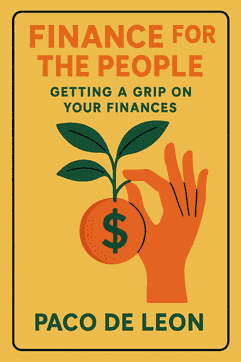
Finance for the People: Getting a Grip on Your Finances by Paco de Leon Summary

Overview of Finance for the People
Paco de Leon's "Finance for the People" revolutionizes personal finance with illustrations and empathy, not austerity. Named one of Fortune's Most Anticipated Books of 2022, it explains inflation through whiskey and student debt through plants. What financial beliefs are secretly controlling your life?
- Prioritize emergency savings before aggressive debt payoff.
- Shift from scarcity to abundance by automating savings and negotiating higher income streams.
- Track daily expenses for 30 days to uncover emotional spending triggers and patterns.
- Use script templates to negotiate lower credit card interest rates.
- Build a “bill-payer mindset” by separating guilt from necessary financial obligations.
- Improve credit scores through strategic balance reductions and persistent credit report disputes.
- Invest retirement funds in low-cost index funds for steady long-term growth.
- Reframe budgeting as “conscious spending” aligned with personal values, not deprivation.
- Turn financial reviews into routine empowerment sessions.
- Recognize systemic inequality while leveraging automated tools to bypass willpower gaps.
- Replace “I’m bad with money” narratives with growth-focused financial habit-building.
- Balance debt repayment with joyful spending to sustain long-term financial discipline.
About the Author of Finance for the People
Paco de Leon is the author of Finance for the People and a financial expert renowned for demystifying personal finance for creatives and entrepreneurs. A certified financial planner and founder of The Hell Yeah Group, a Los Angeles-based financial firm, she blends her background in wealth management, small business consulting, and artistic pursuits to address systemic financial barriers.
The book combines practical money management with mindfulness, reflecting her mission to empower readers through approachable frameworks and hand-drawn illustrations.
De Leon’s insights have been featured in The New York Times, NPR, Bloomberg, and VICE, and she authored Refinery29’s finance column Taking Stock. A TED speaker, she hosts the podcast Weird Finance, exploring money’s societal impact, and publishes the Nerdletter, a weekly guide to financial literacy.
Finance for the People has been hailed as a “transformative, no-fluff classic” by Refinery29, resonating with readers seeking inclusive, actionable strategies to build wealth and reclaim financial agency.
FAQs About Finance for the People
What is Finance for the People by Paco de Leon about?
Finance for the People is a practical, illustrated guide to improving financial health by addressing both practical steps and psychological barriers. Paco de Leon blends mindfulness exercises with actionable strategies for managing debt, saving, and investing, while acknowledging systemic inequalities. The book features over 50 diagrams to simplify complex concepts, making it accessible for readers at any financial level.
Who should read Finance for the People?
This book suits anyone overwhelmed by finances, especially creatives and those excluded from traditional financial systems. It’s ideal for readers seeking to balance emotional money struggles with tactical advice, such as building emergency funds or navigating credit card debt. De Leon’s empathetic approach resonates with millennials and underrepresented groups.
Is Finance for the People worth reading?
Yes, reviewers praise its unique blend of empathy and practicality, calling it “one of the most approachable financial books” (Refinery29). Unlike conventional guides, it tackles systemic challenges and personal beliefs, offering tools like the “Pyramid of Financial Awesomeness” framework. The illustrations and relatable tone make complex topics engaging.
How does Finance for the People address systemic financial inequalities?
De Leon acknowledges rigged systems but emphasizes actionable control, like negotiating debts or automating savings. She provides strategies to “play the game” within flawed structures, such as improving credit scores or investing retirement funds wisely. The book avoids blaming individuals, focusing instead on resilience.
What is the “Pyramid of Financial Awesomeness”?
This framework prioritizes financial milestones like emergency savings, debt repayment, and retirement investing. De Leon encourages non-linear progress, allowing readers to tackle achievable goals first. The pyramid serves as a visual roadmap for building stability and wealth.
What are key quotes from Finance for the People?
- “Sometimes dealing with debt requires us to take responsibility of the position we’re in, even if the circumstance is not entirely our fault”
- “Finances are about patience, determination, and consistency—not luck”
These emphasize accountability and systematic effort over quick fixes.
How does Paco de Leon approach credit card debt?
She advises listing all debts, negotiating lower interest rates, and using the “avalanche method” (prioritizing high-interest debts first). De Leon also stresses addressing emotional spending habits through mindfulness exercises.
Does Finance for the People cover investing?
Yes, it demystifies stocks, retirement accounts (e.g., 401(k)s), and compound growth. De Leon advocates low-cost index funds and diversifying investments. The book contrasts with traditional guides by linking investing to systemic barriers and personal empowerment.
How does this book differ from Broke Millennial or The Latte Factor?
Unlike austerity-focused guides, Finance for the People emphasizes increasing income over cutting small expenses. De Leon critiques scarcity mindsets, blending structural analysis with tools like budget tracking and debt payoff calculators.
What criticisms exist about Finance for the People?
Some note it’s basic for finance-savvy readers, focusing more on foundational steps than advanced strategies. Others highlight its U.S.-centric examples, though global readers can adapt core principles.
How does Paco de Leon’s background influence the book?
As founder of The Hell Yeah Group (serving creatives), her experience in banking, wealth management, and small business consulting informs the book’s practical tone. Her TED talks and podcast (Weird Finance) further shape its accessible style.
Is mindfulness a key theme in Finance for the People?
Yes, de Leon ties financial health to self-awareness, using exercises to uncover hidden money beliefs. Readers journal responses to prompts like “What did your family teach you about debt?” to align actions with values.
Why is Finance for the People relevant in 2025?
With rising inflation and student debt, its focus on systemic resilience and mental shifts remains critical. The book’s hybrid approach—mixing tactical steps with emotional wellness—aligns with post-pandemic financial realities.
Feel the book through the author's voice
Turn knowledge into engaging, example-rich insights
Capture key ideas in a flash for fast learning
Enjoy the book in a fun and engaging way
Key Themes in Finance for the People
Quotes from Finance for the People
Money isn't just currency-it's power.
We're all weird about money in our unique ways.
Credit numbs the spending pain.
The antidote to scarcity is gratitude.
Experiences plant themselves like seeds in your subconscious.
Characters in Finance for the People
Quick Summary Mode - Read or listen to Finance for the People Summary in 12 Minutes

Break down key ideas from Finance for the People into bite-sized takeaways to understand how innovative teams create, collaborate, and grow.

Flash Card Mode - Top 7 Insights from Finance for the People in a Nutshell

Distill Finance for the People into rapid-fire memory cues that highlight key principles of candor, teamwork, and creative resilience.

Fun Mode - Finance for the People Lessons Told Through 22-Min Stories

Experience Finance for the People through vivid storytelling that turns innovation lessons into moments you'll remember and apply.
Personalize Mode - Read or listen to Finance for the People Summary in 0 Minutes

Ask anything, pick the voice, and co-create insights that truly resonate with you.

From Columbia University alumni built in San Francisco
"Instead of endless scrolling, I just hit play on BeFreed. It saves me so much time."


"I never knew where to start with nonfiction—BeFreed’s book lists turned into podcasts gave me a clear path."


"Perfect balance between learning and entertainment. Finished ‘Thinking, Fast and Slow’ on my commute this week."
"Crazy how much I learned while walking the dog. BeFreed = small habits → big gains."
"Reading used to feel like a chore. Now it’s just part of my lifestyle."

"Feels effortless compared to reading. I’ve finished 6 books this month already."
"BeFreed turned my guilty doomscrolling into something that feels productive and inspiring."

"BeFreed turned my commute into learning time. 20-min podcasts are perfect for finishing books I never had time for."
"BeFreed replaced my podcast queue. Imagine Spotify for books — that’s it. 🙌"

"It is great for me to learn something from the book without reading it."
"The themed book list podcasts help me connect ideas across authors—like a guided audio journey."
"Makes me feel smarter every time before going to work"
From Columbia University alumni built in San Francisco
"Instead of endless scrolling, I just hit play on BeFreed. It saves me so much time."
"I never knew where to start with nonfiction—BeFreed’s book lists turned into podcasts gave me a clear path."
"Perfect balance between learning and entertainment. Finished ‘Thinking, Fast and Slow’ on my commute this week."
"Crazy how much I learned while walking the dog. BeFreed = small habits → big gains."
"Reading used to feel like a chore. Now it’s just part of my lifestyle."
"Feels effortless compared to reading. I’ve finished 6 books this month already."
"BeFreed turned my guilty doomscrolling into something that feels productive and inspiring."
"BeFreed turned my commute into learning time. 20-min podcasts are perfect for finishing books I never had time for."
"BeFreed replaced my podcast queue. Imagine Spotify for books — that’s it. 🙌"
"It is great for me to learn something from the book without reading it."
"The themed book list podcasts help me connect ideas across authors—like a guided audio journey."
"Makes me feel smarter every time before going to work"
"Instead of endless scrolling, I just hit play on BeFreed. It saves me so much time."
"I never knew where to start with nonfiction—BeFreed’s book lists turned into podcasts gave me a clear path."
"Perfect balance between learning and entertainment. Finished ‘Thinking, Fast and Slow’ on my commute this week."
"Crazy how much I learned while walking the dog. BeFreed = small habits → big gains."
"Reading used to feel like a chore. Now it’s just part of my lifestyle."
"Feels effortless compared to reading. I’ve finished 6 books this month already."
"BeFreed turned my guilty doomscrolling into something that feels productive and inspiring."
"BeFreed turned my commute into learning time. 20-min podcasts are perfect for finishing books I never had time for."
"BeFreed replaced my podcast queue. Imagine Spotify for books — that’s it. 🙌"
"It is great for me to learn something from the book without reading it."
"The themed book list podcasts help me connect ideas across authors—like a guided audio journey."
"Makes me feel smarter every time before going to work"
"Instead of endless scrolling, I just hit play on BeFreed. It saves me so much time."
"I never knew where to start with nonfiction—BeFreed’s book lists turned into podcasts gave me a clear path."
"Perfect balance between learning and entertainment. Finished ‘Thinking, Fast and Slow’ on my commute this week."
"Crazy how much I learned while walking the dog. BeFreed = small habits → big gains."
"Reading used to feel like a chore. Now it’s just part of my lifestyle."
"Feels effortless compared to reading. I’ve finished 6 books this month already."
"BeFreed turned my guilty doomscrolling into something that feels productive and inspiring."
"BeFreed turned my commute into learning time. 20-min podcasts are perfect for finishing books I never had time for."
"BeFreed replaced my podcast queue. Imagine Spotify for books — that’s it. 🙌"
"It is great for me to learn something from the book without reading it."
"The themed book list podcasts help me connect ideas across authors—like a guided audio journey."
"Makes me feel smarter every time before going to work"

Get the Finance for the People summary as a free PDF or EPUB. Print it or read offline anytime.