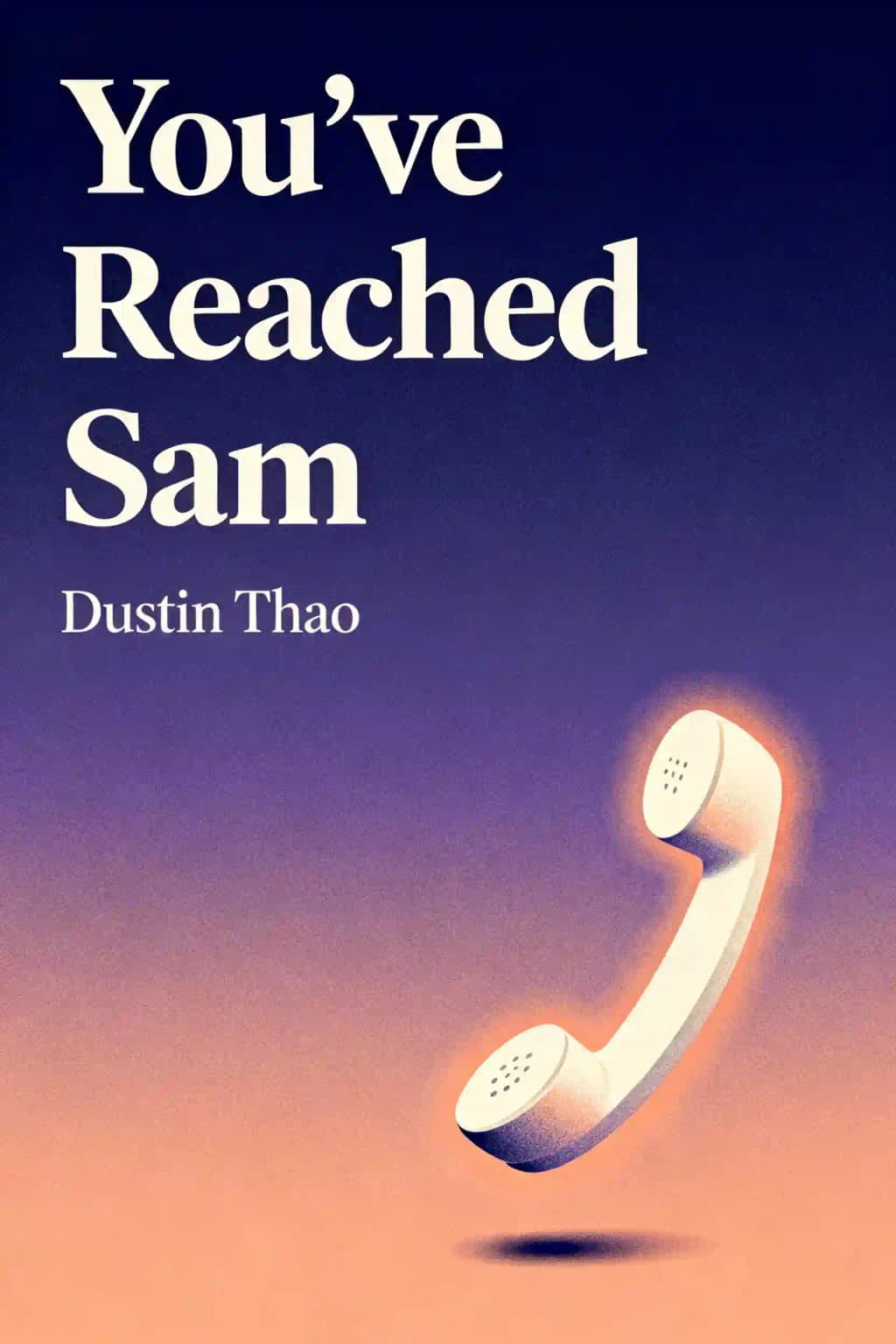
When a phone call bridges life and death, grief finds its voice. This TikTok viral sensation and NYT bestseller features rare Vietnamese American representation in YA romance. What would you say if your deceased love answered your call one last time?
Dustin Thao is the Vietnamese American bestselling author of You've Reached Sam, a contemporary young adult novel exploring grief, love, and letting go. Thao graduated from Amherst College with a degree in Political Science and is currently pursuing a PhD at Northwestern University, where he studies critical media literacy.
His deeply personal approach to writing emotional fiction stems from his own experiences and his desire to capture the universal feelings of first love, heartbreak, and loss that define the teenage years.
You've Reached Sam became a breakout BookTok sensation, resonating with readers worldwide who connected with its raw portrayal of grief and the magical realism of staying connected to someone who's gone. Thao followed this success with When Haru Was Here in September 2024 and You've Found Oliver, which expands the You've Reached Sam universe. The debut novel spent eight months on the New York Times bestseller list and has been translated into multiple languages, establishing Thao as a distinctive voice in emotional young adult contemporary fiction.
You've Reached Sam by Dustin Thao is a young adult contemporary romance with magical realism about 17-year-old Julie who loses her boyfriend Sam in a tragic death. When she calls his phone to hear his voicemail one last time, Sam miraculously picks up. The story follows Julie's emotional journey as she receives a temporary second chance at goodbye through supernatural phone calls with Sam, while struggling between holding on to their connection and letting him go.
You've Reached Sam is ideal for readers who enjoy emotional young adult contemporary fiction, tearjerker romances, and stories about grief and healing. This book appeals to fans of magical realism who appreciate heartfelt explorations of loss and moving forward. Readers should prepare for an intensely emotional experience, as many report crying multiple times throughout the 300-page novel. It's perfect for those seeking a beautiful, painful, and ultimately cathartic reading experience about cherishing memories while learning to let go.
You've Reached Sam is worth reading for its authentic portrayal of grief and emotionally powerful storytelling that resonates long after finishing. Dustin Thao's debut novel became a New York Times and USA Today bestseller for good reason—it captures the messy, painful reality of loss without shying away from difficult emotions. The well-rounded characters, particularly Julie's realistic grief journey and Sam's gradual revelation through flashbacks, create a deeply moving narrative. However, readers seeking lighter fare should note this book delivers intense emotional impact throughout.
Dustin Thao is a Vietnamese American writer based in New York City who debuted with You've Reached Sam in 2021. He graduated from Amherst College with a B.A. in Political Science and is currently in a PhD program at Northwestern University. Thao writes contemporary fiction that explores themes of grief, memory, and connection. His debut novel became a New York Times and USA Today bestseller, establishing him as a notable voice in young adult contemporary fiction. He has since published When Haru Was Here, another emotional exploration of loss and love.
The main message of You've Reached Sam is that letting go can be harder than holding on, but it's essential for healing and moving forward. The novel teaches readers about cherishing time with loved ones while understanding when to release them. Julie's journey demonstrates that we don't need to forget those we've lost—instead, we should remember them through joyful memories rather than painful ones. Holding on to people or past plans for too long causes more suffering than acceptance and growth.
No, Julie does not hallucinate Sam in You've Reached Sam—the phone calls are portrayed as real supernatural events. Despite Julie initially wondering if she's imagining the conversations after Sam's death, the narrative confirms these connections are genuine breaches in the veil between worlds. The phone calls represent a miraculous, temporary opportunity for Julie to say goodbye properly. This magical realism element serves as a metaphor for the power of love and human connection that transcends death.
You've Reached Sam explores several interconnected themes:
The novel examines how loss can turn people into versions of themselves they don't recognize, and the journey back to wholeness. Additional themes include the significance of cherishing loved ones, accepting unexpected life paths, and finding healing through community support. Symbolism through objects like paper cherry blossoms, the phone, and memory-laden locations enriches these thematic explorations.
You've Reached Sam ends with Julie finally accepting Sam's death at her high school graduation, the date of their last call. She and Sam share a final conversation where they proclaim eternal love, and Sam asks her not to answer when he calls again. Instead, he leaves her a loving voicemail she can listen to repeatedly for comfort. After breaking their supernatural connection, Julie's phone receives all the messages and calls she missed during their reconnection. The epilogue shows Julie moving forward—attending local college, writing, growing closer to friends and family—while never forgetting Sam or his lessons.
Dustin Thao employs first-person perspective from Julie's viewpoint to create intimate emotional connection and allow readers to experience her grief firsthand. He uses flashbacks strategically to reveal key moments in Julie and Sam's relationship, providing context for their deep bond and highlighting significant shared memories. Symbolism enhances thematic depth through objects like the single winged bookend (foreshadowing incompleteness), Sam's Radiohead T-shirt (Julie's struggle to let go), and the honey lavender latte (Sam's attentiveness). The narrative includes subtle foreshadowing through details like the Mark Lanegan song "Strange Religion" and the lost love lock key.
While specific verbatim quotes should not be reproduced extensively, You've Reached Sam contains powerful messages about grief and memory throughout. The book emphasizes remembering loved ones through good memories that bring smiles rather than sadness. Key thematic quotes revolve around not having to forget those we've lost, but instead learning to let go while holding onto joyful recollections. Sam's reassurances to Julie that "not everything goes as planned" and people can adapt reflect the novel's central wisdom about accepting life's unexpected turns. These emotional moments contribute to the book's reputation for making readers cry repeatedly.
Some readers found You've Reached Sam disappointing, feeling the execution didn't match the compelling concept. Critics noted that while the premise of talking to a deceased boyfriend through phone calls is intriguing, certain aspects of the storytelling or character development fell short of expectations. However, the book maintains strong overall ratings and bestseller status, suggesting most readers found it emotionally satisfying. The intensely sad nature may be overwhelming for some, as the constant stream of tears and heavy grief themes aren't suitable for readers seeking lighter contemporary romance.
The main characters in You've Reached Sam include Julie, the 17-year-old protagonist grieving her boyfriend's death, and Sam, her deceased boyfriend of Japanese heritage who appears through supernatural phone calls. Mika, Sam's cousin, serves as an important supporting character who struggles with Julie's absence from memorial events and her own grief. Oliver, Sam's friend who harbored unrequited love for him, adds complexity to the friendship dynamics and provides deeper understanding of different grief experiences. Additional supporting characters include Mr. Lee, who offers understanding support based on his own losses, demonstrating the importance of community in healing.
Feel the book through the author's voice
Turn knowledge into engaging, example-rich insights
Capture key ideas in a flash for fast learning
Enjoy the book in a fun and engaging way
Julie's coping mechanism is erasure.
"Sam is dead," she says bluntly.
Their shared calendar becomes filled with future plans.
Their love transcends typical teenage romance.
Break down key ideas from You've Reached Sam into bite-sized takeaways to understand how innovative teams create, collaborate, and grow.
Experience You've Reached Sam through vivid storytelling that turns innovation lessons into moments you'll remember and apply.
Ask anything, choose your learning style, and co-create insights that truly resonate with you.

From Columbia University alumni built in San Francisco
"Instead of endless scrolling, I just hit play on BeFreed. It saves me so much time."
"I never knew where to start with nonfiction—BeFreed’s book lists turned into podcasts gave me a clear path."
"Perfect balance between learning and entertainment. Finished ‘Thinking, Fast and Slow’ on my commute this week."
"Crazy how much I learned while walking the dog. BeFreed = small habits → big gains."
"Reading used to feel like a chore. Now it’s just part of my lifestyle."
"Feels effortless compared to reading. I’ve finished 6 books this month already."
"BeFreed turned my guilty doomscrolling into something that feels productive and inspiring."
"BeFreed turned my commute into learning time. 20-min podcasts are perfect for finishing books I never had time for."
"BeFreed replaced my podcast queue. Imagine Spotify for books — that’s it. 🙌"
"It is great for me to learn something from the book without reading it."
"The themed book list podcasts help me connect ideas across authors—like a guided audio journey."
"Makes me feel smarter every time before going to work"
From Columbia University alumni built in San Francisco

Get the You've Reached Sam summary as a free PDF or EPUB. Print it or read offline anytime.
What would you do if you could speak to someone you've lost? In the quiet town of Ellensburg, Julie discovers the impossible-her boyfriend Sam, killed in a car accident, answers when she calls his phone. Their supernatural connection defies explanation, offering both healing and heartbreak as Julie navigates the complex terrain of grief. Through late-night conversations that bridge the gap between life and death, she learns that sometimes the hardest part of losing someone isn't saying goodbye the first time-it's finding the strength to say it again when given a second chance.
Julie and Sam's relationship thrives on meaningful details - paper cherry blossoms in books, perfectly crafted lattes, and Thursday morning drives with curated playlists in his blue Volvo. They slow dance in empty parking lots and communicate in their own invented shorthand. Their connection transcends typical teenage romance. When Julie's parents' marriage collapses, Sam drives her until sunrise. When Sam doubts his musical abilities, Julie creates a blog for his songs that attracts devoted followers. After Sam dies on a rainy Tuesday, Julie responds through systematic erasure - discarding his scent-filled jacket, deleting unread texts, and removing herself from photos. She skips his funeral and avoids their favorite places, believing eliminating all traces might ease her pain. This approach creates conflict with Mika, Sam's cousin and Julie's best friend. While Julie processes grief through elimination, Mika chooses commemoration - organizing memorials and preserving his memory. Their confrontation at Rosie's Diner ends their friendship. Everything changes when she discovers Sam's yearbook message: "I love you, Julie, and always will. Dream big, live bigger, and know that you're meant for amazing things. Yours forever, Sam." At 3 AM, she calls his number - and he answers.
Their supernatural connection follows mysterious rules discovered through trial and error. Calls leave no history, no saved messages, and work best when Julie is alone at night or in empty spaces. Any documentation attempts fail-recordings capture only static, phone logs show nothing. The connection deteriorates over time, with static increasingly cutting conversations short. When Julie shares this secret with Sam's sister, the calls become even more limited-a reminder that even supernatural connections must end. These conversations give Julie needed closure-apologizing for their last argument, sharing college news-yet they prevent her from moving forward, keeping her tethered to a relationship that cannot grow. She schedules her life around potential calls, avoiding social interactions, living in suspended animation. This supernatural element serves as a metaphor for grief itself-how we continue relationships with the deceased through memory and the feeling of their presence. For Julie, these calls become both healing and harmful, creating an emotional tangle that mirrors the messy reality of loss.
Julie experiences multiple layers of goodbye with Sam. At his house, she confronts his physical absence amid funeral flowers. At his grave with Oliver, she faces his name etched in stone-permanent and undeniable. Sam uses their calls therapeutically, guiding Julie to meaningful places like the barley field that inspired "Fields of Gold," where he finally sings it for her. While comforting, he gently nudges her toward acceptance and her own future. This tension between holding on and letting go culminates during a memory lantern ceremony. While others release lanterns with final messages, Julie whispers, "Don't go yet, Sam. Just stay with me a little longer." Her lantern hovers before finally rising beyond reach-a powerful metaphor for the release she must eventually accept. Every corner of Ellensburg now holds painful memories: the antique store where he bought her a wing bookend, the record store of shared music discoveries, the lake of future plans. Julie remains paralyzed, unable to focus on college applications or envision life without Sam, letting deadlines pass as her grades decline.
Julie's carefully planned future-attending Reed College with Sam, building a life of literature and art-suddenly feels hollow. Her Reed rejection letter becomes a crushing symbolic moment, forcing her to confront not just Sam's loss but the dissolution of every plan. Through conversations with her mother about writing, Julie learns that "you don't write to reach the end, but because you enjoy the process." This metaphor helps her understand that life's meaning lies in embracing the journey, not achieving predetermined goals. Her relationships provide different models for moving forward. Oliver's confession of unrequited love for Sam reveals the complex layers of loss-not just of a person but of unexplored possibilities. Mika's community gatherings show Julie the healing power of collective memory. Tristan enters as an unexpected catalyst, demonstrating that new connections can coexist with-rather than replace-her love for Sam. Julie discovers that finding purpose after loss isn't about replacement or forced progress, but gradually expanding her world to include new possibilities while honoring enduring love. Healing isn't linear-it's holding precious memories while opening to new experiences.
On graduation night, Julie and Sam prepare for their final scheduled call-a moment of both closure and loss. When Julie's phone shatters before their appointed time, she races to Sam's house for his old phone, swapping SIM cards in a poignant metaphor for their temporary connection. Their last conversation carries the weight of months of healing and unspoken truths. Sam's request that she promise not to answer when he calls one final time shows his growth and acceptance that their connection must end. He transforms from someone holding Julie back to the person helping her move forward, despite his own discomfort. When the unknown number appears after they hang up, Julie faces her ultimate test. Despite every instinct to answer, she honors her promise-her first real step toward accepting a future without him, though it breaks her heart. Sam's final voicemail becomes his true legacy. His admission that he stayed connected out of fear of being forgotten reveals his vulnerability. His words expressing love and hope that Julie will carry a piece of him forward transform their supernatural story into a universal one about how love persists beyond death.
Julie discovers remembrance weaves through both mundane moments and milestones. Cherry blossoms at college transport her back to shared spring afternoons. She occasionally orders his usual drink for comfort. Conversations with Mika naturally circle back to Sam stories, their laughter mixing with tears. Dating proves complex. Some evenings end awkwardly, leaving her missing Sam; others bring connections showing joy remains possible. New relationships exist parallel to her love for Sam-each occupying its own space in her expanding emotional world. When she moves to their dream city, she feels both unrealized plans and new possibilities. She unconsciously seeks signs of him in coffee shops that would have been "their spots" and parks they would have explored together. Julie learns that remembering doesn't mean being stuck-it means allowing her love for Sam to evolve alongside her growth. She keeps her promise through how his influence shapes her choices and capacity for love, appreciating how their shortened story changed her life forever.