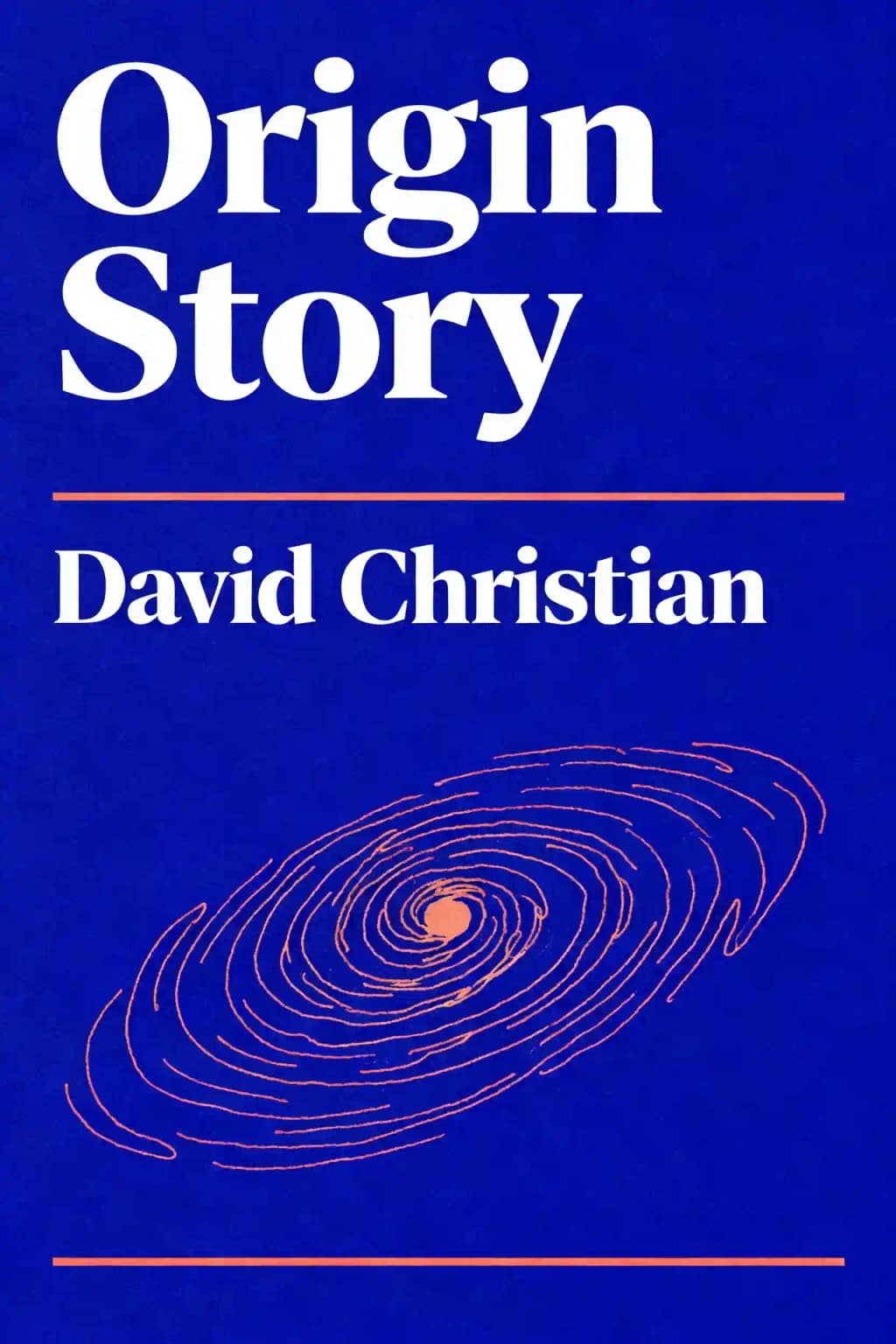
From the Big Bang to modern civilization, "Origin Story" weaves 13.8 billion years of cosmic history into one breathtaking narrative. Bill Gates calls it "elegantly accessible" - the book that transformed how we understand our place in the universe's grand evolutionary story.
Feel the book through the author's voice
Turn knowledge into engaging, example-rich insights
Capture key ideas in a flash for fast learning
Enjoy the book in a fun and engaging way
Break down key ideas from Origin Story into bite-sized takeaways to understand how innovative teams create, collaborate, and grow.
Distill Origin Story into rapid-fire memory cues that highlight Pixar’s principles of candor, teamwork, and creative resilience.

Experience Origin Story through vivid storytelling that turns Pixar’s innovation lessons into moments you’ll remember and apply.
Ask anything, pick the voice, and co-create insights that truly resonate with you.

From Columbia University alumni built in San Francisco

Get the Origin Story summary as a free PDF or EPUB. Print it or read offline anytime.
What if I told you that the same forces that forged stars in the void also built your brain? That the carbon in your morning coffee was once cooked in the belly of a dying sun? We live in a universe that seems to have a peculiar habit-it creates complexity. From absolute nothingness emerged atoms, from atoms came stars, from stellar explosions came planets, and somehow, improbably, magnificently, one of those planets sprouted life that eventually started asking questions about its own origins. This isn't just history-it's the most ambitious detective story ever told, piecing together 13.8 billion years of cosmic evolution into a single, breathtaking narrative that reveals why you exist at all. Picture trying to explain where you came from without mentioning your parents, grandparents, or anyone who came before. That's the universe's problem. Every creation story faces this bootstrapping paradox-something can't come from nothing, right? Ancient thinkers wrestled with this. Indian Vedic texts imagined a tension between being and nonbeing, a concept that eerily mirrors modern quantum physics, where empty space constantly bubbles with particle pairs popping in and out of existence like cosmic hiccups. Then came the big bang-not an explosion in space, but an explosion of space itself. In 1964, two scientists accidentally discovered the universe's baby photo: cosmic microwave background radiation, the afterglow of creation still echoing through space. Within the first fractions of a second, fundamental forces separated, particles formed, and the universe began its long journey from simplicity to complexity. For 380,000 years, the cosmos was an opaque fog of plasma. Then electrons settled into orbit around protons, forming the first complete atoms, and suddenly the universe became transparent. Light could finally travel freely-the first threshold had been crossed.