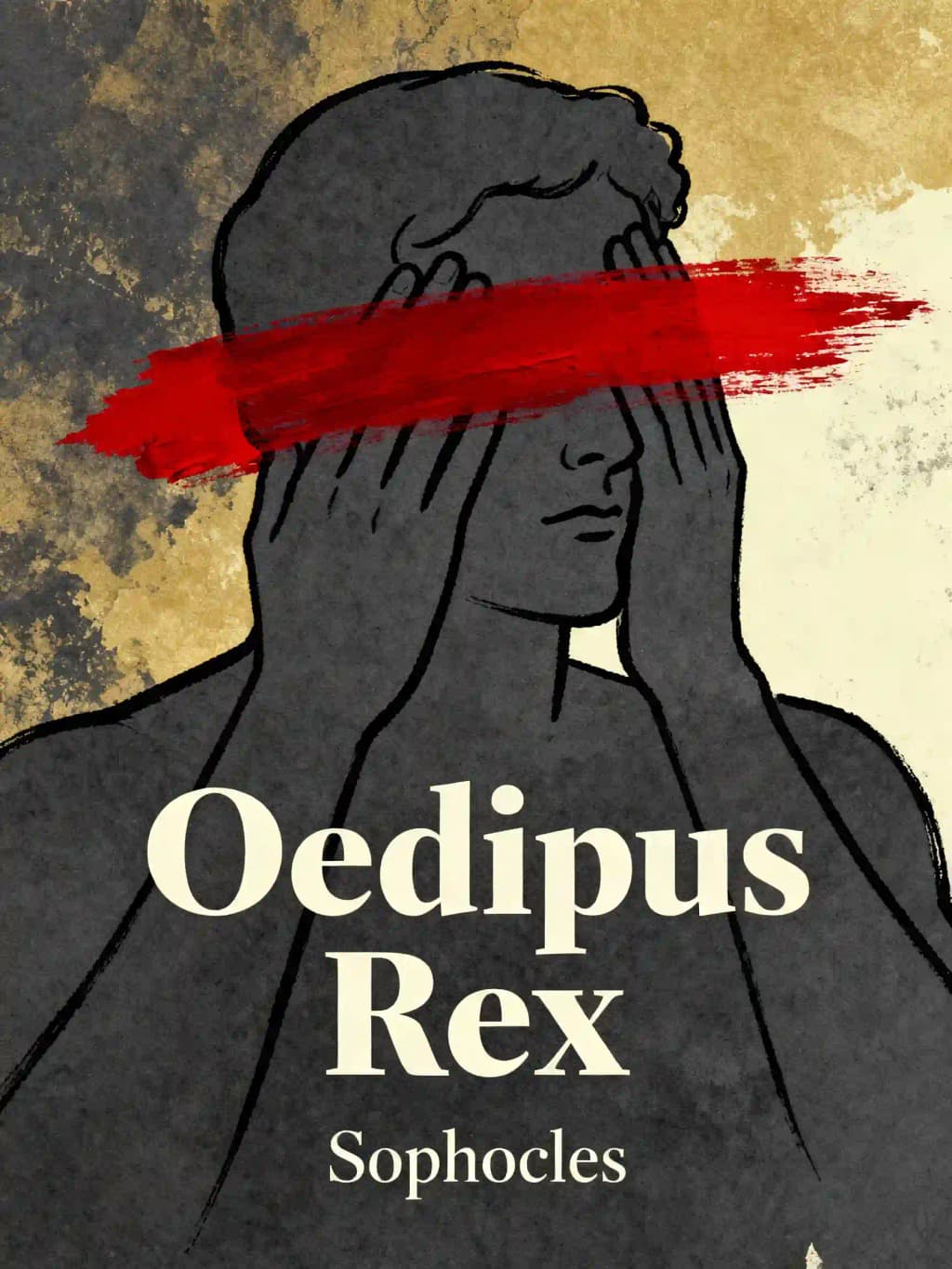
Ancient Greece's most perfect tragedy, "Oedipus Rex" follows a king who unknowingly fulfills a prophecy of patricide and incest. So profound, Aristotle praised it as flawless while Freud built an entire psychological theory around its haunting themes of fate versus free will.
Sophocles (c. 496–406 BCE) was the revered ancient Greek tragedian and author of Oedipus Rex. He crafted one of Western literature’s most enduring explorations of fate, free will, and human suffering.
A master of Athenian drama, Sophocles dominated Greece’s theatrical competitions, winning 24 of 30 City Dionysia festivals. He introduced groundbreaking innovations like the third actor to enhance dramatic tension. His works, including Antigone, Electra, and Ajax, dissect moral paradoxes and divine vs. mortal agency through psychologically complex characters.
Oedipus Rex anchors his Theban Plays trilogy, which examines the cursed lineage of King Oedipus with unflinching emotional intensity. As a state treasurer and military leader in 5th-century Athens, Sophocles bridged political acumen with artistic genius, shaping tragedy into a vehicle for probing societal and existential truths.
His seven surviving plays (of 120+ written) remain cornerstones of classical education and global theater, with Oedipus Rex alone inspiring adaptations by Freud, Cocteau, and Stravinsky.
Oedipus Rex is a Greek tragedy exploring King Oedipus’s quest to uncover the truth behind a plague ravaging Thebes, only to discover he unknowingly killed his father and married his mother. The play examines themes of fate, free will, and the consequences of hubris, culminating in Oedipus’s tragic self-blinding and exile.
This play appeals to readers interested in classical literature, Greek tragedy, and existential themes like fate versus free will. Students of drama, philosophy, or psychology will find its exploration of human limitations and self-discovery deeply relevant.
Yes, it remains a cornerstone of Western literature for its masterful storytelling and timeless themes. Its exploration of irony, destiny, and human frailty offers profound insights into the human condition, making it essential for literary enthusiasts and scholars alike.
The play interrogates whether humans control their destinies or are bound by prophecy. Oedipus’s attempts to defy his fate—killing his father and marrying his mother—ironically fulfill it, underscoring the tension between agency and predestination in Greek thought.
Physical and metaphorical blindness symbolize knowledge and ignorance. While the prophet Tiresias is physically blind but sees the truth, Oedipus gains insight only after gouging his eyes, highlighting the paradox of self-awareness.
The plague represents moral decay and divine punishment for Oedipus’s unwitting sins. It reflects the interconnectedness of individual actions and communal suffering, emphasizing the need for justice and purification.
The crossroads where Oedipus kills Laius symbolizes pivotal choices and their irreversible consequences. It underscores the theme of fate, as this seemingly random act seals Oedipus’s tragic destiny.
Oedipus’s overconfidence in his intellect and refusal to heed warnings—like Tiresias’s prophecies—lead to his downfall. His hubris blinds him to the truth until it’s too late, illustrating Greek warnings against arrogance.
Some critics argue the play overemphasizes fate, reducing human agency. Others question its portrayal of women, as Jocasta’s role is largely passive. However, its exploration of existential themes continues to garner praise.
Its themes of self-discovery, the limits of knowledge, and societal accountability resonate in modern discussions of identity and ethics. The play’s psychological complexity and moral questions remain universally compelling.
While Sophocles’ Antigone and Oedipus at Colonus further explore themes of justice and legacy, Oedipus Rex stands out for its tight narrative structure and devastating exploration of fate. It remains his most studied tragedy.
Feel the book through the author's voice
Turn knowledge into engaging, example-rich insights
Capture key ideas in a flash for fast learning
Enjoy the book in a fun and engaging way
O, O, O, they will all come, all come out clearly!
I'll bring it all to light myself.
Oedipus himself is the murderer and the source of Thebes' pollution.
Break down key ideas from Oedipus Rex into bite-sized takeaways to understand how innovative teams create, collaborate, and grow.
Experience Oedipus Rex through vivid storytelling that turns innovation lessons into moments you'll remember and apply.
Ask anything, choose your learning style, and co-create insights that truly resonate with you.

From Columbia University alumni built in San Francisco
"Instead of endless scrolling, I just hit play on BeFreed. It saves me so much time."
"I never knew where to start with nonfiction—BeFreed’s book lists turned into podcasts gave me a clear path."
"Perfect balance between learning and entertainment. Finished ‘Thinking, Fast and Slow’ on my commute this week."
"Crazy how much I learned while walking the dog. BeFreed = small habits → big gains."
"Reading used to feel like a chore. Now it’s just part of my lifestyle."
"Feels effortless compared to reading. I’ve finished 6 books this month already."
"BeFreed turned my guilty doomscrolling into something that feels productive and inspiring."
"BeFreed turned my commute into learning time. 20-min podcasts are perfect for finishing books I never had time for."
"BeFreed replaced my podcast queue. Imagine Spotify for books — that’s it. 🙌"
"It is great for me to learn something from the book without reading it."
"The themed book list podcasts help me connect ideas across authors—like a guided audio journey."
"Makes me feel smarter every time before going to work"
From Columbia University alumni built in San Francisco

Get the Oedipus Rex summary as a free PDF or EPUB. Print it or read offline anytime.
Imagine a story so powerful it has shaped human understanding for over two millennia. In the sun-drenched theaters of ancient Athens, amid plague and war, Sophocles unveiled a tale that would become the blueprint for all tragedy that followed. "Oedipus Rex" tells the story of a brilliant man who, in trying to escape his fate, runs directly into its embrace. The tale begins with a city in crisis-Thebes is ravaged by plague, and its citizens turn to their king, Oedipus, for salvation. He has saved them before by solving the Sphinx's riddle, and they believe he can do so again. Oedipus learns from the oracle that the plague will end only when the murderer of the previous king, Laius, is found and punished. With characteristic determination, he vows to solve this mystery, declaring, "I'll bring it all to light myself." The dramatic irony is exquisite-for in seeking the criminal who pollutes Thebes, Oedipus is hunting himself. This is not merely a detective story but an excavation of identity, where the investigator and perpetrator are one and the same. What makes us return to this ancient tale? Perhaps it's because we recognize ourselves in Oedipus-brilliant yet blind, confident yet vulnerable, masters of our destiny yet shaped by forces we barely comprehend.
Oedipus defines himself through his intellect, having saved Thebes by solving the Sphinx's riddle: "What walks on four legs in morning, two at noon, and three in evening?" His name - "Oidi-pous" combining "oida" (I know) and "pous" (foot) - ironically suggests a man who knows about feet yet doesn't know his own path. His swollen feet, marks of his parents' attempted prophecy prevention, remain unknown to him. His investigation becomes an unwitting deconstruction of his identity. When Tiresias names him as Laius's murderer, he responds with anger rather than reflection. Jocasta's mention of murder "where three roads meet" sparks recognition - he once killed a man at such a crossroads. Yet he pursues truth with relentless determination. Through testimonies from a Corinth messenger and an old shepherd, the master riddler discovers he embodies the ultimate paradox: son and husband to one woman, father and brother to his children - proving our greatest blindness may be to ourselves.
Did Oedipus freely choose his fate or was he destiny's puppet? While prophecies come true despite attempts to prevent them - Laius and Jocasta fail to kill their infant son, and Oedipus's flight from Corinth leads him straight to his parents. Yet Oedipus's character shapes events. His killing of Laius at the crossroads stems from his own violent temper, striking "in rage" after being pushed aside. Though prophecy arranged their meeting, the lethal outcome reflects Oedipus's nature. As Heraclitus noted, "Character is fate." Oedipus's relentless pursuit of truth makes him both heroic and doomed, embodying a universal paradox: our choices feel entirely our own while being shaped by forces beyond our control - genetics, upbringing, and unconscious drives.
While modern readers focus on psychological aspects of "Oedipus Rex," its original Athenian audience would have seen political parallels. The play was performed during Athens' democratic experiment, as the city grew increasingly tyrannical toward its allies - a tension that led to the Peloponnesian War. Oedipus embodies leadership's promise and peril. He starts as the model ruler - concerned for his citizens and committed to justice. Yet darker qualities emerge: his quick temper, suspicion of Creon, dismissal of Tiresias, and unwavering self-confidence. The chorus captures this theme: "Hubris breeds the tyrant, hubris if glutted with a surfeit, unseasonable, unprofitable, climbs to the roof-top and plunges sheer down to the ruin that must be." This warning about overreaching rulers resonated with Athenians watching their empire's troubles unfold. The play concludes with a stark reversal. The celebrated ruler becomes a pollution to be removed, while Creon, once suspected of treachery, assumes leadership with measured caution. This transition raises questions about legitimate authority and the relationship between personal character and political power.
"Oedipus Rex" emerged during Athens' intellectual awakening, when sophists challenged religious beliefs with philosophical thinking and human-centered reasoning. Oedipus embodies this rationality - solving the Sphinx's riddle through intelligence and investigating Laius's murder through evidence. Yet the play validates divine prophecy, as attempts to outsmart the gods fulfill the very predictions they sought to avoid. Sophocles portrays a world where human reason operates within divine boundaries. Tiresias, the blind prophet who "sees" what Oedipus cannot, represents this paradox. His suggestion that the Sphinx's defeat marked Oedipus's downfall shows how intelligence alone leads to catastrophe. Jocasta's attempt to discredit oracles, only to discover their inevitable fulfillment, demonstrates the peril of pure rationalism. The play reveals that human knowledge has limits - that crucial truths may lie beyond rational understanding.
Physical suffering permeates "Oedipus Rex" from its plague-ridden beginning to its violent end with Jocasta's suicide and Oedipus's self-blinding. The body becomes a vessel for revealing truth through pain. Oedipus's swollen feet - which gave him his name - carry evidence of his infant trauma. When the Corinthian messenger reveals this detail, Jocasta recognizes the truth before Oedipus himself understands his identity. His body knows before his mind does. The play culminates in acts of bodily violence as responses to unbearable truth. Jocasta hangs herself upon realizing she married her son. Oedipus blinds himself with her golden brooches, creating a horrific scene where "blood spurted from his eyeballs, drenching his beard... showering down like black rain." This act transforms metaphorical blindness into physical reality. Declaring "What good were eyes to me? Nothing I could see could bring me joy," Oedipus suggests certain truths emerge only through suffering. His mutilated body becomes the meeting point of identity, prophecy, and choice.
The final scenes explore how one continues living after discovering unbearable truth. Unlike tragic protagonists who die upon recognition, Oedipus must face existence knowing exactly who he is. His self-blinding serves as both punishment and barrier between himself and an intolerable reality. "How could I look my father in the eyes when I go down to death?" he asks. "Or mother... against whom I have committed such abominations?" Yet his blindness also links him to Tiresias's prophetic insight - seeing truth without physical eyes. Oedipus's plea for exile acknowledges his role as pollution incarnate. When Creon suggests consulting the oracle, Oedipus states Apollo's will is already clear: "Drive out the pollution from the land." The final image - blind Oedipus awaiting exile - captures this ambiguous aftermath. Stripped of his identity, he persists, embodying the gap between human intention and outcome. The chorus concludes, "Count no man happy till he dies, free of pain at last," suggesting life's meaning emerges only in retrospect. This transforms Oedipus from a figure of pity to a symbol of the human condition - reminding us that some truths, once discovered, must be lived with rather than escaped.