Chapter 1
When Fighting Becomes a Love Language: Navigating Relationship Storms
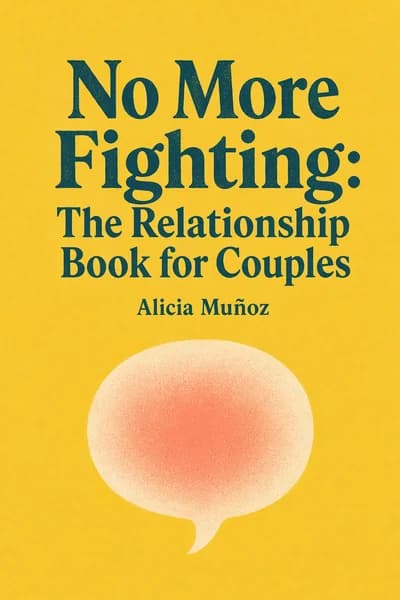
Have you ever wondered why some couples seem to thrive despite constant disagreements while others crumble under the weight of a single argument? Alicia Munoz's groundbreaking work "No More Fighting" has become a relationship bible for couples seeking to transform conflict into connection. This book has earned praise from relationship experts worldwide and has been featured in Psychology Today, The New York Times, and numerous podcasts. What makes it particularly compelling is Munoz's refreshing approach-she doesn't promise a conflict-free relationship but instead offers something more valuable: the tools to make conflict meaningful. Drawing from her personal journey through divorce and remarriage, combined with her extensive clinical experience, Munoz presents a year-long program that has helped thousands of couples develop what she calls "antifragility"-the capacity to not just survive relationship storms but to grow stronger because of them.
Chapter 2
The Oxygen Mask Principle: Self-Care as Relationship Foundation
When Hanako and Saul came to therapy, they were caught in a painful cycle. Hanako, a medical resident working grueling 12-hour shifts, felt constantly criticized by Saul despite his apparent devotion to handling all household responsibilities. The problem wasn't lack of care but a fundamental imbalance in how care was exchanged. Their situation exemplified a common pattern where one partner's well-intentioned support actually creates distance rather than connection.
Saul, who had stepped into a caretaker role during childhood when his mother fell ill, had developed an identity around providing for others. This role began at age twelve when he managed household duties and cared for his younger siblings while his mother battled chronic illness. Yet when Hanako attempted to reciprocate-cooking dinner, picking up his dry cleaning, or scheduling his medical appointments-he dismissed her efforts, creating a no-win situation. His childhood experiences had conditioned him to give care but not receive it, leaving both partners frustrated and disconnected.
This pattern illustrates what therapists call the "oxygen mask principle"-just as airplane safety instructions direct you to secure your own mask before helping others, relationships require self-care before partner-care. Without it, one partner depletes themselves while the other feels perpetually inadequate. The consequences often manifest as chronic exhaustion, resentment, and an increasing emotional distance that neither partner knows how to bridge.
The solution isn't simply taking turns caretaking but developing genuine self-awareness about what nourishes you. For Saul, this meant recognizing that his caretaking identity had become a defense against vulnerability. Through therapy, he discovered that accepting help triggered deep-seated fears of abandonment from his childhood. By learning to receive care and prioritize his own needs-starting with small acts like letting Hanako make him breakfast or accepting her offer to handle bill payments-he could transform their relationship from a one-way street into a mutual exchange.
This principle extends beyond obvious self-care activities like exercise or meditation. It includes emotional self-regulation, boundary-setting, and acknowledging when you're running on empty. For instance, it might mean declining social obligations when overwhelmed, communicating needs clearly without guilt, or maintaining individual friendships and interests outside the relationship. When both partners commit to maintaining their own "oxygen supply," they bring their full, energized selves to the relationship rather than depleted versions seeking to be filled by the other.
The most powerful relationships aren't built on sacrifice but on two whole individuals choosing to share their completeness. This means recognizing that self-care isn't selfish-it's essential maintenance for sustainable love. By attending to your own needs first, you create the capacity to truly see and meet your partner without resentment or expectation. Successful couples learn to balance independence and interdependence, understanding that personal well-being and relationship health are inextricably linked.
For Hanako and Saul, implementing this principle led to profound changes. They established regular "self-care check-ins," where each partner shared their needs and boundaries for the coming week. This practice helped them move from a caretaker-dependent dynamic to a partnership of equals, each responsible for their own well-being while supporting the other's growth.
Chapter 3
The Power of No: Setting Boundaries for Authentic Connection
"Sometimes I wonder if you married me to be polite," Susan told her husband Arjun during a particularly tense therapy session. Their conflict had reached a breaking point when Arjun offered his visiting parents the couple's bed while suggesting he and Susan sleep on their futon couch-all without consulting Susan first. This moment crystallized years of mounting frustration over Arjun's pattern of prioritizing others' comfort over their shared boundaries as a couple.
Arjun's inability to say "no" wasn't just about politeness. As the child of immigrant parents who worked multiple jobs while raising three children, he had learned early that compliance reduced his parents' stress. This childhood survival adaptation had become a relationship-threatening pattern in adulthood. Growing up, he watched his parents sacrifice everything for their children's future, creating an implicit expectation that gratitude meant constant accommodation. Even minor disagreements triggered intense anxiety for Arjun, who associated conflict with the risk of destabilizing his family's precarious balance.
When we can't say "no," our "yes" becomes meaningless. For Susan, Arjun's constant agreeability created profound distrust-how could she believe in his commitment when she suspected it came from obligation rather than choice? She noticed how his smile would tighten when agreeing to plans he clearly didn't want, how he would later withdraw emotionally while technically fulfilling his promises. For Arjun, the fear of disappointing others by setting boundaries created a life of quiet resentment and disconnection from his authentic desires. He found himself avoiding activities he once loved because saying "yes" to everyone else left him depleted.
The path forward began with small experiments in boundary-setting. Arjun practiced saying "no" in low-stakes situations, gradually building his tolerance for the discomfort of potential disapproval. He started with simple things like declining additional work projects or suggesting alternative restaurants when friends made dinner plans. When he finally booked his parents a hotel room instead of displacing Susan from their bed, he faced his mother's disappointment but held firm in his boundary. Though difficult, this moment marked a crucial shift in both his marriage and his relationship with his parents.
This process reveals a counterintuitive truth about relationships: healthy boundaries don't create distance but actually enable genuine intimacy. When partners can honestly express their limits and needs without fear of abandonment or rejection, they create space for authentic connection based on choice rather than obligation. Through therapy, Arjun discovered that his parents respected him more when he demonstrated self-respect through boundary-setting. His relationship with Susan deepened as she could finally trust that his "yes" came from genuine desire rather than compulsion.
Boundary work isn't selfish-it's an act of relationship preservation. By defining where you end and your partner begins, you create clarity that prevents resentment from festering. The ability to say "no" protects the integrity of your "yes," ensuring that when you do agree to something, it comes from a place of genuine desire rather than fear or obligation. For couples like Susan and Arjun, learning to navigate boundaries becomes a fundamental practice in building trust, fostering mutual respect, and creating relationships where both partners feel seen and honored in their full humanity.
Chapter 4
Feeling Your Feelings: The Full Emotional Keyboard
"How it makes me feel? To see his shoes?" Janice's skeptical response to a seemingly simple therapy question revealed volumes about her relationship with emotions. As a successful diplomat navigating complex international negotiations, she excelled at reading and responding to others' needs but remained strikingly disconnected from her own emotional landscape. This disconnect manifested in subtle ways - from her measured tone in heated discussions to her tendency to intellectualize deeply personal matters.
Many couples struggle not with communication techniques but with emotional literacy-the ability to identify, express, and regulate feelings. Janice had learned from her protective Dutch parents, who lived through post-war austerity, to shield herself from painful emotions. She developed sophisticated mechanisms to neutralize feelings before they fully emerged: changing the subject, focusing on tasks, or retreating into work. Her husband Lloyd, raised in a more expressive American household, craved her vulnerability: "I need to know you're vulnerable... I like you when you're human. Even when you're scared or angry - especially then."
This emotional disconnect creates a particular kind of loneliness in relationships, a phenomenon psychologists call "emotional isolation." When one or both partners operate with limited emotional range, they miss the richness of human connection. It's like playing only Middle C on a piano repeatedly when you have 88 keys available - the music of relationship becomes monotonous, lacking the depth and variation that creates true intimacy.
Developing emotional literacy begins with naming feelings without judgment, a process that requires patience and practice. The basic emotional palette includes happiness, power, peace, sadness, anger, and fear-each with countless nuanced variations. For instance, anger might manifest as irritation, frustration, rage, or indignation. For Janice, acknowledging that she felt irritated when seeing Lloyd's shoes in the foyer opened a door to deeper self-awareness and connection, leading her to recognize patterns of control and perfectionism in other areas of her life.
The resistance to certain emotions often stems from childhood experiences when expressing feelings like anger or sadness brought punishment or neglect. In Janice's case, her father's stern response to emotional displays created an unconscious rule that "proper people don't lose control." These early lessons create deeply ingrained patterns about which emotions are "acceptable" and which must be suppressed. Breaking these patterns requires courage to face the discomfort of unfamiliar emotional territory and a safe relationship context for exploration.
Emotional literacy doesn't mean wallowing in negativity but expanding your capacity to experience the full range of human feeling. This expansion creates resilience-the ability to move through difficult emotions rather than being stuck in them. When couples develop this skill together, they create a relationship container strong enough to hold both joy and pain. This container becomes a safe space for vulnerability, allowing partners to share not just their successes but their fears, disappointments, and hopes. The result is unprecedented intimacy and understanding, where both partners can play across the full emotional keyboard, creating rich harmonies in their shared life.
Chapter 5
The Stories We Tell Ourselves: Narratives That Shape Reality
"The story I make up is that all you care about is sex," Gabriella told her husband Jack during a therapy session, adding "...and it makes me feel disgusted and angry." This simple phrase-"The story I make up"-marked a breakthrough in their decade-long relationship struggle. It represented the first time either of them had acknowledged the possibility that their interpretations might not represent absolute truth.
We are natural storytellers, constantly interpreting fragments of information to create coherent narratives. When Gabriella's husband mentioned their troubles began after her hysterectomy, she immediately constructed a story about his motivations and character. Her mind filled in gaps with assumptions based on past experiences, fears, and cultural messages about men and sexuality. These interpretations feel like absolute truth until we recognize them as subjective creations, shaped by our unique emotional landscapes and personal histories.
Our relationship "horror stories"-narratives like "I'm not good enough," "I can't trust anyone," or "My needs don't matter"-distort reality but paradoxically feel safer than directly asking our partners what they're thinking or feeling. A woman might interpret her partner's silence as rejection, while he's actually processing a difficult workday. A man might read his partner's criticism of his parenting as proof that she thinks he's incompetent, when she's expressing her own anxiety about their child's development. These stories often originate in childhood experiences and get projected onto current relationships, creating self-fulfilling prophecies.
The simple practice of prefacing assumptions with "The story I make up..." creates crucial distance between perception and reality. This linguistic shift acknowledges that our interpretations are subjective rather than factual, opening space for curiosity instead of certainty. For Gabriella, this awareness brought visible relief-like turning on a light and discovering that what seemed threatening was merely a coat rack. When she shared her story with Jack, he could respond to her interpretation rather than defend against an accusation.
These stories aren't harmless-they drive behavior in powerful ways. When Gabriella believed Jack only cared about sex, she responded with hostility and withdrawal, creating exactly the disconnection she feared. Her story led to defensive behaviors that prevented intimate conversations about their shared grief over the hysterectomy and its impact on their relationship. By recognizing her narrative as an interpretation rather than truth, she could interrupt this cycle and create space for genuine understanding.
Identifying your relationship horror stories requires vigilance and humility. Notice when you feel absolutely certain about your partner's motivations, especially when strong emotions arise. Watch for absolute terms like "always" or "never" in your internal dialogue. These moments of triggering often signal that an old story has been activated. Consider keeping a journal of your relationship stories, noting patterns in your interpretations and emotional reactions. By naming these stories and sharing them vulnerably with your partner, you transform potential conflict into opportunity for deeper connection and understanding. Regular practice in story awareness can gradually reshape your relationship narrative from one of threat and defensiveness to one of curiosity and compassion.
Chapter 6
The Art of Listening: Creating Space for Difference
Jessica and Andrew, a couple with a 30-year age gap, had developed a communication pattern with only two settings: silence or fighting. Their arguments ranged from petty nitpicking to character assassination, yet carried a strange undercurrent of comfort-as if conflict had become their home.
When introduced to the practice of "mirroring"-repeating back what your partner has said before responding-Jessica was skeptical: "Why is it important to reflect back what he says when I already know everything about him?" Her question revealed a fundamental misconception about listening that plagues many relationships.
True listening isn't about gathering information but about honoring your partner's separate reality. It demonstrates respect for their differences and creates space for their experience to exist without immediate judgment or correction. This practice feels painstaking at first precisely because it interrupts our habitual responses-the immediate contradictions, corrections, or defenses that shut down genuine communication.
The transformation began gradually as Jessica and Andrew took turns speaking and accurately reflecting what they'd heard. Instead of preparing rebuttals while the other spoke, they focused on remembering and mirroring their partner's words. This small shift created profound change-after several weeks, their pre-session interactions in the waiting room had evolved from tense silence to even-keeled conversation and occasional laughter.
Effective listening requires recognizing four common "communication stoppers": criticism (attacking character rather than behavior), defensiveness (deflecting responsibility), contempt (expressions of superiority), and stonewalling (emotional withdrawal). These patterns, identified by relationship researcher John Gottman as predictors of relationship failure, can be countered through conscious practice.
The most powerful aspect of deep listening is that it doesn't require agreement-only understanding. When partners feel truly heard, they become less rigid in their positions and more open to compromise. This creates a foundation for resolving conflicts that previously seemed intractable.
Developing this skill means temporarily setting aside your perspective to fully inhabit your partner's world. This isn't about abandoning your truth but about creating space to hold two different truths simultaneously-a capacity that transforms relationship conflict from a battle for dominance into an opportunity for growth and deeper connection.
Chapter 7
Validation and Empathy: The Bridge to Understanding
When Abigail and Yolanda faced conflict over including Yolanda's friend Greg in their wedding, they weren't just arguing about a guest list-they were navigating fundamentally different worlds. Abigail resented Greg's vulgar behavior and how he frequently excluded her from gatherings with Yolanda. Meanwhile, Yolanda dismissed these concerns with "Don't take it so personally," creating a deadlock that threatened their engagement.
The breakthrough came through validation-acknowledging the logic in your partner's perspective without necessarily agreeing with it. When Abigail finally said, "What you're saying makes sense. Your friends are like family to you," Yolanda responded with visible relief: "Wow. Thank you. That feels really, really good to hear you say."
Validation creates safety that allows partners to reveal deeper vulnerabilities. Only after feeling understood did Yolanda share how Greg had been her lifeline during childhood trauma with drug-addicted parents-calling an ambulance when her mother overdosed and supporting her through hospitalization and eventual death. Greg wasn't just a friend; he was family.
This process illustrates how validation serves as a bridge between separate realities. It doesn't require abandoning your perspective but rather expanding to include your partner's experience as equally legitimate. The phrase "What you're saying makes sense because..." opens doors that remain closed when we insist on a single correct viewpoint.
Empathy takes this connection deeper by imagining your partner's emotional experience. When Andrew shared his difficulty discarding meaningful possessions, Jessica moved beyond frustration to genuine understanding: "I imagine it feels painful. The memories. Sad. Overwhelming." This emotional attunement brought tears to Andrew's eyes and created space for mutual vulnerability as he admitted his fear of leaving her alone someday.
The power of empathy lies in its ability to transform conflicts by enlarging each partner's emotional world. Being present to a partner's full emotional truth-without trying to fix it, collapse into it, or push it away-creates connection that transcends specific disagreements.
These practices aren't just communication techniques but pathways to genuine intimacy. When partners feel validated and understood, they no longer need to defend their reality so vigorously, creating space for collaboration rather than competition. The result isn't just conflict resolution but a deeper sense of being known and accepted in all your complexity.
Chapter 8
Intimacy Tolerance: Finding Your Comfort Zone
Janice and Lloyd made significant progress in their communication-Janice was experiencing a wider range of emotions and sharing her vulnerability more freely. Yet a new challenge emerged: Lloyd's reactions to her openness sometimes seemed insensitive. When Janice shared about her father's heart attack, Lloyd excused himself to take a call about refrigerator repairs. When she expressed how much she valued him, he deflected with an insensitive joke.
These moments revealed differences in intimacy tolerance-the capacity to remain present during emotionally vulnerable exchanges. Just as partners may have different sexual desires or communication styles, they often have varying comfort levels with emotional closeness. Some find extended intimacy overwhelming while others crave it constantly.
An eye-gazing exercise highlighted these differences dramatically. Lloyd experienced physical discomfort after just seconds of eye contact: "There's a heaviness in my stomach and the muscles in my throat go tight. It feels like I can't breathe." Janice, meanwhile, could look into Lloyd's eyes indefinitely, feeling mostly excitement and pleasure.
These reactions weren't random but rooted in early experiences. Lloyd's mother had inappropriately treated him as an emotional confidant during childhood, sharing adult concerns and even seeking comfort from him. This created confusion and resentment, teaching him that intimacy meant loss of self. For Lloyd, insensitive behaviors during intimate moments weren't intentional rejections but unconscious self-protection.
Understanding these differences helped both partners adapt. Janice learned to check Lloyd's comfort level before sharing vulnerabilities, while Lloyd practiced staying present despite discomfort, reminding himself that intimacy with Janice was a choice unlike his childhood experiences.
This awareness transforms the common "pursuer-distancer" dynamic in relationships. When partners understand their different intimacy tolerances as neither right nor wrong, they can collaborate rather than criticize. The partner who craves closeness learns patience and self-soothing, while the partner who needs space practices stretching their capacity for connection.
Recognizing your own intimacy avoidance patterns-breaking eye contact, changing subjects, checking your phone, growing restless-creates opportunities for growth. These moments of discomfort, when approached with curiosity rather than judgment, become gateways to deeper connection rather than barriers to it.
Chapter 9
Psychological Ownership: The Courage to Claim Your Truth
When Abigail and Yolanda returned from their honeymoon, tensions emerged as they sorted through furniture that wouldn't fit in their new shared space. During a particularly difficult moment, Abigail took psychological ownership of her emotions: "I'm afraid of trusting. Trusting that we're family now. It's something I've wanted my whole life. Now that it's happening, part of me thinks it's a trick. What if it doesn't last? I'm afraid I wouldn't recover."
This act of psychological ownership-claiming responsibility for our internal experiences rather than blaming others for them-transforms relationship conflicts. By acknowledging her fear, Abigail established boundaries while making herself vulnerable. She recognized she was creating her current reality through her perceptions and reactions rather than simply responding to Yolanda's behavior.
We often hold our psychological cards close in relationships, believing this protects us from vulnerability. We say "You make me so angry" instead of "I feel angry when this happens," or "You never listen" rather than "I feel unheard when you look at your phone while I'm speaking." This language creates an illusion of safety but actually diminishes our power and authenticity.
Speaking without ownership confuses our partners and prevents genuine connection. When we show our cards-revealing our fears, hopes, and vulnerabilities-we create the possibility for collaboration rather than combat. Psychological ownership means standing in your truth even when it feels risky, acknowledging that your perceptions are filtered through your unique history and triggers.
This practice becomes particularly important when examining projections-the tendency to attribute our own disowned qualities to others. When Hanako criticized Saul for being angry, irresponsible, and reckless, she eventually recognized these were qualities she couldn't tolerate in herself. By owning her projection, she freed both herself and Saul from an impossible dynamic.
Psychological ownership isn't about taking blame but about reclaiming agency. When we own our reactions, we move from victim to creator in our relationships. This shift doesn't guarantee our partner will respond perfectly, but it creates authentic connection based on truth rather than manipulation or defense.
The courage to claim your truth-including your fears, judgments, and vulnerabilities-paradoxically creates greater safety in relationships. When vulnerabilities are received with compassion, they build trust and draw partners closer rather than pushing them away.