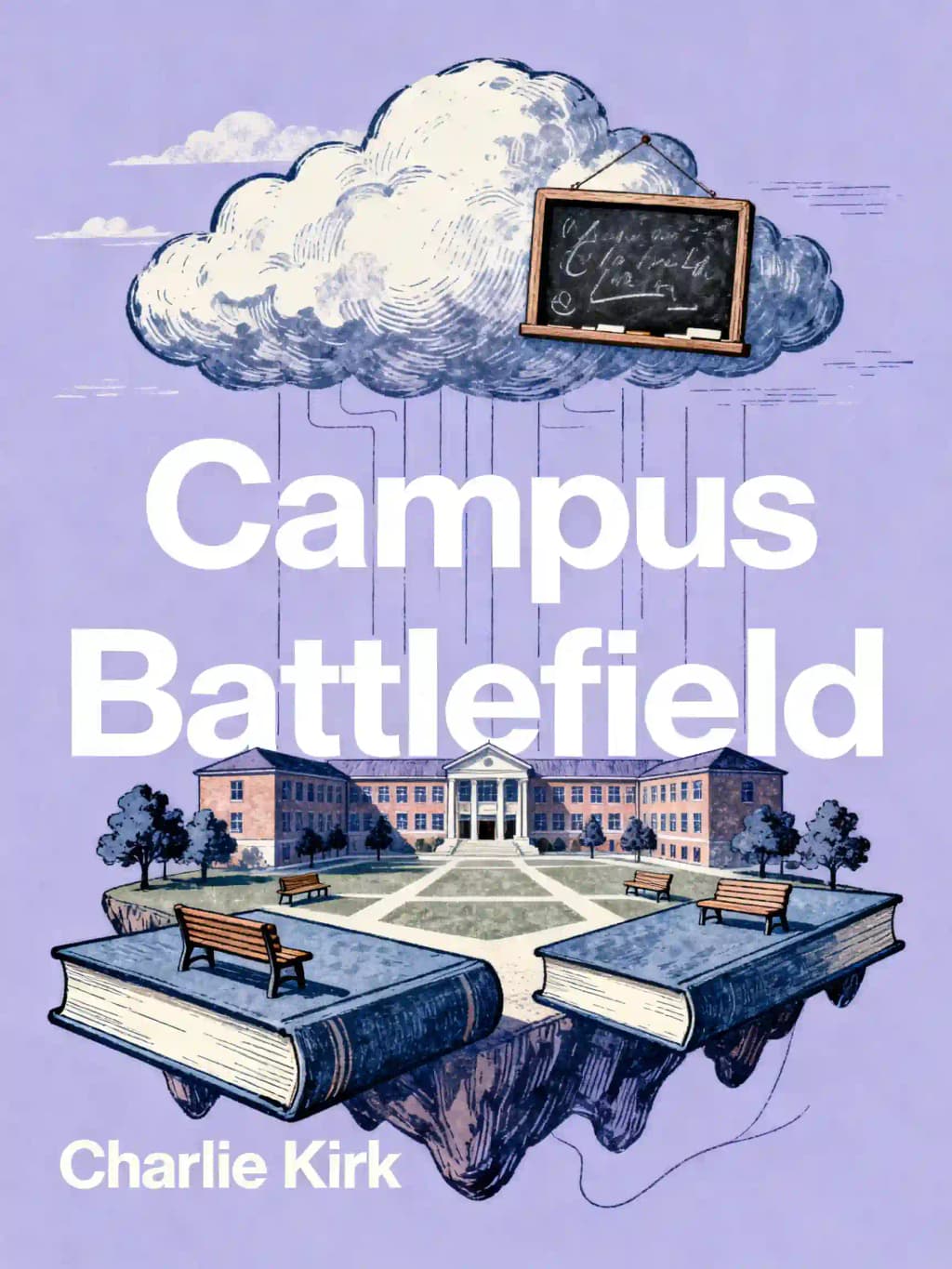
Campus Battlefield
How Conservatives Can WIN the Battle on Campus and Why It Matters
Overview of Campus Battlefield
Charlie Kirk's "Campus Battlefield" exposes universities as ideological battlegrounds. Featuring Donald Trump Jr.'s foreword and fueling Kirk's viral tour that garnered 2 billion views, this compact manifesto reveals why Gen Z conservatives are mobilizing - with TikTok stars now making conservatism unexpectedly cool.
Key Themes in Campus Battlefield
- campus free speech
- ideological echo chambers
- conservative student activism
- safe space culture
- microaggression framework
Quotes from Campus Battlefield
Protection became segregation.
Words have been transformed into weapons.
The accuser serves simultaneously as prosecutor, judge, and jury.
Universities should be preparing students for the world as it exists-not sheltering them from it.
Safe spaces become fundamentally problematic when they undermine higher education's essential purpose.
Characters in Campus Battlefield
- Charlie KirkAuthor and founder of Turning Point USA
- Donald Trump Jr.Conservative figure who wrote the book's foreword
- Ben ShapiroInfluential conservative who praised the book
- Chester PiercePsychiatrist who coined the term microaggression
About the Author
About the Author of Campus Battlefield
Charlie Kirk, founder and president of Turning Point USA, is the bestselling author of Campus Battlefield and a prominent conservative activist dedicated to youth engagement.
The book examines cultural and political conflicts on college campuses, drawing from Kirk's firsthand experience building the nation's largest conservative student movement across 3,000+ campuses.
A frequent Fox News commentator and host of The Charlie Kirk Show podcast, Kirk expands on these themes in his other works including the #1 New York Times bestseller The MAGA Doctrine and The College Scam. His upcoming book Rightwing Revolution continues this focus.
Kirk's frontline campus activism informs his critique of academic culture, with Turning Point USA mobilizing over 650,000 students under his leadership.
Download Summary of Campus Battlefield
Get the Campus Battlefield summary as a free PDF or EPUB. Print it or read offline anytime.
FAQs About This Book
Campus Battlefield analyzes the ideological clashes on American college campuses, arguing that conservative students face systemic discrimination from liberal-dominated institutions. Kirk contends universities suppress free speech, promote leftist indoctrination, and marginalize right-leaning perspectives. He outlines strategies for conservatives to counter progressive dominance through campus organizing, free-market advocacy, and political engagement. The book frames higher education as a critical battleground for America’s cultural future.
This book targets conservative students, activists, and educators seeking to challenge liberal bias in academia. It’s equally relevant for parents concerned about ideological indoctrination and policymakers interested in education reform. Kirk’s insights appeal to readers advocating for free speech, limited government, and traditional values in educational spaces.
Critics dismiss the book as a "marketing pitch" for Turning Point USA (TPUSA), lacking substantive analysis. Reviews highlight its heavy reliance on Kirk’s tweets and recycled quotes, calling it a "thin hot mess." Detractors argue it prioritizes grievance narratives over constructive solutions and oversimplifies campus dynamics.
Kirk documents instances of conservative voices being silenced through deplatforming, biased curricula, and administrative hostility. He advocates for counterspeech tactics like forming TPUSA chapters, inviting right-wing speakers, and leveraging social media to expose bias. The book emphasizes mobilizing student networks to reclaim intellectual diversity.
Kirk urges conservatives to:
- Organize student groups to challenge progressive monopolies.
- Promote free-market ideas through campus events and debates.
- Leverage alumni and donors to pressure administrations.
- Utilize legal avenues when speech rights are violated.
The book serves as a manifesto for TPUSA’s mission, detailing its growth from a small initiative to a 3,000-campus network. Kirk shares internal strategies used by TPUSA to mobilize youth, illustrating real-world applications of the book’s principles.
Key quotes include:
"Universities are factories of liberal conformity."
"Conservatives must stop apologizing for their beliefs."
These encapsulate Kirk’s call to action against ideological homogeneity.
Kirk accuses administrators of enabling "brainwashing" through diversity initiatives that stigmatize conservative views. He cites budget bloat, tuition hikes, and the suppression of dissenting speakers as evidence of institutional malpractice. The book argues that such policies prioritize ideology over education.
For conservatives navigating academia, it offers tactical guidance and moral validation. However, its polemical style and anecdotal focus limit its appeal to non-conservatives. While praised by right-wing audiences, it’s criticized for lacking empirical depth and nuanced discourse.
His experience founding TPUSA at 18—without a college degree—informs the book’s grassroots focus. Kirk draws from TPUSA’s expansion to argue that institutional change is possible through youth-led movements, framing his personal journey as a blueprint.
Unlike theoretical critiques, Kirk’s book emphasizes actionable organizing, mirroring TPUSA’s model. It uniquely combines memoir, political strategy, and cultural analysis, differentiating it from academic treatises on campus politics.
Kirk condemns "safe spaces" and speech codes as tools to silence conservatives. He champions unfiltered debate, using examples like TPUSA’s provocative events to illustrate resistance against censorship. The book positions free expression as essential to ideological competition.