Chapter 4
Paradise Lost: Ignatius at Work
When financial necessity forces Ignatius to seek employment, he reluctantly accepts a filing position at Levy Pants, a declining garment factory run by the absentee owner Mr. Levy and managed by the meek Mr. Gonzalez. Here, Ignatius encounters Miss Trixie, an elderly secretary who can barely remember her own name, and the black factory workers who toil in deplorable conditions for minimal wages.
Rather than simply performing his filing duties, Ignatius launches what he calls a "crusade" to improve working conditions. He attempts to organize the factory workers into a protest movement, performing a ridiculous dance to inspire them and creating a crude banner depicting Mr. Levy being stabbed. When he forges Mr. Levy's signature on an insulting letter to the company's largest client, his brief career at Levy Pants comes to an abrupt end.
His next job, selling hot dogs from a Paradise Vendors cart, provides even richer comic material. Dressed as a pirate (his own embellishment to the uniform), Ignatius roams the French Quarter, consuming most of his inventory and attracting stray cats with his food handling practices. When he meets Gus, a mysterious man who possesses Ignatius's stolen copy of "The Consolation of Philosophy," he agrees to help transport packages that turn out to contain pornography.
These workplace episodes reveal Ignatius's fundamental inability to adapt to social norms. Every environment he enters becomes transformed by his presence-not through genuine reform, but through chaos. His "crusades" are doomed to failure because they spring not from true concern for others but from his own grandiose self-image. The black factory workers don't see him as an ally but as another white man using them for his own purposes. His supervisor at Paradise Vendors doesn't see an innovative employee but a liability who eats the profits.
Yet there's something almost admirable about Ignatius's refusal to conform. In a world of mindless consumption and exploitation, his rejection of workplace norms represents a kind of resistance, however ineffective. When he tells the factory workers that "Fortuna has spun you downward, downward," he's expressing a genuine insight about their economic situation, even if his medieval framework and patronizing attitude undermine his message.
The workplace scenes also highlight the novel's broader social critique. New Orleans emerges as a city of stark inequality, where the wealthy Levys live in suburban comfort while their workers struggle in squalor. The economic system traps everyone-even Ignatius, with his education and intelligence, cannot escape the need to work for wages that barely cover his expenses. The American dream of upward mobility appears as a cruel joke in the decaying urban landscape.
Chapter 5
The Carnivalesque Underworld
New Orleans itself becomes a central character in the novel-not the tourist-friendly version but a decadent underworld populated by strippers, hustlers, and outcasts. The Night of Joy bar serves as the novel's dark heart, a place where various plot threads converge amid the smell of cheap liquor and desperation.
Lana Lee, the bar's owner, runs a pornography operation using the hot dog vendor Gus as her courier. Darlene dreams of becoming an exotic dancer, practicing with a cockatoo that will become instrumental in Ignatius's downfall. Burma Jones, forced to work for pitiful wages to avoid vagrancy charges, sweeps the floors while plotting his revenge against Lana's exploitation.
This setting allows Toole to explore themes of racial and sexual politics with remarkable nuance for a novel written in the 1960s. Jones, despite being relegated to menial labor, possesses a shrewd intelligence and moral clarity that many of the white characters lack. His distinctive voice-rendered in dialect that captures both his cultural background and his sardonic wit-provides some of the novel's most incisive commentary. When he remarks that he's working for "slavery wage," he cuts through Ignatius's theoretical medievalism to the economic reality of racial inequality in America.
The sexual politics of the Night of Joy reveal another dimension of the novel's social critique. Lana exploits female sexuality for profit, selling pornographic photos while treating her employees with contempt. Darlene's dream of becoming a dancer represents both a desire for autonomy and a capitulation to the commodification of women's bodies. Ignatius, despite his professed moral superiority, becomes obsessed with a woman in the pornographic photos who resembles a former professor, revealing the hypocrisy beneath his puritanical facade.
The carnivalesque atmosphere reaches its peak during Ignatius's visit to the Night of Joy to see what he believes will be the professor-like woman's performance. Instead, he witnesses Darlene's disastrous debut with her cockatoo, which becomes entangled in his earring. The resulting chaos-Ignatius crashing through tables, fleeing into the street, and being hit by a bus-exemplifies the novel's blend of physical comedy and social satire. The high-minded philosopher is literally brought low by his own prurient interests, his massive body sprawled on the pavement for newspaper photographers to capture.
This scene also represents a turning point in the narrative. Ignatius can no longer maintain the fiction of his moral superiority when his hypocrisy is so publicly exposed. The fortress of medievalism begins to crumble as reality intrudes, setting the stage for the novel's resolution.
Chapter 6
The Wheel of Fortune Turns
Throughout the novel, Ignatius invokes Boethius's concept of Fortune's wheel-the idea that fate capriciously raises people up only to cast them down again. This medieval philosophy provides him with an external explanation for his failures, absolving him of responsibility. Yet as the story progresses, we see that many of Ignatius's misfortunes are self-inflicted, the result of his refusal to adapt to social realities or consider others' needs.
The wheel imagery recurs in various forms. Ignatius's mother's car accident sets the plot in motion. The hot dog cart he pushes through the French Quarter becomes another wheel carrying him toward his destiny. Even the cockatoo's circular dance at the Night of Joy suggests the turning of Fortune's wheel. These circular motions reflect the novel's structure, which brings characters together in increasingly complex patterns until they collide in the final chapters.
As Ignatius's public humiliation spreads through newspaper coverage, his mother Irene reaches her breaking point. Years of enabling his behavior give way to a desperate plan to have him committed to a mental institution. Meanwhile, Mr. Levy discovers the insulting letter Ignatius sent to his client, creating another crisis that threatens to engulf him. The pornography operation at the Night of Joy is exposed through Officer Mancuso's investigation, aided by Burma Jones's strategic revelations.
These converging plot lines create a sense of inevitable catastrophe for Ignatius. The medieval world he has constructed cannot withstand the pressures of modernity. His mother's newfound independence, fostered by her friendship with Santa Battaglia and Officer Mancuso, represents a threat to his domestic arrangement. The legal consequences of his actions at Levy Pants loom over him. Even his body rebels, as his valve problems worsen under stress.
In this moment of crisis, Myrna Minkoff arrives from New York, having sensed through Ignatius's letters that something is wrong. Despite their ideological battles, she represents his only genuine connection to another person who understands his intellect. Their escape together in her car, just moments before the ambulance arrives to take Ignatius to the mental hospital, provides a resolution that is neither triumphant nor tragic.
This ending embodies the novel's ambivalent attitude toward its protagonist. Ignatius escapes immediate disaster but remains trapped within himself. The wheel has turned, sparing him commitment but sending him into an uncertain future with Myrna. There's no suggestion that he has fundamentally changed or gained self-awareness. Instead, he seems likely to continue his pattern of grandiose schemes and inevitable failures in a new setting.
The wheel turns for other characters as well. Burma Jones uses his knowledge of Lana's illegal activities to secure better employment. Miss Trixie finally gets her retirement. Irene forms a potential romantic connection with Claude Robichaux. These resolutions suggest that while Fortune may be capricious, human agency still matters-those who take action to change their circumstances may succeed, while those who merely rail against fate remain trapped.
Chapter 7
A Gallery of Grotesques
What distinguishes "A Confederacy of Dunces" from conventional satire is its refusal to provide a moral center. There are no purely sympathetic characters to guide our judgment-instead, we're presented with a gallery of grotesques, each flawed in distinctive ways. This approach creates a democratic vision of human folly that implicates everyone, regardless of class, race, or education.
Irene Reilly, Ignatius's long-suffering mother, initially appears as a victim of her son's tyranny. Her drinking and emotional outbursts seem understandable responses to her situation. Yet as the novel progresses, we see her complicity in enabling Ignatius's behavior over many years. Her newfound backbone, inspired by Santa Battaglia's influence, comes with a cruel edge-her willingness to have Ignatius committed reveals the limitations of her maternal love.
Santa Battaglia, with her aggressive matchmaking and domineering personality, represents another kind of excess. Her conventional morality contrasts with Ignatius's medievalism but proves equally rigid. Her house, filled with plastic-covered furniture and religious kitsch, embodies a different kind of bad taste than Ignatius's squalor but is no less grotesque.
Mr. and Mrs. Levy present a satire of wealthy suburban life. Their marriage consists largely of mutual recriminations, with Mrs. Levy weaponizing her psychoanalytic jargon against her husband. Mr. Levy's guilt over his father's business practices leads him to keep the failing Levy Pants operating, despite its inefficiency. Their daughter's expensive education has produced nothing but pretension and entitlement.
Even Burma Jones, perhaps the most morally clear-eyed character, operates through deception and manipulation to achieve his ends. His revenge against Lana Lee is justified but involves using others as pawns in his scheme. His dark sunglasses, worn even indoors, symbolize his detachment from the world around him-a necessary survival mechanism in a society that offers him so few opportunities.
This democratic vision of human folly connects to the novel's title, taken from Jonathan Swift's observation that "When a true genius appears in the world, you may know him by this sign, that the dunces are all in confederacy against him." Ignatius sees himself as the genius surrounded by dunces, but the novel suggests a more complex reality-perhaps we are all dunces in our own ways, forming confederacies against those who threaten our comfortable illusions.
The grotesque physical descriptions throughout the novel reinforce this theme. Bodies bulge, smell, make inappropriate noises, and fail their owners at crucial moments. Ignatius's enormous size and digestive problems, Miss Trixie's decrepitude, Lana Lee's excessive makeup, Officer Mancuso's ridiculous disguises-all suggest that the body itself is a kind of joke played on human dignity. Yet these physical descriptions never feel merely cruel; instead, they connect the characters to a shared human vulnerability that transcends their differences.
Chapter 8
The City as Character
New Orleans emerges in the novel not just as a setting but as a complex organism with its own personality and logic. Toole, a native son, captures the city's distinctive neighborhoods, speech patterns, and social hierarchies with anthropological precision and deep affection. This isn't the sanitized tourist version of New Orleans but a lived-in city of decaying grandeur and vibrant street life.
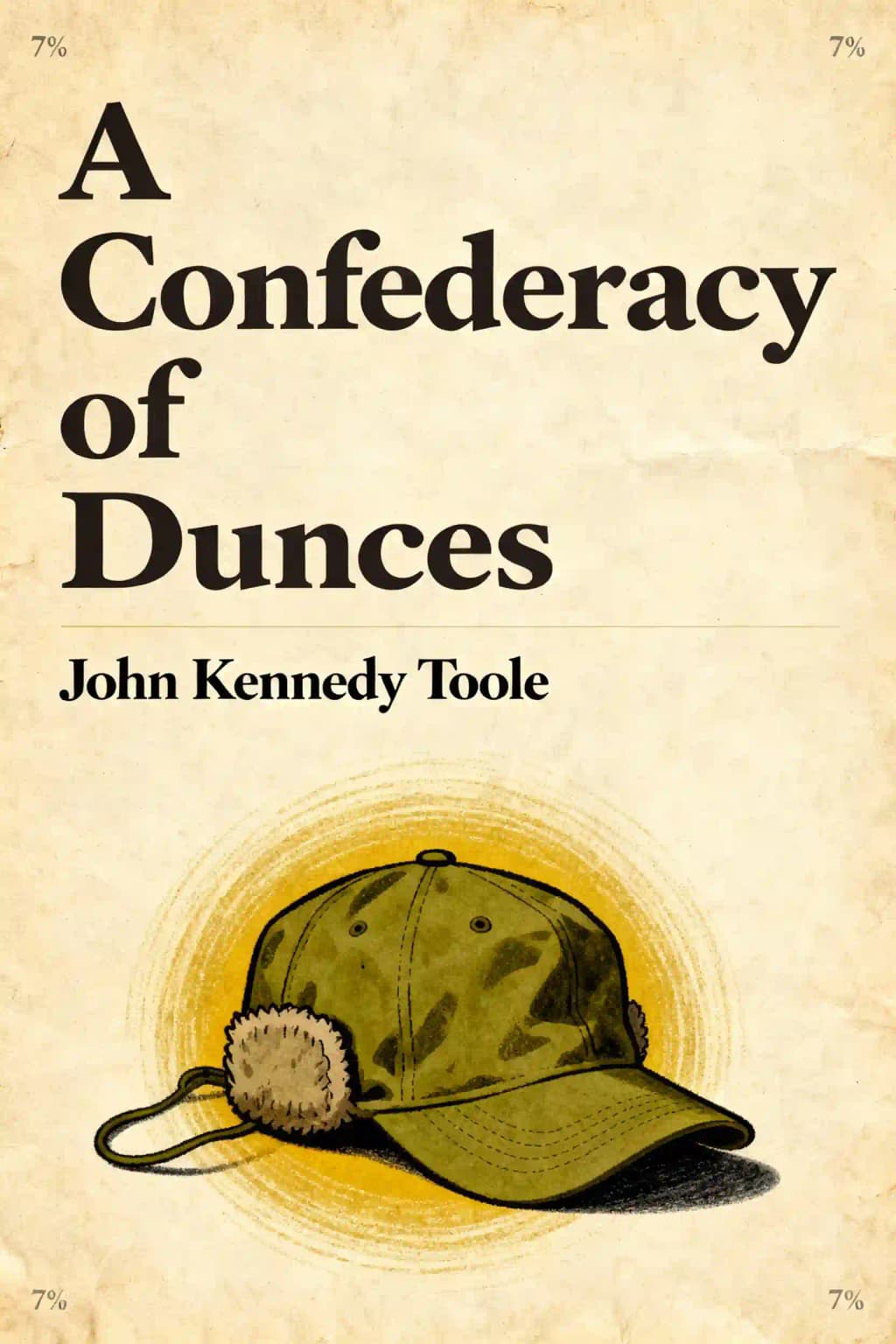
The French Quarter, with its mix of history and tawdriness, provides the perfect backdrop for Ignatius's medieval sensibility colliding with modern decadence. As he pushes his hot dog cart past strip clubs and tourist traps, the contrast between his lofty philosophical ideals and his sordid surroundings creates both comedy and poignancy. His costume-the hunting cap, the scarf, the pirate outfit he adopts for his vendor job-blends seamlessly into a city known for its carnival traditions and theatrical public life.
The novel also captures New Orleans' complex racial dynamics during the early civil rights era. The black factory workers at Levy Pants live in a different world from the white characters, yet these worlds inevitably intersect. Burma Jones navigates this racial landscape with strategic caution, aware that the system is stacked against him but finding ways to work within its constraints for his own benefit. His vernacular speech, rendered phonetically on the page, preserves the distinctive cadences of New Orleans' black community.
Class divisions appear in the contrasting neighborhoods-from the genteel decay of Ignatius and Irene's home to the suburban prosperity of the Levys to the working-class territory where Santa Battaglia reigns supreme. These divisions are reinforced by linguistic markers, as characters from different backgrounds speak in distinctive dialects and registers. Mrs. Levy's pseudo-intellectual psychobabble contrasts with Santa's blunt neighborhood talk, while Ignatius's archaic formality sets him apart from everyone.
Food becomes another way the novel establishes New Orleans as a character. Ignatius's consumption of hot dogs, his mother's cooking, the meals at the Night of Joy-all reflect the city's obsession with eating as both sustenance and performance. When Ignatius gorges himself on his vendor's wares, he's participating in a distinctly New Orleans tradition of public indulgence, even as he violates the economic logic of his job.
Perhaps most importantly, the novel captures the city's tolerance for eccentricity. In another setting, Ignatius would be institutionalized much sooner, but New Orleans accommodates his strangeness for quite some time. The city's carnival tradition, where social norms are temporarily suspended and the world turns upside down, provides a context for understanding the novel's structure. Like carnival itself, the story creates a space where hierarchies are inverted, bodies are exaggerated, and conventional morality is suspended-only to be reasserted at the end when Ignatius must flee.
Chapter 9
A Confederacy Against Modernity
Beyond its comic surface, "A Confederacy of Dunces" offers a serious critique of modern American society that remains relevant decades after its creation. Through Ignatius's medieval perspective, Toole examines the alienation, consumerism, and spiritual emptiness of contemporary life, suggesting that our "progress" has come at a significant cost.
Ignatius's rejection of modernity isn't merely cranky conservatism; it contains genuine insights about what has been lost in the transition to consumer capitalism. His reverence for Boethius represents a longing for a time when philosophy addressed fundamental questions about human existence rather than academic specialization. His disgust with mass entertainment-even as he compulsively consumes it-highlights the emptiness of a culture that has replaced communal traditions with commercial spectacle.
The workplace scenes offer particularly sharp social criticism. Levy Pants represents the dehumanization of industrial labor, where workers are treated as interchangeable parts in a machine they don't control. Paradise Vendors shows the indignity of service work, where employees must debase themselves (literally becoming costumed performers) to sell products of questionable value. Even the Night of Joy, with its commodification of sexuality, reflects the market's penetration into the most intimate aspects of human life.
Technology appears as both fascinating and threatening. Television exerts a hypnotic power over Ignatius, drawing him into a love-hate relationship with programs he simultaneously mocks and can't stop watching. The newspaper's ability to instantly transform private humiliation into public spectacle foreshadows our contemporary concerns about privacy in the digital age. Cars-particularly Irene's repeatedly crashed Plymouth-represent both freedom and danger, the promise and peril of mobility in modern America.
Political movements fare no better under Toole's satirical gaze. Ignatius's attempt to organize gay men into a political party to infiltrate the military and bring about world peace through pacifism parodies both right-wing conspiracy theories and left-wing utopianism. Myrna's earnest activism, with its jargon and self-righteousness, receives equally skeptical treatment. The novel suggests that political ideologies often serve psychological needs rather than addressing real social problems.
Yet for all its criticism of modernity, the novel doesn't simply advocate a return to the past. Ignatius's medievalism is clearly portrayed as delusional, a fantasy that allows him to avoid confronting his own limitations. The pre-modern world he imagines-with its clear moral hierarchies and divine order-never actually existed in the form he envisions. His rejection of modernity is ultimately as selective and self-serving as the consumerism he criticizes.
This ambivalence gives the novel its enduring power. Rather than offering simple solutions to the problems of modern life, it suggests that human folly transcends any particular social arrangement. The "confederacy of dunces" includes not just those who embrace modernity uncritically but also those who reject it without understanding their own motivations. In this way, the novel achieves a kind of wisdom through comedy, showing us our shared absurdity while inviting us to laugh at it-and perhaps, in laughing, to gain some perspective on our own participation in the confederacy.
Chapter 10
The Tragic Genius Behind the Comedy
The story of John Kennedy Toole's life and death adds an unavoidable layer of meaning to "A Confederacy of Dunces." The parallels between creator and creation-both brilliant misfits struggling against a world that failed to recognize their genius-create a meta-narrative that enriches our understanding of the novel while deepening its tragedy.
Toole, like Ignatius, was highly educated and possessed a keen eye for social absurdity. Both moved between different worlds-academia and working-class New Orleans-without fully belonging to either. Both struggled with mother relationships that were simultaneously supportive and suffocating. And both ultimately failed to find a sustainable place in society, though their failures took different forms.
The novel's publication history reads like a plot that Toole himself might have created. After numerous rejections from publishers who couldn't categorize his unusual work, Toole fell into depression and eventually committed suicide in 1969, leaving the manuscript in a drawer. His mother, Thelma Toole-as persistent and forceful as any character in the novel-spent years trying to get it published, finally convincing novelist Walker Percy to read it. Percy's astonishment at discovering this "great comic talent" led to its publication in 1980 and the Pulitzer Prize in 1981.
This posthumous vindication gives the novel an additional resonance. When Ignatius rails against a world that fails to appreciate his genius, we hear echoes of Toole's own frustration with publishers who couldn't see the value of his work. The "confederacy of dunces" takes on a meta-literary dimension, encompassing not just the characters who oppose Ignatius but the real-world gatekeepers who rejected Toole.
Yet the novel resists simple identification between author and protagonist. Toole was clearly aware of Ignatius's flaws and portrays them with unflinching clarity. The comedy depends on our ability to see Ignatius as both sympathetic and ridiculous-a balance that suggests Toole had achieved a degree of self-awareness that his character lacks. In creating Ignatius, Toole may have been exorcising aspects of himself that he recognized as problematic while preserving the genuine insights that came with his outsider perspective.
The tragedy of Toole's suicide adds poignancy to the novel's ending. While Ignatius escapes New Orleans with Myrna, finding at least a temporary reprieve from his troubles, Toole himself found no such escape. The wheel of fortune that turned in Ignatius's favor at the last moment did not turn for his creator until it was too late for him to witness it.
This biographical context doesn't diminish the novel's achievement but enhances it. "A Confederacy of Dunces" succeeds not just as comedy but as a profound exploration of alienation, genius, and the difficulty of finding one's place in a world that values conformity over creativity. Its enduring appeal lies partly in this dual nature-we laugh at Ignatius's absurdity while recognizing the genuine pain of exclusion that drives his behavior.
In this way, the novel transcends its specific time and place to speak to anyone who has ever felt out of step with their society. Its continued relevance in our own era of increasing social isolation and political polarization suggests that Toole's vision was not just comic but prophetic-a warning about what happens when we lose the ability to connect across our differences and become trapped in our own intellectual fortresses.