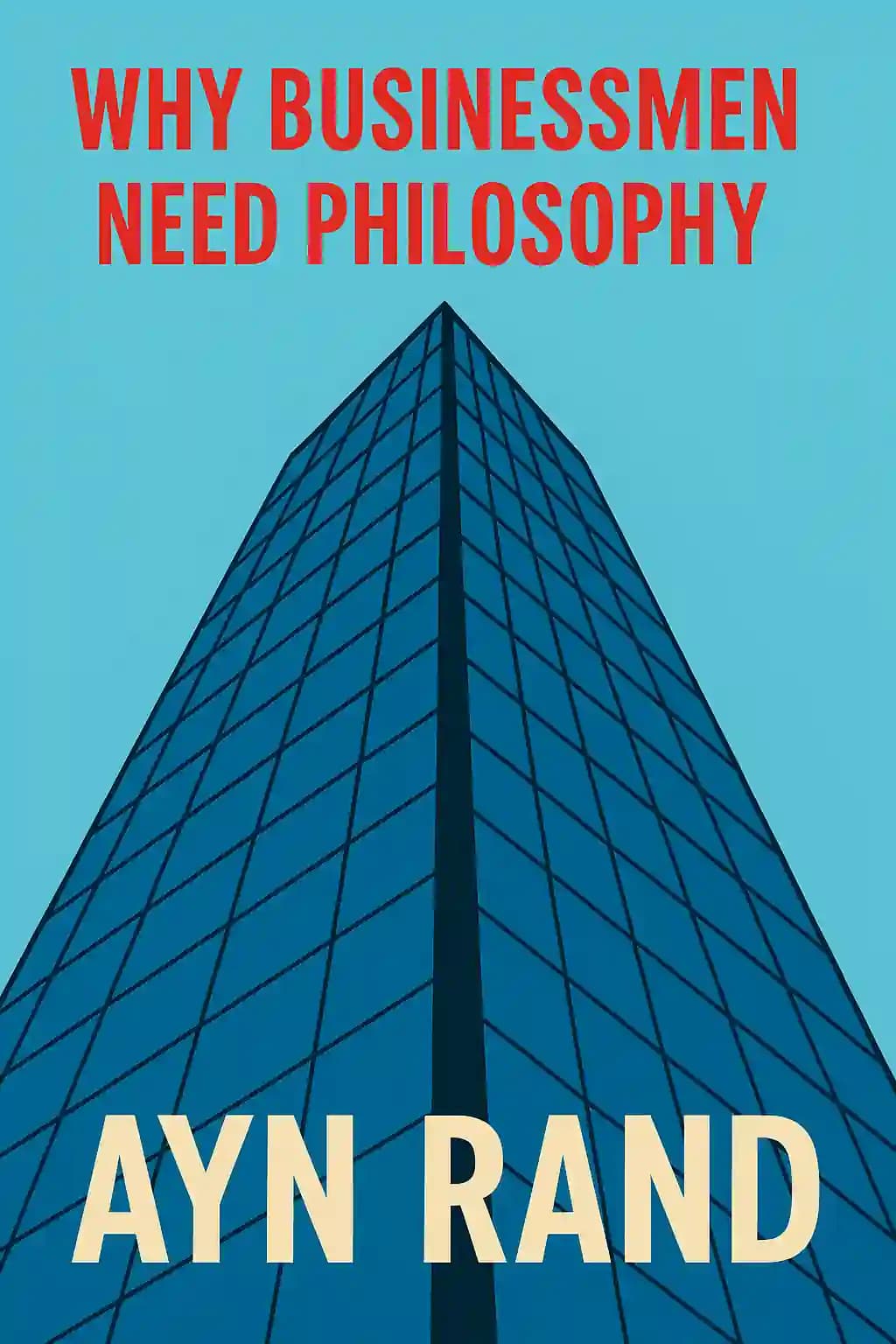
In "Why Businessmen Need Philosophy," Ayn Rand defends capitalism's moral foundation. Former BB&T CEO John Allison's introduction underscores its relevance for leaders seeking ethical clarity. What if the philosophical principles rejected by academia are actually essential for business success?
Ayn Rand (1905–1982), born Alissa Rosenbaum in St. Petersburg, Russia, was a philosopher, novelist, and influential advocate of Objectivism, a philosophy centered on rational self-interest and individualism.
Her essay collection Why Businessmen Need Philosophy distills her ideas on capitalism, reason, and moral clarity, reflecting her belief that philosophy is essential to practical decision-making. Rand’s works, including bestsellers Atlas Shrugged and The Fountainhead, blend fiction with philosophical discourse, critiquing collectivism and championing entrepreneurial freedom.
A refugee from Soviet Russia, her anti-communist stance and defense of laissez-faire capitalism stemmed from firsthand experiences with totalitarianism. Her nonfiction works, such as The Virtue of Selfishness and Capitalism: The Unknown Ideal, further systematize her ideas, which have influenced libertarian thought and business leaders worldwide. Atlas Shrugged alone has sold over 10 million copies, cementing Rand’s legacy as one of the 20th century’s most provocative thinkers.
Why Businessmen Need Philosophy is a collection of essays defending capitalism through Ayn Rand’s Objectivist philosophy. It argues that business leaders need philosophical principles to justify profit-driven enterprise, counter anti-capitalist rhetoric, and embrace rational self-interest as moral. Key themes include the spiritual value of creation, critiques of altruism, and capitalism’s role in human flourishing.
This book targets business professionals, entrepreneurs, and free-market advocates seeking intellectual tools to defend capitalism. It’s also valuable for readers interested in Ayn Rand’s ethics, Objectivism’s application to business, or philosophical critiques of collectivism. The essays blend theory with practical advice for navigating ideological challenges.
Yes, for those seeking a moral defense of capitalism. The book offers rare essays by Rand and Objectivist thinkers like Harry Binswanger, linking philosophy to real-world business decisions. It provides frameworks to reject guilt over profit-seeking and address accusations of corporate greed.
Rand portrays businessmen as heroic creators who transform ideas into tangible goods, driving progress. Their pursuit of profit is a spiritual endeavor, reflecting reason, productivity, and self-esteem. This contrasts with societal views of business as purely materialistic.
Harry Binswanger’s essay argues philosophy acts as the “ultimate CEO” by providing a coherent worldview for strategic decisions. Just as CEOs set corporate vision, philosophy addresses fundamental questions about reality, ethics, and human potential, guiding long-term business success.
The essays reframe “greed” as virtuous self-interest, emphasizing that ethical profit requires creating value for others. Rand’s philosophy rejects altruism as immoral, asserting that guilt-free ambition drives innovation and societal wealth.
Altruism is labeled destructive because it demands self-sacrifice, discourages innovation, and enables collectivist policies. The book argues that equating morality with sacrifice undermines capitalism’s ethical foundation and empowers anti-business rhetoric.
Both works defend capitalism through Rand’s Objectivist lens. Atlas Shrugged’s fictional entrepreneurs mirror the essays’ real-world arguments, illustrating how philosophical principles shape economic systems and individual achievement.
The book remains pertinent amid debates over corporate responsibility, ESG criteria, and wealth inequality. Its defense of profit-driven innovation offers counterarguments to modern critiques of capitalism, particularly in tech and global markets.
Critics argue Rand’s rejection of altruism oversimplifies morality and ignores systemic inequities. Some view the essays as overly dogmatic, dismissing valid concerns about corporate power or environmental impacts.
Feel the book through the author's voice
Turn knowledge into engaging, example-rich insights
Capture key ideas in a flash for fast learning
Enjoy the book in a fun and engaging way
Wealth creation begins not with physical resources or labor but with human thought.
Selfishness has been universally condemned while self-sacrifice has been praised as the highest virtue.
Profit-seeking isn't merely tolerated but celebrated as a moral achievement.
The businessman epitomizes the productive mind in action.
The businessman who creates valuable products is actively virtuous.
Break down key ideas from Why businessmen need philosophy into bite-sized takeaways to understand how innovative teams create, collaborate, and grow.
Distill Why businessmen need philosophy into rapid-fire memory cues that highlight key principles of candor, teamwork, and creative resilience.

Experience Why businessmen need philosophy through vivid storytelling that turns innovation lessons into moments you'll remember and apply.
Ask anything, pick the voice, and co-create insights that truly resonate with you.

From Columbia University alumni built in San Francisco
"Instead of endless scrolling, I just hit play on BeFreed. It saves me so much time."
"I never knew where to start with nonfiction—BeFreed’s book lists turned into podcasts gave me a clear path."
"Perfect balance between learning and entertainment. Finished ‘Thinking, Fast and Slow’ on my commute this week."
"Crazy how much I learned while walking the dog. BeFreed = small habits → big gains."
"Reading used to feel like a chore. Now it’s just part of my lifestyle."
"Feels effortless compared to reading. I’ve finished 6 books this month already."
"BeFreed turned my guilty doomscrolling into something that feels productive and inspiring."
"BeFreed turned my commute into learning time. 20-min podcasts are perfect for finishing books I never had time for."
"BeFreed replaced my podcast queue. Imagine Spotify for books — that’s it. 🙌"
"It is great for me to learn something from the book without reading it."
"The themed book list podcasts help me connect ideas across authors—like a guided audio journey."
"Makes me feel smarter every time before going to work"
From Columbia University alumni built in San Francisco

Get the Why businessmen need philosophy summary as a free PDF or EPUB. Print it or read offline anytime.
A curious pattern emerged in Silicon Valley boardrooms and Wall Street corner offices: executives kept returning to the same philosophical text. Peter Thiel recommended it. John Allison built a banking empire on its principles. Yet most business books gathering dust on these same shelves offered nothing but tactical advice-how to optimize supply chains, boost quarterly earnings, or master the latest management fad. This collection asked something far more fundamental: Do you have the moral right to profit from your work? The question wasn't academic. In a culture that celebrates entrepreneurs in theory while vilifying them in practice, business leaders found themselves defenseless against accusations they couldn't quite answer. Why are successful businesspeople treated as villains despite creating prosperity? What gives anyone the right to pursue profit? These essays don't just defend capitalism-they transform how we understand wealth creation itself.