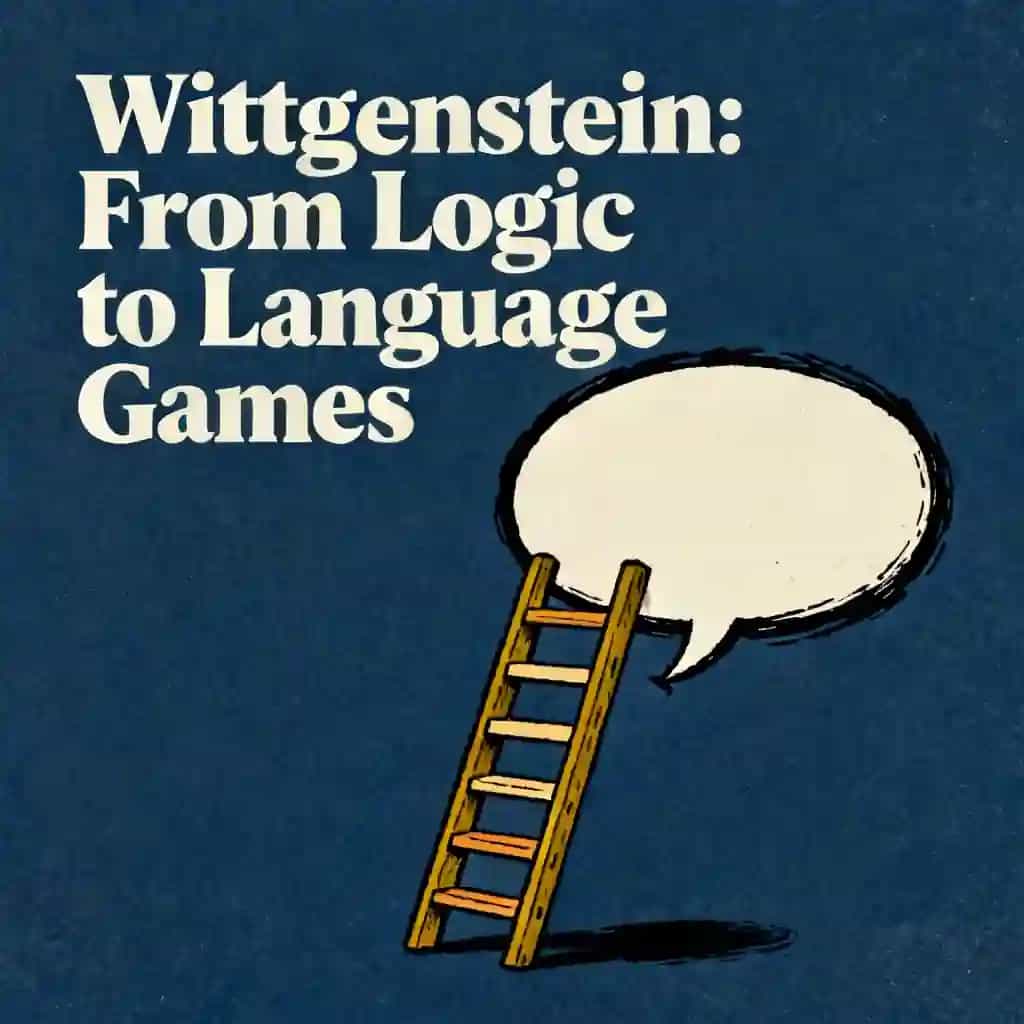
Philosophical investigations by Ludwig Wittgenstein Summary

Overview of Philosophical investigations
Wittgenstein's "Philosophical Investigations" revolutionized how we understand language, ranking as the most important philosophical text of the 20th century. What if everyday words don't mean what you think? Discover why this posthumous masterpiece transformed linguistics, anthropology, and cognitive science forever.
- Meaning arises from social use, not abstract definitions.
- "Language-games" determine word function within specific human activities.
- Philosophical problems dissolve when analyzing real-world language contexts.
- Private sensations can't sustain language without public verification.
- Concepts connect through family resemblances, not universal essences.
- Rules derive meaning from community practices, not private interpretations.
- Understanding requires mastering applications, not internal mental pictures.
- Truth claims rely on shared linguistic conventions, not absolutes.
- Wittgenstein frames philosophy as therapy for language confusion.
- "Forms of life" ground meaning in biological/cultural behaviors.
- Meaning stability emerges from recurring social interaction patterns.
- Language's purpose shifts based on situational "grammar" frameworks.
About the Author of Philosophical investigations
Ludwig Wittgenstein (1889–1951), the Austrian-born philosopher and author of Philosophical Investigations, revolutionized 20th-century philosophy with his groundbreaking work on language, meaning, and human understanding. A seminal figure in analytic philosophy, Wittgenstein shifted from his early focus on logical structure in Tractatus Logico-Philosophicus to exploring language as a dynamic, context-driven tool in Philosophical Investigations.
His later work introduced the concept of "language-games," arguing that meaning arises from use within social practices rather than fixed definitions—a framework that reshaped linguistics, cognitive science, and postmodern thought.
Educated at Cambridge under Bertrand Russell, Wittgenstein’s eclectic career included engineering, teaching, and monastic solitude, all informing his rigorous yet unconventional approach. Philosophical Investigations, published posthumously in 1953, remains a cornerstone of philosophy curricula worldwide, critiquing traditional metaphysics while offering a pragmatic view of communication. Its influence extends to fields from artificial intelligence to literary theory, with translations spanning over 30 languages. Wittgenstein’s dual legacy—bridging logic and lived experience—cements his status as one of history’s most consequential thinkers.
FAQs About Philosophical investigations
What is Philosophical Investigations by Ludwig Wittgenstein about?
Philosophical Investigations critiques traditional views of language, arguing meaning arises from contextual use rather than fixed definitions. Wittgenstein introduces language games—rule-bound social practices shaping communication—and challenges notions of private mental states. The work shifts focus from abstract logic to everyday language, exploring how words function in diverse human activities like teaching, joking, or commanding.
Who should read Philosophical Investigations?
This book suits philosophy students, linguists, and readers exploring language theory or 20th-century thought. Its analysis of meaning, rule-following, and mental states appeals to those studying epistemology, cognitive science, or semantics. While challenging, Wittgenstein’s dialogic style offers insights for anyone examining how communication shapes reality.
Is Philosophical Investigations worth reading?
Yes—Wittgenstein’s later work revolutionized philosophy of language, influencing fields from AI to sociology. Though fragmented, its critique of linguistic essentialism and emphasis on social context remain foundational. Readers gain tools to dissect ambiguities in communication, though its dense style demands patience.
What are “language games” in Philosophical Investigations?
Language games are contextual frameworks governing word use, akin to rules in sports. Wittgenstein compares commanding, joking, or praying to distinct games with unique norms. For example, the meaning of “water!” varies if shouted by a thirsty hiker versus a chemist in a lab. This concept rejects universal linguistic rules, emphasizing situational meaning.
How does Philosophical Investigations critique private language?
Wittgenstein argues private mental states (e.g., pain) cannot have meaningful linguistic labels without shared criteria. A personal “pain language” would lack verifiable rules, making communication impossible. Meaning requires communal validation—a rejection of Cartesian inner/outer divides.
What does “meaning as use” mean in Wittgenstein’s philosophy?
Words derive meaning from how they’re applied, not inherent definitions. “Checkmate” matters in chess but not chemistry; its function determines significance. This shifts focus from abstract symbolism to practical utility, analyzing language as a tool embedded in human activity.
How does Philosophical Investigations contrast with Wittgenstein’s Tractatus?
The Tractatus posits language mirrors reality via logical structure, while Investigations emphasizes fluid, context-driven meaning. The later work abandons rigid atomism for a pragmatic view where language evolves through social interaction. This marks Wittgenstein’s shift from logical positivism to ordinary language philosophy.
What are criticisms of Philosophical Investigations?
Critics cite its fragmentary structure and vagueness on normativity—how language rules stabilize. Some argue Wittgenstein overstates context-dependence, neglecting innate semantic frameworks. Others note his examples lack empirical rigor, leaning on thought experiments.
What are key quotes from Philosophical Investigations?
- “The limits of my language mean the limits of my world” [TLP] – Often cited to show language’s role in shaping perception.
- “If a lion could speak, we could not understand him” – Highlights how meaning hinges on shared forms of life.
- “Don’t ask for meaning, ask for use” – Epitomizes the shift from essence to function.
How is Philosophical Investigations relevant to AI and machine learning?
Wittgenstein’s focus on contextual meaning challenges AI’s reliance on static datasets. Training models require exposure to human “language games”—social nuances shaping word use. His work cautions against reducing language to syntax, urging integration of pragmatic, real-world interactions.
What are “forms of life” in Wittgenstein’s philosophy?
Forms of life are shared cultural/biological practices enabling communication. For example, pain-behavior links to empathy in humans, creating a framework for understanding “hurt”. These bedrock practices make language games intelligible, bridging individual and collective experience.
How does Philosophical Investigations approach philosophical problems?
Wittgenstein treats philosophy as therapy—dissolving perplexities by exposing linguistic confusions. Instead of solving “What is truth?” he examines how “truth” functions in specific contexts, dispelling false essentialism. The goal isn’t theory-building but clarifying misuse.
Are there modern books similar to Philosophical Investigations?
For language-as-action themes, try J.L. Austin’s How to Do Things With Words. Daniel Dennett’s Intuition Pumps mirrors Wittgenstein’s thought experiments. In cognitive science, Andy Clark’s Being There explores embodied, social cognition akin to “forms of life”.
Feel the book through the author's voice
Turn knowledge into engaging, example-rich insights
Capture key ideas in a flash for fast learning
Enjoy the book in a fun and engaging way
Key Themes in Philosophical investigations
Quotes from Philosophical investigations
To imagine a language is to imagine an entire form of life.
Understanding language requires seeing how words function.
Look and see!
The concept 'game' has blurred edges.
This fuzziness isn't a flaw but a feature of language itself.
Characters in Philosophical investigations
Quick Summary Mode - Read or listen to Philosophical investigations Summary in 8 Minutes

Break down key ideas from Philosophical investigations into bite-sized takeaways to understand how innovative teams create, collaborate, and grow.

Flash Card Mode - Top 10 Insights from Philosophical investigations in a Nutshell

Distill Philosophical investigations into rapid-fire memory cues that highlight key principles of candor, teamwork, and creative resilience.

Fun Mode - Philosophical investigations Lessons Told Through 18-Min Stories

Experience Philosophical investigations through vivid storytelling that turns innovation lessons into moments you'll remember and apply.
Personalize Mode - Read or listen to Philosophical investigations Summary in 0 Minutes

Ask anything, pick the voice, and co-create insights that truly resonate with you.

From Columbia University alumni built in San Francisco
"Instead of endless scrolling, I just hit play on BeFreed. It saves me so much time."


"I never knew where to start with nonfiction—BeFreed’s book lists turned into podcasts gave me a clear path."


"Perfect balance between learning and entertainment. Finished ‘Thinking, Fast and Slow’ on my commute this week."
"Crazy how much I learned while walking the dog. BeFreed = small habits → big gains."
"Reading used to feel like a chore. Now it’s just part of my lifestyle."

"Feels effortless compared to reading. I’ve finished 6 books this month already."
"BeFreed turned my guilty doomscrolling into something that feels productive and inspiring."

"BeFreed turned my commute into learning time. 20-min podcasts are perfect for finishing books I never had time for."
"BeFreed replaced my podcast queue. Imagine Spotify for books — that’s it. 🙌"

"It is great for me to learn something from the book without reading it."
"The themed book list podcasts help me connect ideas across authors—like a guided audio journey."
"Makes me feel smarter every time before going to work"
From Columbia University alumni built in San Francisco
"Instead of endless scrolling, I just hit play on BeFreed. It saves me so much time."
"I never knew where to start with nonfiction—BeFreed’s book lists turned into podcasts gave me a clear path."
"Perfect balance between learning and entertainment. Finished ‘Thinking, Fast and Slow’ on my commute this week."
"Crazy how much I learned while walking the dog. BeFreed = small habits → big gains."
"Reading used to feel like a chore. Now it’s just part of my lifestyle."
"Feels effortless compared to reading. I’ve finished 6 books this month already."
"BeFreed turned my guilty doomscrolling into something that feels productive and inspiring."
"BeFreed turned my commute into learning time. 20-min podcasts are perfect for finishing books I never had time for."
"BeFreed replaced my podcast queue. Imagine Spotify for books — that’s it. 🙌"
"It is great for me to learn something from the book without reading it."
"The themed book list podcasts help me connect ideas across authors—like a guided audio journey."
"Makes me feel smarter every time before going to work"
"Instead of endless scrolling, I just hit play on BeFreed. It saves me so much time."
"I never knew where to start with nonfiction—BeFreed’s book lists turned into podcasts gave me a clear path."
"Perfect balance between learning and entertainment. Finished ‘Thinking, Fast and Slow’ on my commute this week."
"Crazy how much I learned while walking the dog. BeFreed = small habits → big gains."
"Reading used to feel like a chore. Now it’s just part of my lifestyle."
"Feels effortless compared to reading. I’ve finished 6 books this month already."
"BeFreed turned my guilty doomscrolling into something that feels productive and inspiring."
"BeFreed turned my commute into learning time. 20-min podcasts are perfect for finishing books I never had time for."
"BeFreed replaced my podcast queue. Imagine Spotify for books — that’s it. 🙌"
"It is great for me to learn something from the book without reading it."
"The themed book list podcasts help me connect ideas across authors—like a guided audio journey."
"Makes me feel smarter every time before going to work"
"Instead of endless scrolling, I just hit play on BeFreed. It saves me so much time."
"I never knew where to start with nonfiction—BeFreed’s book lists turned into podcasts gave me a clear path."
"Perfect balance between learning and entertainment. Finished ‘Thinking, Fast and Slow’ on my commute this week."
"Crazy how much I learned while walking the dog. BeFreed = small habits → big gains."
"Reading used to feel like a chore. Now it’s just part of my lifestyle."
"Feels effortless compared to reading. I’ve finished 6 books this month already."
"BeFreed turned my guilty doomscrolling into something that feels productive and inspiring."
"BeFreed turned my commute into learning time. 20-min podcasts are perfect for finishing books I never had time for."
"BeFreed replaced my podcast queue. Imagine Spotify for books — that’s it. 🙌"
"It is great for me to learn something from the book without reading it."
"The themed book list podcasts help me connect ideas across authors—like a guided audio journey."
"Makes me feel smarter every time before going to work"

Get the Philosophical investigations summary as a free PDF or EPUB. Print it or read offline anytime.