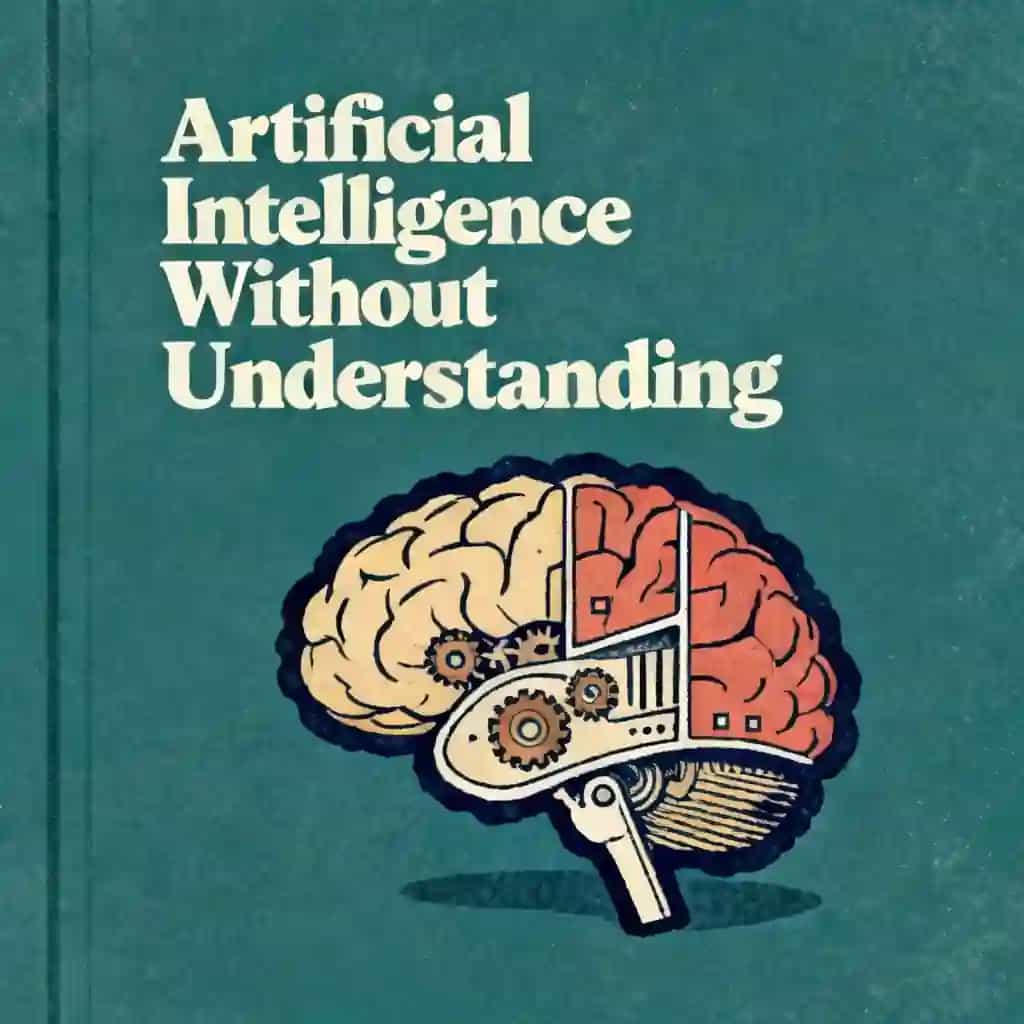
On Intelligence by Jeff Hawkins and Sandra Blakeslee Summary

Overview of On Intelligence
PalmPilot inventor Jeff Hawkins revolutionizes our understanding of intelligence, arguing the brain is a memory-prediction system, not a computer. Elon Musk once called it "essential reading" for anyone curious about AI's future. What if consciousness itself is just sophisticated pattern recognition?
- Intelligence emerges from the brain’s predictive hierarchy using memory-based patterns.
- True AI requires cortical-like systems that learn world models through sensory input.
- The neocortex achieves intelligence via invariant representations and sequence prediction mechanisms.
- Machine learning fails without hierarchical feedback loops mimicking biological prediction systems.
- Future AI must prioritize temporal memory over static data processing.
- Human cognition centers on anticipation—neurons fire before events, not just reactively.
- Jeff Hawkins argues AI progress hinges on reverse-engineering cortical architecture.
- “Memory-prediction framework” explains perception, creativity, and consciousness in one model.
- Intelligent machines need autonomous sensory experiences to build predictive world models.
- On Intelligence challenges conventional AI by prioritizing neuroscience over brute-force algorithms.
- Cortical columns process patterns hierarchically—key to building self-learning artificial systems.
- Hawkins’ theory positions prediction errors as drivers of learning and adaptation.
About the Author of On Intelligence
Jeff Hawkins and Sandra Blakeslee are the authors of On Intelligence: How a New Understanding of the Brain Will Lead to the Creation of Truly Intelligent Machines. They combine their expertise in neuroscience and science communication to explore the brain’s predictive capabilities.
Hawkins is a computer engineer and serial entrepreneur, known as the co-founder of Palm and Handspring. He bridges the gap between technology and neuroscience through his Hierarchical Temporal Memory (HTM) theory, which he developed at his Redwood Neuroscience Institute, now located at UC Berkeley.
Blakeslee is a veteran New York Times science correspondent and co-author of Phantoms in the Brain. She translates complex neuroscience concepts into accessible insights for a broad audience. Their collaboration skillfully weaves Hawkins’ technical research with Blakeslee’s storytelling, demystifying the neocortex’s critical role in intelligence.
Hawkins further expanded upon these ideas in his later work, A Thousand Brains: A New Theory of Intelligence, which delves into the intricacies of cortical structures. Blakeslee’s decades-long career includes numerous award-winning books on psychology and human behavior.
Originally published in 2004, On Intelligence remains a foundational work in the fields of artificial intelligence and neuroscience, influencing both academic research and practical machine learning applications.
FAQs About On Intelligence
What is On Intelligence by Jeff Hawkins about?
On Intelligence outlines Jeff Hawkins' theory that the brain’s neocortex operates via a hierarchical memory-prediction framework, enabling humans to anticipate future events based on patterns. The book argues intelligence arises from this predictive ability and critiques traditional AI for neglecting biological principles. Hawkins posits that replicating this framework in machines could lead to truly intelligent systems.
Who should read On Intelligence by Jeff Hawkins?
This book suits readers interested in neuroscience, AI theory, or the intersection of biology and technology. Tech professionals, neuroscientists, and students exploring machine learning alternatives will find Hawkins’ ideas provocative. It’s also accessible to laypeople curious about how the brain’s predictive mechanisms shape human cognition.
What is the “memory-prediction framework” in On Intelligence?
Hawkins’ memory-prediction framework proposes the brain continuously predicts future inputs using hierarchical cortical layers. Lower layers process sensory data, while higher layers generate predictions sent back downward. Correct predictions signify understanding; incorrect ones trigger updates. This loop enables adaptive learning and forms the basis of intelligence.
How does On Intelligence critique traditional AI approaches?
Hawkins argues traditional AI and neural networks fail because they ignore the brain’s predictive hierarchy. Unlike AI systems that react to data, the brain’s model-based predictions allow context-aware reasoning. He claims AI’s brittleness stems from lacking this biological-inspired framework.
What are the key criticisms of On Intelligence?
Critics note Hawkins’ theory relies heavily on speculation and lacks experimental validation. The book glosses over unresolved neuroscience debates and presents hypotheses as settled fact. Some argue his engineering perspective oversimplifies brain complexity, while his AI predictions remain unproven.
How does Jeff Hawkins’ tech background influence On Intelligence?
As Palm Computing’s founder, Hawkins blends engineering rigor with neuroscience curiosity. His Silicon Valley experience shapes his focus on practical applications, like building brain-inspired AI. The book reflects his frustration with academia’s slow progress and advocates for cross-disciplinary innovation.
What role does the neocortex play in Hawkins’ theory?
Hawkins identifies the neocortex as the seat of intelligence, organized into hierarchical regions that process sensory input and generate predictions. Each region’s six-layered structure enables feedback loops, allowing higher layers to refine predictions based on contextual memory.
How does On Intelligence explain human consciousness?
Consciousness emerges as the brain’s predictive model becomes self-referential, allowing awareness of its own predictions. Hawkins suggests consciousness isn’t mystical but a byproduct of the cortex’s ability to simulate future states, including its own processes.
Can Hawkins’ theory be applied to modern AI development?
Yes. Hawkins’ work inspired Numenta’s research on hierarchical temporal memory (HTM), a machine learning model mimicking cortical prediction. While not yet mainstream, HTM shows promise for anomaly detection and sensor data analysis. Critics argue it hasn’t surpassed deep learning.
How does On Intelligence compare to other neuroscience books?
Unlike purely descriptive texts, Hawkins offers an engineering blueprint for intelligence. It’s closer to Kurzweil’s speculative works than academic primers like Kandel’s Principles of Neural Science. The focus on actionable theory makes it unique in popular neuroscience.
What are Jeff Hawkins’ predictions for future AI in On Intelligence?
Hawkins predicted (in 2004) that brain-inspired AI would dominate within a decade—a timeline he later revised. He maintains that AI must adopt predictive hierarchical models to achieve human-like adaptability, warning current deep learning approaches are fundamentally limited.
Does On Intelligence address ethical concerns about AI?
No. The book focuses on technical mechanisms rather than ethics. Hawkins’ later works, like A Thousand Brains, delve slightly into AI safety, but On Intelligence assumes ethical frameworks will follow technological breakthroughs.
Feel the book through the author's voice
Turn knowledge into engaging, example-rich insights
Capture key ideas in a flash for fast learning
Enjoy the book in a fun and engaging way
Key Themes in On Intelligence
Quotes from On Intelligence
The field had fundamentally misunderstood intelligence by focusing on behavior rather than understanding.
The brain is just another kind of computer, with intelligence viewed as symbol manipulation.
The true essence of intelligence is predictive capability.
The neocortex demonstrates remarkable plasticity.
Characters in On Intelligence
Quick Summary Mode - Read or listen to On Intelligence Summary in 9 Minutes

Break down key ideas from On Intelligence into bite-sized takeaways to understand how innovative teams create, collaborate, and grow.

Flash Card Mode - Top 8 Insights from On Intelligence in a Nutshell

Distill On Intelligence into rapid-fire memory cues that highlight key principles of candor, teamwork, and creative resilience.

Fun Mode - On Intelligence Lessons Told Through 26-Min Stories

Experience On Intelligence through vivid storytelling that turns innovation lessons into moments you'll remember and apply.
Personalize Mode - Read or listen to On Intelligence Summary in 0 Minutes

Ask anything, pick the voice, and co-create insights that truly resonate with you.

From Columbia University alumni built in San Francisco
"Instead of endless scrolling, I just hit play on BeFreed. It saves me so much time."


"I never knew where to start with nonfiction—BeFreed’s book lists turned into podcasts gave me a clear path."


"Perfect balance between learning and entertainment. Finished ‘Thinking, Fast and Slow’ on my commute this week."
"Crazy how much I learned while walking the dog. BeFreed = small habits → big gains."
"Reading used to feel like a chore. Now it’s just part of my lifestyle."

"Feels effortless compared to reading. I’ve finished 6 books this month already."
"BeFreed turned my guilty doomscrolling into something that feels productive and inspiring."

"BeFreed turned my commute into learning time. 20-min podcasts are perfect for finishing books I never had time for."
"BeFreed replaced my podcast queue. Imagine Spotify for books — that’s it. 🙌"

"It is great for me to learn something from the book without reading it."
"The themed book list podcasts help me connect ideas across authors—like a guided audio journey."
"Makes me feel smarter every time before going to work"
From Columbia University alumni built in San Francisco
"Instead of endless scrolling, I just hit play on BeFreed. It saves me so much time."
"I never knew where to start with nonfiction—BeFreed’s book lists turned into podcasts gave me a clear path."
"Perfect balance between learning and entertainment. Finished ‘Thinking, Fast and Slow’ on my commute this week."
"Crazy how much I learned while walking the dog. BeFreed = small habits → big gains."
"Reading used to feel like a chore. Now it’s just part of my lifestyle."
"Feels effortless compared to reading. I’ve finished 6 books this month already."
"BeFreed turned my guilty doomscrolling into something that feels productive and inspiring."
"BeFreed turned my commute into learning time. 20-min podcasts are perfect for finishing books I never had time for."
"BeFreed replaced my podcast queue. Imagine Spotify for books — that’s it. 🙌"
"It is great for me to learn something from the book without reading it."
"The themed book list podcasts help me connect ideas across authors—like a guided audio journey."
"Makes me feel smarter every time before going to work"
"Instead of endless scrolling, I just hit play on BeFreed. It saves me so much time."
"I never knew where to start with nonfiction—BeFreed’s book lists turned into podcasts gave me a clear path."
"Perfect balance between learning and entertainment. Finished ‘Thinking, Fast and Slow’ on my commute this week."
"Crazy how much I learned while walking the dog. BeFreed = small habits → big gains."
"Reading used to feel like a chore. Now it’s just part of my lifestyle."
"Feels effortless compared to reading. I’ve finished 6 books this month already."
"BeFreed turned my guilty doomscrolling into something that feels productive and inspiring."
"BeFreed turned my commute into learning time. 20-min podcasts are perfect for finishing books I never had time for."
"BeFreed replaced my podcast queue. Imagine Spotify for books — that’s it. 🙌"
"It is great for me to learn something from the book without reading it."
"The themed book list podcasts help me connect ideas across authors—like a guided audio journey."
"Makes me feel smarter every time before going to work"
"Instead of endless scrolling, I just hit play on BeFreed. It saves me so much time."
"I never knew where to start with nonfiction—BeFreed’s book lists turned into podcasts gave me a clear path."
"Perfect balance between learning and entertainment. Finished ‘Thinking, Fast and Slow’ on my commute this week."
"Crazy how much I learned while walking the dog. BeFreed = small habits → big gains."
"Reading used to feel like a chore. Now it’s just part of my lifestyle."
"Feels effortless compared to reading. I’ve finished 6 books this month already."
"BeFreed turned my guilty doomscrolling into something that feels productive and inspiring."
"BeFreed turned my commute into learning time. 20-min podcasts are perfect for finishing books I never had time for."
"BeFreed replaced my podcast queue. Imagine Spotify for books — that’s it. 🙌"
"It is great for me to learn something from the book without reading it."
"The themed book list podcasts help me connect ideas across authors—like a guided audio journey."
"Makes me feel smarter every time before going to work"

Get the On Intelligence summary as a free PDF or EPUB. Print it or read offline anytime.