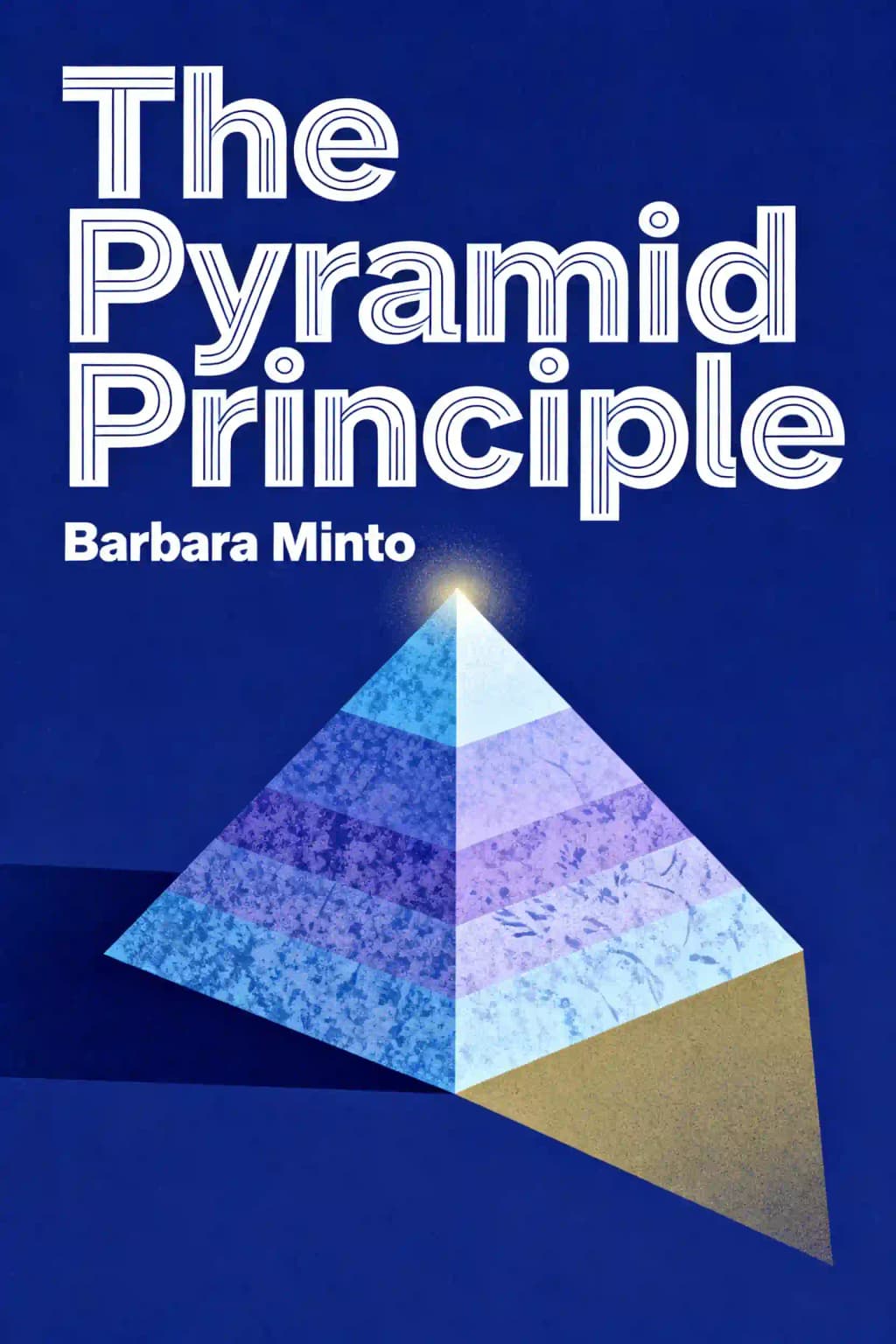
The Pyramid Principle
Overview of The Pyramid Principle
Revolutionize your communication with "The Pyramid Principle" - McKinsey's bible for structured thinking. Barbara Minto's groundbreaking framework, taught at elite consulting firms worldwide, transforms chaotic ideas into crystal-clear presentations. Why do millions of professionals swear by this legendary problem-solving method?

Key Themes in The Pyramid Principle
- top-down communication
- hierarchical thinking
- logical grouping
- deductive reasoning
- structured writing
Quotes from The Pyramid Principle
The pyramid structure isn't merely aesthetic-it's deeply psychological.
The beauty of the pyramid structure lies not in simplifying content but in organizing it.
Barbara Minto turns this conventional wisdom on its head.
The reward is communication that respects your audience's intelligence and time.
When your supporting points are MECE, your argument becomes airtight.
Characters in The Pyramid Principle
- Barbara MintoAuthor and creator of the Pyramid Principle
About the Author
About the Author of The Pyramid Principle
Barbara Minto is the acclaimed author of The Pyramid Principle: Logic in Writing, Thinking, and Problem Solving and a pioneering authority in structured business communication. A Harvard Business School graduate and McKinsey & Company’s first female consultant, Minto developed her renowned Pyramid Principle during her tenure at the firm, revolutionizing how professionals articulate complex ideas.
Her methodology, which emphasizes hierarchical structuring of information for clarity and persuasion, has become a cornerstone of corporate consulting and executive training globally.
Minto’s expertise stems from decades of refining analytical frameworks at McKinsey and later through her firm, Minto International, Inc., where she trains Fortune 500 companies and government agencies. A trailblazer for women in business, she was one of only eight women in her 600-member Harvard MBA class. The Pyramid Principle, translated into multiple languages, remains a definitive guide in business schools and consulting firms, cementing Minto’s legacy as a visionary in logical problem-solving and effective communication.
Download Summary of The Pyramid Principle
Get the The Pyramid Principle summary as a free PDF or EPUB. Print it or read offline anytime.
FAQs About This Book
The Pyramid Principle by Barbara Minto teaches professionals to communicate complex ideas clearly by structuring arguments hierarchically. It emphasizes starting with the main conclusion, followed by supporting arguments organized through vertical logic (question-answer flow) and horizontal logic (deductive/inductive reasoning). This framework helps writers and presenters deliver persuasive, logically coherent messages efficiently.
Consultants, managers, and professionals who need to craft reports, proposals, or presentations will benefit most. It’s particularly valuable for roles requiring clear articulation of complex ideas, such as business analysts, strategists, and corporate trainers. The book’s techniques are foundational in management consulting and remain relevant for anyone aiming to improve structured thinking.
Yes, it’s a classic for mastering professional communication, though its dense style can challenge newcomers. The pyramid structure forces clarity in argumentation, making it indispensable for consultants and executives. While not intuitive initially, its principles are widely applied in top firms like McKinsey, offering timeless value for persuasive writing.
Vertical logic builds a question-answer dialogue, ensuring each layer of the pyramid addresses the reader’s implicit queries. Horizontal logic uses deductive (general to specific) or inductive (specific patterns to conclusions) reasoning to validate each tier. Together, they create a cohesive narrative that preempts and resolves audience doubts.
By front-loading conclusions and organizing supporting arguments hierarchically, it saves time for busy decision-makers. This structure aligns with how brains process information, reducing cognitive load. For example, a consultant might state a recommendation first, then back it with data-driven subpoints, ensuring clarity and persuasiveness.
SCQA (Situation, Complication, Question, Answer) structures introductions by setting context, highlighting a problem, posing a core question, and delivering the solution. This method hooks readers by mirroring their natural thought process, as seen in effective consulting reports and executive summaries.
Unlike linear storytelling, the pyramid method prioritizes conclusions upfront, unlike the STAR method (focused on anecdotes) or SOAR (problem-solution). It complements the MECE principle (Mutually Exclusive, Collectively Exhaustive) for ensuring argument completeness, often used together in consulting.
Some find its rigid structure stifling for creative writing, and newcomers may struggle with its abstract concepts. Critics argue it overemphasizes formalism, potentially leading to repetitive documents. However, its adaptability to different contexts counters these concerns.
Start slides with key takeaways, then use subpoints to validate them. For example, a revenue-growth proposal might lead with “Expand to Asia,” supported by market-size data, competitor analysis, and financial projections. This aligns with how executives consume information.
- “The mind automatically groups ideas into pyramids.”
- “Start with the answer first—always.”
- “Horizontal logic ensures your reasoning is air-tight.”
These quotes underscore the book’s focus on hierarchical clarity and logical rigor.
MECE (Mutually Exclusive, Collectively Exhaustive) ensures arguments are non-overlapping and comprehensive. For example, segmenting a market by age and geography (not age or geography) avoids gaps. Minto popularized this alongside the pyramid structure for bulletproof analysis.
By breaking complex issues into layered questions, it guides systematic analysis. A team tackling declining sales might first ask, “Is the issue product, pricing, or distribution?” Each branch then drills deeper, ensuring thorough exploration before synthesizing recommendations.