Chapter 1
Your Focus Is Being Stolen. Fight Back.
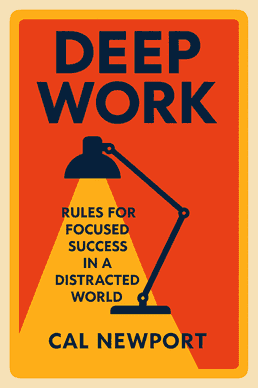
In an age where the average worker checks email 74 times daily and switches tasks every 3 minutes, Cal Newport's "Deep Work" arrives as both revelation and rebellion. This isn't just productivity advice - it's intellectual warfare strategy for a distracted world.
Newport, a computer science professor who remarkably publishes groundbreaking research while never working past 5:30pm, introduces a revolutionary concept: the ability to focus without distraction is becoming increasingly rare precisely as it becomes increasingly valuable.
What makes this manifesto extraordinary is how it systematically dismantles our culture's celebration of shallow work - those easily replicated tasks that create minimal value - while providing a practical framework for cultivating depth in your professional life.
Since its 2016 publication, "Deep Work" has transformed how Silicon Valley executives structure their days and inspired countless professionals to redesign their work lives around periods of intense concentration.
Read this book to discover why Bill Gates retreats to a cabin in the woods twice yearly, and how you can harness similar powers of uninterrupted thought.
Chapter 2
The Rising Value of Deep Work in Our Distracted Economy
The modern economy increasingly rewards those who can master complex systems and produce exceptional results. Consider Nate Silver, whose FiveThirtyEight blog became the New York Times' main traffic driver during the 2012 election. His sophisticated statistical models cut through political noise to provide accurate predictions. Or David Heinemeier Hansson, creator of Ruby on Rails, whose programming framework powers countless websites. These individuals exemplify a crucial economic shift identified by MIT researchers Erik Brynjolfsson and Andrew McAfee: success now favors those who can perform deep, focused work.
This economic transformation benefits three specific groups. First are high-skilled workers like Nate Silver, who can work effectively with intelligent machines and complex data. As technology advances, those who can navigate and leverage this complexity become increasingly valuable. The second group consists of superstars like Hansson, who benefit from winner-take-all markets. In a connected world, companies can hire the absolute best talent regardless of location, allowing exceptional performers to reap disproportionate rewards. Finally, there are the owners of capital who can invest in breakthrough technologies that require minimal labor input.
To thrive in this new reality, you need two core abilities: quickly mastering hard things and producing at an elite level. These skills aren't innate-they're cultivated through deep work. The process of mastering difficult concepts requires the kind of intense concentration that deep work provides. Modern research on deliberate practice confirms this, showing that expertise develops through focused, feedback-driven effort that stretches your abilities. This type of practice demands distraction-free concentration-precisely what deep work entails.
The quality of your output also depends directly on your ability to focus deeply. Consider the productivity equation: High-Quality Work Produced = Time Spent x Intensity of Focus. When you switch between tasks, you experience what psychology professor Sophie Leroy calls "attention residue"-your mind remains partially focused on the previous task, reducing your cognitive capacity. This explains why Adam Grant, one of academia's most productive scholars, blocks out extended periods for focused research rather than trying to squeeze it between meetings and emails.
Chapter 3
The Paradox: Deep Work's Value Rises as Its Practice Declines
Despite the growing value of deep work, modern workplace trends actively undermine it. Open offices prioritize immediate accessibility over focused thought. Instant messaging and email create constant interruptions. The result is a paradoxical situation where the ability to perform deep work becomes simultaneously more valuable and more rare.
Why does this contradiction persist? First, there's what I call a "metric black hole"-the impact of deep work is difficult to measure precisely. When Atlantic Media's CTO calculated that employees spent over a million dollars worth of time annually on email, it highlighted how easily we can measure shallow work. Deep work's value, however, remains more elusive and harder to quantify.
Second, we tend to follow the principle of least resistance, gravitating toward whatever is easiest in the moment. Responding immediately to messages provides a sense of accomplishment, while deep work requires more effort and delayed gratification. Research from Harvard Business School has shown that periodic disconnection actually improves collaboration and productivity, yet the allure of constant connectivity persists because it's simpler.
Third, in the absence of clear productivity metrics, knowledge workers substitute busyness as a proxy. When Yahoo's Marissa Mayer eliminated remote work, citing the need for people to be physically present, she exemplified this mindset-equating visibility with productivity. True knowledge work often contradicts this approach, requiring periods of apparent inactivity that actually generate the most value.
Finally, we've developed what Evgeny Morozov calls a "technological idolatry" that treats internet-related activities as inherently beneficial. This cult of connectivity leads us to embrace shallow work without questioning its actual value, further eroding our capacity for depth.
The good news? This trend creates a strategic opportunity. As deep work becomes rarer, those who cultivate this skill gain a significant competitive advantage. While organizations may overlook its importance, individuals who embrace depth will increasingly stand out in a distracted world.
Chapter 4
Finding Meaning Through Depth: The Psychological Benefits
Deep work isn't just professionally advantageous-it's psychologically rewarding. Consider Ric Furrer, a master blacksmith who crafts intricate pattern-welded swords through intense concentration and skill. The satisfaction he derives from his craft illustrates a profound truth: humans find deep satisfaction in work that demands their full attention and abilities.
This insight has neurological foundations. As Winifred Gallagher discovered after her cancer diagnosis, "The skillful management of attention is the sine qua non of the good life." Our experience of life is created by what we pay attention to. Research shows that focusing on positive, meaningful activities rather than distractions leads to greater life satisfaction. By directing our attention deliberately through deep work, we shape our experience of the world.
The psychological concept of "flow"-that state of complete immersion in a challenging activity-further supports this connection between depth and meaning. Mihaly Csikszentmihalyi's research using the Experience Sampling Method found that people report greater happiness during flow states than during relaxation. Surprisingly, many people experience more flow at work than in leisure, suggesting that we undervalue the satisfaction that comes from deep engagement with challenging tasks.
There's also a philosophical dimension to deep work's meaningfulness. In their book "All Things Shining," Hubert Dreyfus and Sean Kelly explore how we can find meaning in a secular age. They suggest that craftsmanship-whether in traditional forms like woodworking or modern ones like programming-provides a source of meaning through skilled engagement with reality. When programmers talk about "beautiful code," they're expressing an aesthetic appreciation similar to what traditional craftsmen feel about their work.
This perspective suggests that humans are evolving toward what we might call "Homo Sapiens Deepensis"-beings who find their greatest satisfaction in deep engagement with meaningful challenges. By embracing deep work, we not only become more productive but also tap into a profound source of meaning that superficial activities cannot provide.
Chapter 5
Rule #1: Work Deeply by Designing Your Deep Work Strategy
Knowing that deep work is valuable isn't enough-you need practical strategies to make it happen. The first rule is to work deeply by creating routines and rituals that minimize the friction involved in starting deep work sessions.
Start by choosing a depth philosophy that fits your circumstances. The monastic philosophy, exemplified by computer scientist Donald Knuth who has no email address, involves eliminating or radically minimizing shallow obligations. This approach works well for those whose success depends on doing one thing exceptionally well.
The bimodal philosophy, practiced by Carl Jung during his retreats to Bollingen Tower, involves dividing your time between periods of deep isolation and normal engagement. This might mean dedicating certain days of the week or certain seasons (like academic sabbaticals) to deep work while maintaining regular responsibilities at other times.
The rhythmic philosophy makes deep work a regular habit through consistent scheduling. Jerry Seinfeld's "don't break the chain" method of writing jokes daily exemplifies this approach. By working deeply at the same time each day, you transform deep work from a decision into a habit.
The journalistic philosophy, named after Walter Isaacson's ability to write in any spare moment, involves fitting deep work into your schedule whenever you can. This approach requires significant practice and is best for those who already have experience with deep work.
Once you've chosen your philosophy, create rituals around your deep work sessions. Specify where you'll work and for how long, establish rules for the session (like no internet access), and ensure you have the support you need (whether that's coffee, food, or specific reference materials). These rituals reduce the willpower required to start deep work.
Consider making grand gestures to reinforce your commitment. J.K. Rowling checked into a luxury hotel to finish writing the Harry Potter series, while Bill Gates takes "Think Weeks" in isolated cabins. These significant investments of money or effort create a psychological barrier against procrastination.
Importantly, deep work doesn't mean working in complete isolation. The hub-and-spoke model used at MIT's Building 20 and Bell Labs shows how to balance collaboration and focus-providing spaces for serendipitous encounters while preserving private areas for concentrated work. The goal isn't to eliminate all collaboration but to ensure it enhances rather than disrupts deep work.
Chapter 6
Rule #2: Embrace Boredom and Train Your Focus Muscle
Just as athletes must condition their bodies through consistent training and progressive overload, knowledge workers must systematically train their minds to concentrate. The challenge isn't simply finding time for deep work-it's developing the mental stamina and capacity to sustain intense focus for extended periods. This is particularly crucial in our hyperconnected world where the average person's attention span has significantly decreased.
Most people approach distraction backward, treating focus as the exception rather than the rule, taking occasional breaks from distraction instead of viewing focused work as their default state. This fundamental misunderstanding leads to a weakened attention span. Instead, implement a structured approach: schedule specific times for using the internet (for example, two 30-minute blocks per day) and maintain strict offline periods outside these windows. This practice trains your brain to resist the constant novelty that online distractions provide and helps rebuild neural pathways associated with sustained attention.
When you feel the urge to check something online during a scheduled offline period, don't give in immediately. Start by waiting just 5-10 minutes, then gradually increase this delay. Even these small waiting periods help recondition your mind to tolerate boredom and uncertainty. This is similar to building physical endurance - start small and progressively increase the challenge. Extend this practice beyond work hours to further strengthen your concentration muscles. For instance, practice being fully present during meals without checking your phone, or read a book for 30 minutes without digital interruptions.
"Roosevelt dashes," named after Theodore Roosevelt's intense study sessions at Harvard, provide another powerful training method. Set aggressive but achievable deadlines for deep work tasks - for example, completing a report in 2 hours that would normally take 3. This artificial time pressure creates a state of focused urgency that drives deep concentration. Start with shorter dashes (25-30 minutes) and gradually increase duration as your focus improves.
Practice "productive meditation" by focusing on a single professional problem while engaged in physical but mentally undemanding activities. During a 30-minute walk, for instance, choose one specific work challenge to analyze. When your mind wanders (as it inevitably will), gently but firmly bring it back to the problem, just as you would in traditional meditation. This builds your ability to direct and maintain attention while also potentially generating creative solutions to work challenges.
Memory training offers another powerful avenue for developing concentration. Memory champions like Daniel Kilov and Joshua Foer have demonstrated that exceptional memory isn't innate but trained. Through techniques like the memory palace (where you associate information with specific locations in a familiar place) and number-shape systems, you can dramatically improve both your memory and your ability to focus intensely. Start with memorizing a deck of cards or a list of 20 random words, gradually increasing complexity as your skills improve. These methods strengthen your ability to maintain sustained attention - a fundamental skill for deep work.
To make these practices stick, track your progress. Keep a log of your focus sessions, noting duration and quality. Set specific goals, such as increasing your deep work time by 15 minutes each week, and celebrate small wins along the way. Remember that like physical fitness, mental fitness requires consistent practice and progressive challenge to improve.
Chapter 7
Rule #3: Quit Social Media and Curate Your Digital Tools
Social media and other digital distractions aren't inherently evil, but they require careful evaluation based on their actual contribution to your goals and overall well-being. Most people fall into what Newport calls the "any-benefit approach," justifying a tool's use if they can identify even the smallest possible benefit - like staying in touch with distant acquaintances or getting occasional news updates. Instead, embrace the more rigorous "craftsman approach" to tool selection, where you strategically adopt only those tools whose positive impacts substantially outweigh their negative effects, including the hidden costs of fragmented attention and time consumption.
The negative impacts of social media are often subtle but significant. Research shows that the average person spends 2-3 hours daily on social platforms, adding up to roughly 45 days per year. This time could be redirected toward deep work, skill development, or meaningful relationships. Moreover, the constant context-switching and dopamine-driven feedback loops of social media can significantly impair your ability to focus, even when you're not actively using these platforms.
Apply the "law of the vital few" (also known as the 80/20 rule or Pareto Principle) to your digital life. This means identifying the core 20% of factors that determine 80% of your success in your professional and personal life. For instance:
• For a writer, this might be sustained periods of focused writing and meaningful engagement with other authors
• For a programmer, it might be uninterrupted coding time and collaboration tools like GitHub
• For an entrepreneur, it might be customer communication channels and project management tools
Try this practical experiment: Quit social media for 30 days without announcing your departure (announcing it often becomes a way of seeking attention or validation). During this period, track how you use the freed-up time and notice any changes in your concentration and productivity. After the period ends, ask yourself two critical questions:
1. Would the last month have been notably better if I had used this service?
2. Did people care that I wasn't using this service?
If the answer to both questions is no, quit permanently. Many people discover that their feared "fear of missing out" (FOMO) was largely unfounded.
Beyond social media, be intentional about all internet use. Arnold Bennett, writing in 1910, lamented how people squandered their leisure time on mindless activities rather than self-improvement - a criticism that remains remarkably relevant today. The modern equivalent is aimless web surfing, YouTube rabbit holes, and endless news feed scrolling. Instead, structure your leisure time around high-quality activities that require skill and engagement, such as:
• Learning a musical instrument
• Reading challenging books
• Practicing a craft or hobby
• Engaging in physical exercise
• Having meaningful conversations
Remember that the goal isn't digital asceticism but rather thoughtful curation of your digital tools. Some social media and digital tools might genuinely serve your goals - for instance, LinkedIn for certain professionals or Instagram for photographers. The key is to be selective and intentional, treating these tools as what they are: tools to serve your larger purposes, not ends in themselves.
Chapter 8
Rule #4: Drain the Shallows by Minimizing Busywork
Even if you can't eliminate shallow work entirely, you can dramatically reduce it. The software company Basecamp (formerly 37signals) famously implemented a four-day workweek and found productivity remained stable because they eliminated low-value activities.
Start by scheduling every minute of your workday. This doesn't mean becoming rigid-you'll often revise your schedule as the day progresses-but it forces you to be intentional about how you spend your time. When you must revise, do so consciously rather than defaulting to the easiest option.
Quantify the depth of each activity by asking how long it would take to train a smart recent college graduate to do this task. If the answer is "not long," it's likely shallow work that doesn't leverage your specialized skills.
Ask your boss for a shallow work budget-a specific percentage of your time that can be devoted to administrative tasks. Most knowledge workers should aim to spend no more than 30-50% of their time on shallow activities. Having this explicit budget helps you justify saying no to new shallow commitments.
Adopt fixed-schedule productivity by setting a firm end to your workday-say, 5:30 PM. This constraint forces you to be more deliberate about what you do with your limited time and often leads to greater overall productivity.
Finally, become harder to reach. Make people who send you email do more work by implementing sender filters or specific contact instructions. When you do respond to emails, process them fully rather than sending quick replies that create more back-and-forth. And perhaps most controversially, don't respond to all emails-focus only on those where a response is truly warranted and valuable.
Chapter 9
Reclaiming Depth in a Shallow World
Deep work isn't just a productivity strategy-it's a philosophy of life that recognizes the profound satisfaction that comes from pushing your cognitive capabilities to their limit. This approach represents a fundamental shift in how we view work and achievement in the modern era. Like a craftsperson who finds flow in their workshop or an artist who loses track of time while creating, deep work practitioners discover that intense concentration becomes not just productive but deeply fulfilling. By embracing depth, you position yourself to thrive professionally in an increasingly complex economy while also finding greater meaning and fulfillment in your work.
The path to deep work isn't easy, particularly in our hyperconnected world. It requires swimming against the cultural current of constant connectivity and immediate responsiveness. The average knowledge worker now checks email 74 times per day and switches tasks every 11 minutes, creating a perpetual state of divided attention. It demands the courage to disappoint others in the short term by saying no to shallow demands on your time and attention. This might mean declining meeting invitations, setting strict email boundaries, or even removing social media apps from your phone. And it calls for the discipline to structure your days around your most important work rather than letting them be consumed by whatever seems most urgent.
The barriers to deep work are both external and internal. Organizations often inadvertently discourage depth through open office plans, instant messaging expectations, and cultures of constant availability. Meanwhile, our own habits and anxieties about missing out can make sustained concentration feel almost uncomfortable at first. Overcoming these challenges requires both strategic planning and psychological adaptation.
But the rewards are worth it. Those who master deep work will increasingly stand out in a world where most knowledge workers are drowning in digital distraction. Research shows that it takes about 23 minutes to fully regain focus after an interruption, making the ability to maintain sustained concentration a genuine competitive advantage. They'll produce work of exceptional quality at a pace that seems impossible to their scattered colleagues. Examples abound across fields: writers who produce transformative books in focused morning sessions, programmers who solve complex problems in long stretches of uninterrupted coding, and researchers who make breakthrough discoveries through sustained investigation.
And perhaps most importantly, they'll experience the deep satisfaction that comes from fully engaging their human capacity for concentration and skill. This satisfaction goes beyond professional success - it touches on fundamental aspects of human psychology and wellbeing. Studies have shown that states of deep focus are strongly correlated with happiness and life satisfaction, while constant task-switching and shallow work often lead to stress and anxiety.
The choice is yours: Will you join the ranks of the distracted majority, or will you cultivate the increasingly rare and valuable skill of deep work? Your answer may determine not just your professional success, but the quality of your life itself. The path to depth requires intention, practice, and sometimes sacrifice, but it offers a way to reclaim both productivity and meaning in an age of distraction. Those who choose this path often find that they're not just working better - they're living better.