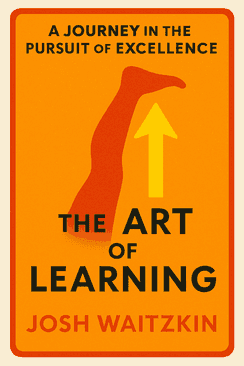
The Art of Learning: A Journey in the Pursuit of Excellence by Josh Waitzkin Summary

Overview of The Art of Learning
Chess prodigy turned Tai Chi champion Josh Waitzkin reveals the universal principles of mastery. Endorsed by Deepak Chopra and praised by Robert Pirsig, this guide transforms how elite performers learn. What mental framework connects world-class achievement across completely different disciplines?
- Focus on depth over breadth to build unshakable foundational mastery
- Master techniques through "smaller circles" by refining core movements endlessly
- Alternate intense stress phases with strategic recovery to prevent burnout cycles
- Adopt growth mindset to reframe failures as fuel for incremental progress
- Study endgame principles first to develop intuitive mastery of fundamentals
- Embrace learning plateaus as subconscious integration periods before skill leaps
- Use deliberate practice to transform conscious effort into unconscious competence
- Prioritize incremental skill-building over talent myths for lasting achievement
- Align training methods with personal identity to sustain motivation long-term
- Cultivate presence to convert competitive pressure into flow-state performance
- Apply lateral learning by connecting chess and martial arts mastery principles
- Develop pre-performance rituals to channel anxiety into razor-sharp focus
About the Author of The Art of Learning
Josh Waitzkin, author of The Art of Learning: An Inner Journey to Optimal Performance, is a renowned performance strategist, eight-time U.S. National Chess Champion, and two-time Tai Chi Push Hands World Champion. Blending memoir with actionable insights, his book explores themes of deliberate practice, resilience, and transferring skills across disciplines—principles honed through his unprecedented success in chess and martial arts.
A Brazilian Jiu-Jitsu black belt under Marcelo Garcia, Waitzkin later founded The Art of Learning Project, a nonprofit revolutionizing education through personalized learning frameworks.
Consulting Fortune 500 executives and Olympic athletes, Waitzkin’s methodologies are taught in top business schools and applied by elite sports teams. His work has been featured in major media outlets and translated into over 20 languages, establishing The Art of Learning as a cornerstone of modern performance psychology. The book’s principles continue to empower professionals worldwide to master their craft through intentional skill development.
FAQs About The Art of Learning
What is The Art of Learning by Josh Waitzkin about?
The Art of Learning explores strategies for mastering skills through resilience, presence, and incremental growth. Waitzkin distills his experiences as a chess prodigy and martial arts champion into three core themes: cultivating mindfulness in practice, learning through trial and error, and balancing tension during skill development. The book blends memoir with actionable insights on optimizing performance in any discipline.
Who should read The Art of Learning?
This book is ideal for high-performers, educators, athletes, and professionals seeking to refine their learning process. It’s particularly valuable for those interested in mindset optimization, overcoming plateaus, or transferring skills across domains (e.g., chess to martial arts to finance). Waitzkin’s principles apply to anyone committed to long-term growth over quick fixes.
Is The Art of Learning worth reading?
Yes, it’s a compelling blend of personal narrative and practical methodology. Waitzkin’s unique perspective—from chess championships to Tai Chi world titles—offers timeless strategies for resilience and deliberate practice. Readers praise its depth on topics like pressure management and intuition-building, making it a staple for lifelong learners.
What are the main concepts in The Art of Learning?
Key concepts include:
- Presence: Full engagement in the learning process to build instinctual mastery.
- Smaller Circles: Breaking skills into components for incremental refinement.
- Adversity Alchemy: Transforming setbacks into growth opportunities.
- Unique Voice: Leveraging personal strengths rather than mimicking others.
How does Josh Waitzkin define "presence" in learning?
Waitzkin describes presence as a state of mindful focus where learners absorb feedback and adjust in real time. It’s cultivated through daily practice, not just reserved for high-stakes moments. For example, he details how chess errors or martial arts missteps became opportunities to refine technique through attentive repetition.
What is the "Smaller Circles" technique?
This method involves mastering foundational skills through simplified, repetitive drills before tackling complexity. Waitzkin used it to hone chess tactics and Tai Chi movements, emphasizing that expertise emerges from deeply internalized basics. Traders and educators have adapted it to break down intricate subjects into learnable components.
How does The Art of Learning address overcoming failure?
The book frames mistakes as essential stepping stones. Waitzkin shares how losses in chess tournaments and injuries in martial arts taught him to analyze errors without ego, adjust strategies, and persist. This "trial and error cycle" reinforces resilience and systematic improvement.
What does Waitzkin mean by "making sandals"?
This metaphor encourages adapting strategies to personal strengths. Just as a shoemaker tailors sandals to individual feet, learners should customize techniques to their unique style. Waitzkin illustrates this by contrasting his creative chess play with rigid, formulaic approaches.
How does The Art of Learning compare to Grit by Angela Duckworth?
While both emphasize perseverance, Waitzkin focuses on the process of skill acquisition (e.g., presence, incremental growth), whereas Duckworth explores passion and long-term commitment. The Art of Learning offers more tactical drills for refining deliberate practice, making it complementary to Duckworth’s broader mindset research.
What criticisms exist about The Art of Learning?
Some readers note Waitzkin’s anecdotes rely heavily on his exceptional achievements, which may feel less relatable to everyday learners. Others suggest the book’s abstract concepts require active application to realize benefits. However, its principles remain widely praised for adaptability across disciplines.
Can The Art of Learning help with career development?
Yes. Executives, entrepreneurs, and creatives apply its lessons to stress management, decision-making under pressure, and skill transfers (e.g., coding to leadership). Waitzkin’s nonprofit, The Art of Learning Project, also uses these methods to reform education systems.
What is Josh Waitzkin’s background?
Waitzkin is an 8-time U.S. National Chess Champion, 2-time Tai Chi Push Hands World Champion, and a Brazilian Jiu-Jitsu black belt. He later became a performance coach for Fortune 500 leaders and founded an educational nonprofit. His multidisciplinary expertise grounds the book’s insights.
Feel the book through the author's voice
Turn knowledge into engaging, example-rich insights
Capture key ideas in a flash for fast learning
Enjoy the book in a fun and engaging way
Key Themes in The Art of Learning
Quotes from The Art of Learning
Growth comes at the point of resistance. We learn by pushing ourselves to the edge.
The key to pursuing excellence is to embrace an organic, long-term learning process, and not to live in a shell of static, safe mediocrity. Usually, growth comes at the expense of comfort or security.
Mental resilience is arguably the most critical trait of a world-class performer, and it should be nurtured continuously. Left to my own devices, I am always looking for ways to become more comfortable with uncertainty.
Growth typically comes at the expense of comfort.
Time fell away, the concept of "I" disappeared, and he experienced pure presence and absolute flow.
Characters in The Art of Learning
Quick Summary Mode - Read or listen to The Art of Learning Summary in 8 Minutes

Break down key ideas from The Art of Learning into bite-sized takeaways to understand how innovative teams create, collaborate, and grow.

Flash Card Mode - Top 8 Insights from The Art of Learning in a Nutshell

Distill The Art of Learning into rapid-fire memory cues that highlight key principles of candor, teamwork, and creative resilience.

Fun Mode - The Art of Learning Lessons Told Through 18-Min Stories

Experience The Art of Learning through vivid storytelling that turns innovation lessons into moments you'll remember and apply.
Personalize Mode - Read or listen to The Art of Learning Summary in 0 Minutes

Ask anything, pick the voice, and co-create insights that truly resonate with you.

From Columbia University alumni built in San Francisco
"Instead of endless scrolling, I just hit play on BeFreed. It saves me so much time."


"I never knew where to start with nonfiction—BeFreed’s book lists turned into podcasts gave me a clear path."


"Perfect balance between learning and entertainment. Finished ‘Thinking, Fast and Slow’ on my commute this week."
"Crazy how much I learned while walking the dog. BeFreed = small habits → big gains."
"Reading used to feel like a chore. Now it’s just part of my lifestyle."

"Feels effortless compared to reading. I’ve finished 6 books this month already."
"BeFreed turned my guilty doomscrolling into something that feels productive and inspiring."

"BeFreed turned my commute into learning time. 20-min podcasts are perfect for finishing books I never had time for."
"BeFreed replaced my podcast queue. Imagine Spotify for books — that’s it. 🙌"

"It is great for me to learn something from the book without reading it."
"The themed book list podcasts help me connect ideas across authors—like a guided audio journey."
"Makes me feel smarter every time before going to work"
From Columbia University alumni built in San Francisco
"Instead of endless scrolling, I just hit play on BeFreed. It saves me so much time."
"I never knew where to start with nonfiction—BeFreed’s book lists turned into podcasts gave me a clear path."
"Perfect balance between learning and entertainment. Finished ‘Thinking, Fast and Slow’ on my commute this week."
"Crazy how much I learned while walking the dog. BeFreed = small habits → big gains."
"Reading used to feel like a chore. Now it’s just part of my lifestyle."
"Feels effortless compared to reading. I’ve finished 6 books this month already."
"BeFreed turned my guilty doomscrolling into something that feels productive and inspiring."
"BeFreed turned my commute into learning time. 20-min podcasts are perfect for finishing books I never had time for."
"BeFreed replaced my podcast queue. Imagine Spotify for books — that’s it. 🙌"
"It is great for me to learn something from the book without reading it."
"The themed book list podcasts help me connect ideas across authors—like a guided audio journey."
"Makes me feel smarter every time before going to work"
"Instead of endless scrolling, I just hit play on BeFreed. It saves me so much time."
"I never knew where to start with nonfiction—BeFreed’s book lists turned into podcasts gave me a clear path."
"Perfect balance between learning and entertainment. Finished ‘Thinking, Fast and Slow’ on my commute this week."
"Crazy how much I learned while walking the dog. BeFreed = small habits → big gains."
"Reading used to feel like a chore. Now it’s just part of my lifestyle."
"Feels effortless compared to reading. I’ve finished 6 books this month already."
"BeFreed turned my guilty doomscrolling into something that feels productive and inspiring."
"BeFreed turned my commute into learning time. 20-min podcasts are perfect for finishing books I never had time for."
"BeFreed replaced my podcast queue. Imagine Spotify for books — that’s it. 🙌"
"It is great for me to learn something from the book without reading it."
"The themed book list podcasts help me connect ideas across authors—like a guided audio journey."
"Makes me feel smarter every time before going to work"
"Instead of endless scrolling, I just hit play on BeFreed. It saves me so much time."
"I never knew where to start with nonfiction—BeFreed’s book lists turned into podcasts gave me a clear path."
"Perfect balance between learning and entertainment. Finished ‘Thinking, Fast and Slow’ on my commute this week."
"Crazy how much I learned while walking the dog. BeFreed = small habits → big gains."
"Reading used to feel like a chore. Now it’s just part of my lifestyle."
"Feels effortless compared to reading. I’ve finished 6 books this month already."
"BeFreed turned my guilty doomscrolling into something that feels productive and inspiring."
"BeFreed turned my commute into learning time. 20-min podcasts are perfect for finishing books I never had time for."
"BeFreed replaced my podcast queue. Imagine Spotify for books — that’s it. 🙌"
"It is great for me to learn something from the book without reading it."
"The themed book list podcasts help me connect ideas across authors—like a guided audio journey."
"Makes me feel smarter every time before going to work"

Get the The Art of Learning summary as a free PDF or EPUB. Print it or read offline anytime.