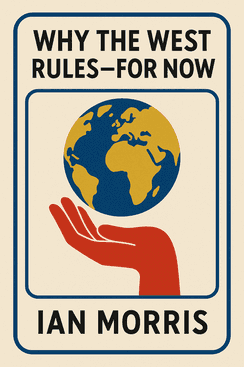
Overview of Why the West Rules - For Now
Morris's sweeping 15,000-year history explains why the West dominates today - not through cultural superiority but geography and human ingenuity. Praised by Jared Diamond as "an exciting novel that happens to be true," this award-winning work reveals whether Eastern powers will soon reclaim global leadership.
- Geography determines civilizational dominance more than culture or genetics.
- Social development index measures energy capture, organization, war-making, and information systems.
- Western rule emerged from geography-driven advantages, not inherent racial superiority.
- The “law of backwardness” lets trailing societies leapfrog leading civilizations.
- Five apocalyptic horsemen—migration, disease, famine, climate, state failure—reshape empires.
- Industrialization’s geographic roots made Western dominance probable but not inevitable.
- East-West power shifts follow cyclical patterns of social development surges.
- Fossil fuel mastery propelled the West’s 19th-century global hegemony.
- China’s resurgence mirrors historical cycles of Eastern technological adaptation.
- Future leadership hinges on navigating energy transitions and climate crises.
- Morris dismisses “great men” theories, emphasizing systemic over individual agency.
- Civilizational survival requires creative solutions to geography’s constraints.
About the Author of Why the West Rules - For Now
Ian Matthew Morris, bestselling author of Why the West Rules—For Now: The Patterns of History and What They Reveal About the Future, is a British historian, archaeologist, and Stanford University’s Jean and Rebecca Willard Professor of Classics. A leading authority on global social development and long-term historical trends, Morris combines decades of archaeological fieldwork—including directing Stanford’s Sicilian excavations—with expertise in classical studies to analyze the forces shaping civilizations.
His work bridges ancient history, economics, and geopolitics, notably explored in related titles like The Measure of Civilization and Geography Is Destiny: Britain and the World.
A senior fellow at the London School of Economics and recipient of Guggenheim and Carnegie fellowships, Morris has shaped public discourse through media appearances and strategy advisory roles. His paradigm-challenging frameworks on energy capture, social organization, and East-West power dynamics have influenced academic and policy circles alike.
Why the West Rules—For Now has been translated into 13 languages and recognized as a New York Times Notable Book, cementing Morris’s reputation for making complex historical forces accessible to general audiences.
FAQs About Why the West Rules - For Now
What is Why the West Rules—for Now about?
Why the West Rules—for Now by Ian Morris explores 50,000 years of history to explain Western global dominance, arguing geography—not race, culture, or individual genius—shaped societal development. Morris uses metrics like energy capture, urbanization, and technology to compare Eastern and Western trajectories, concluding that shifting power dynamics (e.g., China’s rise) may redefine future dominance.
Who is Ian Morris?
Ian Morris is a Stanford University historian, archaeologist, and Jean and Rebecca Willard Professor of Classics. His work bridges ancient history and modern geopolitics, employing interdisciplinary methods to analyze long-term societal patterns. He’s known for integrating data-driven frameworks into historical narratives.
Who should read Why the West Rules—for Now?
This book suits history buffs, geopolitics enthusiasts, and futurists interested in civilizational trajectories. It’s ideal for readers seeking a data-rich analysis of global power shifts, blending archaeology, economics, and sociology. Academics and students will appreciate its interdisciplinary approach to understanding East-West dynamics.
Is Why the West Rules—for Now worth reading?
Yes—Morris’s synthesis of 50,000 years of history offers fresh insights into Western ascendancy, countering Eurocentric narratives with evidence-based arguments. Critics praise its accessible style but debate its predictive models. It’s a compelling read for those open to rethinking historical “inevitability”.
How does Ian Morris measure social development in Why the West Rules—for Now?
Morris quantifies progress using four metrics: energy capture (calories used per person), urbanization (city size), information technology (communication tools), and war-making capacity (military tech). This framework allows cross-cultural comparisons, revealing East-West “leapfrogging” across millennia.
What are the “long-term lock-in” vs. “short-term accident” theories?
- Long-term lock-in: Assumes inherent Western traits (e.g., culture, genetics) destined global dominance. Morris rejects this as ethnocentric.
- Short-term accident: Attributes Western rule to post-1750s industrialization. Morris argues this overlooks deeper geographic and developmental patterns.
Why does Morris emphasize geography in explaining Western dominance?
Geography—such as fertile river valleys or accessible coal reserves—shaped how societies adapted to crises (climate, disease). For example, Europe’s fragmented geography spurred competition and innovation, while China’s centralized systems delayed industrial takeoff.
How does Why the West Rules—for Now compare to Guns, Germs, and Steel?
Both books stress geography over cultural superiority, but Morris adds a data-driven timeline (50,000 vs. 13,000 years) and explicit East-West comparisons. Unlike Diamond, Morris predicts potential Eastern resurgence by 2103, contingent on energy and tech trends.
What are the main criticisms of Why the West Rules—for Now?
Critics argue Morris’s social development metrics oversimplify cultural complexity and underestimate non-material factors (e.g., ideology). Some question his deterministic view of geography, noting exceptions like Japan’s rapid modernization despite isolated geography.
How does Morris predict the future of Western dominance?
He projects Eastern parity by 2103 if current trends (economic growth, tech adoption) persist. However, climate change, pandemics, or warfare could disrupt this trajectory. Morris stresses that “rule” may become irrelevant in a globally integrated world.
What key quotes define Why the West Rules—for Now?
- “The West rules because of geography.” Highlights Morris’s argument against racial or cultural determinism.
- “Social development is a marathon, not a sprint.” Emphasizes long-term societal adaptability over short-term advantages.
Why is Why the West Rules—for Now relevant in 2025?
Amid U.S.-China tech rivalry and climate crises, Morris’s analysis of resource competition and innovation offers a lens to assess modern power shifts. The book’s interdisciplinary approach resonates in debates about AI governance and sustainable development.
How does Morris address the rise of Asia in the 21st century?
He frames Asia’s growth as a return to historical norms, noting that Eastern regions led in social development for 14 of the last 15 millennia. Modern industrialization and education investments could restore this pattern unless unforeseen disruptions occur.
Feel the book through the author's voice
Turn knowledge into engaging, example-rich insights
Capture key ideas in a flash for fast learning
Enjoy the book in a fun and engaging way
Key Themes in Why the West Rules - For Now
Quotes from Why the West Rules - For Now
History is often weaponized to justify present dominance.
The triumph of farming was essentially inevitable.
Western scores have actually been higher than Eastern for over 90% of the time since 14,000 BCE.
Characters in Why the West Rules - For Now
Quick Summary Mode - Read or listen to Why the West Rules - For Now Summary in 9 Minutes

Break down key ideas from Why the West Rules - For Now into bite-sized takeaways to understand how innovative teams create, collaborate, and grow.

Flash Card Mode - Top 9 Insights from Why the West Rules - For Now in a Nutshell

Distill Why the West Rules - For Now into rapid-fire memory cues that highlight key principles of candor, teamwork, and creative resilience.

Fun Mode - Why the West Rules - For Now Lessons Told Through 25-Min Stories

Experience Why the West Rules - For Now through vivid storytelling that turns innovation lessons into moments you'll remember and apply.
Personalize Mode - Read or listen to Why the West Rules - For Now Summary in 0 Minutes

Ask anything, pick the voice, and co-create insights that truly resonate with you.

From Columbia University alumni built in San Francisco
"Instead of endless scrolling, I just hit play on BeFreed. It saves me so much time."


"I never knew where to start with nonfiction—BeFreed’s book lists turned into podcasts gave me a clear path."


"Perfect balance between learning and entertainment. Finished ‘Thinking, Fast and Slow’ on my commute this week."
"Crazy how much I learned while walking the dog. BeFreed = small habits → big gains."
"Reading used to feel like a chore. Now it’s just part of my lifestyle."

"Feels effortless compared to reading. I’ve finished 6 books this month already."
"BeFreed turned my guilty doomscrolling into something that feels productive and inspiring."

"BeFreed turned my commute into learning time. 20-min podcasts are perfect for finishing books I never had time for."
"BeFreed replaced my podcast queue. Imagine Spotify for books — that’s it. 🙌"

"It is great for me to learn something from the book without reading it."
"The themed book list podcasts help me connect ideas across authors—like a guided audio journey."
"Makes me feel smarter every time before going to work"
From Columbia University alumni built in San Francisco
"Instead of endless scrolling, I just hit play on BeFreed. It saves me so much time."
"I never knew where to start with nonfiction—BeFreed’s book lists turned into podcasts gave me a clear path."
"Perfect balance between learning and entertainment. Finished ‘Thinking, Fast and Slow’ on my commute this week."
"Crazy how much I learned while walking the dog. BeFreed = small habits → big gains."
"Reading used to feel like a chore. Now it’s just part of my lifestyle."
"Feels effortless compared to reading. I’ve finished 6 books this month already."
"BeFreed turned my guilty doomscrolling into something that feels productive and inspiring."
"BeFreed turned my commute into learning time. 20-min podcasts are perfect for finishing books I never had time for."
"BeFreed replaced my podcast queue. Imagine Spotify for books — that’s it. 🙌"
"It is great for me to learn something from the book without reading it."
"The themed book list podcasts help me connect ideas across authors—like a guided audio journey."
"Makes me feel smarter every time before going to work"
"Instead of endless scrolling, I just hit play on BeFreed. It saves me so much time."
"I never knew where to start with nonfiction—BeFreed’s book lists turned into podcasts gave me a clear path."
"Perfect balance between learning and entertainment. Finished ‘Thinking, Fast and Slow’ on my commute this week."
"Crazy how much I learned while walking the dog. BeFreed = small habits → big gains."
"Reading used to feel like a chore. Now it’s just part of my lifestyle."
"Feels effortless compared to reading. I’ve finished 6 books this month already."
"BeFreed turned my guilty doomscrolling into something that feels productive and inspiring."
"BeFreed turned my commute into learning time. 20-min podcasts are perfect for finishing books I never had time for."
"BeFreed replaced my podcast queue. Imagine Spotify for books — that’s it. 🙌"
"It is great for me to learn something from the book without reading it."
"The themed book list podcasts help me connect ideas across authors—like a guided audio journey."
"Makes me feel smarter every time before going to work"
"Instead of endless scrolling, I just hit play on BeFreed. It saves me so much time."
"I never knew where to start with nonfiction—BeFreed’s book lists turned into podcasts gave me a clear path."
"Perfect balance between learning and entertainment. Finished ‘Thinking, Fast and Slow’ on my commute this week."
"Crazy how much I learned while walking the dog. BeFreed = small habits → big gains."
"Reading used to feel like a chore. Now it’s just part of my lifestyle."
"Feels effortless compared to reading. I’ve finished 6 books this month already."
"BeFreed turned my guilty doomscrolling into something that feels productive and inspiring."
"BeFreed turned my commute into learning time. 20-min podcasts are perfect for finishing books I never had time for."
"BeFreed replaced my podcast queue. Imagine Spotify for books — that’s it. 🙌"
"It is great for me to learn something from the book without reading it."
"The themed book list podcasts help me connect ideas across authors—like a guided audio journey."
"Makes me feel smarter every time before going to work"

Get the Why the West Rules - For Now summary as a free PDF or EPUB. Print it or read offline anytime.