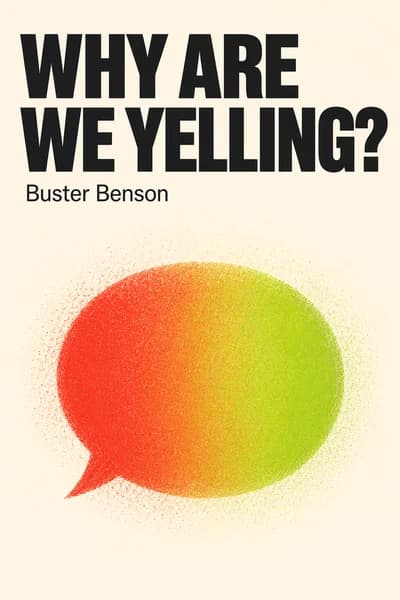
Why Are We Yelling?
The Art of Productive Disagreement
《Why Are We Yelling?》概述
In "Why Are We Yelling?," Buster Benson transforms how we view conflict, revealing arguments as opportunities rather than threats. This Amazon and Twitter veteran's guide turns everyday disagreements - even bagel-slicing debates - into powerful tools for creativity, problem-solving, and deeper human connection.

《Why Are We Yelling?》核心主题
- productive disagreement
- cognitive dissonance resolution
- conflict mediation frameworks
- anxiety-driven communication
- internal voice management
《Why Are We Yelling?》经典语录
Arguments aren't problems to eliminate but opportunities to embrace.
Anxiety sparks-signaling that something we value feels threatened.
We can learn to treat these internal voices as suggestions rather than commands.
The voice of power resolves disagreements by forcefully shutting them down.
Loss aversion makes us value things we already have more.
《Why Are We Yelling?》主要人物
- Buster BensonAuthor and former product leader
- Buster Benson's sonThe author's child used in conflict case studies
- Buster Benson's wifeThe author's partner in family disagreements
关于作者
《Why Are We Yelling?》作者介绍
Buster Benson, author of Why Are We Yelling? The Art of Productive Disagreement, is a renowned product leader, entrepreneur, and advocate for constructive communication.
A veteran of Silicon Valley, Benson’s career spans influential roles at Amazon, Twitter, Slack, and Patreon, where he honed his expertise in collaboration and conflict resolution. His book, blending self-help and behavioral psychology, draws on decades of experience fostering teamwork in high-stakes tech environments and founding ventures like Health Month and the journaling platform 750words.com.
Benson’s approach to disagreement emphasizes curiosity and empathy, reflecting his belief that friction can drive innovation—a philosophy shaped by his work building tools for personal growth and organizational dynamics. A frequent speaker on productivity and communication, his insights have been featured in podcasts and essays exploring human behavior.
Why Are We Yelling? has been widely embraced by professionals seeking to transform contentious debates into meaningful dialogue, solidifying Benson’s reputation as a pragmatic voice in modern workplace culture.
下载《Why Are We Yelling?》摘要
免费获取《Why Are We Yelling?》摘要的 PDF 或 EPUB 版本。可打印或随时离线阅读。
关于本书的常见问题
Why Are We Yelling? by Buster Benson redefines conflict as a tool for growth, offering strategies to transform heated arguments into productive conversations. It teaches readers to identify biases, communicate empathetically, and reframe disagreements as opportunities to strengthen relationships and solve problems effectively.
Professionals, couples, and anyone navigating polarized discussions will benefit from this book. It’s ideal for leaders, team members, or individuals seeking to improve communication in high-stakes environments, inspired by Benson’s experience at Amazon, Twitter, and Slack.
Yes—it provides actionable frameworks for conflict resolution, making it valuable for personal and professional growth. Reviews highlight its practicality in addressing modern communication challenges, from workplace tensions to family disagreements.
Benson outlines eight principles, including reframing conflict as curiosity, identifying argument types, and practicing empathy. These habits help redirect unproductive debates toward solutions while fostering mutual understanding.
The book emphasizes recognizing personal anxieties and triggers, then channeling them into constructive dialogue. By focusing on shared goals and asking open-ended questions, individuals can reduce defensiveness and create safer spaces for disagreement.
Benson argues that productive disagreements prioritize understanding over victory. He identifies four “fruits” of conflict: stronger relationships, better decisions, expanded perspectives, and collaborative problem-solving—all more valuable than traditional “winning.”
Absolutely. Techniques like articulating opponents’ viewpoints before rebutting them and categorizing argument types are tailored for team dynamics. Benson’s strategies draw from his work with tech giants, offering scalable solutions for workplace tension.
Some may find its approach overly idealistic for deeply entrenched conflicts. However, the book addresses this by providing incremental steps to build “disagreement muscles,” making it accessible even for conflict-averse readers.
Unlike generic advice, it combines psychological insights with Silicon Valley-tested methods. It uniquely frames disagreement as a skill to hone, not a problem to avoid, with whimsical illustrations and real-world examples.
Benson shares scenarios like debating political views with friends or resolving team conflicts at tech companies. One case study involves a voter exploring a non-voter’s rationale, illustrating empathy’s role in dissolving assumptions.
By teaching readers to replace accusatory language with curiosity, the book helps couples and families navigate sensitive topics. Its emphasis on active listening and vulnerability fosters deeper connections during disagreements.
Regular practice of its principles builds emotional resilience, reduces conflict avoidance, and cultivates a growth mindset. Over time, readers report fewer repetitive arguments and increased confidence in tackling complex discussions.