第 1 章
The Phantom Menace: How Gender Became a Battleground
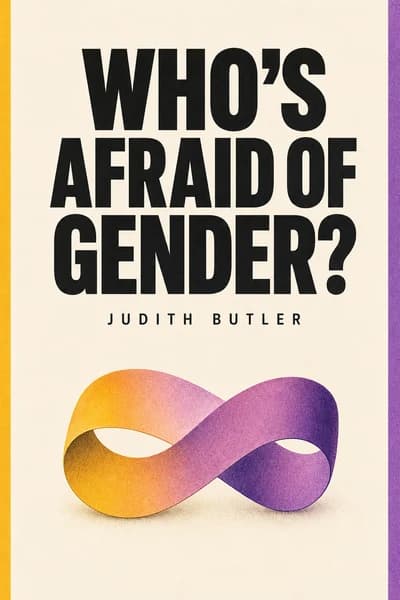
In a world increasingly polarized by culture wars, Judith Butler's "Who's Afraid of Gender?" arrives as both lightning rod and lighthouse. This provocative analysis has become required reading in progressive academic circles while simultaneously fueling conservative outrage across continents. Butler, whose earlier works revolutionized feminist and queer theory, now turns their analytical prowess to examine why "gender" itself has become such a feared concept. The book has garnered praise from figures ranging from philosopher Martha Nussbaum to pop culture icon Lady Gaga, who cited Butler's work as influential to her artistic expression of gender fluidity. As anti-trans legislation proliferates across America and "gender ideology" becomes a rallying cry for right-wing movements globally, Butler's intervention couldn't be more timely or necessary. This exploration of how an academic concept became a phantasmatic threat reveals the deeper anxieties underlying contemporary political movements.
第 2 章
The Weaponization of Gender as Existential Threat
The anti-gender movement represents a profound authoritarian impulse at its core. What we're witnessing isn't merely disagreement about terminology or academic theories, but a manufactured existential crisis designed to enhance state powers and restore what Butler calls a "patriarchal dream-order" - an idealized past that likely never existed but occupies the mythic space of "history" or "nature" in conservative imagination.
This movement implicates itself in fascist tendencies by targeting sexual and gender minorities as dangers to society. The pattern is disturbingly familiar: identify a vulnerable group, strip them of fundamental rights, and justify this violence by claiming to defend not just family values, but values themselves; not just a way of life, but life itself. The rhetoric escalates to apocalyptic proportions, where accepting gender diversity supposedly threatens civilization's very foundations.
What makes this phantasm so powerful isn't that it's empty, but that it's overdetermined - absorbing wildly different fears from social history and political discourse. When Italian Prime Minister Giorgia Meloni claims gender advocates will strip people of their sexed identity, she's engaging in a perverse projection. The very fear of deprivation she mobilizes becomes weaponized against transgender people, who are actually experiencing systematic deprivation of rights and recognition.
This dynamic creates a troubling reversal: those most vulnerable to violence are portrayed as the violent ones. Those seeking recognition become cast as destroyers. Those asking for protection become framed as threats. The psychological mechanism at work resembles what psychoanalysts call "projection" - attributing one's own unacceptable impulses to others. But this isn't merely individual psychology; it's a coordinated political strategy operating across continents.
What's at stake isn't abstract theory but concrete rights: reproductive justice, women's rights, transgender and non-binary recognition, and all efforts toward gender equality. The accelerating inflation of these manufactured dangers requires urgent understanding before more lives are destroyed. How did we reach a point where acknowledging gender diversity became equated with civilizational collapse?
第 3 章
The Global Anti-Gender Movement: Networks and Contradictions
The phantasm of "gender" functions as a psychosocial phenomenon where intimate fears become socially organized to incite political passions. This dangerous phantasm appears globally - in Christian nationalism in Taiwan, French presidential platforms, European racial purity movements, and conservative critiques of gender-mainstreaming policies.
Organizations like CitizenGo exemplify this transnational approach. Founded in Spain by Ignacio Arsuaga in 2013, this platform now boasts over nine million followers and operates in at least fifty countries. They've successfully campaigned against abortion services in Kenya and spread disinformation opposing reproductive rights across Africa. CitizenGo maintains extensive connections with other conservative organizations, including the World Congress of Families (WCF), which links Orthodox, Catholic, and Evangelical organizations defending what they call "the natural family."
The WCF itself emerged from collaboration between Reagan appointee Allan Carlson and Russian sociologists in 1995, focused on fears of falling birth rates and civilizational collapse. These networks extend to Russia through figures like Alexey Komov, who serves on CitizenGo's board while representing WCF in Russia, facilitating alliances between Russian Orthodox oligarchs and American Evangelicals.
What's particularly disturbing about this moral campaign is how it relishes denying others' existence, stripping rights, restricting freedoms, and engaging in racial hatred while controlling, demeaning, and criminalizing marginalized lives. The movement increasingly merges opposition to "gender ideology" with anti-immigration sentiment and white nationalism. Hungary's Prime Minister Viktor Orban exemplifies this intersection, linking migrants to threats against families and children while promoting replacement theory through lamenting Europe's declining population.
For Orban, "natural reproduction" represents "not just one national cause among many, but the national cause" essential to preserving a white Europe. He explicitly rejects both immigration and non-heteronormative families as solutions to population decline, insisting only the "traditional family" can save the nation from the threat of "gender ideology."
The anti-gender movement contains striking contradictions that enhance rather than diminish its influence. Depending on regional anxieties, gender can be portrayed as Marxist or capitalist, tyrannical or libertarian, fascist or totalitarian, a colonizing force or unwanted migrant. This inconsistency isn't a weakness but a strength - allowing the movement to adapt its messaging to local contexts while maintaining transnational coordination.
Through projections and reversals, those damaged by hateful movements are cast as the true agents of destruction, leaving us with urgent questions: Who is truly destroying whom? How does moral sadism masquerade as virtue?
第 4 章
The Vatican's Foundational Role in Anti-Gender Ideology
The Vatican has played a pivotal role in establishing the contemporary anti-gender movement. In 2004, Joseph Ratzinger (before becoming Pope Benedict XVI) wrote to all Catholic bishops distinguishing between two approaches to "women's issues." He characterized gender theory as minimizing physical difference (sex) while maximizing cultural elements, warning this would question the "natural" family structure and equate homosexuality with heterosexuality.
Ratzinger framed gender as a dangerous "human attempt to be free from biological conditioning," arguing that if people are "free to constitute themselves as they like," they will destroy their human essence. He positioned gender theory as both a product of historical/cultural effects and paradoxically as excessive personal liberty. His fundamental objection appears to be that gender, properly understood as sex, is divinely ordained and exclusively constituted by God, making human self-constitution a dangerous exercise.
As Pope Benedict, he later declared that gender "ultimately ends up being man's attempt at self-emancipation from creation and the Creator." This theological framing has provided justification for political movements opposing gender-affirming policies, same-sex marriage, and reproductive rights globally.
In 2010, Monsignor Tony Anatrella acted as Vatican spokesperson, urging African Catholic bishops to resist gay and lesbian rights groups sponsored by the UN, EU, and NGOs. He characterized "gender theory" as an "intellectual virus" comparable to Marxism that could paradoxically lead to unbridled capitalism if unchecked. According to Anatrella, this monolithic theory would "deregulate" humanity's moral center and plunge the concept of human into disorder.
The Vatican's stance represents a curious contradiction: it claims gender theory is both too culturally relativistic and too individually libertarian. This inconsistency reveals that the opposition isn't really about logical coherence but about maintaining traditional authority over bodies and relationships. While Evangelical groups opposing gender don't typically invoke Catholic complementarity, they share the Vatican's view that feminist and LGBTQIA+ rights are unnatural and dangerous to children and moral order.
第 5 章
Censorship and Rights-Stripping: The American Front
Those who oppose gender studies often refuse to engage with the actual texts they criticize, treating them as dangerous ideological material rather than scholarly work. This anti-intellectual stance manifests in book bans and curriculum restrictions, with critics imagining gender theory as a monolithic dogma rather than a diverse field marked by internal debate.
The opposition mirrors religious orthodoxy by projecting its own dogmatic tendencies onto gender studies, fearing that reading such materials will "contaminate" minds. This refusal to read critically undermines democratic discourse, as informed public debate becomes impossible when parties reject examining the material under dispute.
Oklahoma Senator Rob Standridge's bill exemplifies this approach, claiming education should teach only "core areas of learning" while keeping "moral lessons" for parents. His Senate Bill 114 prohibits materials addressing sex, sexual preferences, gender identity, or "content of a sexual nature." Such legislation divides parents into "reasonable" protectors versus supposedly dangerous enablers who "abuse" children by allowing access to LGBTQIA+ content.
This censorship conflates education with violation - reading about gender diversity is portrayed as unwanted penetration, with ideas themselves transformed into abusers. The critics manufacture their own pornographic fantasy where children are violated by what they read, blurring allegations of indoctrination with pedophilia. Ironically, it's feminism and LGBTQIA+ movements that have most clearly opposed sexual violence and taught about consent.
In 2022, legislative efforts intensified, with Governor Abbott directing Texas authorities to investigate parents providing gender-affirming care as "abusers." Florida's "Don't Say Gay" bill banned classroom instruction on sexual orientation or gender identity through grade 3, while Alabama criminalized gender-affirming care with penalties up to ten years imprisonment for physicians.
Medical organizations, including the American Psychiatric Association and American Medical Association, have opposed these laws, noting that treatments like hormone blockers can be lifesaving, and "it would be unethical to withhold potentially lifesaving care." These restrictions expand state power while restricting bodily autonomy, introducing clear principles of inequality by subordinating certain groups to state control.
Christopher Rufo exemplifies this anti-intellectual approach, railing against critical race theory while admitting "I don't give a shit about this stuff" when asked to explain it. He makes wild claims about queer theory teaching "sex liberation" and "BDSM" without ever examining the curricula. These opponents fear universities not for teaching dogma but for producing open minds. The anti-gender movement thus represents a politically consequential form of anti-intellectualism that opposes critical thinking itself as dangerous to society.
第 6 章
Gender-Critical Feminism: Contradictions and Alliances
J.K. Rowling's arguments about transgender youth suicide are contradicted by major medical associations, including the American Psychiatric Association. She cites psychiatrist David Bell who claimed that warnings about trans youth suicide don't align with "robust data," yet fails to provide any such data herself. Bell's experience at the Tavistock clinic (which was closed by the NHS in 2022) involved youth who were already receiving care, not those without access to treatment who face higher suicide risks. This rhetoric mirrors right-wing arguments that claim to prevent harm while actually causing it by denying healthcare to vulnerable youth.
Rowling misrepresents trans advocates by claiming they deny the reality of sex, stating: "If sex isn't real, there's no same-sex attraction. If sex isn't real, the lived reality of women globally is erased." Yet this strawman argument ignores that sex can be both real and mutable. The concept of sex has historical dimensions and varies across cultures and languages. Trans advocates aren't a monolith-many see places for both sex and gender as categories. Some trans people, like writer Andrea Long Chu who identifies as "female," are more interested in sex as a category than gender.
When Kathleen Stock focuses on isolated incidents of trans women committing violence in women's prisons, she neglects the broader reality that trans prisoners are assaulted monthly in UK facilities. Her selective use of examples serves to generalize and stoke fear. If preventing sexual assault in prisons were truly her concern, she might first address the more prevalent issue of male prison guards assaulting female inmates, or acknowledge that women assigned female at birth also commit sexual violence against other women.
The implicit assumption that having or once having had a penis predisposes someone to rape ignores feminist analyses that rape is an act of social domination, not biological determinism. Rape is an act of social and sexual domination arising from social relations that establish masculine domination and access to women's bodies without consent. The body is organized by operative relations of power, not biology. The penis itself is not the cause of rape but sometimes its instrument in service of a desire for absolute domination.
Trans-exclusionary feminism betrays the core principles of feminism as a struggle for justice formed in alliance and affirming difference. It makes no sense for "gender-critical" feminists to ally with reactionary powers targeting trans and gender-diverse people. Despite our differences, we must build alliances that keep the source of oppression in focus, remaining open to having traditional suppositions challenged.
第 7 章
Beyond the Binary: The Science of Sex and Gender
Butler challenges positivist approaches to sex by examining how sex assignment operates within interpretive frameworks. Rather than simply naming objective facts, sex assignment involves an imaginative anticipation of normative gender development. When we observe an infant's sexual characteristics, we simultaneously project a social trajectory - seeing not just anatomy but a future girl/boy or woman/man.
Facts never appear outside frameworks that determine what's valuable to observe. This doesn't deny material reality but recognizes that frameworks organizing sexed phenomena are inseparable from what's observed. Unlike positivism, which treats bodies as decontextualized facts, Butler's materialism acknowledges that bodies take form within social institutions and historical contexts.
Thomas Pradeu, a philosopher of biological sciences, examines developmental systems theory that focuses on "the co-evolution of organisms and their environments." Biologist Susan Oyama maintains that "genes do not play a central, or even a privileged role in development," that developmental factors "become causally relevant only by their interaction," and that "the nature/nurture dichotomy should be gotten rid of." This co-constructionist approach recognizes that the "causal power of DNA in development only arises through the interactions with other factors," challenging genetic determinism in sex determination.
In debates about women's sports, "sex" becomes disarticulated into hormonal, anatomical, and chromosomal features that don't always align with binary expectations. Studies show significant overlap in testosterone levels between male and female athletes - 16.5% of men had low testosterone while 13.7% of women had high levels. The IOC revised its guidelines when science revealed testosterone levels among women and men overlap substantially, and performance doesn't correlate predictably with endogenous testosterone.
Sexual dimorphism functions not as simple fact but as a normative framework that determines what we see and often leads people to deny hormonal and neurological complexities rather than challenge this "hallowed framework." When evidence contradicting strict dimorphism emerges, the binary hypothesis isn't revised but instead forecloses that evidence, revealing itself as an obligatory epistemic norm rather than good science.
Despite scientific evidence supporting co-constructionist models, some groups resist these frameworks. The trans-exclusionary feminist organization Sex Matters dismisses scientific publications in journals like Scientific American and Nature that present sex as more complex than a simple binary. They paradoxically claim that contemporary scientific research on sex is "harmful to scientific discourse" while failing to provide counterevidence.
第 8 章
Colonial Legacies and Decolonizing Gender
Both right-wing groups and trans-exclusionary feminists insist sex is binary and natural, but this view has been contested through feminist, queer, and trans inquiries that consider racial and colonial histories in the construction of sex. The dimorphic idealism of gender has deep roots in colonial power and slavery, making it impossible to separate considerations of gender from these historical legacies.
Contrary to Vatican claims that "gender" represents Western ideological colonization, decolonial theorists argue it was actually the gender binary that was violently imposed by colonial and racist powers. Drawing on Maria Lugones and Anibal Quijano, colonial arrangements provide the context for understanding normative gender relations, including heteronormativity, dimorphic idealism, the patriarchal family, and gender appearance norms.
Lugones describes how "sexual dimorphism" characterized the "light side" of the colonial/modern gender system, while those in the "dark side" weren't necessarily understood dimorphically. Colonial powers' sexual fears led them to imagine Indigenous peoples as hermaphrodites, though intersexed individuals were recognized in many tribal societies without assimilation to the sexual binary.
C. Riley Snorton's work documents how Black women's bodies were used for gynecological experiments during slavery, linking gender and trans identity to slavery's brutal history. Following Hortense Spillers, Snorton describes the "ungendered flesh" of Black bodies that were derealized in service of white gender norms. For Spillers, flesh isn't passive matter but a "capacitating structure" that "transorients sex and gender." Black women made possible "women's medicine" but were treated as flesh, not women, since gender arrived only with whiteness.
African scholars like Stella Nyanzi advocate "thinking beyond the loaded westernized frame of the LGBTI acronym," attending to Indigenous expressions that include "gestures, silences, erasures, and invisibilizations." Terms like "gogo" - meaning both grandparent and healer - challenge binary thinking while connecting to Ubuntu philosophy's understanding of humans as part of a spiritual inter-relationality.
These concepts resist translation into Western "gender theory" frameworks, as they would lose their temporal, spiritual and social meanings. The colonial imposition of binary gender through Christian missions represents ongoing colonization, while resistance to this binary should align with affirming queer, trans, and intersex lives against continuing colonial power.
第 9 章
Translation and the Politics of Language
The anti-gender movement often claims that "gender" represents an unwanted foreign intrusion into national languages. This objection oscillates between portraying gender as imperialist power and unwanted migrant, confusing anti-imperialist sentiment with xenophobic nationalism. While resisting cultural imperialism makes political sense, translation itself represents a necessary multilingual epistemology that preserves local languages while enabling complex understanding.
Anglophone gender theorists often unwittingly adopt a monolingual attitude when discussing gender, assuming their terms are universally translatable. This "smug monolingualism" fails to recognize how conceptual equivalence between languages cannot always be established. When we invite everyone to adopt English terminology or export our linguistic frame, we become "polite imperialists."
Many languages lack noun forms for "gender" entirely. Japanese, Chinese, and Korean have words for women and men but not for the concept of gender itself. In Japanese, linguistic self-reference is gendered through terms like ore and boku (masculine "I") versus atashi and watashi (feminine "I"), with usage inflected by social class, education, and relational context. Japanese approximates "gender" with the phonetic echo jen-daa, similar to French gen-daire.
In Chinese, gender is expressed as xing-bie, where xing means "category/kind/sex" and bie means "difference." Chinese feminist scholars distinguish gender from sex by adding "social" (she-hui) before xing-bie. These linguistic adaptations demonstrate how languages develop coinages in response to translation demands, showing that gender terminology is constantly evolving through cross-cultural contact.
People seek different paths to gender livability. Some embrace the binary, including trans people who want to find their rightful place as either man or woman. Their desire deserves radical, unqualified honor. Others cannot live within binary terms, including trans people who understand "trans" as existing at a critical angle to the binary. These individuals require alternative gender vocabularies and pronouns to inhabit the world and feel at home in language.
We must avoid imposing new gender norms that generalize livability conditions or dictate what others should be called. Instead, we must translate between our own language and another's, even when that translation dispossesses us of monolingual certainty. When gender is figured as a foreign invader, opponents reveal themselves as nation-builders and border patrollers, often defending white supremacy and heteronormativity.
第 10 章
Resisting Fascism, Building Coalitions
The language of eradication directed against trans people, "gender," "critical race theory," and "wokism" belongs to fascism's historical playbook of othering and elimination. Contemporary fascist rhetoric has evolved to embrace sophisticated messaging that presents itself as defending traditional values while attacking vulnerable groups. We need new analytical frameworks and vocabularies to understand how modern fascism emerges within neoliberal economic systems and enhanced surveillance states that normalize the systematic destruction of targeted communities' lives and livelihoods. While today's authoritarians may reject the fascist label, they consistently employ classic fascist techniques - scapegoating minorities, promoting ultranationalism, and stoking moral panics about social movements like feminism, multiculturalism, and LGBTQIA+ rights as internal enemies threatening national purity and social order.
These contemporary authoritarians position themselves as liberators from what they characterize as an oppressive progressive consensus that affirms trans lives and supports social justice movements. This calculated positioning enables a shameless assault on civil rights, unleashing privileged groups' sense of entitlement to maintain dominance by destroying marginalized communities' basic rights and protections. Unlike the charismatic dictators of twentieth-century fascism, today's authoritarian trends operate through distributed networks of power, strengthening systems of control while claiming to defend traditional family values and patriarchal institutions from supposed corruption by progressive forces.
While we aren't witnessing fascist states directly comparable to Nazi Germany, the anti-gender ideology movement contains clear fascist potentials being increasingly actualized in countries worldwide. From attacks on trans healthcare access to book bans targeting LGBTQ+ content to restrictions on gender-affirming care, these movements show how fascism emerges gradually through seemingly isolated policy changes that accumulate into systematic oppression. Recognizing these early warning signs is crucial for building resistance through sustainable coalitions that maintain internal solidarity.
The challenge isn't simply exposing factual inaccuracies in anti-gender arguments, but deflating the emotional power of fascist phantasms while producing an alternative vision of collective liberation. This requires targets of anti-gender movements to build robust alliances against those who would deny their right to exist freely in the world. Such coalition-building demands consistent principles - we cannot oppose discrimination against our own group while enabling it against others, nor ally with those who spread hatred targeting multiple communities.
By nurturing radical democratic potential through expanding intersectional coalitions, we can demonstrate that we represent the side of livable life and genuine freedom. These ideals must be made compelling enough that people actively desire a world where gender expression and human desire belong to the realm of freedom and equality. The goal is to make liberty as essential as the air we breathe together, while remaining vigilant against the toxic forces that would poison our collective atmosphere with hatred and oppression.