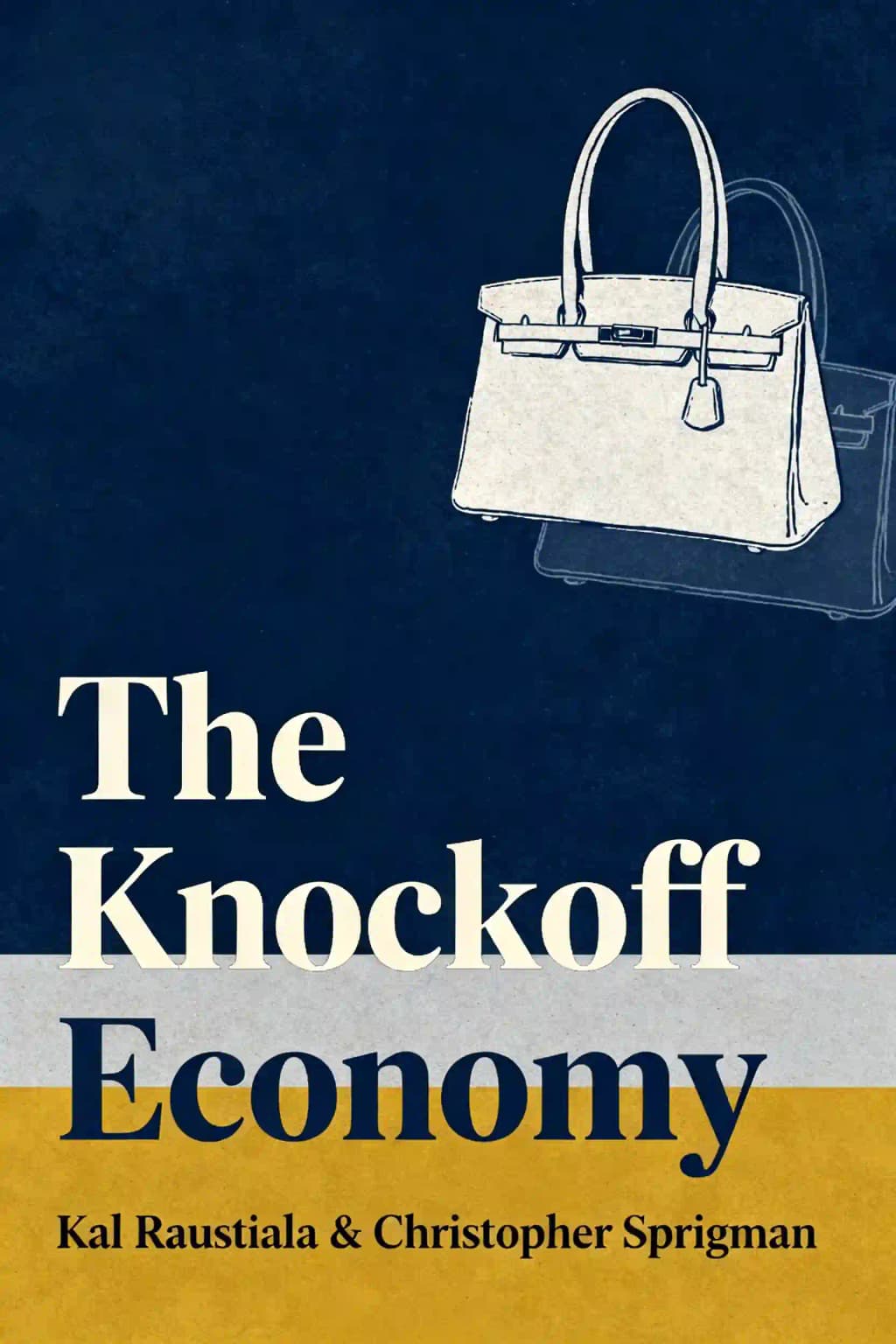
In "The Knockoff Economy," Raustiala and Sprigman boldly challenge conventional wisdom: what if imitation actually drives innovation? While fashion designers and tech giants battle copycats, this provocative 2012 bestseller reveals how industries without copyright protection paradoxically thrive through - not despite - imitation.
Kal Raustiala and Christopher Sprigman, co-authors of The Knockoff Economy: How Imitation Sparks Innovation, are eminent legal scholars and experts in intellectual property law. Raustiala is the Promise Institute Distinguished Professor of Comparative and International Law at UCLA, and Sprigman is a professor at NYU School of Law.
They combine decades of research on innovation, antitrust, and creative industries. Their groundbreaking work challenges conventional wisdom by demonstrating how fields like fashion, cuisine, and technology thrive through imitation rather than strict IP protections.
Raustiala’s acclaimed biography The Absolutely Indispensable Man: Ralph Bunche, the United Nations, and the Fight to End Empire (2023) won the Council on Foreign Relations’ Silver Medal, while Sprigman co-authored the widely used textbook Copyright Law: Cases and Materials (2022).
Both frequently contribute to Foreign Affairs, The New Yorker, and Freakonomics, and their research has influenced global debates on piracy and creativity. The Knockoff Economy has been translated into Chinese, Japanese, and Korean, and has been cited in major media outlets from The New York Times to Le Monde.
The Knockoff Economy challenges traditional views on intellectual property by arguing that imitation can drive innovation in industries like fashion, food, and football. Authors Kal Raustiala and Christopher Sprigman show how copying accelerates creativity through case studies on fast fashion trends, culinary remixing, and sports playbooks—demonstrating that lax IP rules often spur competition and progress.
Entrepreneurs, policymakers, and professionals in intellectual property, fashion, or tech will gain insights into balancing imitation and innovation. It’s also ideal for readers interested in business strategy, legal frameworks, or unconventional economic theories, offering actionable lessons on thriving in copy-heavy markets.
Yes—it provides a fresh perspective on innovation with real-world examples like fashion’s “piracy paradox,” where knockoffs force designers to constantly innovate. The book’s blend of academic rigor and accessible storytelling makes it valuable for understanding modern creative industries.
The “piracy paradox” describes how rampant copying in fashion fuels rapid turnover of trends, pushing designers to create new styles faster. Knockoffs democratize high fashion, increasing demand for original designs while shortening product lifecycles—a cycle that benefits both innovators and imitators.
Raustiala and Sprigman highlight industries like cuisine and football, where innovation thrives despite minimal IP protection. Chefs reinterpret dishes freely, while sports teams copy successful plays, fostering iterative improvement. Informal norms, not laws, often regulate copying, proving legal monopolies aren’t always necessary.
The book examines fashion, food, fonts, football, and finance. For example, font designers tolerate copying to build industry-wide standards, while chefs treat recipes as open-source—illustrating diverse strategies for managing imitation.
Unlike conventional IP theory, which prioritizes strict copyrights, the book argues that imitation can coexist with innovation. It contrasts music/film industries (struggling with piracy) with fashion (thriving via knockoffs), suggesting tailored approaches to IP regulation.
Critics argue its findings may not apply to IP-reliant industries like pharmaceuticals or software. Some question if informal norms in fashion or food can scale to global digital markets, where copying is harder to control.
As AI and 3D printing make copying easier, the book’s insights help businesses adapt. Its analysis of non-legal innovation incentives remains critical for navigating today’s global, digital economy—from counterfeit goods to open-source collaboration.
Kal Raustiala is a UCLA law professor and international relations expert, while co-author Christopher Sprigman is a NYU legal scholar. Their combined expertise in IP law and economics grounds the book’s interdisciplinary analysis.
The book advises leveraging imitation as a catalyst for innovation—e.g., using knockoffs to identify market trends or adopting rapid iteration cycles. It also emphasizes community-driven norms over litigation to manage copying.
通过作者的声音感受这本书
将知识转化为引人入胜、富含实例的见解
快速捕捉核心观点,高效学习
以有趣互动的方式享受这本书
Copying thus paradoxically fuels creativity rather than stifling it.
If there were not imitation there could be no fashion.
This knockoff economy reveals that creativity and copying can benefit each other.
将《The Knockoff Economy》的核心观点拆解为易于理解的要点,了解创新团队如何创造、协作和成长。
将《The Knockoff Economy》提炼为快速记忆要点,突出坦诚、团队合作和创造力的关键原则。

通过生动的故事体验《The Knockoff Economy》,将创新经验转化为令人难忘且可应用的精彩时刻。
随心提问,选择声音,共同创造真正与你产生共鸣的见解。

"Instead of endless scrolling, I just hit play on BeFreed. It saves me so much time."
"I never knew where to start with nonfiction—BeFreed’s book lists turned into podcasts gave me a clear path."
"Perfect balance between learning and entertainment. Finished ‘Thinking, Fast and Slow’ on my commute this week."
"Crazy how much I learned while walking the dog. BeFreed = small habits → big gains."
"Reading used to feel like a chore. Now it’s just part of my lifestyle."
"Feels effortless compared to reading. I’ve finished 6 books this month already."
"BeFreed turned my guilty doomscrolling into something that feels productive and inspiring."
"BeFreed turned my commute into learning time. 20-min podcasts are perfect for finishing books I never had time for."
"BeFreed replaced my podcast queue. Imagine Spotify for books — that’s it. 🙌"
"It is great for me to learn something from the book without reading it."
"The themed book list podcasts help me connect ideas across authors—like a guided audio journey."
"Makes me feel smarter every time before going to work"

免费获取《The Knockoff Economy》摘要的 PDF 或 EPUB 版本。可打印或随时离线阅读。
Imagine watching the Oscars and seeing a stunning designer gown on the red carpet. Within days, nearly identical versions appear in stores for a fraction of the price. Surprisingly, this copying is perfectly legal. Fashion designs receive virtually no copyright protection in America, yet the industry continues to thrive creatively. This paradox challenges our fundamental assumptions about innovation and intellectual property. The traditional view, enshrined in the Constitution, suggests creators need control over copying to incentivize creation. But across numerous industries - fashion, cuisine, comedy, and more - innovation remains vibrant despite rampant copying. In some cases, copying actually accelerates innovation. As technology makes copying increasingly easier, understanding this "knockoff economy" offers an optimistic counterpoint to fears that easier copying will destroy creative industries. The evidence suggests creativity and copying can not only coexist but sometimes benefit each other.