第 1 章
A Revolution Through a Child's Eyes: Growing Up Between Worlds
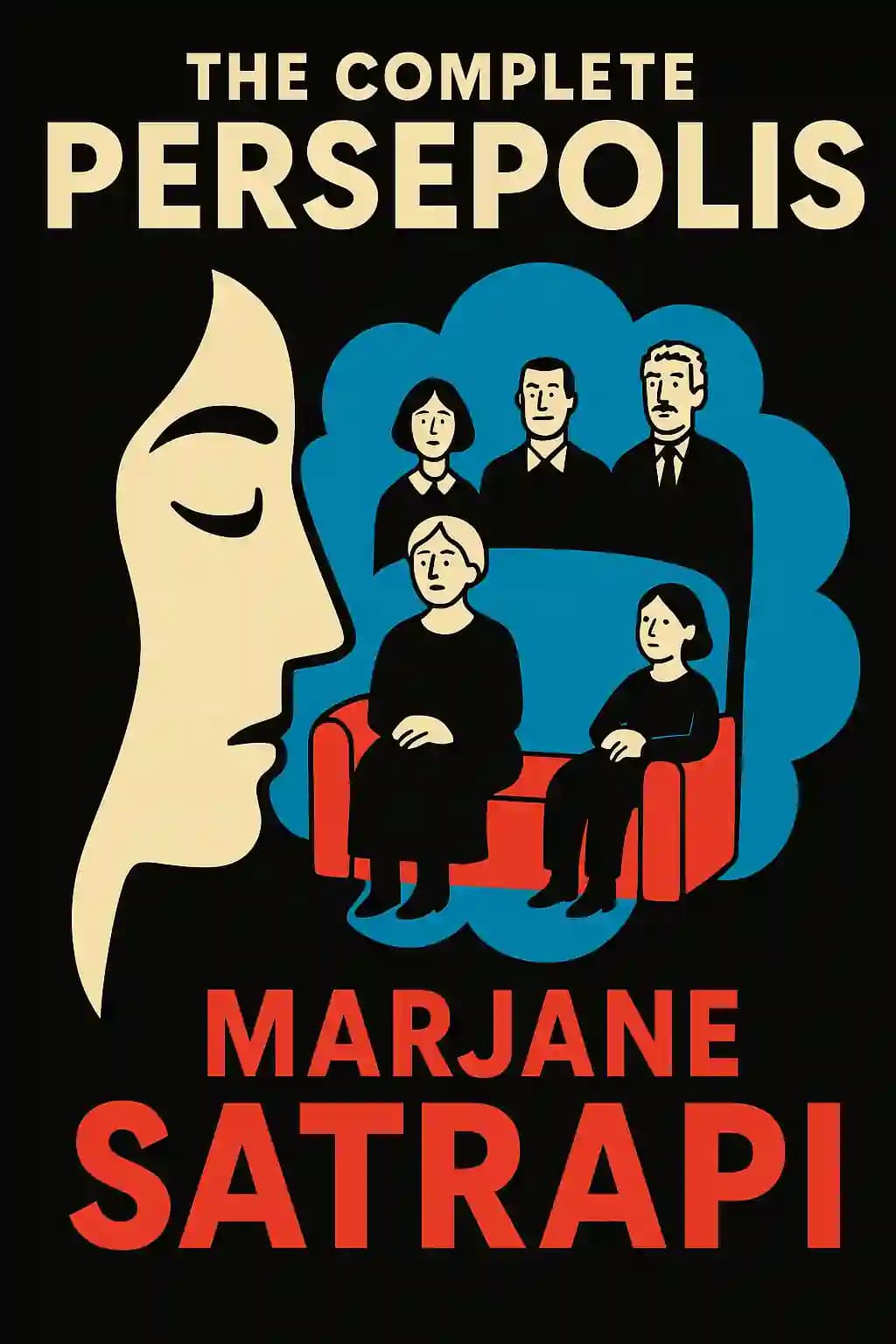
Marjane Satrapi's graphic memoir "Persepolis" stands as one of the most powerful coming-of-age stories ever told against the backdrop of political upheaval. Since its publication, it has become required reading in universities worldwide, translated into over 20 languages, and adapted into an acclaimed animated film that won the Jury Prize at Cannes. Michelle Obama listed it among her essential reads, while Art Spiegelman called it "the most original memoir of our time." What makes this black-and-white illustrated narrative so compelling is how it transforms Iran's complex history into something deeply personal-a child's perspective on revolution, war, and exile that transcends cultural boundaries. Through Marjane's eyes, we witness how political forces reshape individual lives, making distant historical events feel intimately familiar. Her story reminds us that behind every headline about Iran lies millions of human stories just as complex, funny, and heartbreaking as our own.
第 2 章
The Veil and the Child: Iran's Revolution Through Innocent Eyes
In 1980 Tehran, ten-year-old Marjane Satrapi finds herself caught in the whirlwind of Iran's Islamic Revolution. The once-secular society transforms overnight as the new regime mandates the veil for all women and girls. Young Marjane and her classmates awkwardly adjust to this new reality, playing with their veils during recess - using them as jump ropes, makeshift puppets, and even pretending they're ghosts - despite not understanding their significance. "I really didn't know what to think about the veil," Marjane confesses, capturing the confusion of a child trying to make sense of rapid social change. The playground becomes a microcosm of society's adaptation, with some girls embracing the new rules while others rebel in small ways.
At home, Marjane enjoys a progressive upbringing with educated, politically active parents who attend demonstrations against the increasingly restrictive regime. Her mother, a passionate advocate for women's rights, refuses to surrender her modern lifestyle entirely, while her father photographs the protests, documenting the changing times. This creates a stark contrast between her private and public worlds. While teachers enforce religious conformity at school - mandating prayer sessions and requiring modest behavior - Marjane's home remains filled with books, Western music, and heated political discussions. She processes these contradictions through childish imagination, playing at being a revolutionary prophet one day, complete with homemade robes and theatrical pronouncements, and pretending to be a Western pop star the next, singing into her hairbrush in front of the mirror.
What makes Marjane's perspective so powerful is how it strips away the complex political ideologies to reveal simple human truths. When her school suddenly segregates boys and girls, Marjane doesn't understand the religious reasoning-she simply misses playing soccer with her male friends and sharing comic books during lunch breaks. When the government mandates longer, more conservative clothing, she doesn't grasp the theological arguments-she just feels uncomfortable in the hot Tehran summer and longs for the colorful clothes now hidden in the back of her closet. Her childhood drawings reflect this disconnect, mixing images of revolutionary soldiers with teenage pop idols and family scenes.
Through these everyday frustrations, we experience how political revolutions manifest in the most mundane aspects of life. Marjane observes her neighborhood changing - the local shop removing Western products, friends' families suddenly disappearing abroad, and new propaganda murals appearing on building walls. Her childhood innocence serves as the perfect lens through which to view these changes, highlighting their absurdity without explicit criticism. When she overhears adults discussing torture and imprisonment, she reimagines these horrors through the filter of childhood games and superhero stories, making the reality both more bearable and more poignant. Her confusion mirrors our own as readers trying to understand how a progressive society could transform so dramatically, so quickly. This innocent perspective accomplishes what political analysis cannot-it makes us feel the human impact of revolution through the eyes of a child who simply wants to play, learn, and grow up in a world that makes sense.
第 3 章
A Legacy of Resistance: Family History as Political Education
Marjane's political awakening comes through bedtime stories-not of princesses and dragons, but of her family's history of resistance against oppression. Her grandfather, once a prince of the Qajar dynasty, became a communist revolutionary only to be imprisoned by Reza Shah for nine years. Her uncle Anoosh spent years in Soviet exile and Iranian prisons for his political beliefs. These aren't distant historical figures but beloved family members whose photographs hang on walls and whose personal artifacts - letters, watches, old newspapers - create tangible connections to Iran's turbulent past.
When Uncle Anoosh visits after being released from prison, Marjane treats him like a superhero, collecting every detail of his stories like precious gems. She sits captivated as he recounts fleeing across snow-covered borders with forged papers, finding refuge in the Soviet Union, and surviving years of solitary confinement. Through his stories, concepts like "revolution" and "resistance" transform from abstract ideas into vivid human experiences. "You risked your life for freedom," she tells him admiringly, already internalizing the value of standing up for one's beliefs regardless of consequences. These intimate conversations become Marjane's political education, teaching her that resistance runs in her blood and carries both glory and terrible cost.
This family history provides crucial context for understanding Iran's complex political landscape. Through her relatives' stories, we learn how the country cycled through different forms of oppression-from monarchy to theocracy-with brief windows of democracy quickly closed by foreign intervention or internal power struggles. When Marjane's father explains how British and American interests orchestrated a coup against democratically elected Prime Minister Mossadeq in 1953, using detailed maps and newspaper clippings from his personal archive, we understand the deep roots of Iranian suspicion toward Western powers. Each family member adds layers to this historical tapestry - her mother's participation in anti-Shah demonstrations, her uncle's involvement in Marxist organizations, her grandmother's witnessing of multiple regime changes.
What makes these history lessons remarkable is how they're conveyed through personal connection rather than dry exposition. When Marjane's grandmother describes the humiliation of having her veil forcibly removed during Reza Shah's westernization campaign, then being forced to wear it again during the Islamic Revolution, we grasp the whiplash of Iran's political pendulum through one woman's lived experience. Her grandmother's stories are peppered with sensory details - the smell of tear gas during protests, the sound of midnight knocks on doors, the texture of different mandatory head coverings - that make history immediate and visceral.
These intergenerational conversations reveal how political consciousness forms in children not through abstract ideology but through love and admiration for family members who stood for something greater than themselves. Marjane doesn't just learn about resistance-she inherits it as a family value as essential as honesty or kindness. Through bedtime stories, photo albums, and dinner table discussions, she absorbs not just historical facts but an ethical framework that will guide her own political awakening. Her family's legacy of resistance becomes both a burden and a source of pride, shaping her understanding of duty, courage, and the personal cost of standing up for one's beliefs.
第 4 章
When Worlds Collapse: Witnessing Revolution Through a Child's Eyes
As demonstrations intensify in Tehran, Marjane's childhood intersects with history in increasingly dangerous ways. She watches her parents join thousands in the streets protesting the Shah's regime, torn between pride in their courage and fear for their safety. When her mother photographs government forces firing on unarmed demonstrators, Marjane begins to understand the deadly stakes of political resistance. "They're killing people," she realizes, her childhood innocence cracking under the weight of this knowledge.
The revolution unfolds through a series of vivid, child's-eye vignettes that capture both the hope and horror of this period. Marjane joins neighborhood children playing "revolution" instead of "house," mimicking the protests they witness. She overhears adults whispering about torture in the Shah's prisons. She watches television broadcasts of massive demonstrations where protesters chant for freedom. These moments, rendered in stark black and white illustrations, show how children absorb political turmoil even when adults try to shield them.
What makes this perspective so powerful is how it strips away political complexity to reveal moral clarity. When Marjane learns that a friend's father, who worked as the Shah's torturer, has himself been executed, her response is childishly straightforward: "But he was a bad man, wasn't he?" The adults around her struggle with more nuanced questions about justice versus vengeance, but Marjane cuts through to the essential moral question-should people who hurt others face consequences?
As the revolution succeeds in ousting the Shah, Marjane witnesses the surreal social transformations that follow. Former regime supporters suddenly claim revolutionary credentials, wearing Islamic clothing and growing beards to demonstrate their allegiance to the new order. Her neighborhood transforms overnight as people remove symbols of Western influence and embrace Islamic identity-whether from genuine conviction or self-preservation remains unclear.
Through these observations, we experience how revolutions create not just political but social upheaval, forcing everyone to renegotiate their public identities. Marjane's confusion mirrors our own as we witness how quickly people adapt to new power structures, raising questions about authenticity and survival that have no easy answers. Her childhood perspective, free from adult cynicism, allows us to see both the genuine idealism and the human hypocrisy that coexist in revolutionary moments.
第 5 章
Paradise's Plastic Keys: The Iran-Iraq War and Childhood's End
When Iraq invades Iran in 1980, war transforms Marjane's already turbulent childhood into something surreal and terrifying. Air raid sirens interrupt school days, sending children scrambling for shelter, their half-finished assignments abandoned on desks. Food and necessities grow scarce as the conflict stretches on, with families waiting in endless lines for basic supplies like bread and gasoline. Blackout curtains cover windows while families huddle in basements during bombings, telling stories and playing cards to distract themselves from the sounds of explosions overhead. Yet amid this chaos, children find ways to incorporate war into their play - Marjane and her friends invent games where they "torture" Iraqi soldiers represented by nails, demonstrating how quickly violence becomes normalized in young minds.
The most haunting aspect of this period is the regime's exploitation of religious faith to recruit child soldiers. Boys as young as twelve are given "keys to paradise" - cheap plastic trinkets painted gold - and promised eternal glory in heaven if they die fighting. Marjane watches in horror as her classmate's brother, just fourteen, marches off to war wearing a bandana inscribed with "I love martyrdom." School assemblies celebrate these "martyrs," with principals giving passionate speeches about sacrifice while mothers weep in the audience. "They told us that if we died, we would go to heaven," explains her classmate, revealing how deeply this propaganda penetrated young minds. The regime even sends representatives to schools, distributing sweets and showing films glorifying martyrdom.
The contrast between rich and poor becomes starker during wartime, revealing the cruel economics of conflict. While wealthy families like Marjane's can buy black market supplies, maintain private generators, and eventually consider leaving the country, poor boys from rural areas become the primary cannon fodder. In one particularly poignant scene, Marjane's maid receives news of her nephew's death at the front - he had enlisted because his family needed the martyr's pension. The class dimensions of sacrifice become painfully clear: wealthy families can buy their sons' way out of service, while poor families send their children to die for economic survival.
Despite her parents' efforts to maintain normalcy - continuing piano lessons, hosting dinner parties, helping with homework - war intrudes into every aspect of Marjane's life. When her neighborhood is bombed, she witnesses the aftermath firsthand: Mrs. Hossaini's arm protruding from rubble, still wearing the distinctive turquoise sleeve she had complimented just days before. The family's beloved neighbor, known for her garden and homemade cookies, reduced to a fragment amid concrete and dust. This moment marks a profound loss of innocence as death becomes not an abstract concept but a visible reality involving people she knows and loves.
What makes this portrayal of war so affecting is how it captures the strange normalization of violence in daily life. Children become experts at distinguishing between the sounds of different missiles - Iraqi Scuds make a different whistle than Iranian defensive fire. Families develop elaborate routines for rushing to shelters, with designated bags packed with essentials and family photos. Schools hold memorial services for martyrs while continuing math lessons, teachers attempting to maintain educational standards even as their classes shrink from casualties and evacuations. This juxtaposition of the extraordinary and the mundane - homework assignments alongside air raid drills, birthday parties interrupted by bombings - reveals how humans adapt to even the most extreme circumstances, especially when they have no choice. The war transforms not just the physical landscape but the psychological terrain of childhood itself.
第 6 章
Rebellion in Black and White: Teenage Resistance Under Theocracy
As Marjane enters adolescence under the Islamic Republic, her rebellion takes increasingly dangerous forms. She secretly buys Western music cassettes on the black market, modifies her mandatory uniform to express individuality, and cleverly talks her way out of trouble when confronted by the "Guardians of the Revolution"-women who patrol the streets enforcing Islamic dress codes. When they stop her for running in public (which could cause her body to move in "provocative" ways), she invents a story about a man following her, turning their own moral logic against them.
These small acts of defiance reveal how authoritarian control of public behavior creates a generation skilled in subterfuge. Marjane and her friends become experts at maintaining double lives-appearing compliant in public while secretly listening to Iron Maiden, wearing makeup, and attending forbidden parties. "We were living in a paradox," she explains. "Our private self was completely different from our public image."
The regime's obsession with controlling women's bodies becomes a central battleground. Female guardians measure girls' hair if it peeks out from their headscarves. Teachers check students' nails for polish. The absurdity reaches its peak when a school administrator warns girls not to move their hips while walking downstairs to avoid arousing the male janitor. These restrictions transform even the most mundane physical movements into acts loaded with political significance.
At home, Marjane's parents continue hosting secret parties where adults briefly escape the oppressive atmosphere through forbidden music, alcohol, and dancing. These gatherings represent not just entertainment but psychological survival-spaces where people can momentarily remember their pre-revolution identities. When police raid neighboring apartments, partygoers frantically flush alcohol down toilets and women rush to don headscarves, revealing the constant fear underlying these moments of freedom.
What makes this portrayal of teenage rebellion particularly powerful is how it universalizes the experience while acknowledging its unique dangers. Teenagers everywhere push boundaries, but in revolutionary Iran, getting caught with a Michael Jackson tape or attending a party could result in imprisonment or public flogging. Through Marjane's experiences, we understand how authoritarian regimes create societies where everyone becomes skilled at deception simply to express normal human desires for music, fashion, romance, and joy.
第 7 章
Exile's Bitter Freedom: Displacement and Identity in Vienna
When Marjane's parents make the heartbreaking decision to send their fourteen-year-old daughter to Vienna for safety, she faces the paradoxical experience of gaining freedom while losing her sense of belonging. Arriving in Austria, she encounters a different kind of struggle-navigating Western culture as an Iranian teenager during a time when her country is vilified in international media. "I was nothing," she reflects. "I was a foreigner in Austria, and I had been a foreigner in my own country."
Her initial excitement about escaping Iran's restrictions quickly gives way to profound loneliness. Language barriers, cultural differences, and casual racism isolate her from peers. When classmates ask ignorant questions about camels in Iran or assume she can't understand modern technology, Marjane confronts the stereotypes that flatten her complex identity into a one-dimensional "exotic other." She alternates between fiercely defending Iranian culture and trying to distance herself from it-a common struggle for immigrants caught between worlds.
Housing insecurity compounds her isolation. After her mother's friend proves unwelcoming, Marjane moves to a Catholic boarding house run by nuns, then to a friend's apartment, then to a communal home with eight gay men, and finally to the home of an eccentric doctor. Each displacement reinforces her status as an outsider with no stable place in Austrian society. Too proud to admit her struggles to her parents in war-torn Iran, she suffers in silence.
Marjane's attempts at assimilation lead to identity confusion. She dyes her hair, adopts punk fashion, and experiments with drugs and casual relationships-trying on Western identities like costumes. Yet these experiments bring little genuine connection. When she falls in love with a young man named Markus, his eventual betrayal devastates her not just romantically but culturally, confirming her suspicion that she will never truly belong.
The freedom she finds in Vienna proves double-edged-while escaping Iran's political and religious restrictions, she encounters different forms of alienation. Without family or cultural context, this freedom becomes a kind of exile from herself. When her housing situation collapses completely, Marjane experiences homelessness in winter Vienna, sleeping in train stations and parks until bronchitis nearly kills her. This physical deterioration mirrors her emotional and cultural dislocation-a body without a home, just as she has become a person without a secure identity.
第 8 章
Return to a Changed Land: The Disorientation of Homecoming
After four years abroad, Marjane returns to an Iran transformed by war and increasing religious fundamentalism. The Tehran airport walls display murals of martyrs and revolutionary slogans, immediately signaling that this homecoming will not be simple. Though her family's loving embrace provides immediate comfort, she quickly realizes she has become a stranger in her own homeland. "I was a westerner in Iran, an Iranian in the West," she reflects, capturing the disorientation of belonging nowhere completely.
This return forces Marjane to confront the gulf between her experiences and those of friends who remained in Iran during the war. While she experimented with freedom in Vienna, they endured bombings, food shortages, and intensifying religious restrictions. When she attempts to share stories from Europe, they respond with accounts of cousins and classmates killed at the front. This conversational disconnect reveals the impossibility of truly sharing divergent traumas-her exile and their survival represent fundamentally different experiences of the same historical moment.
Depression overwhelms Marjane as she struggles to reconcile her Western experiences with Iran's restrictions. Simple activities she took for granted in Vienna-wearing makeup, showing her wrists, laughing loudly-now carry the risk of arrest or public harassment. The psychological burden of constantly monitoring her appearance and behavior in public spaces becomes unbearable. After a failed suicide attempt with her mother's pills, she realizes she must find a way to integrate her divided self rather than erasing either part.
Her journey toward self-acceptance begins with small acts of reinvention-getting a perm, taking aerobics classes, applying to art school. These seemingly superficial changes represent her determination to carve out space for individual expression within Iran's constraints. When she passes the entrance exam for art school (which includes questions on religious doctrine alongside artistic technique), Marjane begins finding community among other young Iranians similarly navigating between compliance and resistance.
What makes this homecoming narrative so powerful is how it complicates simplistic notions of belonging. Rather than finding resolution through return, Marjane discovers that exile has permanently altered her relationship to her homeland. She can neither fully embrace Iran's post-revolutionary culture nor completely reject it. Instead, she must create a third space-one that honors her Iranian identity while incorporating the personal freedom she experienced abroad. This struggle reflects the broader challenge facing Iran's youth: how to honor cultural heritage while resisting oppressive aspects of the current regime.
第 9 章
Between Two Worlds: Finding Freedom Through Self-Acceptance
Marjane's journey culminates not in choosing between East and West, tradition and modernity, but in embracing the complexity of existing between worlds. After divorcing her husband Reza-a marriage that represented an attempt to conform to Iranian expectations-she makes the difficult decision to leave Iran permanently. This departure differs fundamentally from her earlier exile; as an adult, she chooses to leave with full awareness of what she's gaining and losing.
The night before her departure, her grandmother shares wisdom that becomes Marjane's guiding philosophy: "Always keep your dignity and be true to yourself." This simple advice acknowledges the core struggle of her journey-maintaining personal integrity while navigating contradictory cultural expectations. Her grandmother gives her jasmine flowers to remember her by, a sensory connection to Iran that Marjane will carry into her new life.
At the airport, the final separation from her family carries devastating finality. Her mother faints, her father carries her away, and Marjane walks through customs knowing she might never see her grandmother again. This moment captures the true cost of her freedom-the severance of daily connection to those she loves most. "Freedom had a price," she reflects, understanding that her choice to live authentically requires this painful sacrifice.
What makes Marjane's story ultimately hopeful is how she transforms displacement into a unique perspective. Rather than seeing her divided identity as a weakness, she eventually recognizes it as the source of her creative voice. Her experience of both Iran and the West allows her to serve as a cultural translator, using her art to humanize Iranians for Western audiences while preserving complex truths about her homeland that go beyond stereotypes of either exotic mystique or religious fanaticism.
Through her graphic memoir, Marjane accomplishes what seemed impossible during her adolescent identity crisis-she integrates her contradictory experiences into a coherent narrative. The black and white illustrations themselves represent this synthesis, combining Western comic book traditions with Persian visual influences. The simplicity of the drawing style contrasts with the complexity of the story, creating an accessible entry point into difficult historical and personal material.
Marjane's journey reminds us that freedom isn't just a political condition but an internal state achieved through self-acceptance. By embracing all parts of her identity-Iranian and Western, traditional and rebellious, serious and humorous-she finds liberation not in geographical location but in the integrity of being fully herself. Her story challenges us to recognize how we all navigate multiple identities and contradictory cultural messages, suggesting that wholeness comes not from resolving these tensions but from acknowledging and integrating them into our unique human stories.