第 1 章
The Revolution of More From Less
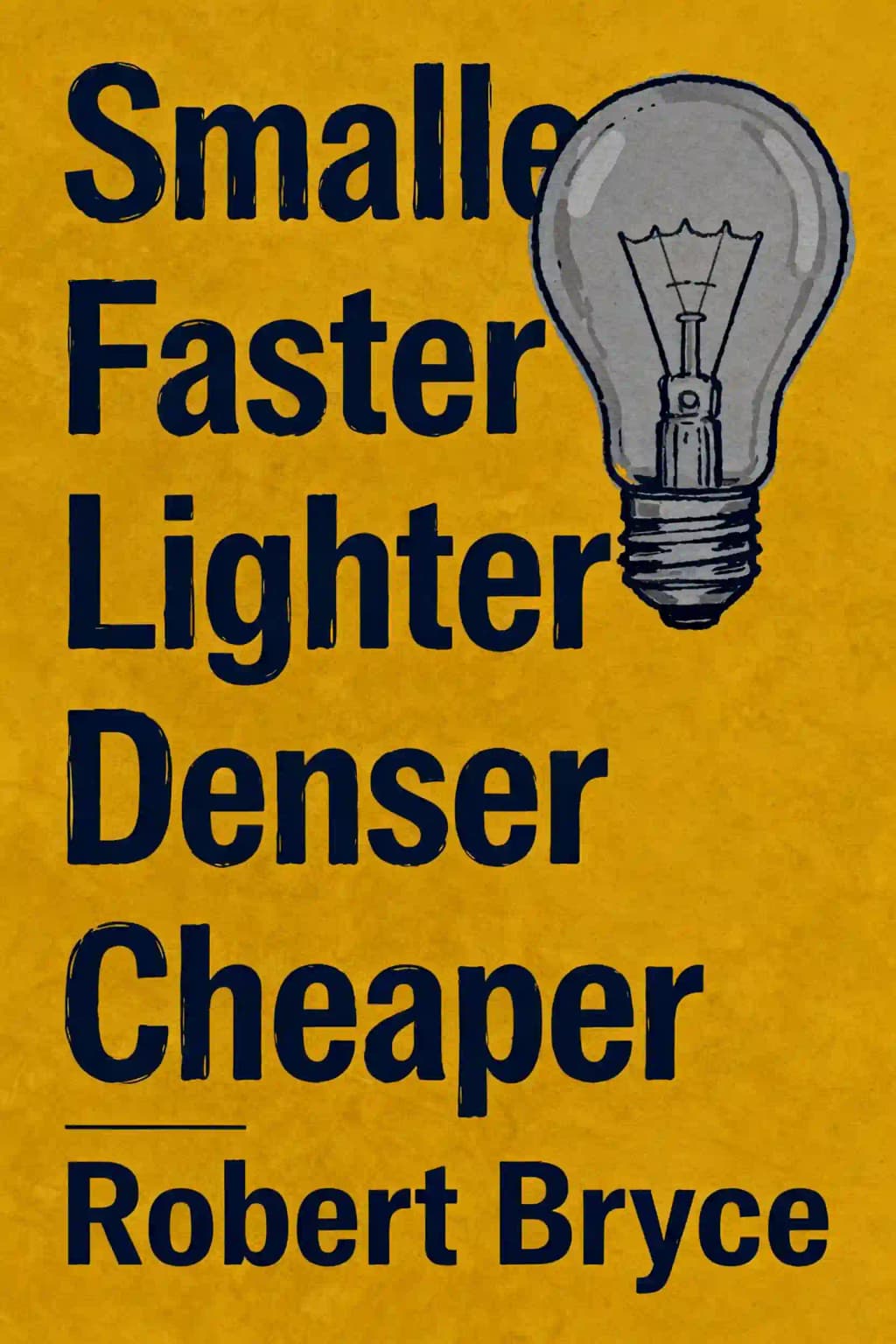
What if the key to solving humanity's greatest challenges isn't about consuming less, but about innovating more? In Robert Bryce's "Smaller Faster Lighter Denser Cheaper," we discover a counterintuitive truth: human progress isn't destroying our planet-it's saving it. This provocative book has become required reading in Silicon Valley boardrooms and university engineering departments alike, with Elon Musk reportedly keeping a copy on his nightstand. As climate anxiety dominates headlines, Bryce's optimistic perspective offers a refreshing alternative to doom-laden narratives. By examining how we've consistently found ways to do more with less throughout history, he presents a compelling case that innovation-not restriction-holds the key to addressing our most pressing problems. Through countless examples of technological breakthroughs that have made our world more efficient, Bryce demonstrates why the future may be brighter than we've been led to believe.
第 2 章
Beyond Collapse Anxiety: The Case for Technological Optimism
We are constantly bombarded with apocalyptic visions of the future. Climate change, pollution, famine, water shortages, terrorism, and economic malaise dominate our headlines. The UN Secretary-General sounded alarms when Earth reached seven billion people. Health organizations warn of emerging diseases at "historically unprecedented" rates. This avalanche of negativity has created what Gregg Easterbrook calls "collapse anxiety"-a pervasive feeling that Western prosperity cannot be enjoyed because our lifestyle may crash from economic breakdown, environmental damage, or resource exhaustion.
This mindset pervades environmental rhetoric, with many groups portraying modern energy use as a sin against Earth so severe that even weather has turned against us. In their view, we're driving too much, flying too much, consuming too much, and using excessive energy for comfort. They advocate returning to simpler times, embracing what might be called a "40-acres-and-a-mule-Green-Acres" approach to living.
But history tells a different story. For centuries, humans have been finding ways to do more with less-creating technologies and systems that are smaller, faster, lighter, denser, and cheaper. This isn't just about efficiency; it's about fundamentally transforming how we interact with our world.
Consider the Panama Canal, which celebrated its centennial in 2014 with a $5.2 billion expansion project. The canal's construction was the nineteenth century's moonshot-unrivaled in scale and ambition. It dramatically reduced the New York to San Francisco journey by 8,000 miles, eliminating the months-long voyage around Cape Horn. This pursuit of efficiency continues today, with the upgraded locks accommodating vessels carrying up to 13,000 containers, making shipping significantly cheaper.
The canal's opening in August 1914 marked the true beginning of the twentieth century, coinciding with World War I and the rise of automobiles, airplanes, and electricity. A century later, it remains one of humanity's most astounding achievements, embodying our drive toward innovation that makes things smaller, faster, lighter, denser, and cheaper.
This pattern of innovation isn't an accident-it's the defining characteristic of human progress. And contrary to collapse anxiety narratives, it offers our best hope for addressing the challenges we face.
第 3 章
The Human Drive for Innovation: Smaller, Faster, Lighter
The human brain exemplifies extraordinary efficiency-its gravimetric power density is 100,000 times that of the Sun. While consuming just 20% of our calories despite being only 2% of body weight, it operates at about 13 watts per kilogram compared to the Sun's 0.00019 watts per kilogram. Beyond its power efficiency, the brain supports unparalleled complexity-100 billion neurons with each connecting to roughly 1,000 others, creating 100 trillion distinct connections. This network dwarfs the World Wide Web's estimated 40 billion pages. Remarkably compact yet immensely powerful, our brain represents nature's ultimate achievement in density and efficiency.
Our drive to innovate has manifested throughout history in countless examples of doing more with less. Johannes Gutenberg's printing press (c. 1440) revolutionized human knowledge by making books smaller, lighter, faster, and cheaper. As Sir Francis Bacon noted, it changed "the appearance and state of the whole world." By 1500, over 2,500 European cities had printing presses, democratizing education beyond the wealthy, clergy, and nobility. It accelerated the dissemination of scientific discoveries, increased accuracy in knowledge transfer, and wrested control of ideas from the Catholic Church.
The vacuum tube transformed music and culture by democratizing musical power. Perfected by Lee De Forest in 1906, it enabled the amplification of electrical signals, putting real power into musicians' hands. While big bands needed many players to create volume, the vacuum tube allowed just three or four musicians with electric guitars to rock entire stadiums. The electric guitar, particularly mass-produced models like the Fender Telecaster (1950), Gibson Les Paul (1952), and Fender Stratocaster (1954), became cultural icons representing youth and rebellion.
Rock and roll, powered by vacuum tubes, helped undermine prejudice and authoritarianism worldwide. The Beatles' appearance on the Ed Sullivan Show in 1964 introduced white Americans to black American music that had inspired British musicians. Soviet authorities banned Beatles music, yet it spread underground, with one Russian claiming "they helped destroy the Evil Empire."
Even weapons technology followed this trend. Mikhail Kalashnikov's AK-47 represents the darker side of innovation-making killing cheaper through smaller, lighter design. Since its 1947 development, approximately 100 million Kalashnikov rifles have been produced, with some African regions selling them for as little as $30. The AK-47's revolutionary design-shorter and lighter than traditional rifles but more powerful than submachine guns-combined with exceptional reliability and simplicity made it ubiquitous in conflict zones.
These examples illustrate our relentless pursuit of improvement and optimization-a pattern that continues to define human progress today.
第 4 章
Transforming the World Through Density and Efficiency
The Haber-Bosch process may be humanity's most significant invention for basic survival. Developed by Germans Fritz Haber and Carl Bosch (who received Nobel Prizes in 1918 and 1931), the process converts atmospheric nitrogen and natural gas into ammonia fertilizer under high temperature and pressure. Before this innovation, farmers relied on expensive guano (bird droppings) from Chile's coast for nitrogen fertilizer. The process's importance is staggering: approximately two out of every five people alive today get their dietary protein thanks to foods grown with Haber-Bosch fertilizers.
Transportation has been revolutionized by the diesel engine and jet turbine-two machines that have made movement faster and cheaper. Diesels move over 80% of American freight with 25-40% higher efficiency than gasoline engines. Today's massive ship diesels reach 94,000 horsepower with 50% thermal efficiency. Meanwhile, jet turbines revolutionized air travel, increasing speeds threefold and altitudes twofold compared to piston aircraft. Air travel exploded from 28 billion passenger-kilometers in 1950 to 5.2 trillion in 2011-a 186-fold increase. Flights that once cost $8,000 in today's money now cost under $1,000, while travel time from New York to Paris dropped from twenty hours to eight.
Our ability to see both the very distant and the very small has been transformed by telescopes and microscopes-the first true extensions of human vision and pivotal instruments of the Scientific Revolution. They made magnification cheaper, allowing ordinary people to witness celestial and microscopic phenomena firsthand. Galileo's improvements to the telescope and his 1610 publication "Sidereus Nuncius" challenged Church doctrine with observational evidence. Meanwhile, Antoni van Leeuwenhoek's enhanced microscopes achieved 270x magnification, revealing bacteria, muscle fibers, capillaries, and single-celled organisms for the first time.
Electricity fundamentally changed human experience when Thomas Edison launched the Pearl Street power plant in Manhattan in 1882. This coal-fired 600-kilowatt facility made lighting cheaper and broke the ancient synonymy between light and fire. Electricity became the transformative energy of the modern era, allowing precision manufacturing, metallurgical advances, and industrial emancipation from mechanical power transmission systems. As Henry Ford noted, without electricity "there could be nothing of what we call modern industry."
Howard Hughes Sr.'s roller-cone drill bit, patented in November 1908, revolutionized oil production just as Ford's Model T was launching the automotive age. Hughes's innovation crushed and powdered rock rather than scraping it, dramatically increasing drilling speed from 2 feet to 12 feet per day in early tests. This breakthrough made drilling faster and cheaper, enabling US oil production to grow from 502,000 barrels daily in 1909 to 9.2 million by 1969.
Digital communications have transformed society by democratizing information sharing. Where Martin Luther could "throw ink at the devil" through printed pamphlets, today nearly anyone can publish their views online for free. For those fighting repression, these technologies have become essential-as one Syrian activist put it, "If there's no Internet, there's no life."
第 5 章
The Unprecedented Rise in Human Wellbeing
Throughout much of human history, life was short, disease-ridden, and impoverished. As epidemiologist Abdel Omran noted, humans were caught between "towering peaks of mortality" and "chronic malnutrition," making short lives and human misery inevitable. Today, that reality has dramatically changed. Life expectancy in the US has jumped from 47 years in 1900 to nearly 80 today, while even the world's poorest countries have seen lifespans increase from 43 years in 1970 to 59 years by 2011.
Disease and premature death are retreating globally, with infant mortality dropping from 61 per 1,000 in 1990 to 40 by 2010. Maternal mortality has nearly halved, new AIDS infections have declined 20% since their peak, and global literacy has soared from 47% in 1970 to nearly 84% by 2009. Perhaps most remarkably, extreme poverty has plummeted-from affecting 85% of humanity two centuries ago to just 16% today, with the steepest declines occurring in recent decades.
Freedom has expanded too, with the number of "free" countries nearly doubling since 1972. As Steven Pinker has documented, we may be living in the most peaceful era in human history. This progress stems from our ability to find and utilize more resources while making our tools and technologies smaller, faster, lighter, denser, and cheaper.
Despite warnings from neo-Malthusians about resource depletion, many natural resources are actually becoming cheaper. John Boyce's analysis of 81 minerals from 1900-2007 found that 48 showed falling real prices despite increasing per-capita consumption-a result of technological innovation shifting the supply curve faster than demand. The Kern River oilfield demonstrates this principle: initially estimated to have just 54 million recoverable barrels remaining in 1942, it went on to produce over 2 billion barrels with hundreds of millions more still recoverable by 2010.
Solar energy adoption is surging-up 58% in 2012 alone-driven largely by plummeting photovoltaic panel costs. Since installing solar panels on my Austin home, prices have fallen by half, with First Solar projecting production costs as low as $0.40 per watt by 2017. However, perspective is crucial: despite this growth, solar energy contributed just 400,000 barrels of oil equivalent per day in 2012, merely 1/625th of global energy demand. This illustrates how we're continuously finding ways to extract more value from our resources while making technologies smaller, faster, lighter, denser, and cheaper.
第 6 章
The Misguided Push for Degrowth
Despite unprecedented human progress, a powerful movement advocates reversing course. Nordhaus and Shellenberger aptly call this "nihilistic ecotheology"-a worldview built on apocalyptic fears, fallen-world narratives, and calls for collective sacrifice to prevent ecological collapse.
The catastrophists position themselves as uniquely able to see our impending doom, with Bill McKibben declaring "the world as we knew it is already over." Yet their low-density solutions contradict the evidence that density-in both energy and food production-is actually what's green and sustainable. They romanticize primitive living: organic gardens, compost piles, bicycles instead of cars.
McKibben's proposal to stabilize atmospheric carbon dioxide at 350 parts per million would require cutting fossil fuel use by a factor of twenty. This would reduce global hydrocarbon consumption to about 11 million barrels of oil equivalent per day-roughly what India alone used in 2012. The math is stark: such cuts would limit each person on Earth to just 0.25 liters of oil equivalent daily-less than a soda can's worth. For context, the average global citizen currently uses about 4.9 liters daily. Under McKibben's plan, Bangladeshis would need to halve their already minimal energy use, Indians would need to cut by 80%, and Chinese citizens by 95%. Americans would be limited to 1 liter per day, allowing a Prius driver just 13 miles of travel.
Despite the romanticization of pre-industrial life, archaeological evidence shows ancient societies had brutally short lives. The misanthropic view persists in modern environmentalism, with figures like Paul Ehrlich demanding "conscious regulation of human numbers" and David Attenborough declaring humans "a plague on the Earth." George Monbiot has advocated for "an ordered and structured downsizing of the global economy," suggesting the planet can only support two billion people.
These neo-Malthusian views fundamentally reject progress. Economic growth is essential for funding schools and universities, supporting research, creating employment, and fostering innovation. The alternative-degrowth-means embracing poverty and rejecting technology. It's time to discard the romantic view of primitive harmony and support the innovators pursuing smaller, faster, lighter, denser, cheaper solutions.
第 7 章
Our Attosecond World: The Relentless Drive for Speed
While 1870s photographer Eadweard Muybridge used cameras with 1/1000th-second shutter speeds to prove galloping horses lift all hooves simultaneously, today's scientists like Paul Corkum work at speeds a quadrillion times faster. Using specially tuned lasers, Corkum measures distances in angstroms (one-tenth of a nanometer) and time in attoseconds (a billionth of a billionth of a second).
Corkum's work at Ottawa's National Research Council exemplifies our quest for smaller, faster, lighter, denser, cheaper. His lasers concentrate light beams 100 microns wide onto molecules, momentarily releasing electrons that act like ultra-high-speed camera flashes. The areal power density reaches an astonishing 10^14 watts per square centimeter-about a billion times more powerful than the core of a nuclear reactor.
Humans have an innate need for speed that drives innovation across all aspects of life. From Guinness World Records for unusual feats to technological breakthroughs, we're obsessed with doing things faster. This quest for speed has been ongoing for millennia. The oldest known wheel dates back to 3500 B.C. in Mesopotamia, with the Egyptians developing spoked wheels 1,500 years later. While ancient Egyptian chariot wheels rotated at about 400 revolutions per minute, today's engine turbocharger impellers spin at up to 250,000 RPM-6,000 times faster.
Our desire for faster travel has continuously driven improvements in technologies from sailing vessels to automobiles and aircraft, spurring advances in metallurgy, engine design, and aerodynamics. Internet speeds have increased by 900,000 percent since 2000. Transportation speeds have similarly evolved-Roman ships moved at 4.5 mph while modern jets travel at 518 mph, over 100 times faster. Columbus's Atlantic crossing took two months in 1492; by 1952, the SS United States made the journey in just 3.5 days.
The push for more powerful yet smaller and lighter engines continues unabated. In 2012 alone, manufacturers produced 222 million engines-approximately one for every 31 people on Earth-powering everything from hedge trimmers to supertankers. These engines of the economy grow smaller, faster, lighter, denser, and cheaper with each passing year.
Henry Ford's obsession with speed began early. In 1902, his 999 Racer with its massive 1,155 cubic inch engine set a world speed record of 91.4 mph in 1904. Ford Motor Company's century-long success stems from its relentless pursuit of smaller, faster, lighter, denser, cheaper vehicles. The 1908 Model T cost $850 (equivalent to over $20,000 today), while a modern Ford Fiesta-with cruise control, power windows, CD player, and multiple airbags-costs less than $12,000, representing a 40% price reduction despite vastly superior features.
第 8 章
From ENIAC to iCloud: The Computing Revolution
The march toward smaller, faster, lighter, denser, and cheaper is perfectly illustrated by computing's evolution. By 2013, Ray Kurzweil noted that "a kid in Africa with a smartphone is walking around with a trillion dollars of computation circa 1970." This transformation has enabled humans to exchange staggering volumes of digital information, growing from 2 zettabytes in 2011 to a projected 8 zettabytes by 2015-approximately 40 million times the data contained in the Library of Congress.
This global connectivity revolution stems directly from the push toward smaller and faster components. Gordon Moore's 1965 prediction that computing power would double every two years has proven accurate, with Intel now producing microprocessors with circuits just 22 nanometers wide-a thousand times thinner than a human hair.
The world's first general-purpose electronic computer, ENIAC, was born from military necessity during World War II. The Manhattan Project required unprecedented computational power to model atomic bomb behavior. ENIAC, completed in 1946, was a behemoth: 27 tons, covering 240 square feet, containing 17,468 vacuum tubes, and consuming 174 kilowatts of electricity-enough to momentarily dim Philadelphia's lights when activated. Its power density of 7,800 watts per square meter dwarfed typical residential usage of 5 watts per square meter.
The transformation from ENIAC to modern computing is remarkable. In 1996, University of Pennsylvania students replicated ENIAC's capabilities on a single 8mm-square chip requiring just 0.5 watts-making it 350,000 times smaller and 348,000 times more energy efficient than the original.
Intel's evolution tells a similar story. The 1978 Intel 8086 processor contained 29,000 transistors on 3-micron circuits. By 2013, Intel's Core i7 Sandy Bridge-E packed 2.27 billion transistors on 22-nanometer circuits-a 78,000-fold increase in computing power density while circuits shrank more than 130-fold.
Despite the hype surrounding Facebook's 2012 IPO, little attention was paid to the enormous electricity demands of tech companies. When Greenpeace graded tech giants on their energy usage, giving Facebook a "D" for "energy transparency," they missed a fundamental reality: renewable energy simply cannot meet the power density requirements of modern data centers.
James Hamilton of Amazon Web Services calculated that Apple's North Carolina data center would require 6.5 square miles of solar panels to power it. Similarly, Facebook's 28-megawatt Prineville data center would need 11 square miles of wind turbines-about half of Manhattan Island-to operate on wind energy alone.
The scale is staggering: U.S. data centers consume 86 terawatt-hours annually (2% of domestic electricity), equivalent to the Czech Republic's consumption and 47 times all U.S. solar production in 2011. Globally, data centers use 1.3% of all electricity, while the entire digital ecosystem-including manufacturing and usage of all devices-consumes about 7% of global electricity, nearly matching Japan and Germany combined.
第 9 章
Digital Transformation: From Music to Money
The evolution of music storage and playback perfectly illustrates our smaller, faster, lighter world. Music that once required physical media now exists digitally on tiny devices or in the cloud, accessible from anywhere through services like Pandora and Spotify.
My analysis reveals the dramatic efficiency gains: my collection of 250 vinyl LPs (weighing 62 kilograms and occupying 95 liters) holds about 2,500 songs, while an iPod Classic weighing just 140 grams can store 40,000 songs. The iPod is approximately 7,000 times more efficient by weight and 20,000 times more efficient by volume than vinyl records. If an iPod had the same density as vinyl, it would be refrigerator-sized and weigh as much as a Fiat 500.
This transformation began with Thomas Edison's wax phonograph in 1892, which could record just two minutes of sound, and progressed through 78-rpm records (three minutes per side), LPs (fifteen minutes per side), and CDs (which weighed half as much as LPs while containing six times more music per cubic centimeter), culminating in today's digital formats that continue making music smaller, faster, lighter, denser, and cheaper than ever before.
Money is evolving from physical to digital form, becoming smaller, faster, lighter, and cheaper. While the SS Gairsoppa's sunken treasure of 219 tons of silver (worth $230 million) represents traditional wealth, today's currency increasingly exists as weightless digits on phones.
Money isn't merely a thing but a process enabling "pure interaction"-it lubricates commerce and allows people to exchange value. The Chinese emperor Kublai Khan pioneered this concept in the thirteenth century by introducing paper money, which was lighter and faster than metal coins.
Digital money has long existed for institutions-the US Federal Reserve's Fedwire system moves approximately $2.4 trillion daily, with volumes quadrupling between 1987-2012. But the most remarkable development is happening in Africa, where millions of "unbanked" people use basic mobile phones and SMS technology for financial transactions.
Safaricom, Kenya's dominant mobile provider (40% owned by Vodafone), launched M-PESA in March 2007. Within 16 months, it had 3.6 million customers adding 10,000 new registrations daily and handling $245 million in monthly transactions averaging $33 each. By 2013, Safaricom had nearly 19 million subscribers (roughly equal to Kenya's adult population), with 15 million using M-PESA for everything from utilities and school fees to direct person-to-person transfers.
第 10 章
The Power of Density in Urban and Agricultural Innovation
Cities are where "ideas go to have sex," as Matt Ridley puts it. This innovation engine continues accelerating as humanity urbanizes rapidly-from 3% urban in 1800 to 14% in 1900 to 50% in 2007. Every week, 1.3 million people (70 million annually) move to cities in what Stewart Brand calls "the largest movement of people in history."
Cities are not only centers of innovation but also economic powerhouses. McKinsey estimates that through 2025, about 65% of global economic growth will occur in cities, with urban consumers injecting $20 trillion in additional annual spending. The world's top 600 cities (20% of global population) account for over half of global GDP. In the US, the 100 largest metro areas contain two-thirds of the population but generate 74% of America's GDP.
Cities are "green" because urban residents require less material per capita than suburban dwellers. Despite challenges like crowding, noise, and vulnerability to terrorism, cities remain "humankind's greatest creation" as Joel Kotkin notes. World Bank data confirms that highly urbanized countries are consistently wealthier than rural ones-a pattern visible from economic powerhouses like Japan and the US to transitioning nations like Mauritius.
In 1968, Paul Ehrlich grimly predicted mass starvation in the 1970s. Instead, with global population doubling since then, death rates have fallen thanks to denser food production. Modern farming has increased food supply per capita by 30% since 1950, even as land per capita has fallen by half.
While organic food sales have soared to $27 billion by 2010, studies consistently show organic yields lag significantly behind conventional farming-typically 5-34% lower according to a 2012 Nature study. With global population projected to increase by 2.3 billion over four decades and little new arable land available, farmers must increase yields on existing acreage.
Plant pathologist Steve Savage calculated that switching to all-organic production in the US would require 39% more cropland-an area nearly the size of Spain. Between 1950 and 2011, farmers tripled grain production per hectare, but organizations like Greenpeace oppose GMOs despite scientific consensus on their safety. Golden Rice, which could prevent blindness in 500,000 children annually through vitamin A, faced a decade of opposition before finally entering production in the Philippines in 2013.
Jesse Ausubel of Rockefeller University predicts that thanks to denser food production, humanity will actually release at least 146 million hectares of farmland (ten times Iowa's size) over the next five decades, "sparing land for nature" and marking the "peak of crop land use."
第 11 章
Democratizing Knowledge and Healthcare
In our connected world, information wants to travel freely and quickly. The correlation between information flow and freedom is clear: countries with fast, unrestricted information flows are wealthier and freer, while those restricting information are poorer and less free. The Arab Spring demonstrated how rapidly spreading information can topple regimes, as Mohammed Bouazizi's self-immolation in Tunisia ignited region-wide protests through social media.
The countries with the fastest broadband speeds-Hong Kong, Singapore, Luxembourg, Japan, and Sweden-are among the world's wealthiest. Conversely, authoritarian regimes like North Korea, Cuba, and Iran that actively censor journalists and restrict internet access have significantly lower per-capita GDPs. The Committee to Protect Journalists' list of most-censored countries reveals that nations restricting information flows have average per-capita GDPs of $13,815, while countries with good telecommunications access average $41,068.
Mobile technology exemplifies how smaller, faster, cheaper innovations democratize communication. From 2000 to 2012, mobile phone subscribers grew from under one billion to over six billion, with five billion in developing countries. The evolution of mobile phones perfectly illustrates the smaller-faster-lighter-cheaper trend. In 1984, New York City had just 1,000 mobile phones with only 12 usable simultaneously. Motorola's "brick" phone weighed 2 pounds, offered 30 minutes of talk time, cost $3,995 ($8,300 in today's dollars), and occupied 1,311 cubic centimeters. By comparison, 2012's Samsung Galaxy S3 weighed just 133 grams, provided 22 hours of talk time, cost around $600 unlocked, and took up only 83 cubic centimeters.
Online education is revolutionizing learning by making it faster and cheaper than ever before. We've transitioned from an era where only the wealthy could afford tutors and hand-copied books to one where massive open online courses (MOOCs) make world-class education available to anyone with internet access. This shift represents a dramatic evolution from one-to-one aristocratic education to mass education at scale.
Modern medicine is experiencing a digital revolution that would impress even Star Trek's Dr. McCoy. The Scanadu Scout exemplifies this transformation-a device half the size of an iPhone that measures vital signs within seconds, wirelessly transmitting results to a smartphone. Beyond Scanadu, continuous glucose monitoring is transforming diabetes management for the 26 million Americans with the disease. Tiny sensors implanted under the skin eliminate the need for finger-prick blood tests, wirelessly transmitting glucose levels to a device that alerts patients when levels become dangerous.
第 12 章
Energy Innovation and the Path Forward
Modern drilling technology has transformed oil and gas production, with innovations both onshore and offshore extending the hydrocarbon era. Despite predictions of depletion, global oil reserves continue to grow through technological advancement. History is littered with failed predictions about oil and gas depletion. From the Bureau of Mines' 1914 prediction of oil depletion within ten years, to the US Interior Department's similar warnings in 1939 and 1951, to the Club of Rome's 1972 forecast that oil would be gone by 1992, experts have consistently underestimated hydrocarbon resources.
The notion of "the tyranny of oil" ignores the fundamental reality of energy density. Rather than oil being tyrannical, we face the "tyranny of density"-the physical reality that few substances match petroleum's energy content per volume or mass. Oil's extraordinary energy density can be demonstrated through aviation mathematics. Jet fuel contains about 43 megajoules per kilogram. A Boeing 737-700 carries about 26,000 liters (20,500 kg) of fuel containing roughly 880 gigajoules of energy-accounting for up to 26% of the plane's takeoff weight.
By comparison, lithium-ion batteries hold only about 540,000 joules per kilogram-nearly 80 times less energy than jet fuel. To replace the jet fuel in a 737 with batteries would require about 1.6 million kilograms of lithium-ion batteries-21 times the airplane's weight.
The North Antelope Rochelle Mine in Wyoming's Powder River Basin demonstrates coal's massive scale and efficiency. The mine loads approximately one train per hour, each carrying about 16,000 tons of coal. This single facility, part of a region producing 40% of all US coal, operates at a staggering pace-generating about 3 tons of coal per second.
Despite coal's demonization by climate scientists like James Hansen, who called coal trains "death trains" and coal plants "factories of death," coal remains the world's fastest-growing energy source. This presents a paradox for the Smaller Faster Lighter thesis: coal is bulky and heavy, yet remains resilient in our energy mix because it efficiently creates electrons-among the Smallest Fastest Lightest things in existence.
While environmental groups like the Sierra Club push "beyond coal" campaigns in America, developing countries like India are rapidly increasing coal consumption. India, the world's third-largest coal consumer behind China and the US, doubled its coal use between 2002-2012, contributing to an 81% jump in carbon dioxide emissions.
Energy is the master resource-the foundation of everything in society begins with energy transformation. Therefore, our energy policies must align with the trend toward Smaller Faster Lighter Denser Cheaper. Policies promoting low-density, expensive energy sources are destined to fail because they ignore both physics and economics. Wind energy's power density is just 1 watt per square meter-a fatal flaw that makes it unworkable at scale. Replacing America's 300 gigawatts of coal-fired capacity would require 300 billion square meters-a land area the size of Italy.
Despite the 2011 Fukushima accident, nuclear energy's prospects have never been brighter. Nuclear energy exemplifies the smaller-faster-lighter-denser-cheaper paradigm through its unmatched power density. Nuclear reactors have extraordinary power density-about 338 million watts per square meter inside an average reactor core. The Indian Point Energy Center in New York, with just 240 acres, provides 30% of New York City's electricity with 2,069 megawatts of capacity. Its power density exceeds 2,130 watts per square meter-2,100 times that of wind energy.
America will dominate the Smaller Faster future through its entrepreneurial spirit, natural resources, and innovation ecosystem. Despite challenges including $17 trillion in debt, partisan gridlock, military overreach, and needed reforms in patents and education, the United States maintains crucial advantages over global competitors.
For decades, prominent environmentalists have preached rejection of economic growth, modernism, and modern energy. These views share a common thread of fear-fear of innovation, corporations, and technology. We must discard the notion that profits are bad and instead celebrate the entrepreneurs designing better batteries, efficient lights, and improved drill rigs. We cannot retreat to grinding poverty or "return to the land." As homo faber-man the creator-we must continue exploring the atom, deep space, and creating new tools.
Our future depends on innovation to make energy Cheaper, which will foster better living standards and further innovation. The best environmental protection comes through wealth-rich countries can afford environmental safeguards while poor ones cannot. It's time to reject the catastrophists and embrace humanism, optimism, and technology. The evidence shows things are getting better-technology and economic growth are bringing millions out of darkness into fuller, healthier, freer lives while helping protect nature. Our future lies in the inexorable human desire for Smaller Faster Lighter Denser Cheaper.