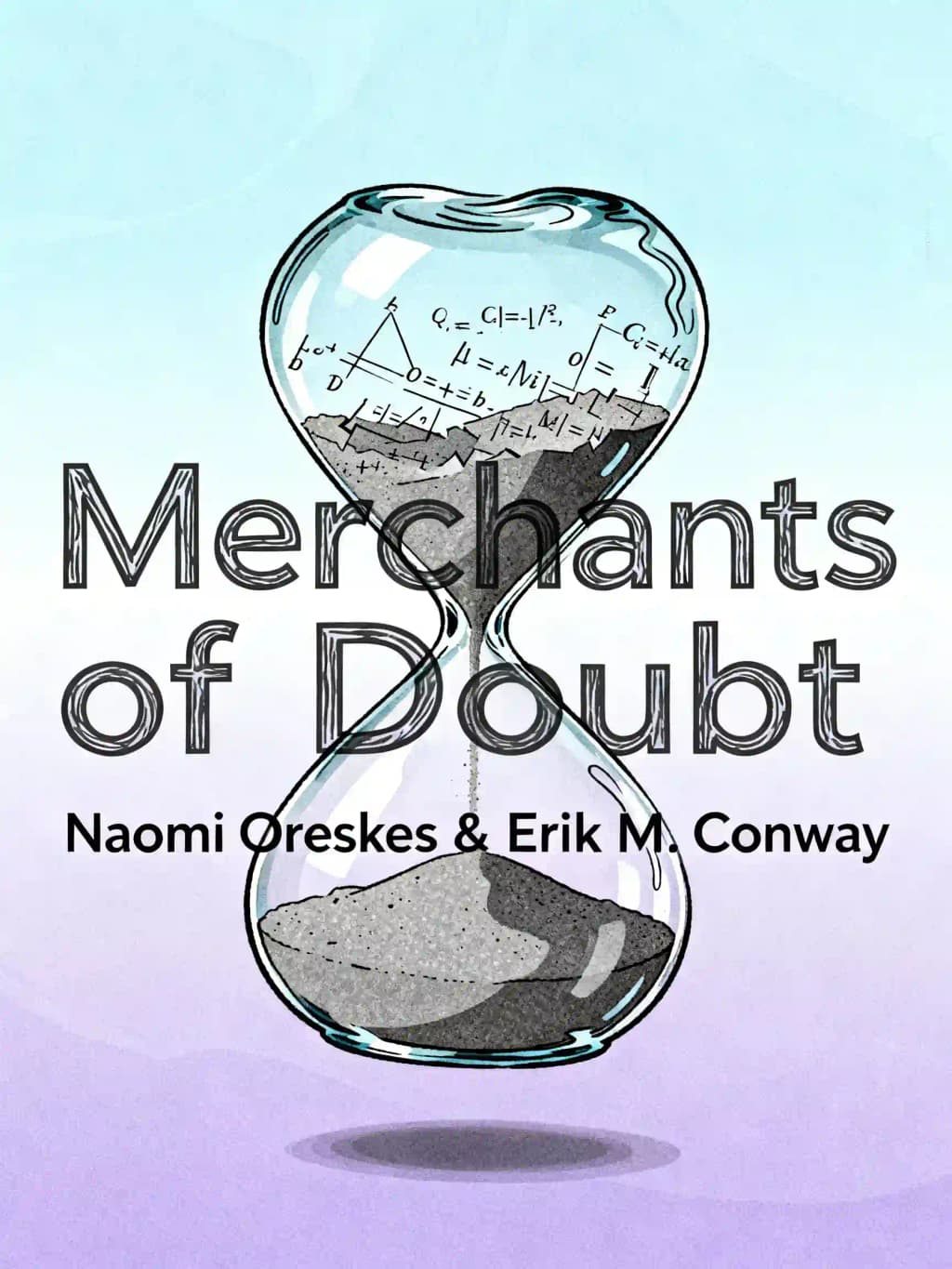
Discover how a handful of scientists derailed critical public health and environmental policies. Endorsed by Al Gore as essential reading "for anyone concerned about democracy in America," this expose reveals the playbook used to manufacture doubt from tobacco to climate change.
Naomi Oreskes and Erik M. Conway are historians of science and the acclaimed authors of Merchants of Doubt: How a Handful of Scientists Obscured the Truth on Issues from Tobacco Smoke to Global Warming. They combine rigorous scholarship with public engagement to expose systemic efforts to undermine scientific consensus.
Oreskes is a Harvard University professor and geologist who gained prominence for her groundbreaking work on climate change denial, notably cited in Al Gore’s An Inconvenient Truth. Conway, resident historian at NASA’s Jet Propulsion Laboratory, brings expertise in the interplay of science, policy, and industry.
Their nonfiction works, including The Collapse of Western Civilization and The Big Myth, dissect corporate influence on public discourse, emphasizing the impact of free-market ideology on environmental policy. Merchants of Doubt, adapted into a 2014 documentary, explores how industries co-opt scientific uncertainty to delay action on crises like tobacco-related diseases and global warming. The book has become a cornerstone of science communication, praised for its meticulous research and compelling narrative.
Their latest collaboration, The Big Myth (2023), further examines the roots of anti-government sentiment in American culture. Oreskes and Conway’s work has been translated into over 20 languages and featured in major media, including The New York Times and NPR.
Merchants of Doubt exposes how a small group of scientists, often with ties to political or corporate interests, systematically undermined public understanding of scientific consensus on issues like tobacco smoke, acid rain, and climate change. The book reveals their tactics—media manipulation, cherry-picked data, and personal attacks on researchers—to cast doubt on established science and delay policy action.
This book is essential for readers interested in science communication, policymaking, or the history of misinformation. It resonates with scientists, educators, journalists, and activists seeking to understand how doubt is weaponized against empirical evidence.
Yes. The book provides a meticulously researched account of anti-science campaigns, offering critical insights into modern debates over climate change and public health. Its compelling narrative and historical examples make it a cornerstone for understanding science denialism.
Key strategies include leveraging media platforms to amplify fringe views, discrediting peer-reviewed research through ad hominem attacks, and posing as impartial experts despite financial or ideological conflicts of interest. These tactics create false debates where scientific consensus already exists.
The book identifies overlapping actors—such as Fred Seitz and Fred Singer—who transitioned from defending tobacco companies to challenging climate science. Both campaigns relied on distorting evidence, manufacturing uncertainty, and targeting regulatory outcomes.
The book underscores the need for scientists to engage publicly, counter misinformation proactively, and expose bad-faith actors. It highlights the dangers of conflating scientific uncertainty with ignorance, a tactic exploited by doubt merchants.
Media outlets often amplify contrarian voices for "balance," even when they lack scientific credibility. This false equivalence creates perceived controversy, eroding public trust in institutions like the IPCC or FDA.
The title reflects how these actors commodify uncertainty, selling doubt to industries and politicians seeking to avoid regulation. Their work prioritizes profit or ideology over public health and environmental integrity.
The book’s framework explains ongoing efforts to dismiss climate science, such as funding denialist think tanks or promoting "skeptic" conferences. These tactics mirror earlier campaigns against ozone depletion and tobacco research.
Yes. A 2014 documentary adapts the book, featuring interviews with key figures and highlighting modern climate denialism. While closely following the book, it adds visual context to the manipulation of science.
Some critics argue the book focuses narrowly on U.S.-centric cases, though its themes apply globally. Others note it emphasizes historical context over contemporary solutions, but its analysis remains foundational for combating misinformation.
It traces patterns from 1950s tobacco disinformation to 1980s acid rain debates, showing how the same playbook—funding biased studies, attacking researchers—was reused to delay action on climate change. This repetition underscores systemic flaws in science-policy interactions.
通过作者的声音感受这本书
将知识转化为引人入胜、富含实例的见解
快速捕捉核心观点,高效学习
以有趣互动的方式享受这本书
Doubt is our product.
More research is needed.
Doubt is also the limit of our 'product'...
The science isn't settled.
Acid rain was real, human-caused, and damaging.
将《Merchants of Doubt》的核心观点拆解为易于理解的要点,了解创新团队如何创造、协作和成长。
将《Merchants of Doubt》提炼为快速记忆要点,突出坦诚、团队合作和创造力的关键原则。

通过生动的故事体验《Merchants of Doubt》,将创新经验转化为令人难忘且可应用的精彩时刻。
随心提问,选择声音,共同创造真正与你产生共鸣的见解。

"Instead of endless scrolling, I just hit play on BeFreed. It saves me so much time."
"I never knew where to start with nonfiction—BeFreed’s book lists turned into podcasts gave me a clear path."
"Perfect balance between learning and entertainment. Finished ‘Thinking, Fast and Slow’ on my commute this week."
"Crazy how much I learned while walking the dog. BeFreed = small habits → big gains."
"Reading used to feel like a chore. Now it’s just part of my lifestyle."
"Feels effortless compared to reading. I’ve finished 6 books this month already."
"BeFreed turned my guilty doomscrolling into something that feels productive and inspiring."
"BeFreed turned my commute into learning time. 20-min podcasts are perfect for finishing books I never had time for."
"BeFreed replaced my podcast queue. Imagine Spotify for books — that’s it. 🙌"
"It is great for me to learn something from the book without reading it."
"The themed book list podcasts help me connect ideas across authors—like a guided audio journey."
"Makes me feel smarter every time before going to work"

免费获取《Merchants of Doubt》摘要的 PDF 或 EPUB 版本。可打印或随时离线阅读。
Imagine a world where cigarettes are considered harmless, acid rain is dismissed as natural, and climate change remains "controversial" despite overwhelming scientific evidence. This isn't science fiction-it's recent history. A small group of influential scientists, primarily Cold War-era physicists, systematically created confusion about scientific findings that threatened industries they ideologically supported. Their strategy? Manufacturing doubt. As one tobacco executive candidly wrote in 1969: "Doubt is our product, since it is the best means of competing with the 'body of fact' that exists in the minds of the general public." This blueprint for science denial would shape public discourse on critical issues for decades to come.