第 1 章
Beyond the Veil: Glimpses of the Afterlife
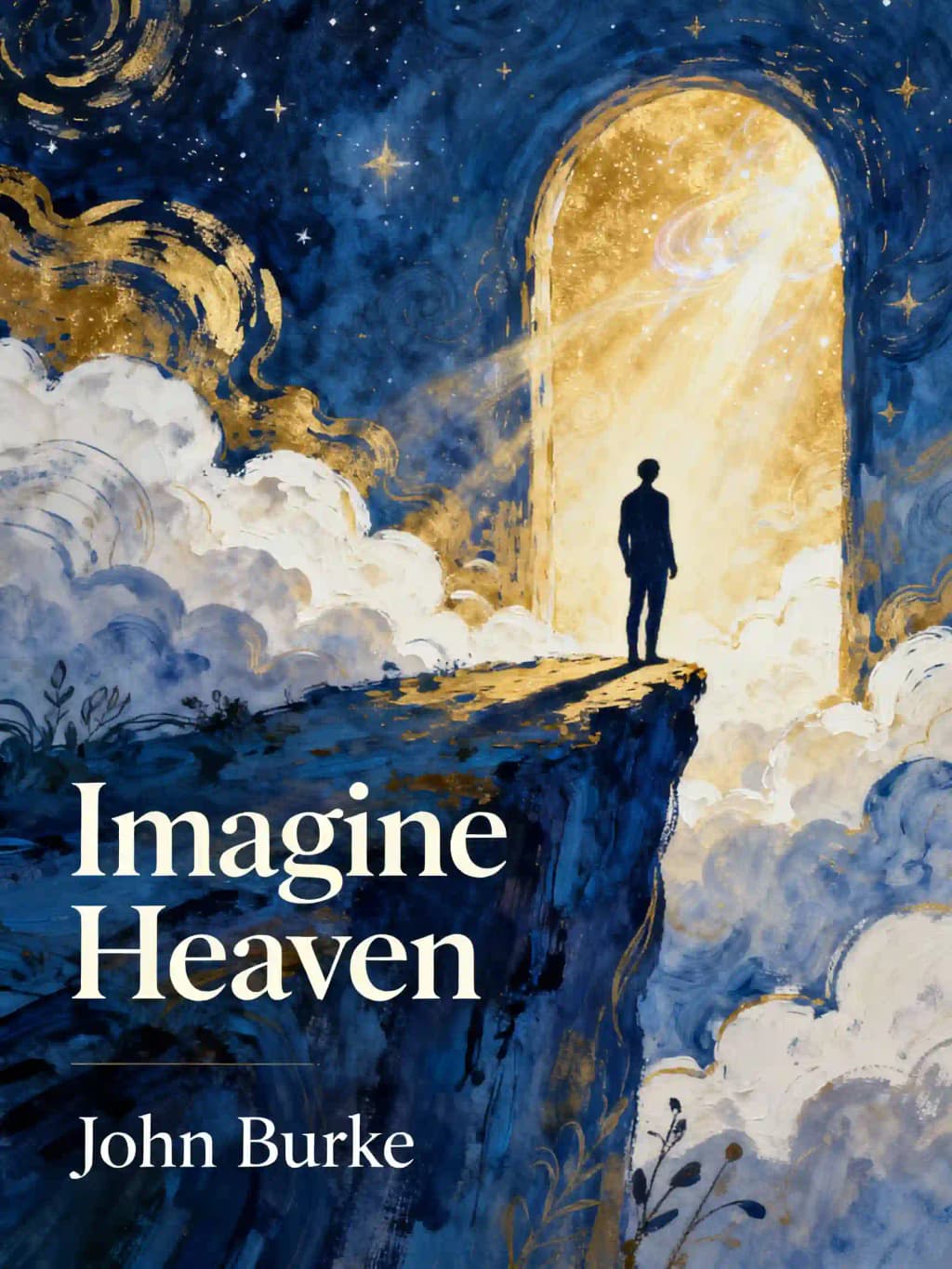
Have you ever wondered what happens after we die? John Burke's "Imagine Heaven" has become a cultural phenomenon, captivating millions with its exploration of near-death experiences (NDEs). The book has remained on bestseller lists for years, with celebrities like Justin Bieber recommending it to fans seeking spiritual insight. What makes this investigation so compelling is Burke's unique approach: as a former skeptical engineer turned pastor, he meticulously analyzed over 1,000 NDE accounts, comparing them with biblical descriptions of the afterlife. The result is a work that has bridged religious divides and sparked conversations about mortality across America's increasingly secular landscape.
第 2 章
The Evidence for Life After Death
What happens when we die? This question has haunted humanity since the beginning of consciousness. In 1975, Raymond Moody's groundbreaking book "Life After Life" documented hundreds of near-death experiences with remarkably consistent elements: people hearing their death pronounced, finding themselves outside their bodies watching resuscitation efforts, adjusting to a new state with a different kind of body, encountering deceased loved ones, meeting a being of light, experiencing a life review, reaching a boundary, and reluctantly returning to their physical bodies.
Modern medicine has inadvertently created a laboratory for studying the afterlife. With improved resuscitation techniques, near-death experiences have become increasingly common. A 1982 Gallup poll reported 8 million Americans had experienced NDEs, with recent studies suggesting about 13 million Americans-nearly 4.2% of the population-have had such experiences.
What convinced initially skeptical researchers like cardiologist Dr. Michael Sabom were patients like Pete Morton who accurately described their own resuscitations in remarkable detail. Pete recalled a doctor striking his chest with force, a needle insertion that looked like "one of those Aztec Indian rituals," and his body jumping "about two feet off the table" from defibrillation. Sabom verified these accounts against medical records. Dr. Penny Sartori's study further disproved the "good guesses hypothesis" by showing that cardiac patients who didn't claim NDEs couldn't accurately describe their resuscitations, unlike the precise accounts from those who reported out-of-body experiences.
The scholarly literature on NDEs has expanded dramatically since Moody's pioneering work, with over 900 articles published in peer-reviewed journals before 2011. The Handbook of Near-Death Experiences documents 65 studies of over 3,500 NDEs by 55 researchers or teams. While alternative explanations exist, many researchers conclude the simplest explanation is that life continues after death.
第 3 章
The Consistent Core of Near-Death Experiences
Research across cultures reveals remarkably consistent core elements in near-death experiences, regardless of age, language, or background. Dr. Jeffrey Long's extensive study of 1,300 NDEs worldwide documents specific percentages for each element, from out-of-body experiences (75.4%) to life reviews (22.2%). After thirty years examining alternative explanations, Dr. Long concludes these experiences cannot be explained by impaired brain functioning, as they demonstrate lucidity and predictable patterns impossible with a flat EEG.
Dutch cardiologist Pim van Lommel's perspective changed dramatically in 1969 when a resuscitated patient described a vivid afterlife experience. Van Lommel discovered patients rarely volunteer these accounts unless specifically asked, fearing ridicule. His research included a remarkable case of a five-year-old meningitis patient who, while comatose, met and accurately described a deceased sister she had never been told about.
Not all NDEs are pleasant. Dr. Maurice Rawlings, once a skeptic, had his beliefs transformed in 1977 when resuscitating a patient who repeatedly screamed "I am in hell!" whenever compressions stopped. At the patient's desperate request, Rawlings reluctantly led him in a prayer. Remarkably, after stabilizing, the patient could only recall pleasant experiences. Rawlings' subsequent research revealed that unpleasant NDEs occur as frequently as pleasant ones, though negative memories often become suppressed.
What makes these accounts so compelling is their consistency across cultural, religious, and age boundaries. While individual interpretations may vary based on religious background, the core elements remain remarkably similar worldwide. This suggests something profound about human consciousness and what awaits us beyond physical death.
第 4 章
The Spiritual Body: Enhanced and Perfected
When we die, we receive a spiritual body that feels more alive than our earthly one. Dr. Mary Neal, who died during a drowning accident, described breaking free from her physical body as "shaking off my heavy outer layer, freeing my soul." This new body still has arms, legs, and features, but without earthly limitations. All senses remain intact but enhanced, experiencing reality more vividly than before.
In our heavenly bodies, we'll feel young again with boundless energy. Marv Besteman, a retired bank president who had an NDE after pancreatic tumor surgery, described being taken by angels to Heaven's gate where he felt completely rejuvenated: "My old geezer body felt young and strong and fantastic. The aches and pains and limitations of age were just gone. I felt like a teenager again, only better."
In Heaven, all physical limitations and disabilities vanish. Gary Wood, who died in a car accident and was pronounced dead for twenty minutes, described meeting his friend who had been decapitated in high school. His friend appeared "just as I remembered him only so much more complete." After his NDE, Gary returned to life with no vocal cords (confirmed by X-rays), yet miraculously speaks and sings-a sign of Heaven's healing power.
These spiritual bodies appear to reflect God's glory through light that emanates from within them. NDErs consistently report seeing spiritual bodies that are somewhat translucent but shine with varying degrees of brightness. Vicki, a blind woman who had an NDE, described Jesus as "the brightest of anybody there." This glory appears connected to one's openness to God's work through them on earth.
The age we'll appear in Heaven remains mysterious. NDErs report seeing people of various ages-children playing, elderly appearing as they were at death but with remarkable vitality, and some who died young appearing as adults. Many describe relatives appearing "in their prime" or around age thirty-five. Some accounts suggest we may be "ageless" yet able to appear at different ages as needed for recognition.
In Heaven, we'll be clothed in what feels natural to us. While many NDErs report seeing white, translucent robes (as mentioned in Revelation), others describe more familiar clothing. Bank president Marv Besteman found himself wearing comfortable casual clothes and observed people from different cultures dressed in their traditional attire. The "white robes" described in scripture may actually represent being clothed in God's glory-a translucent light that shines from within.
第 5 章
Relationships in Heaven: Deeper Connections
People's fear of Heaven often centers on separation from loved ones, but NDEs reveal the opposite truth: God created us for eternal love relationships. Those who glimpse Heaven consistently report that love is the essence of everything there-relationships don't end at death but find their fulfillment in eternity. The love we experience on earth is merely a teaspoon compared to the oceans of love awaiting us in Heaven, where our relationships will continue and deepen beyond what we can imagine.
Don Piper, pronounced dead after a horrific collision with an 18-wheeler, experienced 90 minutes in Heaven before returning to life. He describes being instantly enveloped in brilliant light and finding himself standing before a large crowd rushing toward him. These were people he had known who had died during his lifetime-his "celestial welcoming committee." His grandfather Joe embraced him warmly, calling him "Donnie" as he always had. His childhood friend Mike Wood, who had introduced him to Christianity before dying in a car accident at nineteen, greeted him with a radiant smile.
Many fear that family relationships will be diminished in Heaven, but Jesus's teaching about marriage in the afterlife has been misunderstood. When responding to the Sadducees' trick question about a woman with seven husbands, Jesus wasn't saying we won't be with our loved ones, but rather that new marriages won't be needed since there's no procreation. Our family bonds won't weaken but grow deeper and stronger.
In Heaven, Jesus's prayer for complete unity becomes reality. With perfect communication and love comes perfect oneness, not as Buddhist absorption where individuality is lost, but as Jesus described-distinct yet connected. Captain Dale Black experienced this as the most thrilling part of heaven, feeling God's transforming love. Jeff Olsen realized all souls are linked and equal in God's eyes, while Don Piper became "one with" the heavenly choir without losing his identity. Harvard neurosurgeon Eben Alexander describes remaining distinctly himself while also being "part of everything else," experiencing sight and sound as merged senses.
Jeff Olsen, who lost his wife and baby Griffin in a tragic accident, experienced a profound healing during an NDE. Running on two healthy legs in Heaven, he found his deceased infant son in a crib. The reunion was visceral-feeling Griffin's warmth, his breath, the smell of his hair. Then Jeff sensed a powerful presence behind him, enveloping him in light and love. In this divine moment, rather than having his son ripped away, Jeff was given the opportunity to willingly hand Griffin over to God. This sacred experience brought peace and understanding that Griffin was alive "in a place more real than anything here."
第 6 章
Heaven's Landscape: A Multidimensional Reality
Heaven sounds like fictional fantasy, but perhaps our imaginative capacity exists because God placed an eternal longing in human hearts. NDErs consistently describe a place more real and beautiful than imagination allows. Scripture has always portrayed Heaven as super-real, with earth being merely its shadow. Our thinking is backward-earth is the derivative shadow of Heaven's greater Reality.
When people transition from life to Life, many describe passing through what resembles a wormhole-a tunnel or pathway leading from our dimension to Heaven's expanded dimensions. For those who complete the journey, an exquisite world of beauty awaits.
Brad Barrows, blind since birth with no visual concepts, had an NDE at age eight during severe pneumonia. His consciousness floated up through his room's ceiling, where he "saw" his lifeless body, his blind roommate getting help, and the snow-covered landscape outside. Emerging into an "immense field" with palm trees and tall grass, Brad experienced indescribable peace and perfect weather. The most striking feature was all-penetrating light that seemed to come from every direction and "soak into" everything-grass, trees, leaves-eliminating all shadows.
Many NDErs describe seeing a magnificent landscape with unnamed flowers and plants in perfect detail. This description aligns with Revelation's portrayal of Heaven's earthlike beauty, with people "from every nation and tribe" holding palm branches near "springs of life-giving water" and trees bearing fruit. Marv Besteman specifically noticed grass "far greener and more deluxe" than even the pristine turf at the Masters golf tournament.
Despite John's statement in Revelation that "there was no longer any sea," many NDErs report seeing water in Heaven-specifically "living water." Ian McCormack, a New Zealand surfer, saw "a crystal clear stream winding its way across the landscape with trees on either bank" during his NDE. This aligns with Revelation's description of "the river of the water of life, as clear as crystal, flowing from the throne of God."
In Heaven, vision expands beyond earthly limitations. Dr. Long's research shows 66 percent of NDErs describe vision with "unworldly brightness, clarity, and vividness," including 360-degree spherical vision and "telescope" abilities to see distant objects clearly. Many report being able to focus on anything anywhere instantly, "at the speed of thought." Richard Eby noted that "the light in Heaven would blind our natural eyes" but "with spiritual eyes I could see anywhere and through anything."
Heaven's light contains colors beyond our spectrum. Dean Braxton explains Heaven's atmosphere is "something you experience, not just see" with colors "moving throughout it like the Aurora Borealis." Dale Black observed colors that "seemed to be alive, dancing in the air." Even color-blind NDErs report seeing countless new colors.
第 7 章
The Divine Encounter: Meeting the Being of Light
The highlight of many NDEs is encountering a mystical Being of Light who fills experiencers with indescribable love. Nearly half of Dr. Long's study participants reported meeting "a definite being, or voice clearly of mystical or otherworldly origin." While researchers suggest people interpret this being through their cultural lens (Jesus, Krishna, etc.), the descriptions remain remarkably consistent across cultures.
Every form of love we experience on earth is merely a drop in the ocean of love God created us to experience. Our earthly love always falls short of what we truly crave. Every person who encounters the Being of Light describes Him as personal, with a unique personality. Dr. Moody summarizes how "the love and the warmth which emanate from this being to the dying person are utterly beyond words." NDErs report feeling completely surrounded by this love, at ease and accepted in His presence.
NDErs consistently describe God's voice in remarkably similar terms, often matching biblical descriptions without prior knowledge of scripture. Many describe it as "like rushing waters" or "like the roar of many waters"-the exact phrase used by the prophet Ezekiel. Others describe it as commanding yet gentle, like "a thunderous clap of lightning, a great wind and white water rapids all rolled together," or "like the voice of a hundred friends talking in harmonious unison."
The God NDErs encounter matches the Bible's portrayal of a deeply relational God who longs for loving connection with humanity. Through prophets like Jeremiah, God expresses yearning for relationship using intimate metaphors-a father longing for his wayward child, a bridegroom rejoicing over his bride. Some NDErs even describe God singing individual love songs to each being before His throne, serenading them with overwhelming love.
What distinguishes the God of NDEs is the paradoxical combination of complete knowledge of our moral failures alongside overwhelming compassion rather than condemnation. During life reviews, experiencers see both their good and harmful actions with their ripple effects, yet encounter a Being who desires forgiveness and relationship rather than punishment.
NDErs consistently describe Jesus's eyes as piercing, magnetic, alluring and beautifully captivating. Daniel called them "like flaming torches" and John said "like blazing fire"-yet not frightening. Dean described eyes with changing colors that showed love for every person. Vicki, blind from birth, described Jesus's piercing eyes that "permeated every part" of her, seeing everything yet making her want to reveal everything to him.
第 8 章
The Life Review: Seeing Through God's Eyes
Howard Storm, after being rescued from darkness during his NDE, experienced a life review with Jesus and seven brilliant beings. Unlike some instantaneous panoramic reviews, Howard's was chronological, showing his life from birth onward in great detail, including experiencing the feelings of people he'd interacted with throughout his life.
The life review revealed surprising insights about his relationships. He saw how he had contributed to the breakdown of his relationship with his father through his own resentment and rebellion. The review focused entirely on his interactions with people rather than accomplishments or possessions. When Howard complained that they were skipping his proudest achievements like awards and honors, Jesus responded, "That's not what we're here for you to see. That's not important."
The life review often has the most dramatic impact on NDErs. It reveals how every action creates ripple effects through relationships and generations. Most experience their review in God's presence as He gently asks, "What have you done with the life I gave you?" Dr. Mary Neal saw how events she considered terrible actually created beautiful ripple effects when viewed from a broader perspective.
Life reviews appear consistent globally regardless of cultural background. People experience not just their actions but their thoughts and motives in a panoramic, three-dimensional review. Rene, after a car accident in Australia, stood before a man in a white robe who showed her life's less complimentary moments. She felt both the hurt she caused others and the joy she brought them.
While the world values money, power, and prestige, NDErs learn that relationships truly matter. Jesus taught that loving God and loving our neighbors matters most. In the final judgment, our service to "the least of these" will be counted as service to God himself. NDErs discovered that seemingly insignificant acts of kindness were profoundly important, while things they had valued highly were ultimately insignificant.
During the life review, NDErs recognize that nothing can be hidden from God's sight. The truth about ourselves is fully known, with nowhere to hide and no excuses to make. NDErs report that they themselves were their harshest judges, lingering at incidents where they struggled to accept responsibility. Yet they felt warm support rather than condemnation.
第 9 章
Heaven's Rewards: Living for What Matters
Though life on earth isn't fair, God promises to reward those who persevere through suffering and trials. God rewards those who diligently seek him, walk by faith, and long for his appearing. Faith-trusting God-matters deeply because relationships require trust. Though you may never be famous on earth, if you faithfully seek God and obey his will, "one day you will be one of the great ones for eternity!"
While the world tells us to build ourselves up, God rewards those who build up others spiritually. Professor Howard Storm's life review focused entirely on how he treated students, not his accomplishments. God particularly notices when we serve those who can't repay us-the neglected, outcast, and marginalized. NDErs often report that their life review showed how seemingly insignificant kindnesses had profound impacts.
All our work matters to God when we do it to please him. Whatever we do with the motive of doing it well to please God gets rewarded! We can succeed anywhere, doing anything. But if we're lazy or dishonest employees, God sees that too-and we lose potential rewards he wants to give us.
Jesus reminds us that "from everyone who has been given much, much will be demanded." Those of us in America are among the wealthiest humans in history. What will we do with all God has entrusted to us? It matters to God. Jesus told us clearly that all our money is temporary, and we can't keep any possessions. What lasts is how we played the game to honor God. When we invest our resources in building God's kingdom, making churches strong, feeding the poor, and blessing others as acts of love toward him-he promises rewards with true riches that can never be taken from us.
第 10 章
The City of God: Our Eternal Home
The journey to Heaven may be unique for each person-some arrive instantly while others travel through a tunnel first. Paradise appears to be the beautiful, earth-like country surrounding the City of God and the entry point for most arrivals. Ed describes standing on a carpet of indescribable beauty with vibrant trees, wildly-hued flowers, and grass that glowed from within. The temperature was perfect, the air crystal clear and sweet-smelling. Everything seemed to shine with internal light and vibrant colors beyond earthly experience.
Though Scripture never explicitly describes the New Jerusalem as a "city on a hill," many NDErs consistently report approaching it by walking uphill. Ed saw the immense cube-shaped city (matching Revelation's description) with extraordinary brightness that didn't hurt his eyes, situated where the land slopes upward. Captain Dale Black describes approaching the city gates, noting the wall wasn't a single structure but a series of layered walls with three outer layers, three inner layers, and one higher wall in the center-measuring hundreds of feet tall and equally thick.
As you enter the City, the first sight is the Tree of Life-not just one tree but a row of trees alongside the River of Life. This is the same tree from the Garden of Eden that God protected humans from after the Fall. The fruit grows as described in Revelation, with different fruit every month, and when someone takes a piece, another instantly appears.
The streets aren't the gaudy yellow-gold often imagined, but a transparent, crystal-like substance alive with golden hues. Betty Malz described "a street of golden color with an overlay of glass or water" with dazzling yellow light. Gary noted they walked on "transparent streets" that he could see through completely.
Multiple NDErs describe swimming in the River of Life, which flows from God's throne. The water has miraculous properties-it tastes sweet, cleanses "debris" from the transition between earth and heaven, and allows people to breathe underwater and communicate without speaking. Most remarkably, when emerging from the water, they find themselves completely dry.
The City includes people of all ages, with young lives lost on Earth finding redemption as they grow and thrive in Heaven. Children of every race and color play with Jesus, who stoops to embrace them as they run to him with outstretched arms. Remarkably, animals frolic peacefully with the children-lions play like kittens, birds of elegant beauty perch on shoulders, and teenagers who died prematurely laugh and sing in crystal pools.
At the City's center stands the architectural wonder of the universe-God's throne, where Father, Son and Holy Spirit dwell in glory. NDErs describe a massive structure hundreds of miles wide and fifty miles tall with a domed roof, approached by thousands of steps where millions worship. Before it stretches a vast sapphire platform like a "sea of glass" where countless people gather in worship.
Heaven will be a thriving, joyful, festive place where families and friends work together and gather for feasts to celebrate life with the Giver of Life. The prophets foresaw Heaven's celebrations, with Isaiah describing God's feast of rich food and finest wines. Jesus himself promised to share wine again in the Kingdom and remarkably, the King will serve his servants. Heaven will overflow with creative expression, music, dance, and artistic celebration that makes Earth's creativity seem merely a shadow of what's to come.
第 11 章
Living in Light of Heaven: Why It Matters Now
Our view of Heaven affects everything in life: our priorities, willingness to sacrifice, perspective on suffering, and what we fear. Many people live materialistic, self-centered lives precisely because they can't imagine Heaven well enough to live for it.
The author compares God's suffering with us to his own experience holding down his screaming five-year-old daughter during a painful but necessary medical procedure. As she cried "Daddy, don't let them hurt me," he suffered with her but knew the temporary pain was preventing something worse. Similarly, God allows suffering while experiencing it with us, knowing the day will come when "He will wipe every tear from their eyes. There will be no more death or mourning or crying or pain."
Why would God allow suffering at all? Burke explains that suffering exists because love requires freedom. Just as a rich man can't force or buy genuine love from a woman, God can't force our love-it must be freely chosen. This freedom allows humans to reject God and hurt each other, creating ripples of pain through generations. God never promises a pain-free life, but promises to overcome evil and bring good from suffering.
All creation is experiencing birth pains, awaiting the day when God's children will be revealed in glory. Life is a birth canal into eternity, with earth containing both God's good gifts and the pain of evil-warning us something's wrong. God remains partially hidden because faith requires trusting Him without seeing.
Crystal, who never felt loved due to childhood abuse, describes Heaven as being "bathed in love"-a brightness she not only saw but felt. Human language falls short of capturing the experience, where everything was utterly intense, pure, perfect, and peaceful. What struck her most was how familiar it felt, "like something I remembered, or even recognized." Despite her painful earthly experiences, in Heaven she finally knew: "I was home."
The author concludes that Heaven never ends-it's just the beginning. All of Earth's history was merely the prelude to the real story of Life that's just beginning. Every struggle, suffering, and act of faith on Earth produces "an eternal glory that far outweighs them all." The life we always knew we were meant to live is just beginning, with the most wonderful experiences imaginable lying ahead.