第 1 章
Unmasking the World's Hidden Machinery
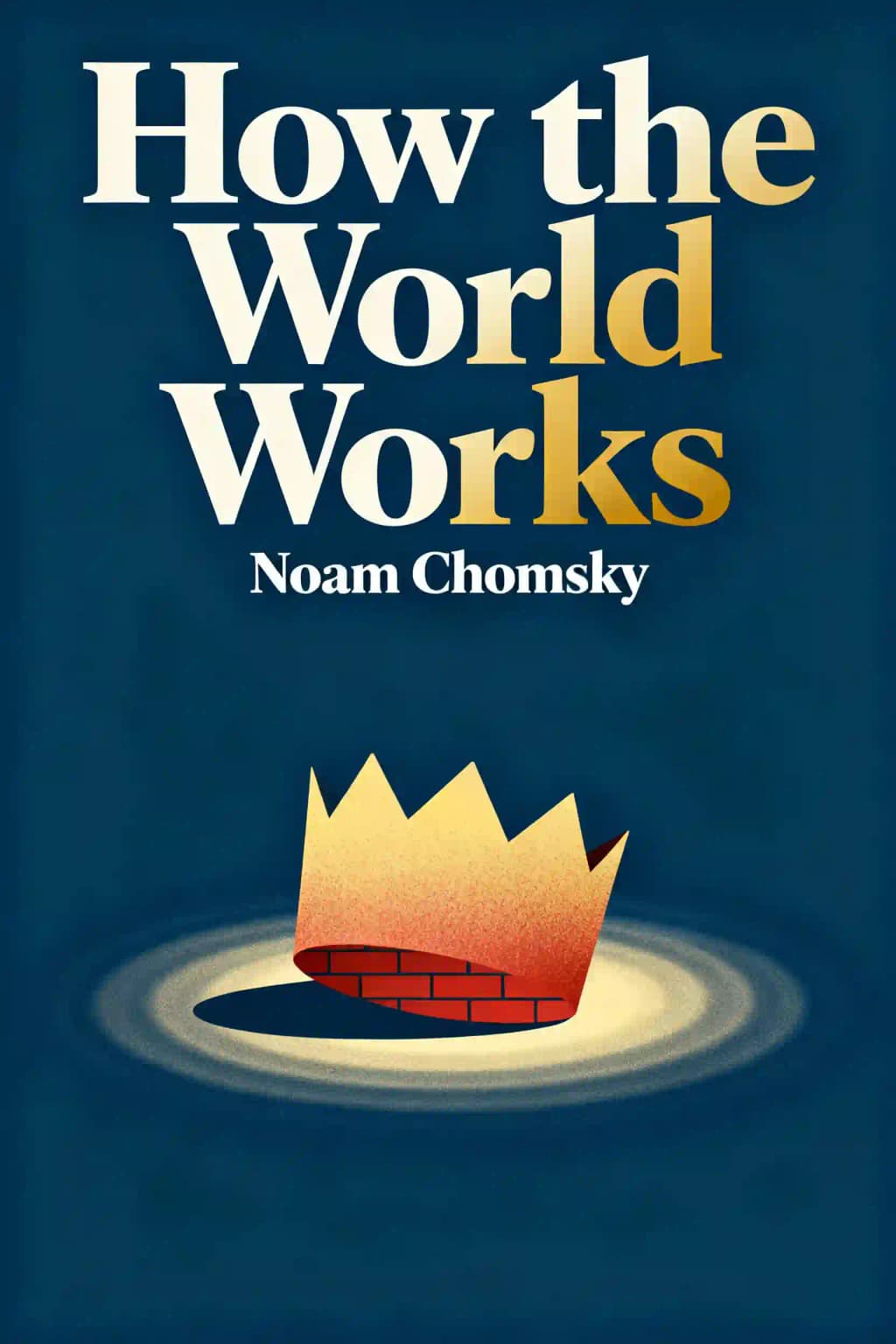
In a world where most political analysis stays safely within acceptable boundaries, Noam Chomsky stands as a singular figure who relentlessly exposes the gap between rhetoric and reality. "How the World Works" has become required reading for anyone seeking to understand the true mechanisms of global power. When Barack Obama was photographed holding this very book in 2008, it sparked both hope among progressives and alarm in conservative circles. Despite being the eighth most cited author of all time alongside Plato and Freud, Chomsky remains strangely marginalized in American media-a testament to the very propaganda system he so meticulously documents. His analysis of American foreign policy has proven remarkably prescient over decades, anticipating financial crises and geopolitical developments that mainstream commentators missed entirely. Through this collection of interviews and talks edited into accessible form, Chomsky provides nothing less than an alternative education in how power actually functions in our world.
第 2 章
The Grand Design: America's Post-War Imperial Strategy
World War II fundamentally transformed America's position in global affairs. While industrial rivals in Europe and Asia lay in ruins from devastating bombing campaigns and ground warfare, the United States emerged from the conflict in an unprecedented position - controlling approximately 50% of global wealth and productive capacity. This dramatic power imbalance presented American strategic planners with a unique historical opportunity to reshape the post-war world order according to American interests.
George Kennan, who headed State Department planning until 1950, articulated this reality with striking candor in a classified 1948 Policy Planning Study: America possessed "about 50% of the world's wealth but only 6.3% of its population." This disparity, he acknowledged, would inevitably arouse "envy and resentment" among other nations. His proposed solution was ruthlessly pragmatic - America must "dispense with all sentimentality" and abandon "vague and unreal objectives such as human rights, the raising of living standards, and democratization" in favor of maintaining this advantageous position through raw power politics.
This stark assessment formed the intellectual foundation for post-war American planning. The State Department, working closely with the Council on Foreign Relations, developed an ambitious concept called the "Grand Area" - a region encompassing the Western Hemisphere, Western Europe, the Far East, the former British Empire, and the Middle East's vast energy resources. This area was to be subordinated to American economic needs through a sophisticated system of trade relationships, military bases, and political influence. Within this framework, each region was assigned specific economic functions: Germany and Japan would be rebuilt as "great workshops" under careful US supervision, serving as industrial powerhouses while remaining dependent on American oversight. Meanwhile, the Third World would "fulfill its major function as a source of raw materials and a market" for industrial societies - essentially continuing colonial economic patterns under American rather than European management.
The primary threat to this grand vision wasn't Soviet military power - despite public rhetoric about the Red Menace. Internal planning documents reveal that what truly concerned American strategists was what they termed "radical nationalism" or "the threat of a good example" - the possibility that countries might successfully pursue independent development paths prioritizing their own populations' needs over American investors' interests. This explains why America often responded with seemingly disproportionate force to small, militarily insignificant countries like Laos, Grenada, or Nicaragua attempting modest social reforms. As Henry Kissinger notably remarked regarding Chile under Salvador Allende, it was a "virus" that might "infect" the region with effects potentially reaching as far as Italy. The real fear was successful alternative development models inspiring other nations to follow suit.
The implementation of this strategy led to some striking paradoxes in the immediate post-war period. American policy systematically suppressed antifascist resistance movements worldwide, often installing former fascists and Nazi collaborators in positions of power instead. This pattern began as early as 1942 when Roosevelt installed Nazi collaborator Admiral Jean Darlan in North Africa and continued in liberated southern Italy where the US imposed Marshal Pietro Badoglio, a prominent Fascist war hero. In Greece, American intervention resulted in approximately 160,000 deaths, ultimately benefiting Nazi collaborators while destroying the Communist-led resistance that had fought against German occupation. Similar patterns played out in Japan, Korea, and Guatemala. Perhaps most notably, the US actively recruited Nazi war criminals like Klaus Barbie - the "Butcher of Lyon" - to target Communist resistance fighters, incorporating their expertise into what would later become American counterinsurgency doctrine throughout the Cold War.
第 3 章
Manufacturing Consent: The Mechanics of Population Control
For any system of power to function effectively, it must control not just actions but thoughts. As philosopher David Hume observed centuries ago, since "force is always on the side of the governed," rulers maintain power only by controlling opinion. This fundamental insight explains the sophisticated propaganda system that has evolved in democratic societies where outright force is limited. Modern power structures have developed intricate methods of thought control that are far more subtle and effective than direct censorship.
The American media system serves this function through structural mechanisms rather than explicit censorship. Major media outlets are corporations selling audiences to other businesses - a relationship that fundamentally shapes content and coverage. For elite media like the New York Times, Washington Post, or Wall Street Journal, the product is privileged audiences, and the content reflects the interlocking interests of sellers (media corporations), buyers (advertisers), and the product (affluent readers). This dynamic creates natural filters against content that might disturb or alienate these key stakeholders. Additional factors reinforce this bias: journalists share class interests with business and government elites, with regular personnel flow between sectors - former government officials become news commentators, journalists take positions in administration, creating a revolving door that homogenizes perspectives. Media organizations need access to official sources and authorities, who demand favorable coverage in return. Power centers can punish deviation through various means: withdrawing advertising, limiting access to sources, economic pressure, and coordinated defamation campaigns.
This system creates what Chomsky calls "manufactured consent" - the appearance of vigorous democratic debate within carefully controlled boundaries that don't threaten fundamental power structures. Political discourse typically employs terms with two distinct meanings: the dictionary definition and the "doctrinal" meaning that serves power. For example, "democracy" in common usage means people participating meaningfully in managing their affairs, but in doctrinal usage refers to a system where business elites make decisions while the public remains passive spectators. When people organize and enter the public arena to advocate for their interests - whether through labor movements, environmental activism, or social justice campaigns - that's labeled a "crisis of democracy" requiring intervention to restore order.
The larger doctrinal system encompasses media, academia, and educational institutions, targeting two distinct groups: the "political class" (roughly 20% who participate in decision-making and system management) and what Walter Lippmann called the "bewildered herd" (the 80% whose role is to follow orders). Mass media divert the majority with entertainment programming that reinforces passivity, submission to authority, and constant fear - whether of crime, terrorists, foreign enemies, or economic instability. The goal is keeping the public bewildered and preventing them from seeing enough of reality to organize and change it. This explains the proliferation of reality TV, celebrity gossip, and sensationalized news that occupy attention while avoiding substantive issues.
This systematic control explains why Chomsky himself, despite being one of the world's most cited intellectuals across multiple fields, is largely excluded from mainstream American media. When asked about claims he was once a regular New York Times contributor, Chomsky clarified he only had one op-ed published there around 1971 - merely excerpts from his Senate Foreign Relations Committee testimony during the Vietnam War. His exclusion from elite publications like the New York Review of Books began around 1973 when dissident voices were systematically removed from its pages. This pattern extends beyond Chomsky to other critics of power structures, who find themselves marginalized regardless of their credentials or the validity of their analysis. The system maintains its effectiveness not through crude censorship but through sophisticated filtering mechanisms that make certain views effectively invisible in mainstream discourse.
第 4 章
The Blood-Soaked Laboratory: Central America as Testing Ground
Central America provides perhaps the clearest case study of American imperial policy in action. For decades, US-installed dictators ruled El Salvador with repression and torture, attracting little media attention. By the late 1970s, Washington grew concerned about two developments: Somoza losing control in Nicaragua and, more threateningly, the growth of "popular organizations" in El Salvador-peasant associations, cooperatives, and church groups that could lead to actual democracy.
In February 1980, Archbishop Oscar Romero begged President Carter not to send military aid to the Salvadoran junta. Weeks later, Romero was assassinated while saying mass, likely by the neo-Nazi Roberto d'Aubuisson, "leader-for-life" of the now-governing ARENA party. This assassination received scant attention in American media-the New York Times published no editorial when it happened or during the commemorations a decade later.
Two weeks before Romero's murder, El Salvador declared a state of siege and unleashed war against its people. The first major attack was the Rio Sumpul massacre, where Honduran and Salvadoran armies butchered at least 600 people-infants cut to pieces, women tortured and drowned-yet US media ignored it. The death toll reached 10,000 in 1980 and 13,000 in 1981 as the Reagan administration took command.
The US-created Atlacatl Battalion, trained by American Special Forces, committed some of the worst atrocities. In December 1981, they killed over a thousand civilians in an orgy of murder and rape. Teenagers as young as 13 were forced to become soldiers, indoctrinated with Nazi SS rituals to prepare them for killings with sexual and satanic overtones. Father Daniel Santiago documented horrific scenes: a peasant woman returning home to find her children, mother and sister decapitated, with heads placed on a table before each body, hands arranged "as if stroking its own head." Men were disemboweled with genitalia stuffed in their mouths; women had wombs cut out and placed over their faces.
In Nicaragua, the US first tried to maintain Somoza's brutal National Guard after his overthrow. When that failed, they reconstituted them on Nicaragua's borders as "Contras" or "freedom fighters" and launched a large-scale terrorist war combined with devastating economic warfare. Why such determination? Oxfam explained that Nicaragua was "exceptional in the strength of that government's commitment to improving the condition of the people." The World Bank called its projects "extraordinarily successful in Nicaragua, better than anywhere else in the world."
These successes terrified US planners. A State Department insider boasted they would "turn Nicaragua into the Albania of Central America" to ruin the Sandinistas' exemplary model. The US attack was three-pronged: pressuring international banks to terminate all assistance, launching the Contra war targeting "soft targets" under US orders, and imposing an economic boycott. As Julia Preston reported, administration officials were "content to see the Contras debilitate the Sandinistas by forcing them to divert scarce resources toward the war and away from social programs"-the very programs that might have inspired other countries to resist American exploitation.
第 5 章
The Economics of Control: Globalization as Neocolonialism
The stark contrast between wealth and poverty has become unavoidable even in affluent areas like Cambridge, Massachusetts, where panhandlers and homeless people are increasingly visible. This represents the "internal Third Worldization" of America, stemming from several key developments.
About twenty years ago, Nixon dismantled the Bretton Woods system as US global dominance declined, leading to attacks on social welfare to preserve corporate profits. The deregulation of currencies and capital dramatically expanded globalization, allowing corporations to export jobs to "high-repression, low-wage areas."
This globalization has two major consequences: First, it extends the Third World model of extreme inequality to industrial countries, most visibly in English-speaking nations. Second, it shifts governance toward an "international executive" through institutions like the IMF, World Bank, NAFTA, GATT, and G-7, all serving transnational corporations while undermining democracy through executive-level decisions that citizens neither influence nor understand.
Trade agreements like NAFTA and GATT primarily benefit investors rather than workers or the general population. The migration of American manufacturing to Mexico exemplifies these consequences. Along the border, workers earn just five dollars daily while enduring toxic pollution and environmental degradation. Though NAFTA was presented as benefiting both countries, it accelerated productive labor flow to Mexico, where a "brutal and repressive dictatorship" guaranteed low wages.
Despite Mexico's so-called "economic miracle," wages there dropped 60% over the decade before NAFTA. Union organizers were killed, companies like Ford freely replaced workers with cheaper labor, and pollution remained unregulated-creating an investor's paradise. The agreement didn't improve Mexican wages as some expected. The repression prevented labor organizing, and heavily subsidized American agricultural products flooded Mexico, undercutting local farmers and driving an estimated 13 million people off their land into urban areas or maquiladoras, further depressing wages.
IMF and World Bank policies force Southern nations to adopt market economies, repay loans in hard currency, and increase exports like coffee and beef at the expense of local food production. Bolivia exemplifies the consequences of these policies. Under Harvard expert Jeffrey Sachs' guidance, Bolivia followed IMF rules: stabilizing currency, increasing agricultural exports, and reducing domestic production.
On paper, this approach succeeded-macroeconomic statistics improved, currency stabilized, and debt decreased. However, beneath these surface achievements lies devastation: increased poverty and malnutrition, and a collapsed educational system. Most tellingly, Bolivia's economic "stabilization" relies primarily on coca exports, which constitute approximately two-thirds of the country's exports. When peasant farmers face competition from subsidized US agriculture, they can't compete producing food for local consumption. Forced to become agricultural exporters, they logically turn to the most profitable crop-coca.
第 6 章
The National Security State: Violence as Policy
With the Soviet Union's collapse, the US became the world's dominant military power just as its relative economic power declined compared to Japan and German-led Europe. The Soviet deterrent previously limited US violence in the Third World by creating the risk that intervention might escalate to nuclear war. Now the US is much freer to use force globally.
In any conflict, participants try to shift the battle to domains where they're strongest. America's strong card is force-establishing that force rules the world benefits the US. Diplomacy is particularly unwelcome unless conducted under threat of violence, because US goals in the Third World (imposing structures of domination and exploitation) have little popular support. Diplomatic settlements must respond to other participants' interests, so the US typically avoids negotiations-contrary to propaganda about Southeast Asia, the Middle East and Central America.
The Gulf War perfectly illustrates America's guiding principles of foreign policy, despite the propaganda veil. When Iraq invaded Kuwait in August 1990, the UN immediately condemned Iraq and imposed severe sanctions. The US government-media alliance claimed this was because Iraq's aggression was uniquely criminal and because the UN was finally functioning as designed now that the Cold War had ended.
Neither claim withstands scrutiny. Saddam Hussein was indeed a murderous gangster-exactly as he was before the war when he was our friend and trading partner. His invasion of Kuwait was an atrocity, but well within the range of similar crimes conducted by the US and its allies. Indonesia's US-supported invasion of East Timor, for example, killed perhaps 175,000 people (one-fourth of the population)-exceeding Pol Pot's slaughter relative to population during the same period.
The US immediately undermined the diplomatic option by deploying a massive military force that couldn't be maintained long enough for sanctions to work. By mid-August 1990, Iraq had proposed withdrawing from Kuwait in exchange for negotiating border issues-specifically Iraqi access to the Gulf through two uninhabited mudflats and resolution of an oil field dispute. The US flatly rejected this and any negotiations, determined to block the "diplomatic track" that might "defuse the crisis."
The "war on drugs" emerged as a convenient replacement for the Soviet threat, serving both as cover for international intervention and as a domestic distraction that increased inner-city repression and eroded civil liberties. When Bush launched his drug war in September 1989, a massive government-media blitz shifted public opinion dramatically-concern about drugs jumped from 3% to over 40% in polls asking about the nation's biggest problems.
The hypocrisy was stark: while targeting illegal drugs causing about 3,500 deaths annually, the administration ignored tobacco (300,000 deaths) and alcohol (100,000 deaths). The US government has actually been a leading stimulator of drug trafficking since WWII. In postwar France, the CIA used the Mafia to weaken the labor movement, allowing them to reestablish the "French connection" heroin trade as payment. Similar patterns followed in Indochina during Vietnam operations, and later in Pakistan, Afghanistan, and Central America, where CIA operations consistently boosted regional drug trafficking.
第 7 章
The Roots of Resistance: Building Democratic Alternatives
Despite the relentless attack of the prosperous few upon the rights of the restless many, ordinary people hold significant power. America has become more free over time through popular struggle-abolishing slavery, extending free speech, granting women's suffrage, and winning workers' rights in the 1930s.
Philosopher David Hume's observation that in any society, the governed ultimately possess the force creates a paradox where rulers can only maintain power if they control public opinion. "If the general population won't accept things, the rulers are finished," though this "underestimates the resources of violence."
Over the past few decades, American society has become significantly more civilized and tolerant. New attitudes about gay rights, smoking, animal rights, and vegetarianism have entered the mainstream. The most dramatic illustration is our changed perspective on America's "original sin"-the elimination of native populations. What was barely mentioned before the 1960s is now widely acknowledged, evidenced by the inability to celebrate Columbus's 500th anniversary in 1992 as triumphantly as would have been possible thirty years earlier.
Social conditions have improved dramatically from the brutal worker repression of the 1890s "Gay Nineties," the terror state of the 1960s South, and the restricted options for women and minorities just fifty years ago. Healthcare access, environmental protection, and workers' rights have all advanced through constant, dedicated struggle.
However, these progressive attitudes haven't touched central areas of power. Major institutions can tolerate and even support social progress as long as it doesn't threaten their dominance, which has actually increased. Corporate oligarchies are perfectly consistent in promoting equality-everyone equally lacks the right to control their fate, equally capable of being passive, obedient consumers and workers.
Effective resistance doesn't emerge spontaneously. Rosa Parks didn't simply appear from nowhere-her action came after extensive education, organizing and struggle. This kind of background development is what we should be cultivating. For political change, Chomsky suggests targeting winnable local elections while connecting electoral efforts to ongoing organizing and activism. He advocates for labor-based parties to consolidate resources rather than scatter energies, potentially creating something like Canada's NDP or Brazil's Workers' Party.
Chomsky rejects the notion that we need a perfect, comprehensive strategy before taking action. Instead, he argues that we learn by doing-engaging with problems, forming organizations, and developing new methods through experience. He dismisses the idea of a "general, all-purpose strategy" for overcoming authoritarian institutions, suggesting such questions often come from those reluctant to get involved. Real change comes through "dedicated, concentrated work" that gradually builds understanding, relationships, and alternative institutions.
第 8 章
The Enlightenment Tradition: Reclaiming Democratic Values
Chomsky grounds his critique in the classical liberal tradition of the Enlightenment, particularly drawing on figures like Thomas Jefferson and John Dewey. He references Jefferson's distinction between aristocrats who "fear and distrust the people" (including most modern liberals) and democrats who believe people should control society regardless of whether they make the right decisions. Jefferson warned against "banking institutions and monied incorporations" that would undermine democracy.
John Dewey, whom Chomsky calls "one of the last spokespersons for the Jeffersonian view," saw democracy as producing "real people" through freedom, solidarity, meaningful work and participation. Like Jefferson, Dewey recognized that institutions of private power were essentially totalitarian and that meaningful reform required democratic control of the workplace.
These classical liberal ideas from figures like Jefferson, Dewey, Wilhelm von Humboldt, and Adam Smith are fundamentally anticapitalist, Chomsky argues, and feed directly into socialist-anarchist traditions. Yet today these foundational American thinkers "sound like crazed Marxist lunatics," showing how far intellectual discourse has deteriorated.
Chomsky begins one lecture by reflecting on Aristotle's political philosophy, noting that Aristotle considered democracy impossible without relative equality and "moderate and sufficient property" for all citizens-essentially an extreme welfare state. This tradition connecting democracy with economic equality runs through the Enlightenment and classical liberalism.
Equality of outcome, not just opportunity, has been central to the humane liberal tradition since Aristotle. Adam Smith believed free markets would lead to perfect equality (which Smith considered desirable), and de Tocqueville warned that "permanent inequality of conditions" would destroy democracy. Using the metaphor of two runners in a race, Chomsky contends that even with equal opportunity, a system where one person gets everything and another starves is intolerable.
Chomsky argues that freedom in a society dominated by huge corporations is largely illusory. He points out the contradiction between corporate rhetoric about freedom and actual practice: corporations are "totalitarian institutions" where workers take orders from above with "about as much freedom as under Stalinism." He illustrates how corporations manipulate the concept of freedom, citing Philip Morris's "freedom" to market to children versus parents' "freedom" to prevent them from smoking.
Rather than "speaking truth to power," Chomsky advocates speaking truth "with the powerless" so they can act to dismantle illegitimate power. While acknowledging his talks sometimes leave people feeling depressed, he emphasizes that the future isn't inevitable: "We've had plenty of successes; they're cumulative, and they lead us to new peaks to climb. We've also had plenty of failures. Nobody ever said it was going to be easy."