第 1 章
The Science of Building Love That Lasts
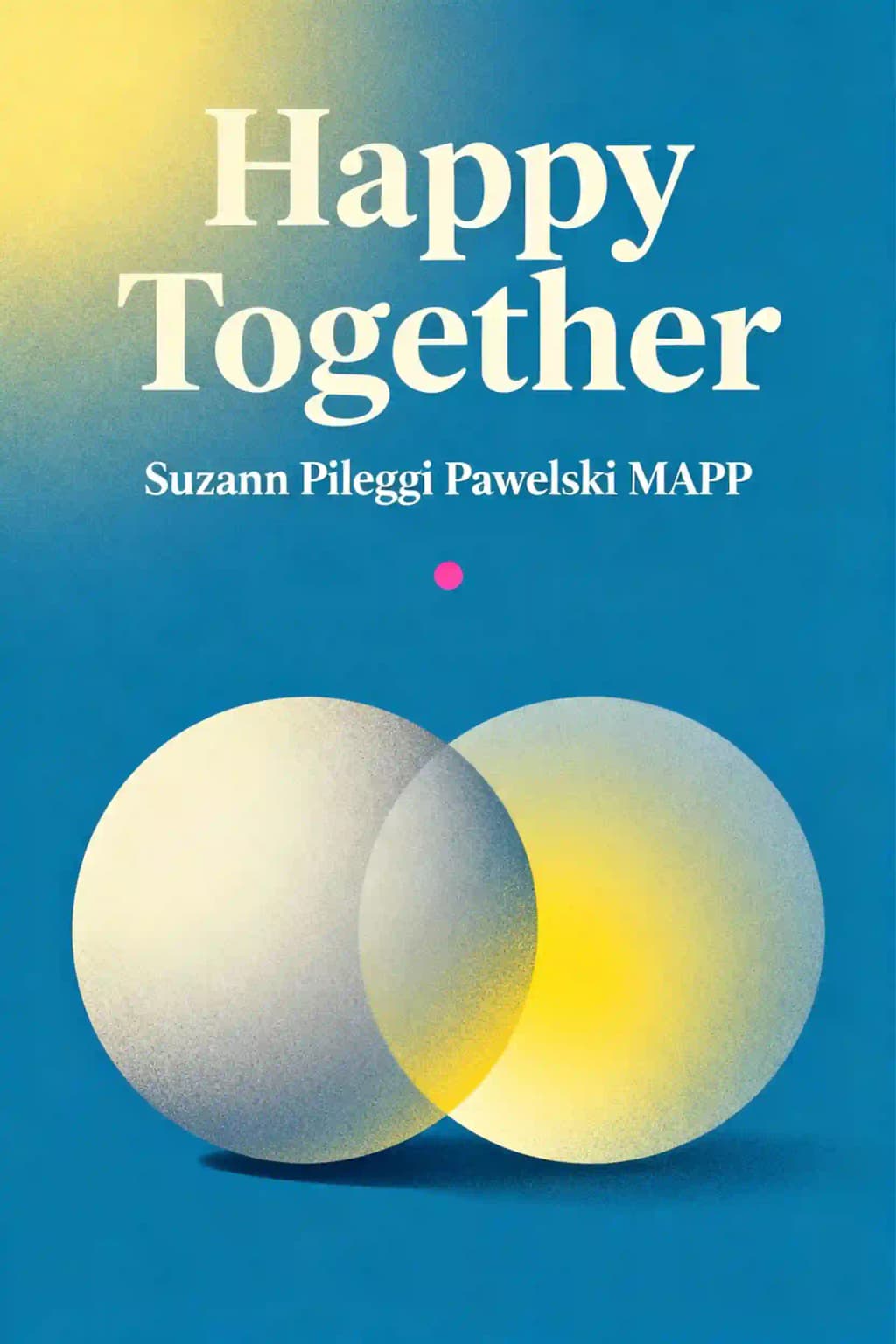
Have you ever wondered why some couples thrive for decades while others fizzle out despite intense initial attraction? What if the fairy tales got it all wrong about "happily ever after"? This groundbreaking book, written by a husband-wife team who met at the University of Pennsylvania's prestigious Master of Applied Positive Psychology program, has become a relationship bible for countless couples seeking evidence-based approaches to lasting love. Celebrities like Oprah Winfrey have praised its practical wisdom, and relationship therapists worldwide recommend it as essential reading. Unlike traditional relationship books that focus on fixing problems, "Happy Together" revolutionizes our understanding of love by applying the science of flourishing to romantic relationships-showing that lasting love isn't something you find but something you build through intentional practice.
第 2 章
Beyond Fairy Tales: The Reality of Lasting Love
We've all been misled. From childhood fairy tales to Hollywood rom-coms, popular culture focuses exclusively on falling in love and wedding planning while offering virtually no guidance for the longest part of the story: maintaining a successful marriage. The irony is striking-couples invest enormous effort preparing for a single wedding day but comparatively little in preparing for the decades of marriage that follow.
This fairy-tale approach to relationships creates dangerous misconceptions. When Suzie married James on an unusually warm January day in Philadelphia, she felt certain their love would sustain them through anything. Years later, she questioned whether love alone is enough, especially during inevitable periods when loving feelings fade.
The truth is that relationships require the same level of intentional effort we apply to other areas of life. Just as we wouldn't expect to transform a job into a career without dedicated work, or seeds into vegetables without regular tending, we shouldn't expect relationships to thrive automatically. Happiness in relationships doesn't just happen-it requires cultivation.
This book introduces positive psychology as a framework for building lasting relationships. Founded by Martin Seligman in 1998, positive psychology scientifically studies what makes life worth living rather than just treating problems. It's like having access to both sides of a reversible cape-the red side for fighting problems (traditional psychology's focus) and the green side for promoting positive outcomes. While our evolutionary "negativity bias" makes us naturally better at using the red side, positive psychology helps us develop the green side by studying human strengths and potential.
The authors' approach focuses on four key areas for lasting relationships: cultivating harmonious passion rather than obsessive infatuation, generating positive emotions that create upward spirals, intentionally savoring positive experiences, and leveraging character strengths to enhance compatibility. By mastering these elements, couples can build what Aristotle would call the highest form of love-one based on appreciating the good in each other rather than just what we can get from a relationship.
第 3 章
The Philosophy of Lasting Love: Completion vs. Improvement
Two famous movie scenes perfectly illustrate contrasting relationship philosophies. In "Jerry Maguire," the protagonist tells his love interest, "You complete me," reflecting the soul mate concept where we need another person to feel whole. In "As Good as It Gets," Melvin tells Carol, "You make me want to be a better man," showing how relationships can inspire self-improvement.
The "completion" approach carries significant dangers. First, it discourages self-development since we expect our partner to fill our gaps. Second, it leads to unhealthy codependency rather than healthy interdependence. Third, it creates unsustainable expectations since people continuously evolve-what "completes" you today may not tomorrow. Research confirms that the healthiest relationships support each person's autonomous motivation rather than requiring self-sacrifice.
Aristotle identified three types of friendship that apply perfectly to romantic relationships. The first is based on utility-people find each other useful, often for financial gain. These self-oriented relationships quickly dissolve when one partner feels shortchanged. The second is based on pleasure-people enjoy each other's company but may part ways when enjoyment fades. The third and highest type is based on goodness-partners value each other's character and support each other's growth.
While profit and pleasure may attract partners initially, they make unstable foundations for lasting relationships. What Melvin from "As Good as It Gets" got right was seeing the good in Carol, valuing her for who she was, and being motivated to become better himself. This exemplifies what the authors call "Aristotelian lovers"-partners who love the good they see in each other (without being blind to flaws), are committed to supporting each other's growth (without forcing change), and are inspired to become better people themselves.
Aristotle defined happiness (eudaimonia) not as pleasure but as "doing well what we are uniquely suited for"-using our rational capacities effectively. Just as Olympic champions must compete rather than stand on the sidelines, in relationships we must actively practice virtue over a lifetime, not just know what's good in theory. This approach to love requires ongoing action and commitment, but creates the strongest foundation for lasting happiness together.
第 4 章
Harmonious vs. Obsessive Passion: The Key to Relationship Health
Consider Amit's story: a successful single man who meets Padma and experiences intense, magnetic attraction-"love at first sight." They marry and have children, but their passionate relationship eventually deteriorates as the initial attraction fades and Amit discovers his wife's controlling nature. Despite divorcing, Amit finds himself repeatedly drawn to similar unhealthy relationships.
Robert Vallerand, a leading researcher on passion, argues that what many mistake for ideal love is actually "obsessive passion," where emotion controls the person rather than the other way around. This romanticized view of love promoted in popular culture can be harmful to relationships. While intense feelings may help cement initial attraction, healthy relationships require a calmer, more sustainable kind of passion.
Vallerand's research reveals that obsessive passion damages relationships as much as having no passion at all. Those with obsessively passionate partners experience more negative emotions during sex, with women reporting less sexual satisfaction and overall relationship happiness. This unhealthy passion often stems from an insecure sense of self, resulting in self-focused behavior that neglects the partner's needs.
Early relationship intensity-butterflies, daydreaming, constant thoughts about your partner-is natural and healthy. Problems arise when relationships never progress beyond this stage. Warning signs of obsessive passion include losing interest once the initial rush fades, permanently losing your sense of self, inability to focus on work or enjoy separate hobbies, and anxiety when apart. This pattern often stems from attachment styles formed in childhood, with anxious and avoidant styles likely linked to obsessive passion.
In contrast, harmonious passion helps maintain a healthy identity while increasing intimacy. Unlike obsessive passion, which can lead to neglecting other aspects of life, harmonious passion allows for a balanced lifestyle with room for friends, career, and personal interests. Phoebe discovered this when she stopped devoting all her attention to relationships at the expense of everything else. Her relationship with Patrick brought an end to tumultuous passion, replacing it with healthier intimacy that led to long-term happiness rather than frustration.
To build harmonious passion in relationships, develop greater trust and emotional attunement with your partner. Trust builds slowly through daily interactions, creating the safety needed to approach conflicts constructively. Maintain your individual identity by avoiding constant preoccupation with your partner, inability to be apart, or sacrificing your own needs. Finally, take up new and interesting activities together as a couple to prevent falling into dull routines that diminish excitement.
第 5 章
The Power of Positive Emotions in Relationships
Sean, a talented Irish rock musician, experiences a dramatic rise to fame when discovered by a major music label. His band tours top venues nationwide, gaining immense popularity. He meets and marries Rachel, and together they maintain a vibrant social life. However, when his band's next album fails commercially and the record label's funding disappears, their marriage begins to crumble.
Their relationship exemplifies Aristotle's second type of friendship based solely on pleasure. In contrast, couples like Beth and Sam represent true Aristotelian lovers whose 25-year partnership thrives on mutual respect, shared goals of self-improvement, and increasing goodness in the world-not just fun moments.
For years, psychology researchers neglected emotions, considering them inconsequential by-products difficult to define or measure. Initial research focused primarily on negative emotions like anger, sadness, fear, and disgust, which have clear survival value through their specific action tendencies-attacking threats, withdrawing to rethink, fleeing danger, and avoiding contamination.
Barbara Fredrickson's groundbreaking "broaden-and-build" theory explains that positive emotions work differently but are equally vital. While negative emotions narrow our focus, positive emotions broaden our attention and increase our thought-action repertoire. When joyful, we're more open, creative, and receptive-our posture straightens, breathing deepens, and minds become more alert to surroundings. Research confirms positive emotions help us see more peripherally, solve complex problems faster, and generate more possibilities for action. Even physicians diagnose complex cases more accurately when in positive moods.
Positive emotions are particularly vital for relationships, helping forge strong connections by breaking down boundaries between people. Through broadening attention, they allow us to see ourselves as less distinct from others, facilitating romantic connections. This aligns with Arthur Aron's self-expansion model of love, where we desire to include our partner within our self-concept.
Through emotional contagion, we "catch" our partner's feelings through unconscious mimicry of facial expressions, vocalizations, and postures. Just as negative emotions can spread and decrease cooperation while increasing conflict, positive emotions can be contagious, enhancing cooperation and performance.
When experiencing negative emotions, small problems magnify, creating downward spirals. Conversely, positive emotions broaden thinking, helping us see the bigger picture rather than fixating on minor annoyances. Barbara Fredrickson defines love as "positivity resonance"-the sharing of positive emotions, biochemical and behavioral synchrony, and mutual care. Couples who regularly engage in novel, exciting activities together create streams of these resonant moments that strengthen their bond over time.
To cultivate positive emotions effectively, Fredrickson recommends three strategies: prioritize positivity (organize your life to naturally include activities that generate positive emotions), act as if (adopt physical postures and facial expressions associated with positive emotions), and become emotion conductors (since emotions are contagious between partners, the partner in a positive mood can share those feelings).
第 6 章
The Art of Savoring: Extending Relationship Joy
Meet Ursula, a successful makeup artist who gives her phone to her assistant during client appointments. One day, the assistant is shocked to find suggestive text messages from a man thanking her for their "morning endeavors." When questioned, Ursula reveals the messages are from Joe, her husband of over twenty-five years. Despite their long marriage, Joe continues to savor their relationship through romantic gestures, affection, and expressions of love.
This contrasts sharply with Marco and Tonya's failed marriage. Marco's practical, no-nonsense approach that served him well at work proved disastrous in his marriage. He consistently rejected Tonya's attempts to connect emotionally, rarely expressing love or appreciation. After twenty-two years, Tonya left, feeling emotionally withered from constant neglect. Only after the divorce did Marco realize what he had lost.
Just as we have ways of coping with negative events, we need strategies for responding to positive experiences. While psychologists have extensively studied coping with adversity, Bryant and Veroff pioneered research on "savoring"-the processes of attending to, appreciating, and enhancing positive experiences.
Savoring differs from merely experiencing positive emotions because it requires mindful awareness and attention to those feelings. While Fredrickson's broaden-and-build theory explains how positive emotions expand our resources, Bryant and Veroff's work reveals how "lengthening and strengthening" positive emotions through savoring can extend their impact on our lives and relationships.
Six factors affect our ability to savor experiences: duration (having ample, unrushed time), timing (low-stress periods, especially following high-stress ones), complexity (sometimes simplicity enhances savoring while other times complexity enriches it), attentional focus (deeper attention enables deeper savoring), balanced self-monitoring (occasional appreciation without excessive happiness-checking), and sharing experiences with the right people.
Bryant and Veroff also explore the temporal dimensions of savoring: reminiscence (savoring the past) and anticipatory savoring (savoring the future). Reminiscing can powerfully extend enjoyment but must be done adaptively-not as escape from present difficulties but as a way to gain perspective and strengthen identity. Anticipatory savoring requires imagination and balance to avoid building expectations that might diminish actual experiences.
Savoring can profoundly enhance romantic relationships through five interconnected processes: appreciative sharing around common interests, self-disclosure of one's inner world, "minding" or consciously attending to what makes your partner unique, collaboration on shared activities and storytelling, and sexual empathy.
When couples collaborate in telling their relationship stories, they report feeling more affectively affirmed. This aligns with John Gottman's research recommending that couples "nurture their fondness and admiration" by intentionally focusing on positive aspects of their partner and relationship. Similarly, Shelly Gable's research shows that how couples respond to good news may be more important than how they handle problems. "Active constructive responding" to a partner's successes predicts relationship quality more than responses to negative situations.
第 7 章
Identifying and Applying Character Strengths in Relationships
Building happy relationships requires character cultivation through consistent action. Aristotle taught that virtues lie in the middle of a continuum between deficiency and excess-courage balances between recklessness and cowardice, while proper pleasure-seeking balances between deprivation and overindulgence. Finding this balanced virtue requires practical wisdom, which varies by context.
We cultivate practical wisdom through repeated action that forms good habits. Character formation begins with childhood lessons from parents but continues throughout life thanks to neuroplasticity. William James, America's first positive psychologist, emphasized the importance of introspection and the "stream of consciousness"-our ever-changing, selective inner experience. By voluntarily focusing our attention on the positive aspects of our partners rather than their shortcomings, we can improve our relationships.
James outlined four maxims for developing good habits (SNAP): Start strong with high motivation; No exceptions to maintain consistency; Always act when the urge arises; Practice exercising willpower daily. These habits aren't mere routines but skills that help us avoid the "hedonic treadmill" where we become habituated to positive experiences.
In 2000, Martin Seligman gathered about twenty-five scholars to develop a science of character. From this work emerged Peterson and Seligman's "Character Strengths and Virtues: A Handbook and Classification," which identifies twenty-four character strengths organized under six virtues: wisdom, courage, humanity, justice, temperance, and transcendence. These strengths are valued across cultures, involve will rather than talent, contribute to well-being, are morally valued in themselves, and can be measured.
When you recognize and appreciate your partner's character strengths, research shows you're more likely to be happy in your relationship, have your psychological needs met, and enjoy greater sexual satisfaction. Sometimes we're surprised by our signature strengths because we have limited understandings of what they mean. James didn't think he was creative because he couldn't draw well, only later realizing creativity applies to language and ideas too.
While using our signature strengths energizes us, we must learn to apply them wisely and in balance. Strengths can be overused (like being so kind to others that you neglect yourself) or underused. Finding this balance requires practice and feedback from others, including your partner. Research by Jonathan Haidt found that focusing on developing signature strengths rather than lesser strengths leads to more sustainable well-being, as people enjoy these activities and continue them voluntarily.
In an Aristotelian loving relationship, knowing and enabling both your own and your partner's strengths creates a combined asset that keeps you growing together. Exercises like sharing stories about when you've observed your partner using their signature strengths successfully can be powerful-hearing your partner tell a story of you at your best helps you feel seen, understood, and loved.
第 8 章
The Gratitude Dance: Giving and Receiving Appreciation
The chapter opens with a humorous anecdote from the authors' wedding reception, where James became entangled in Suzie's veil during their first dance. After watching Suzie's father skillfully take over and gracefully dance with her, James received dance lessons as a birthday gift the following year. This opening story sets up the theme of the "gratitude dance"-the give and take that characterizes healthy relationships. The authors draw parallels between learning to dance together and navigating relationships, noting how both require working in tandem, responding sensitively to one another, and avoiding either forcing moves or resisting guidance.
Gratitude is both a positive emotion and one of the twenty-four character strengths. Described by researcher Robert Emmons as "not only the greatest of virtues, but the parent of all others," gratitude focuses our attention on what we have rather than what we lack. Research shows grateful people enjoy more positive interactions, better empathy, improved sleep, and increased exercise. Gratitude interventions lead to greater life satisfaction and positive emotions, with effects lasting up to six months.
While feeling grateful toward your partner is important, expressing that gratitude effectively is essential for relationship satisfaction. Research shows that the best expressions of gratitude are other-focused rather than self-focused, highlighting your partner's qualities rather than the benefits you received. For example, saying "You're so wonderful" instead of "I just love it!" Additionally, effective expressions must be authentic (coming from the heart rather than obligation) and context-sensitive (tailored to your partner's unique preferences).
When we receive gratitude, we often respond in unhelpful ways: deflection (brushing off appreciation), reciprocation (immediately returning the compliment like a "hot potato"), or discounting (listing all the flaws in what was praised). These responses prevent genuine connection and can feel transactional rather than loving. Instead, healthier responses include: acceptance (simply saying "thank you" and truly receiving the gratitude), amplification (savoring the appreciation deeply and communicating its positive effect), and advancement (using the moment to connect more deeply).
Like dancing, gratitude requires both skillful initiation and response-the relationship itself is a dance requiring both partners to play their roles well. By mastering this dance, couples create upward spirals of appreciation and connection that strengthen their bond over time.
第 9 章
The Interaction Model: Making Relationships Work
The dance of gratitude connects to the broader dance of relationships. John Gottman's research on "bids" for connection in marriages shows that happy couples not only make regular bids throughout the day but also respond positively to their partner's bids about 86% of the time, while couples who eventually divorced responded positively only 33% of the time. This interaction pattern was so significant that Gottman could predict with 94% accuracy which couples would stay together based on these exchanges.
To help couples navigate these interactions, the authors introduce their Interaction Model of Relationships, which breaks down the complex "dance" of relationships into basic steps. The model has two roles-initiation and response-each with three steps. For initiation: cultivation (identifying and practicing a strength), contextualization (considering how to use it in your relationship), and construction (implementing the strength). For response: awareness (noticing your partner's use of a strength), assessment (considering its effectiveness), and action (responding in ways that honor the spirit of initiation). The healthiest relationships have partners who balance these roles and excel at both initiating and responding.
Kindness is critical for compassionate relationships and represents an "orientation of the self toward the other." True kindness isn't motivated by duty or expectation of return, but by emotional connection and sense of common humanity. Happy couples prioritize kindness, making five times as many positive comments as negative ones, even during arguments. Kindness doesn't require grand gestures-it counts most in mundane daily moments where relationships are sustained.
Mindfulness is crucial for the relationship dance, requiring awareness of your own and your partner's passions, emotions, and strengths to move gracefully together. Despite seeming simple, awareness is challenging due to our limited bandwidth-we can only consciously process a small fraction of what's happening around us. Our attention works like a narrow flashlight beam in a dark room, with where we direct it determining our experience. In relationships, focusing on strengths and positive moments rather than dark corners makes a tremendous difference.
Rather than providing a list of relationship dos and don'ts, the authors discuss fundamental principles that should guide our relational lives. The Golden Rule-treat others as you want to be treated-is valuable but limited. The Platinum Rule-treat others as they wish to be treated-works better when we know what others want but fails when their desires aren't good for them. The authors propose the Aristotelian Rule: treat the other person as their best self would want them treated. This approach focuses on helping partners develop their character and become better people, making both individuals and the relationship stronger as the good they see in each other grows.
第 10 章
Love as an Action Verb: The Ongoing Practice of Relationship
Aristotelian love differs from popular notions of romance. Rather than looking to partners to complete us or entering relationships for profit or pleasure, Aristotelian lovers are attracted to the good they see in their partners and are motivated to become better people themselves. This approach requires ongoing action and practice, not passive wishing.
The authors compare relationship-building to muscle-building-potentially fun but requiring hard work directed wisely. They acknowledge that no relationship is ever "perfect" (from Latin meaning "thoroughly done") because living relationships are continually changing and growing. While "perfect" isn't a realistic goal, "better" always is.
Becoming Aristotelian lovers is part science, part philosophy, and part art-requiring application of knowledge with heart and understanding. Meaning is at the core of being happy together, connecting partners to something larger than themselves. Finding a community of like-minded couples is important for support and mentorship.
In their poem "A Prayer for Our Marriage," James describes how he and Suzie have held each other "like a diamond," transforming their experiences together. He describes how Suzie opens her heart to his "angled clarity of mind," turning facts into feelings and healing his heart. Similarly, he cradles her head, calming darting thoughts and turning them into "soothing colors of peace." His prayer for their marriage is that it becomes "an ongoing source of epiphanic grace" where they together refract life events into "radiant beams of joy and hope" and "gentle hues of serenity and gratitude."
This beautiful metaphor captures the essence of what it means to be happy together-not simply finding the right person, but becoming the right people together through intentional practice, mutual growth, and a commitment to seeing and nurturing the good in each other. Love, ultimately, is not something we fall into but something we build, day by day, through conscious choice and dedicated effort.