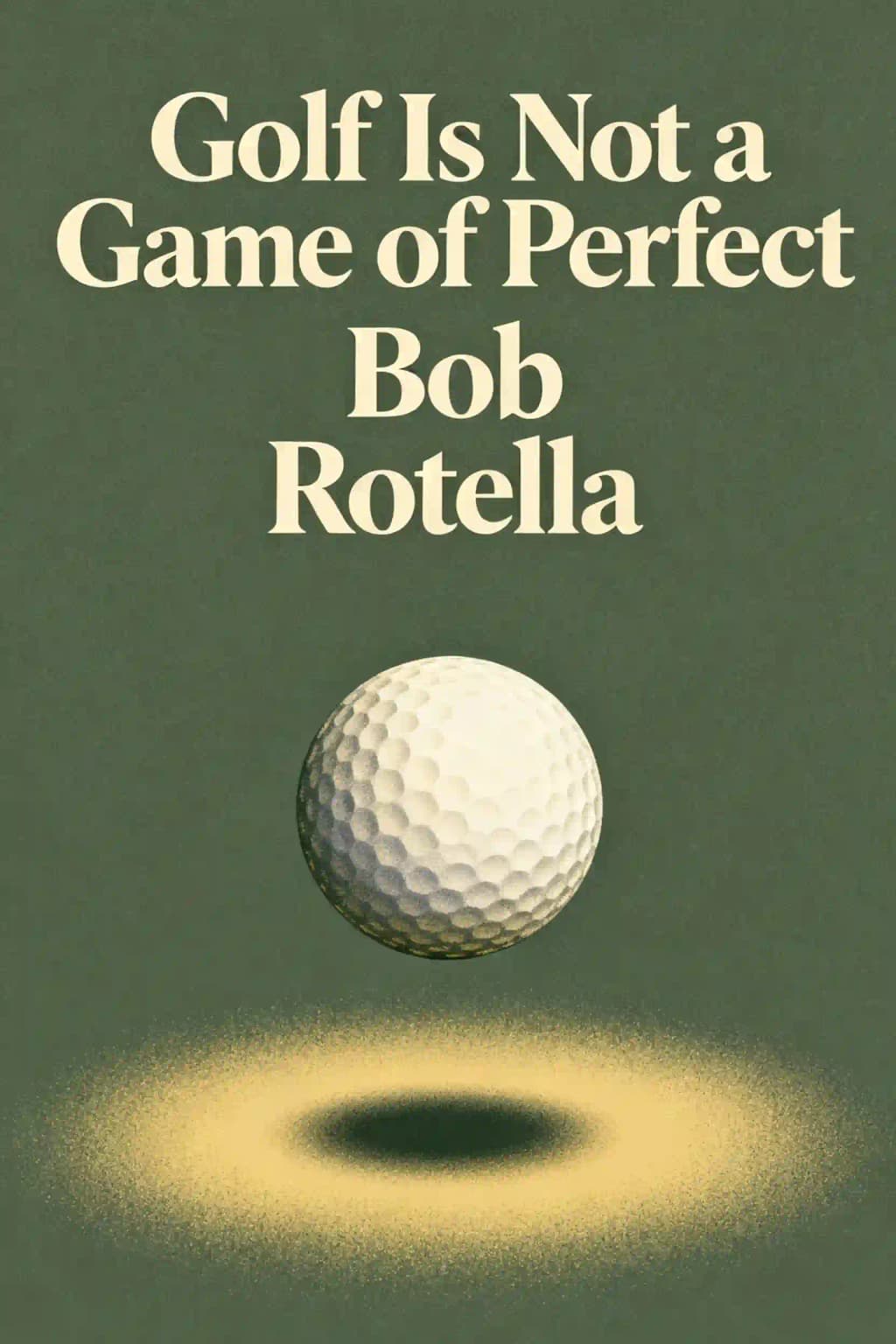
Discover why elite golfers like Jack Nicklaus trust Dr. Rotella's mental game secrets. Beyond perfect swings lies the true path to victory - mastering your mind. What surprising psychological trick do PGA champions use after bad shots?
Dr. Bob Rotella, a renowned sports psychologist and the bestselling author of Golf is Not a Game of Perfect, has profoundly shaped the mental aspects of golf through his decades of expertise in performance psychology. Holding a doctorate from the University of Connecticut, he spent 20 years as the Director of Sports Psychology at the University of Virginia. His groundbreaking work effectively bridges academic rigor with practical strategies, fostering confidence, focus, and resilience under pressure.
Rotella’s influential teachings are further explored in The Unstoppable Golfer and six additional books, all of which blend compelling storytelling with actionable insights gleaned from his work with numerous PGA Tour champions.
A trusted advisor to 15 major championship winners, including Rory McIlroy, Padraig Harrington, and Ernie Els, Rotella’s methods have become foundational elements in elite golf training programs. His collaborations with Golf Digest, along with his lectures at top institutions, further cement his authority and influence in the field of sports psychology. Golf is Not a Game of Perfect, first published in 1995, is a sports psychology classic that has sold millions of copies worldwide and was recognized by Sports Illustrated as one of the ten greatest golf instruction books in history.
Golf is Not a Game of Perfect teaches golfers to master the mental aspects of the sport, emphasizing confidence, focus, and resilience over technical perfection. Dr. Bob Rotella, a renowned sports psychologist, shares strategies to overcome self-doubt, embrace challenges, and develop a winning mindset through anecdotes from pros like Nick Price and John Daly.
This book is ideal for golfers at any skill level struggling with consistency, anxiety, or mental blocks. Weekend players, competitive amateurs, and even professionals like Ernie Els and Davis Love III have used Rotella’s methods to improve performance and enjoyment.
Yes—it’s a bestseller and one of the top three golf books in history, praised for transforming players’ mental games. Rotella’s actionable advice, like “focus on targets, not mechanics,” has helped major champions like Padraig Harrington and Rory McIlroy.
Rotella calls confidence “the aggregate of thoughts you have about yourself,” arguing it’s cultivated through preparation and positive self-talk. He illustrates this with examples like John Daly’s 1995 Open win despite erratic play.
Focus solely on the target, trust your routine, and avoid outcome-oriented thoughts. Rotella cites David Duval’s 2001 Open victory as proof this mindset works under stress.
No—Rotella avoids technical advice, stressing that mental habits like decisiveness and resilience matter more than perfect mechanics. This distinguishes it from instruction-focused golf books.
Both emphasize mental mastery, but Rotella’s work is golf-specific and includes direct examples from major champions. While Inner Game explores broader performance psychology, Rotella tailors concepts like visualization to golf’s unique demands.
Some golfers feel it oversimplifies technical improvements or lacks drills. However, most agree its mental frameworks are invaluable for players already comfortable with their swing.
The book’s principles—resilience, focus, and goal-setting—apply to business, sports, and personal growth. Rotella has advised CEOs and Olympians using similar strategies.
With rising interest in sports psychology and mindfulness, Rotella’s timeless lessons on emotional control and self-belief remain critical for golfers navigating modern competition pressures.
通过作者的声音感受这本书
将知识转化为引人入胜、富含实例的见解
快速捕捉核心观点,高效学习
以有趣互动的方式享受这本书
Perfection isn't the goal.
Golfing potential depends primarily on attitude.
A player without dreams has little real potential.
People by and large become what they think about themselves.
The size of your dreams ultimately determines how far you'll go.
将《Golf Is Not a Game of Perfect》的核心观点拆解为易于理解的要点,了解创新团队如何创造、协作和成长。
通过生动的故事体验《Golf Is Not a Game of Perfect》,将创新经验转化为令人难忘且可应用的精彩时刻。
随时提问,选择你的学习方式,共创真正适合你的洞察。

"Instead of endless scrolling, I just hit play on BeFreed. It saves me so much time."
"I never knew where to start with nonfiction—BeFreed’s book lists turned into podcasts gave me a clear path."
"Perfect balance between learning and entertainment. Finished ‘Thinking, Fast and Slow’ on my commute this week."
"Crazy how much I learned while walking the dog. BeFreed = small habits → big gains."
"Reading used to feel like a chore. Now it’s just part of my lifestyle."
"Feels effortless compared to reading. I’ve finished 6 books this month already."
"BeFreed turned my guilty doomscrolling into something that feels productive and inspiring."
"BeFreed turned my commute into learning time. 20-min podcasts are perfect for finishing books I never had time for."
"BeFreed replaced my podcast queue. Imagine Spotify for books — that’s it. 🙌"
"It is great for me to learn something from the book without reading it."
"The themed book list podcasts help me connect ideas across authors—like a guided audio journey."
"Makes me feel smarter every time before going to work"

免费获取《Golf Is Not a Game of Perfect》摘要的 PDF 或 EPUB 版本。可打印或随时离线阅读。
Picture a professional golfer standing over a six-foot putt worth hundreds of thousands of dollars. His hands are steady, his breathing controlled, but inside his head, a war rages between confidence and doubt. Now imagine a nine-year-old watching the same scene, casually remarking, "Oh, that's nothing. He always makes those." Who do you think has the better mindset for making that putt? This paradox lies at the heart of golf's greatest mystery: why do we often play our worst when it matters most? Why can a weekend hacker stripe drives on the range but slice into the woods when someone's watching? The answer isn't in your grip, your stance, or your swing plane-it's in the six inches between your ears. Golf exposes our mental weaknesses like few other pursuits, which is precisely why mastering your mind transforms not just your scorecard but your entire relationship with pressure, failure, and success. In a world obsessed with swing mechanics, launch angles, and equipment technology, we've forgotten golf's fundamental truth: the game is won or lost in your mind long before the ball leaves the clubface.
Tom Kite was small, wore glasses, and wasn't even the best junior golfer at his local club. Yet he fulfilled every dream-winning tournaments, majors, player of the year honors, and leading the money list. What separated Kite from more "talented" players? The size and clarity of his dreams. Most approach golf-and life-backward, seeking physical advantages first. But potential depends primarily on attitude, mental approach, and dream strength. Nick Price came for help in his early thirties-a good professional who hadn't won in six years. He had talent for incredibly low rounds but suffered maddening inconsistency. The problem: his thinking depended entirely on how he played the first few holes. He was a puppet controlled by external events rather than internal choices. The revelation that transformed his career was understanding that his state of mind was a choice, not a consequence. He could decide before each round how he would think and maintain that mindset regardless of results.
Walking a balance beam on the floor is easy. Suspend it forty feet up, and suddenly every step becomes jerky and uncertain. Your coordination hasn't changed-your thinking has. Fear makes you overthink each movement, destroying the natural flow your body already knows. Golf works the same way. When you stand over a shot analyzing grip pressure or shoulder turn, you're walking that high beam while consciously controlling every muscle. The fundamental principle: train it on the range, trust it on the course. The practice tee is where you work on mechanics. But the moment you step onto the first tee, mechanical thoughts must disappear. Jack Nicklaus knew to put away troublesome clubs mid-round rather than trying to fix mechanics during play. Tom Watson exemplified this-the worse he hit it, the more aggressively he swung, understanding that tentative thinking only makes things worse. Think about walking or typing. You don't consciously think about mechanics-you simply think about where you want to go. Your conscious mind selects the target; your subconscious mind handles execution. This explains why golfers hit beautiful shots on the range but struggle on the course. On the range, they're relaxed and target-focused. On the course, they're tense and swing-focused.
Stuart Anderson, a college football player, once missed over twenty consecutive shots in a high school basketball playoff game. With his team down by one point and seconds left, he demanded the final shot. His reasoning: as a 50% shooter, each miss made the next shot more likely. When making several in a row, he believed he was on a hot streak. Contradictory? Perhaps. Effective? Absolutely. This "shooter's mentality" is critical for golfers. After missing three putts or hitting a drive out of bounds, believe each mistake increases your chances of success next time. Though seemingly irrational, it's far more effective than doubt and mechanical tinkering. Consider "Don't hit it in the water" versus "I'm going to land this right on the green." The first creates tension and often produces what you fear; the second allows your natural ability to emerge. Most golfers experience brief periods where everything clicks-playing at a level they always believed possible. These golden stretches typically end with one bad shot, leading many to believe they were playing "over their head." The opposite is true: these moments represent genuine capability when playing with complete trust. Chip Beck, who shot 59 in Las Vegas, described his mental state as "staying out of my way"-allowing no doubts to interfere. The zone isn't mystical-it's a mental state you can choose on every shot if you trust what you've trained.
A sound preshot routine creates a mental sanctuary - a series of familiar steps bringing you into the present moment. When properly executed, nothing exists except you, the ball, and your target. The core is simple: look at the target, look at the ball, swing. The pace should match your personality while maintaining rhythm. Nick Price focuses intensely on his target, not his swing. Fred Couples tries to have no swing thoughts at all. Physical motions alone aren't enough. Val Skinner's experience at the 1994 British Women's Open illustrated this - she went through her routine motions but doubt and anger clouded her mind, sabotaging her performance. The mental component is essential: unwavering belief that the ball will go where you intend. If doubt exists, change clubs or targets before you swing. The best approach is having no swing thoughts. If you need one, use only a single thought per round for shots over 120 yards. Your routine actually speeds up play by eliminating indecision. Think of it as a mental reset button - your portable zone, available on every shot.
Most golfers resist this truth: low scores depend on play within 120 yards of the hole. They'd rather practice drives, but the payoff for good short shots far exceeds that of good long shots. You can hit excellent drives but still make bogey with poor short play, while saving par after poor long shots with excellent chips or pitches. Curtis Strange won the 1989 U.S. Open despite hitting into nine greenside bunkers in the final round - he got up and down eight times. The ideal mental approach requires having absolutely no swing thoughts from 120 yards in. Think only of your target, using your standard routine until the swing feels right. Tom Watson's famous chip at Pebble Beach's 17th hole won the 1982 U.S. Open with this mindset. He told his caddie he was going to hole it - and he did. Bobby Locke, history's greatest putter, revealed his secret: "You just hit it and listen." He maintained unwavering confidence, refusing to dwell on missed putts because that would undermine his certainty about making the next one. Great putters expect to make everything. Poor putters hope to avoid three-putting. That subtle shift in expectation creates dramatically different results.
The difference between professional golfers and talented amateurs isn't just skill-it's concentration. Tom Kite explained to college players who matched his scoring during a casual round that pros maintain focus on every shot during tournaments, while amateurs typically lose concentration four or five times per round. Those mental lapses cost the strokes that separate winners from also-rans. Golf's greatest paradox: while striving for perfection is essential, demanding perfection on the course is deadly. After hitting his approach into the water on the final hole at Bay Hill, Tom Kite didn't dwell on the mistake but hit his next wedge stiff and won in a playoff-demonstrating acceptance, the last step in a sound routine. Good players learn to enjoy "winning ugly" by accepting all shots. When pros hit into trouble, they become even calmer and more focused. Getting angry after bad shots only creates tension, hurts rhythm, and activates the analytical mind-all of which make you play worse. Walter Hagen expected to make seven mistakes per round. When he hit a bad shot, it didn't bother him-it was just one of the expected seven. As Chip Beck says when he hits into the woods: "You gotta love it. This is what golf is all about." On the first tee, have just two goals: to have fun and to keep your mind where it should be on every shot. Acceptance of imperfection, combined with unwavering commitment to the next shot, is how you access your best golf.