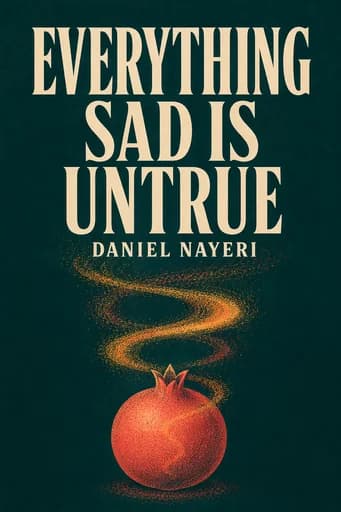
《一切悲伤皆非真实》摘要
(一个真实的故事)
《一切悲伤皆非真实》摘要概述
一位难民男孩将他的波斯往事编织进美国的当下,创作出一部荣获普林茨奖(Printz Award)的拼贴式回忆录。一个12岁少年讲述的真相,是如何成为 Levine Querido 出版社具有历史意义的首部出版作品的?丹尼尔·纳耶里(Daniel Nayeri)的杰作证明了:一切悲伤之事或许确实并非真实。
下载《一切悲伤皆非真实》摘要
免费获取《一切悲伤皆非真实》摘要的 PDF 或 EPUB 版本。可打印或随时离线阅读。

(一个真实的故事)
一位难民男孩将他的波斯往事编织进美国的当下,创作出一部荣获普林茨奖(Printz Award)的拼贴式回忆录。一个12岁少年讲述的真相,是如何成为 Levine Querido 出版社具有历史意义的首部出版作品的?丹尼尔·纳耶里(Daniel Nayeri)的杰作证明了:一切悲伤之事或许确实并非真实。
免费获取《一切悲伤皆非真实》摘要的 PDF 或 EPUB 版本。可打印或随时离线阅读。
由哥伦比亚大学校友创建 源自旧金山
"Instead of endless scrolling, I just hit play on BeFreed. It saves me so much time."
"I never knew where to start with nonfiction—BeFreed’s book lists turned into podcasts gave me a clear path."
"Perfect balance between learning and entertainment. Finished ‘Thinking, Fast and Slow’ on my commute this week."
"Crazy how much I learned while walking the dog. BeFreed = small habits → big gains."
"Reading used to feel like a chore. Now it’s just part of my lifestyle."
"Feels effortless compared to reading. I’ve finished 6 books this month already."
"BeFreed turned my guilty doomscrolling into something that feels productive and inspiring."
"BeFreed turned my commute into learning time. 20-min podcasts are perfect for finishing books I never had time for."
"BeFreed replaced my podcast queue. Imagine Spotify for books — that’s it. 🙌"
"It is great for me to learn something from the book without reading it."
"The themed book list podcasts help me connect ideas across authors—like a guided audio journey."
"Makes me feel smarter every time before going to work"
由哥伦比亚大学校友创建 源自旧金山


来自《一切悲伤皆非真实》的相同理念。选择适合你的声音、深度和节奏,随时切换。
Daniel Nayeri's critically acclaimed memoir has captivated readers across generations since its 2020 release, earning the prestigious Michael L. Printz Award and landing on numerous "best books" lists. This refugee narrative resonates deeply with celebrities like Malala Yousafzai, who praised its "unforgettable portrait of displacement and belonging." What makes this book extraordinary isn't just its harrowing tale of escape from religious persecution in Iran, but its innovative storytelling approach-weaving Persian mythology, family history, and the raw experiences of a child navigating the bewildering landscape of American middle school. Through the eyes of young Khosrou (Daniel), we discover how stories become lifelines when everything familiar has been lost.
All Persians are liars-or so the kids in Mrs. Miller's class believe. Twelve-year-old Khosrou, now called Daniel, sits at the back of an Oklahoma classroom, a refugee kid with a "bubble butt" and stories no one believes. Like Scheherazade from the 1,001 Nights, he offers tales to spare his life from the social death of middle school rejection. "You're the king with my life in your hands," he tells us, establishing the intimate connection between storyteller and audience that drives the narrative. Daniel's first memory-blood slopping from a terrified bull's throat as his grandfather Baba Haji reaches toward him with red hands-establishes the visceral quality of his remembering. This memory, precious and small, he "clenches like a fist grips a ball bearing," afraid of losing it. Before persecution forced his family to flee Iran, they lived a comfortable life, driving through the Iranian desert in a gold-colored Chevrolet with seats like couches, heading to his grandfather's six-hundred-year-old stone house with its walled garden of almond, peach, and fig trees. The contrast with his current reality is stark. In Oklahoma, kids on "the troublesome bus" fight him because they know he won't tell anyone. Once a substitute driver abandoned them mid-route, calling them hooligans. While everyone screamed and shot paper clips, Brandon Goff pinned Daniel down, shoving spitballs in his ear. His name, Khosrou, once belonged to a Persian king who commissioned a magnificent 150-foot spring carpet woven with gold, silk, and gems when tired of winter rain. But the hero is always less than his legend-Khosrou's just a twelve-year-old kid with a big butt, learning to navigate a world that finds him strange.
轻松跟读,《一切悲伤皆非真实》中的每个词都会随音频实时高亮。
Daniel's stories of Iran illuminate the profound depths of what's been lost - not just material comforts but an entire cultural framework steeped in centuries of tradition and prestige. His father's family history stretches back generations, with their ancestral lands reportedly bestowed by the king of India himself after they saved his daughter from a grave illness. His great-ancestor Jamshid was a renowned doctor in Isfahan, celebrated not just for his medical expertise but for his compassionate treatment of the poor and untouchables - social outcasts whom others wouldn't touch. In his sprawling garden, shaded by ancient cypress trees, he would serve aromatic tea while listening to the troubles of anyone who sought his counsel, regardless of their social status. The family's reward was vast: expansive lands around Ardestan including snow-capped mountains, a life-giving river, and several prosperous villages. The contrast with their life in Oklahoma is stark and painful - they've become "the opposite of kings." Their entire world has been reduced to what fits in one weathered gray suitcase, containing mostly practical items: winter coats, essential papers, and a shoebox of precious photographs that his mother takes out late at night, crying silently over memories of their former life. Left behind in Iran were the tangible markers of childhood: Daniel's carefully collected toys, his treasured books, and most notably, his beloved Orich candy bars. His father, a successful dentist whose practice sat above a bustling candy shop in Tehran, would regularly bring home cases of chocolate - a small luxury that became a sweet symbol of their comfortable former life. These memories spawn countless "dessert-oriented stories" that reveal both the sophisticated richness of Persian culture and the acute sense of displacement that colors Daniel's daily existence. Food emerges as a powerful metaphor for cultural identity and belonging, serving as both comfort and alienation. When classmates mock his fruit leather lunch, comparing it derisively to "catfish bait," Daniel quietly clings to the knowledge that in Iran, fruit leather is a prized delicacy, crafted in sophisticated flavors like tart cherry, rich black currant, sweet apple pomegranate, and tangy tamarind. The stark contrast between American church potluck fare - industrial canned green beans, artificially colored Jell-O, and processed Velveeta cheese - and his mother's elaborate Persian feasts becomes a tangible reminder of their outsider status. Yet his mother steadfastly continues to cook "as if we're the shahs of Oklahoma City," preparing intricate dishes like jeweled rice studded with pistachios and barberries, and delicate pastries filled with rosewater and cardamom. Through these culinary traditions, she preserves their dignity and cultural identity, even as everything else familiar has been stripped away. Each carefully prepared meal becomes an act of resistance against erasure, a way to maintain connection to their heritage while building a new life in an unfamiliar land.
Persian myths and family legends intertwine throughout Daniel's narrative, blurring the line between history and storytelling. He explores how these ancient tales serve not just as cultural touchstones, but as mirrors reflecting contemporary struggles and universal truths. The stories pulse with recurring themes of love, loss, sacrifice, and the endless human quest for connection across impossible distances. He recounts the tragic love story of Baker Abbas and beautiful Tamar, explaining how the bakery came to be called "Akh Tamar" - the sound of heartbreak. The tale unfolds in layers, with Abbas kneading his grief into every loaf, his fingers working the dough as he whispered her name. This story echoes through generations, transforming a simple bakery into a monument to enduring love. Later, he discovers a leather-bound book containing Persian myths, including the legend of Akhtamar Island where a princess named Tamar held a lamp for her lover swimming across Lake Van until her father smashed it, drowning the boy whose last words were "Akh, Tamar!" The parallel between these tales - separated by centuries but united in their exploration of thwarted love - demonstrates how myths continue to resonate across time. These stories aren't merely entertainment - they're frameworks for understanding his own fractured reality. When describing his great-grandmother Aziz, whose father disappeared when borders closed during the Second Great War, he notes that "unlike me, who knew Aziz only as a bent old woman offering stale candy from a dish that also held buttons, she spent her life staring northward, hoping for her father's return." This image becomes a powerful metaphor for the inherited trauma of displacement and loss that shapes generations. The tale of Khosrou II and Shirin unfolds as a tragic Persian romance where Khosrou falls in love with Princess Shirin merely from descriptions. The story's complexity - involving exile, political marriages, jealousy, and ultimately death - teaches that love is "many-parted" - more than just attraction but also commitment, self-improvement, and choosing actions that don't hurt those you love. Through elaborate court intrigues and passionate declarations, the story demonstrates how love can simultaneously elevate and destroy, a lesson that resonates with Daniel's own experiences of abandonment and betrayal. "Persian love stories are all tragedies," he explains, reflecting on how these cultural narratives shape his understanding of his parents' failed marriage and his own capacity for love. Yet within each tragedy lies a kernel of hope - the possibility of transformation through suffering. The stories reveal two essential truths: "every story is a storyteller begging to stay alive, and any tale could have gone countless different ways." This understanding helps Daniel navigate his own narrative, recognizing that while we inherit our stories, we also have the power to reshape them. These mythic tales serve as both anchor and compass, helping Daniel locate himself within a broader cultural and emotional landscape. They provide a vocabulary for loss and longing, while simultaneously offering the possibility of redemption through the act of storytelling itself.
The painful process of becoming "Daniel" instead of Khosrou represents the broader trauma of losing cultural identity - a transformation that cuts to the core of immigrant experience. After months in Dubai, living with Australian missionary doctors who offered temporary shelter, his mother abruptly decided no one could pronounce "Khosrou" and started calling him "Daniel." The moment was shattering - he burst into tears and hid under the bed, devastated that his identity seemed as disposable as old clothes. In that dark space beneath the bed, surrounded by dust and confusion, he made a conscious decision: Daniel would be tougher than Khosrou - "like the superbot version" - able to withstand any damage, any transformation, any loss. This transformation, while necessitated by survival, extracts a deep psychological toll. In Oklahoma, Daniel becomes a master of compartmentalization, creating distinct versions of himself for different contexts. At school, he never mentions church; at church, home life remains unspoken; at home, school struggles stay hidden. He develops an extraordinary linguistic adaptability, mastering different American dialects with precision - "the slow, comfortable Okie drawl" for his teachers, "the cool, minimal speech of Black Americans" for his peers, and a carefully neutral English for church. Each dialect becomes a mask, a survival tool in his growing arsenal of identities. Through bitter experience, he learns the essential survival strategy of the displaced: "hide deeply while growing stronger, creating decoy tears to mask real feelings." This performance of identity becomes second nature - showing just enough vulnerability to satisfy observers while protecting his true self. The strategy proves particularly valuable during his father's long-awaited visit from Iran. After years of separation, the mythological father figure he's constructed in his mind - a composite of Ardestan's saffron fields, ancient walls, and sweet pomegranates - collides with reality: a small man "with swollen nose and waddly legs," bearing little resemblance to the heroic figure of his memories. This disillusionment becomes a crucial part of his ongoing process of reconciling memory with reality. He begins to understand that identity itself is partly mythological - "myths are just legends everybody agrees on." The transformation from Khosrou to Daniel isn't simply about adopting a new name; it's about learning to navigate between worlds, to carry multiple truths simultaneously, and to understand that adaptation doesn't necessarily mean erasure. Through this process, he discovers that identity isn't fixed but fluid - a continuous negotiation between past and present, between internal truth and external presentation, between the person he was and the person he's becoming.
At the heart of Daniel's story stands his mother Sima-a sayyed from the Prophet's bloodline who converted to Christianity despite it being a capital crime in Iran. When adults in Oklahoma ask why she gave up everything-their house, his grandfather's villages, all the gold, her medical practice-Daniel can only repeat her simple answer: "Because it's true." She believed Jesus was worth more than seven million dollars in gold coins, thousands of acres of Persian countryside, her medical degree, family, home, and even her life. This conversion had profound consequences. Being a sayyed meant wealth, but more importantly, blessing in one's blood. For his mother to reject her own blood meant becoming "najis"-ritually impure, unclean on a cellular and cosmic level. To the Supreme Leader of Iran, a najis sayyed would be loathsome, deserving death. After joining Pastor Pike's secret church in Iran, Sima was eventually caught by the Komiteh-the Supreme Leader's secret police. They took her to a house with an empty room containing just one chair and a floor drain for blood. When she refused to name others in the underground church, they gave her one week to reconsider or they would kill her and her children. Upon release, she immediately began preparing their escape from Iran. Through refugee camps in Dubai and Italy, Sima remained "unstoppable"-never deterred by bureaucratic obstacles or humiliation. At Hotel Barba in Italy, rather than succumb to the hopelessness of waiting, she found an American family with homeschooled children and traveled two hours by bus to their home. For forty days, she erased 660 pages daily from their completed workbooks so her children could fill them out themselves-completing a year's worth of schooling in two months. She developed permanent calluses from erasing so much, but never stopped, never complained about lost dignity. Her unstoppable strength came from hope-belief that "everything sad will become untrue." Like refugees who endure hardship because they believe freedom awaits, what you believe about the future changes how you live in the present.
轻松跟读,《一切悲伤皆非真实》中的每个词都会随音频实时高亮。
"A patchwork story is the shame of a refugee," Daniel repeats throughout his narrative, acknowledging the fragmentary nature of his memories. The forgetting hurts most - more than persecution, bullying, or abuse. These pains make him strong, "hardening him like jerked meat." But memories pour away like sand, leaving only holes where beloved faces once were. He struggles to recall his grandmother's voice, the exact shade of their Tehran apartment's walls, or the pattern of his mother's favorite dress - details that once formed the fabric of his daily life. This fragmentation extends to his understanding of truth itself. When Mrs. Miller challenges his focus on "food, poop, and bloody parts" of life by asking why Scheherazade's tales contain so much more, Daniel reflects on what constitutes truth. Is it the visceral experiences of the body? The myths we tell ourselves? The blood connections that define us? He realizes that refugees must often choose between different versions of truth: the official narratives on immigration papers, the stories they tell themselves to survive, and the raw, physical realities of displacement. In the refugee camp in Italy, Daniel befriends Ali Shekari, a Kurdish boy with white splotches across his skin - chemical burns from when Saddam Hussein's planes dropped Agent Orange on Kurdish shepherds. Ali becomes Daniel's window into another world of displacement and loss. Through their late-night conversations on squeaking camp beds, Ali explains that the Kurds originated from people who escaped the serpent king Zahhak, hiding in the hills when his shoulder-snakes demanded human brains. "The Kurds are half a people," Ali says, perhaps trying to tell Daniel that everyone's ancestors were once refugees, that displacement is part of the human story. Their friendship becomes a testament to how shared trauma can forge unexpected connections. The narrative culminates with Daniel's father bringing Mr. Sheep Sheep - his beloved stuffed animal - back from Iran. Its once-white wool had turned gray, and its throat had been slit all around, crudely sewn back with black thread, likely from airport security checking for drugs. This damaged toy becomes the perfect metaphor for Daniel's own fractured identity - recognizable but fundamentally altered by his journey. The crude stitches mirror his own attempts to piece together his scattered memories and experiences, while the grayed wool reflects the loss of innocence that comes with forced migration. Like Mr. Sheep Sheep, Daniel survives but carries visible scars of his journey, marking him as someone who has crossed borders both physical and psychological. Through these intertwined stories of loss, memory, and survival, Daniel explores how refugees must constantly negotiate between preserving their past and adapting to their present, between holding onto their cultural identity and forging new connections in strange lands. The patchwork nature of his narrative becomes not just a limitation to overcome, but a truthful reflection of the refugee experience itself - fragmented, complex, and ultimately resilient.
Daniel's relationship with his two grandfathers serves as a profound meditation on how memory shapes our understanding of others and ourselves. Of his paternal grandfather Baba Haji, he possesses only three fleeting memories - most vividly, the ritualistic bull slaughter that both terrified and fascinated his young mind. The scene is etched in his consciousness: the animal's desperate bellowing, the flash of the knife, and his grandfather's steady hands performing what seemed like an act of casual cruelty. Of his maternal grandfather Arman, he has no direct memories at all, knowing him only through a stern black-and-white photograph and family stories that paint a portrait of calculated cruelty, including the haunting tale of drowning the family's beloved cats in a burlap sack in the river. The mathematical precision of this difference - "exactly one memory" - becomes a philosophical touchstone throughout the narrative. As Daniel observes, "the space between zero and one is all the world." This profound observation illuminates how even a single memory can transform our relationship with another person, giving them dimension and humanity that no secondhand account can provide. The presence of even one authentic memory creates a bridge to understanding, while its absence leaves only speculation and inherited stories. Throughout the narrative, Daniel wrestles with the complex question of what it means to truly know another person. This exploration deepens when his mother reveals the context behind the bull slaughter: the animal had gone mad and posed a danger to the community - the killing was an act of mercy rather than cruelty. This revelation forces Daniel to confront how many of our most cherished memories may be similarly incomplete - true in their basic facts but missing crucial context that could fundamentally alter their meaning. The understanding dawns that memory itself is less a perfect record than a starting point for interpretation. The theme of memory and loss reaches its emotional crescendo in the book's closing moments, as Daniel sits with his mother in a dark motel room after their desperate flight from his abusive stepfather Ray. The room becomes a metaphorical space between zero and one - between complete loss and potential redemption. Despite all they've endured - religious persecution in their homeland, flight to an unwelcoming new country, grinding poverty, and domestic violence - Daniel clings to an almost mystical hope: "I knew that someday, maybe after a thousand years, we would be whole again." This belief in the temporary nature of brokenness, that "everything sad will become untrue," becomes more than mere optimism; it transforms into a spiritual framework through which he processes his fractured childhood. The space between zero and one becomes not just a measure of memory, but a measure of hope itself.
Every authentic Persian rug contains a deliberate imperfection - the "Persian flaw" - woven into its intricate patterns because, according to tradition, only Allah can achieve perfection. These intentional mistakes, often subtle variations in color or pattern, serve as humble acknowledgments of human limitation. Yet Daniel challenges this romanticized notion of controlled imperfection: "There's no such thing as a Persian flaw in reality, because that assumes something could have only one thing wrong with it." This insight cuts to the heart of how we narrativize our flaws and suffering. Life's disasters cascade with ruthless momentum - your father disappears into the chaos of revolution, uncles bargain away your future, daughters face unthinkable tragedies. The story unfolds not with a single symbolic flaw but through an intricate web of losses, betrayals, and survival. Each thread pulls on countless others, creating a tapestry far more complex than any deliberate imperfection could represent. In Iranian culture, carpet weaving itself tells stories of persistence through difficulty - knots tied one after another, thousands of times, each one holding the potential for both precision and mistake. As an adult reflecting on his childhood memories, Daniel acknowledges that these are "the myths I believed as a child - both fiction and nonfiction simultaneously, as all memories are." This nuanced understanding recognizes memory as a living thing, constantly being rewoven as we age. The stories we tell about our past shape-shift with time, colored by subsequent experiences and evolving perspectives. What remains consistent is not the absolute historical truth but the emotional resonance of these formative experiences. The metaphor of the Persian carpet extends beyond individual flaws to encompass the entire immigrant experience - the unraveling of one life and the reweaving of another. Daniel's journey across continents becomes a testament to human adaptability, showing how we can preserve essential threads of identity while creating new patterns. His story demonstrates that authenticity lies not in perfection or even in carefully planned imperfection, but in the honest acknowledgment of life's inherent complexity. In the end, Daniel's patchwork narrative becomes not a source of shame but a celebration of resilience - proof that even when scattered across continents, separated from family, language, and cultural touchstones, we can still weave our fragments into something meaningful. Through storytelling, we transform our broken pieces into a new whole, creating beauty not despite our imperfections but through them. This understanding offers a more profound truth than the Persian flaw tradition: that our identities are constantly being rewoven, incorporating both what we've lost and what we've gained along the way.
“坚持使用 23 天了,我每天都会打开它。它现在已经成为我的日常习惯。”
jayallen