第 1 章
When Differences Become Superpowers
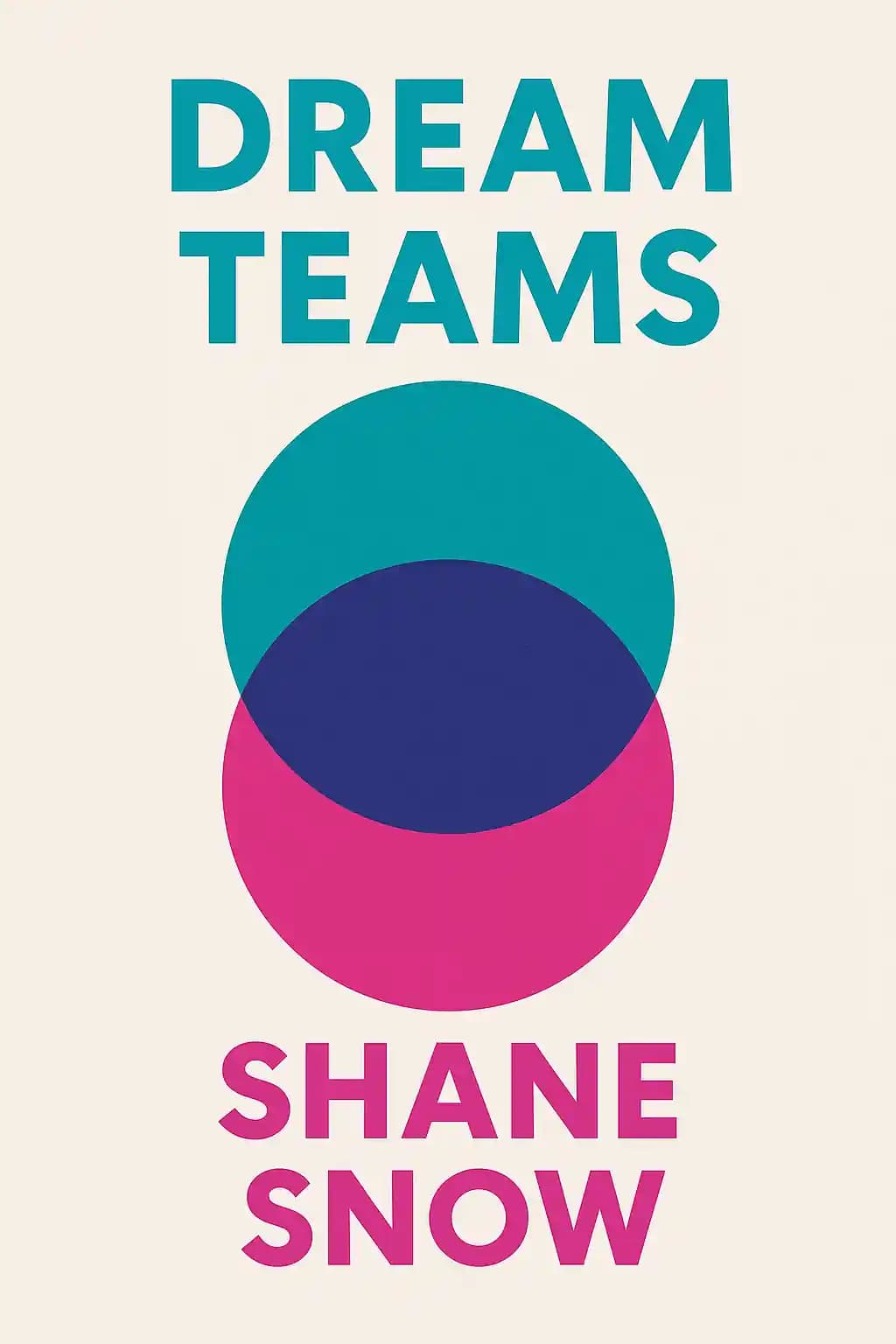
Imagine a world where the greatest hockey team in history wasn't built on physical prowess, but on chess and ballet. Where a female detective in the 1860s-disguised and dismissed by society-saved Abraham Lincoln's life through sheer ingenuity. Where nine rappers from rival housing projects created a musical revolution by channeling their differences rather than suppressing them. Shane Snow's "Dream Teams" has become a cultural touchstone for organizations seeking to harness diversity of thought, with everyone from Silicon Valley CEOs to championship sports coaches citing its principles. The book's popularity stems from its counterintuitive premise: the teams that change the world don't succeed despite their differences-they succeed because of them.
第 2 章
The Alchemy of Cognitive Diversity
In the depths of the Cold War, while America and the Soviet Union battled for global supremacy, one contest remained decidedly one-sided: hockey. Between 1960 and 1990, the Soviet national team dominated international competition, winning nearly every world championship and four consecutive Olympic gold medals. Their success wasn't built on brute strength or individual talent-it came from an unconventional approach to the game.
Coach Anatoly Tarasov had his players study chess and ballet, developing a fluid, cerebral style that confounded Western opponents. Under the later dictatorial leadership of Viktor Tikhonov, the legendary "Russian Five" lineup-including defenseman Slava Fetisov, "The Professor" Igor Larionov, and sniper Sergei Makarov-became arguably the greatest team in sports history. Even when Canadian teams boasted statistically superior players like Wayne Gretzky, the Soviets continued to dominate through their collective approach.
When the Cold War ended and Soviet players migrated to the NHL for better salaries, they initially struggled. Despite their individual brilliance, they couldn't recreate their former magic. Then, in 1994, Detroit Red Wings coach Scotty Bowman gathered five former Soviet players-Fetisov, Larionov, Kozlov, Konstantinov, and Fedorov. Rather than forcing them to adapt to North American hockey, Bowman simply "let them do what they wanted to do." The reunited Russians thrived, winning consecutive Stanley Cups. As Fetisov explained, "Together again on the same team, it was like a fish put back in the water."
This story illustrates what makes Dream Teams special-they become more than the sum of their parts. Despite human tendencies toward tribalism and the fact that groups often underperform individuals, occasionally magical collaboration happens. The secret lies in cognitive diversity-the variety of perspectives and problem-solving approaches that different people bring.
Consider the case of Allan Pinkerton's detective agency in the 1860s. When investigating a plot to assassinate Abraham Lincoln during his Baltimore stop en route to his inauguration, two detectives with dramatically different approaches saved the president's life. Webster, a tough British immigrant and former NYPD officer, and Kate Warne, the first female detective in American history, combined their unique perspectives to orchestrate Lincoln's safe passage through hostile territory.
Warne's pioneering role transformed Pinkerton's agency. Her ability to go unnoticed by suspects and her different thinking approaches to investigations proved so valuable that Pinkerton created the Female Detective Bureau under her leadership. The agency's famous logo-an eye with "We never sleep" underneath-honored Warne's vigilance and became the origin of the term "private eye."
This cognitive diversity-the combination of different perspectives and problem-solving approaches-explains why diverse teams consistently outperform homogeneous groups of "the best and brightest." Scott Page's research confirms this: teams with diverse mental toolkits find better solutions than groups of similar thinkers, even when those similar thinkers are individually brilliant.
第 3 章
The Paradox of Productive Conflict
If cognitive diversity is so powerful, why don't all teams harness it successfully? The answer lies in a fundamental paradox: the same differences that make teams smarter also create conflict that can destroy collaboration before its benefits emerge.
Consider the 1998 merger between Chrysler and Daimler. On paper, it seemed perfect-combining Chrysler's efficiency with Daimler's innovation to create a $100 billion automotive powerhouse. Yet within three years, the company lost over $50 billion in value. Despite superficial similarities between their workforces, profound cultural differences doomed them. Germans valued "quality at all cost" while Americans prioritized utility and affordability. Americans viewed Germans as elitist; Germans saw Americans as tasteless risk-takers.
Research consistently shows that diverse teams experience more conflict, higher turnover, and communication problems. This creates a challenging dilemma: embrace diversity and risk workplace conflict, or avoid diversity and risk losing competitiveness. Studies of diversity initiatives in 700 US companies found they often made things worse for minorities rather than better. Even in communities, Robert Putnam's research showed that diverse cities produce more innovations but have lower social trust.
Yet some diverse teams thrive despite these challenges. The Wu-Tang Clan exemplifies this possibility. On the surface, the members appeared similar-young Black males from New York projects who loved hip-hop. But beneath this surface, profound differences existed. They came from rival housing projects, had vastly different personalities, and each possessed a unique hip-hop style.
Their leader, RZA (Robert Diggs), saw these contrasts as strengths, though the group initially suffered from low social trust. Method Man and RZA argued constantly, while Raekwon and Ghostface were neighborhood enemies. "We didn't know each other enough to really trust each other," Raekwon later admitted. Their differences and mutual suspicion created constant tension that threatened to erupt into violence.
What made Wu-Tang succeed where DaimlerChrysler failed? The answer lies in how they channeled their differences. RZA applied the competitive battle mentality of hip-hop to the group, encouraging each member to showcase their unique style while contributing to the collective. This created what psychologists call "cognitive friction"-where different thinking styles create tension that generates potential energy, like a stretched rubber band.
Between inertia (no tension) and destruction (too much tension) lies "The Zone" where collaborative magic happens. The Wu-Tang Clan operated in this Zone, with RZA harnessing the tension between diverse rap styles to create something revolutionary. DaimlerChrysler's problem wasn't too much conflict but rather its absence-employees froze up and stopped communicating across cultural differences.
第 4 章
Creating Safe Spaces for Dangerous Ideas
How do we keep teams in "The Zone" where differences create energy rather than destruction? The answer lies in creating psychological safety-environments where people feel comfortable taking risks and expressing divergent views without fear of punishment or humiliation.
In early 20th century Buenos Aires, tensions ran high as the city rapidly expanded from 200,000 to 1.5 million people between 1870 and 1910. Most newcomers were European immigrants, including 68,000 Jews escaping persecution in Eastern Europe, who soon faced discrimination in their new home. The local culture promoted the "true Argentino" ideal of el gaucho-a patriotic, horse-riding cowboy-creating a painful choice for Jewish immigrants: either abandon their identity to conform or risk continued persecution.
Yet Buenos Aires found a unique solution through futbol (soccer). As the sport moved from private estates to street play, it created a new shared identity that transcended ethnic divisions. For Jewish immigrants, futbol became a means of creating social connections. By joining others in passion for the game, Jewish Argentines made differences seem less threatening, leading to faster residential integration than in most other cities. Buenos Aires' exceptionally high participation in futbol created a virtuous cycle-more playing meant less segregation, which led to even more playing and less prejudice.
This illustrates a powerful principle: play creates psychological safety that allows differences to become strengths rather than threats. When Carol Vallone faced a culture clash after her company acquired WebCT-bringing together ambitious, creative American employees and academic, cautious Canadian staff-she used play to bridge the divide. At their first conference, she appeared on stage as Cruella de Vil, humorously acknowledging everyone's fears about the merger. This broke the organizational silence and opened communication.
Vallone then created a workplace filled with playful competition-cross-functional teams competed in games, developed funny product code names, and performed costumed skits. This playful environment "defused angst, fear, and worry," helping employees feel like part of the same in-group rather than opposing camps.
The principle extends beyond formal play to any "magic circle" where normal social rules are temporarily suspended. Anthropologist Bonnie Nardi observed how online games like World of Warcraft uniquely brought together people from different social classes, creating spaces where people who might avoid each other in real life collaborated effectively. In these temporary spheres of activity, participants were "just another player," free from the fear and social barriers that typically divide people.
第 5 章
The Power of Provocateurs
Sometimes teams get stuck not because of conflict, but because things are going too well. Cognitive entrenchment-becoming inflexible in our thinking due to prior success-can prevent progress and innovation. In these situations, teams need provocateurs-people who challenge conventional wisdom and push the group toward new perspectives.
Elizabeth Jane Cochran, a 23-year-old reporter for Joseph Pulitzer's New York World, exemplifies this role. In 1887, she went undercover as "Nellie Bly" to investigate Blackwell's Island Asylum. After feigning mental illness and being committed, she experienced firsthand the asylum's horrific conditions-freezing temperatures, insect-infested food, and brutal treatment from nurses.
After ten days inside, Bly published a shocking expose revealing that many of the 1,600 women there weren't mentally ill at all-some were committed for speaking only German or simply for disagreeing with men. Her pioneering investigative journalism provoked a grand jury hearing that resulted in $1 million in reforms and eventually led to replacing the entire asylum system with more humane mental hospitals.
Dr. Charlan Nemeth's research at UC Berkeley explains why provocateurs like Bly are so valuable. Her experiments showed that when even one person vocally disagrees with the common perspective, groups examine issues "on all sides" rather than just seeking information that confirms their existing views. The dissenter doesn't need to have the right answer-their mere presence makes everyone think more critically.
This mirrors what we saw with gender-diverse police teams. Despite women making up only 12 percent of American police, they account for just 2 percent of police shootings. Female officers are eight times less likely to use excessive force than their male counterparts, yet they're equally effective at stopping crime. Their presence forces the entire team to consider alternative approaches beyond physical confrontation.
Provocateurs push us off our comfortable mountain peak, making work feel harder but ultimately helping groups discover better solutions. A study with fraternity and sorority members demonstrated this effect: groups joined by an outsider felt less comfortable but doubled their chances of solving a murder mystery correctly.
第 6 章
Embracing Radical Ideas
Beyond provocateurs who challenge existing thinking, Dream Teams need to consider ideas that initially seem absurd. In 1979, Mark Tigan, a 32-year-old city planner in Winooski, Vermont, proposed putting a dome over the entire town to reduce heating costs during the energy crisis. The wild idea gained traction, attracting media attention and even potential federal funding, before practical concerns shut it down.
This fiasco raises an important question: some "different" ideas are simply bad. As Dr. Page points out, diverse perspectives increase our chances of breakthroughs, but different doesn't automatically mean better. The challenge for teams is discerning when to seriously consider an unusual perspective and when it's just a waste of time.
Consider Kazimir Malevich's "Black Square"-a painting that art critics adore while regular people dismiss as something they "could have done in kindergarten." This seemingly ridiculous painting marked a pivotal moment in art history-it "totally released painting from its function of portrayal." Between this square of nothing and conventional art lay an undiscovered mountain peak of possibility.
This teaches us something counterintuitive about cognitive diversity: sometimes bad ideas can be useful by pointing us in new directions. Scientists call this "error-allowing heuristics"-a solution of lower value can sometimes lead to better solutions. University of Leuven research showed that brainstorming groups presented with bad ideas or unusual characters produced better results than normal groups. Even wrong minority perspectives can help teams find better solutions if they're willing to listen.
This is how the Winooski Dome project, though never built, sparked curiosity that led to practical solutions like a hydroelectric plant and revitalized buildings that ultimately saved the town. Einstein's approach of searching the entire haystack for all possible needles, rather than stopping at the first one, exemplifies this philosophy. Dream Teams don't try to determine which perspectives to ignore-they consider all perspectives, no matter how strange they might seem.
第 7 章
Building Coalitions Across Differences
Dream Teams are "reactors full of different kinds of particles crashing together," and building effective coalitions requires bringing together potentially volatile contributors. The Battle of New Orleans in 1815 illustrates how unlikely allies can form powerful coalitions when united by a superordinate goal-one that takes precedence over all others.
As the British planned their invasion of New Orleans, General Andrew Jackson assembled a makeshift defense force including local lawyers, poorly equipped militia, prostitutes serving as seamstresses, free men of color, and 1,800 rough Tennessee volunteers with hunting rifles. Facing 20,000 trained British soldiers, Jackson reluctantly expanded his coalition to include Choctaw warriors and Baratarian pirates led by Jean Laffite-groups he personally despised but whose skills he desperately needed.
The battle demonstrated how a Dream Team leverages diverse perspectives and heuristics. The pirates' unconventional naval tactics, the Choctaws' guerrilla warfare, and the Tennessee riflemen's sharpshooting precision combined to defeat the British, who suffered 3,750 casualties compared to only 333 American losses. This victory propelled Jackson to national fame and eventually the presidency.
The battle illustrates that team members don't need to be alike or even like each other to form an effective coalition. They simply need a shared goal that supersedes their differences. As the ancient Sanskrit proverb states, "the enemy of my enemy is my friend."
However, superordinate goals, despite their rallying power, can be fleeting once achieved. After the battle, President Madison pardoned the Laffites and their men, but Louisiana seized their goods anyway. Jackson's loyalties dissolved too-he quarreled with the government, executed six civilian soldiers who tried to leave, and downplayed the pirates' crucial role in his reports.
For lasting collaboration across differences, teams need more than temporary shared goals-they need mutual respect and recognition of each other's unique contributions. Muzafer Sherif's 1954 Robbers Cave experiment revealed how groups overcome biases against each other through shared challenges. When faced with problems like a broken water supply or a stalled truck, previously hostile groups began cooperating. Through these superordinate goals, they underwent "decategorization and recategorization," seeing each other as individuals rather than stereotypes.
第 8 章
The Power of Intellectual Humility
The story of Malcolm X demonstrates perhaps the most crucial quality for Dream Team members: intellectual humility-the willingness to revise one's views in light of new evidence.
Malcolm Little's life was shaped by racism from childhood-his earliest memory was of white supremacists burning his home in 1929. After his father's suspicious death and his mother's mental breakdown, Malcolm faced crushing discrimination. When he expressed wanting to become a lawyer, his teacher told him, "You've got to be realistic about being a nigger," suggesting carpentry instead.
Angry and disillusioned, Malcolm dropped out, moved to Boston, and descended into drugs and crime. In prison at nineteen, he embraced hatred toward white people and the teachings of the Nation of Islam, which taught that white people were "devils." Upon release in 1952, he changed his name to Malcolm X and became a minister for the Nation of Islam, helping grow its membership dramatically.
As a charismatic speaker, X preached black self-respect while promoting separation from whites. Then, shockingly, X underwent a profound transformation after his pilgrimage to Mecca. He declared "A man should not be judged by the color of his skin, but rather by his conscious behavior," abandoned black nationalism, embraced gender equality, and began advocating for peaceful cooperation across all races and religions.
What enables someone to change deeply held views despite potential fatal consequences? Research shows that intellectual humility-a "nonthreatening awareness of one's intellectual fallibility"-is the key factor. People with high intellectual humility can find balance between dogmatism and yielding too quickly to opposing views. They are more open to revising important opinions, curious, tolerant of ambiguity, less judgmental of others' beliefs, and better at detecting valid arguments.
Malcolm X's transformation parallels stories like Derek Black, godson of KKK leader David Duke, who changed his racist views after attending college and forming friendships with diverse peers. These relationships forced Black to reconsider his beliefs, ultimately leading him to become an advocate against white nationalism.
Research shows that living abroad facilitates "idea flexibility" more effectively than merely visiting foreign places. Becoming "multicultural"-holding multiple cultural perspectives simultaneously-physically changes the brain. The left inferior parietal cortex becomes denser, leading to more emotional understanding, less fear, and greater rationality when changing one's mind.
第 9 章
The Empathy Engine
How do we develop the intellectual humility needed for Dream Teams? The answer lies in stories-the most powerful tool humans have for developing empathy and understanding across differences.
Between World War II and the Vietnam War's end, a remarkable economic transformation occurred for Asian Americans. The wage gap between white and Asian American men virtually disappeared, shrinking from 30 percent in the 1940s to just 5 percent by 1975. By 2000, Asian Americans had become highly successful in America-holding executive positions, winning political offices, and achieving the highest college graduation rates of any demographic group.
This dramatic shift wasn't because Asian Americans suddenly developed better values or work ethic-they simply faced less racism. As economics journalist Jeff Guo puts it: "The greatest thing that ever happened to them wasn't that they studied hard...It's that other Americans started treating them with a little more respect."
A similar transformation occurred regarding attitudes toward gay people. Despite homosexuality's presence throughout human history, Western societies criminalized it for centuries. Yet public support for gay rights steadily increased after the 1960s, dramatically accelerating in the 2000s across all demographics, including religious groups traditionally opposed to homosexuality.
What drove these shifts in American attitudes? Neuro-economist Paul Zak discovered that character-driven stories naturally stimulate oxytocin production in our brains. This hormone enhances empathy and emotional connection. In experiments where people snorted synthetic oxytocin before watching charity ads, they donated 56% more money and showed greater concern for those depicted.
Television portrayals like Kurt Hummel in Glee directly contributed to shifting attitudes about homosexuality. A Hollywood Reporter study found 27% of Americans who watched shows featuring gay characters credited them with helping become more pro-gay rights. These stories allowed viewers to see gay people not as stereotypes but as individuals with similar struggles and desires.
In 1966, George Takei broke barriers as Lieutenant Sulu on Star Trek, portraying one of the first positive, de-stereotyped roles for an Asian American in Hollywood. Unlike the embarrassing Asian caricatures common in media, Takei's character spoke precise English and masterfully piloted the Enterprise with dignity. This pioneering role reached millions, helping change the narrative about Asian Americans.
Reading books correlates strongly with intellectual humility. Survey data shows people who read at least one book monthly score significantly higher in intellectual humility than those who rarely read. Dr. Delia Baskerville's research found that when children from different backgrounds share stories together, it fosters "empathy, compassion, tolerance and respect for difference." Stories-whether in books, on screens, or person-to-person-help melt the "self-other divide" and make us feel part of the same team.
第 10 章
The Journey Together
The greatest lesson of Dream Teams is that no one can solve all their problems alone. Progress during tough times comes through connection with others. The most important things in life-whether changing the world or changing a life-are made possible through collective effort and shared vision. History's most significant achievements, from landing on the moon to developing breakthrough medicines, have been the result of collaborative endeavors.
Dream Teams require specific shared values that form their foundation: valuing differences, engaging openly, embracing play, inviting dissent, maintaining curiosity, and showing mutual respect. Not all values are created equal. Values that promote inclusion of different people and ideas are particularly beneficial, while having too many other shared values can be a warning sign that indicates a need to expand the circle. For instance, while shared commitment to excellence is positive, having everyone think alike about how to achieve it can limit innovation.
A Dream Team resembles a good family where members maintain their unique identities while sharing a bond that transcends differences, creating an "unselfish culture" where team success outweighs personal success. This dynamic can be seen in championship sports teams, successful startups, and groundbreaking research groups. As Sheryl Sandberg and Adam Grant note in their collaboration, the most critical ingredient for collaboration between different people is mutual respect-believing you have something to learn from each other and, when disagreeing, avoiding assuming the other person is wrong. This respect manifests in active listening, acknowledging others' expertise, and remaining open to changing one's mind.
The psychological safety within Dream Teams allows members to take risks, voice unconventional ideas, and challenge the status quo without fear of ridicule or rejection. This environment nurtures innovation through constructive conflict, where disagreements are viewed as opportunities for growth rather than sources of division. Teams that master this balance often develop breakthrough solutions by combining diverse perspectives in unexpected ways.
The message is simple but powerful: "Nothing great is done alone. We make progress together." By embracing our differences, creating psychological safety, welcoming provocateurs, considering radical ideas, building coalitions, developing intellectual humility, and sharing stories, we can transform ordinary groups into Dream Teams capable of changing the world. This transformation requires consistent effort and intention, but the results-whether in business, science, arts, or social change-demonstrate that diverse, well-functioning teams consistently outperform even the most talented individuals working in isolation.
Success stories from organizations like Pixar, where different departments collaborate to create beloved films, or NASA's diverse teams working together on space exploration, illustrate how Dream Teams can achieve what once seemed impossible through the power of collective genius and shared purpose.