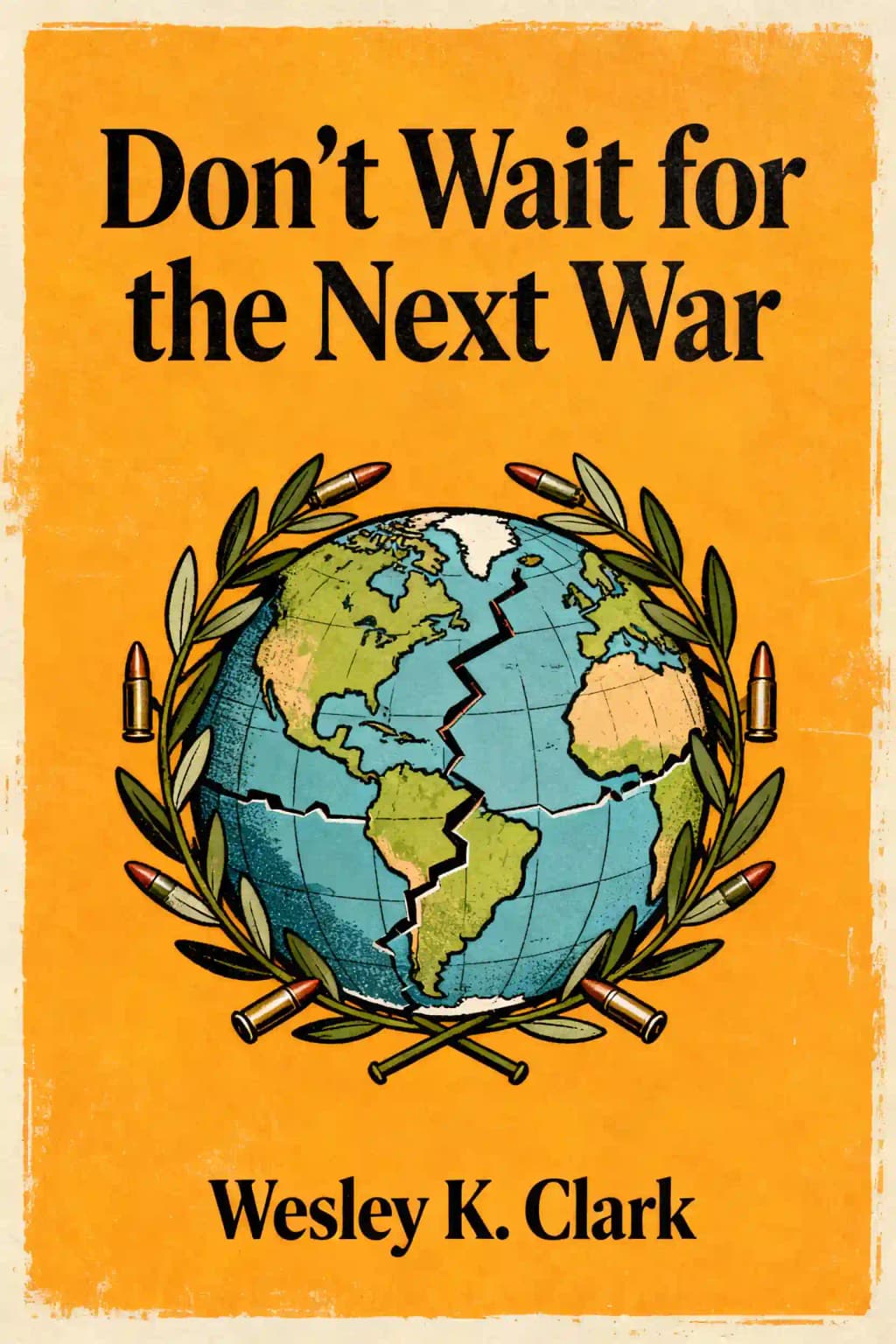
Former NATO Commander Wesley Clark's strategic blueprint for America's future tackles global challenges without waiting for conflict. What if the world's most pressing threats require neither war nor isolation? Clark's vision has shaped Pentagon thinking on everything from climate change to cybersecurity.
Wesley K. Clark, author of Don’t Wait for the Next War, is a retired U.S. Army four-star general and geopolitical strategist renowned for his leadership in modern military conflicts and diplomatic negotiations. The book blends memoir and policy analysis, offering insights into national security, strategic leadership, and global stability—themes rooted in Clark’s decorated 38-year military career.
A Rhodes Scholar and first-in-class West Point graduate, he commanded NATO forces during the Kosovo War and authored Winning Modern Wars and A Time to Lead. Clark also founded Renew America Together to bridge political divides.
Clark’s expertise is frequently sought by media outlets like CNN and The New York Times, and his frameworks on crisis management are taught at military academies. A recipient of the Presidential Medal of Freedom and five Defense Distinguished Service Medals, his work remains foundational reading for policymakers.
Don’t Wait for the Next War draws from his frontline experience negotiating the Dayton Peace Accords and shaping post-Cold War security strategies.
Don't Wait for the Next War argues for a proactive U.S. strategy focused on economic growth, technological innovation, and global leadership instead of relying on military conflict to drive progress. Retired General Wesley K. Clark draws from his NATO command experience and diplomatic insights to propose solutions for challenges like cyber threats, climate change, and geopolitical rivalry, emphasizing collaboration over confrontation.
This book is essential for policymakers, business leaders, and citizens interested in U.S. foreign policy, national security, and sustainable global leadership. Clark’s blend of military expertise and economic vision appeals to readers seeking alternatives to reactive crisis management, particularly in an era of interconnected economies and hybrid warfare.
Yes, particularly for its timely analysis of 21st-century challenges like cyberattacks and climate change. Clark’s credibility as a NATO commander and Rhodes Scholar adds depth, offering actionable strategies for avoiding conflict while strengthening America’s global role. The book bridges military and economic policy, making it relevant to both experts and general audiences.
Key concepts include:
Clark advocates for investing in infrastructure, education, and clean energy to bolster U.S. competitiveness. He emphasizes strengthening NATO, fostering tech innovation, and countering adversaries through economic and diplomatic tools rather than military escalation. This "peace through strength" approach aims to address root causes of instability.
Clark views NATO as vital for collective security but argues it must adapt to cyber threats, climate disruptions, and political fragmentation. He proposes expanding NATO’s mandate to include economic resilience and countering hybrid warfare tactics, ensuring it remains a cornerstone of global stability.
The book highlights cyberattacks as a critical threat to national security, urging public-private partnerships to safeguard infrastructure and data. Clark recommends creating international norms for cyber conduct and investing in AI-driven defense systems to deter state and non-state actors.
Clark references his leadership in the Kosovo War, where NATO’s air campaign prevented ethnic cleansing without ground troops, and the post-9/11 era, stressing lessons in coalition-building and adaptive strategy. These examples underscore the need for preemptive, multifaceted approaches to modern crises.
With rising U.S.-China competition and regional conflicts, Clark’s focus on economic statecraft and alliance-building offers a framework to avoid escalation. The book’s 2025 relevance lies in its warnings against isolationism and its blueprint for addressing AI, climate change, and disinformation.
Some may question Clark’s optimism about multilateralism amid political polarization. Critics might argue his strategies require unprecedented global cooperation, which could be hindered by rising nationalism. However, his military credentials lend weight to his pragmatic vision.
While Winning Modern Wars focused on military tactics post-9/11, this book expands into economic and diplomatic strategy. It reflects Clark’s evolution from wartime commander to advocate for holistic national security, integrating lessons from hybrid warfare and globalization.
通过作者的声音感受这本书
将知识转化为引人入胜、富含实例的见解
快速捕捉核心观点,高效学习
以有趣互动的方式享受这本书
Every golfer knows the answer: "The next one."
"We can intervene militarily in the region with impunity"
you break it, you own it.
That won't work here.
the window where America could use force with impunity has closed.
将《Don't Wait for the Next War》的核心观点拆解为易于理解的要点,了解创新团队如何创造、协作和成长。
将《Don't Wait for the Next War》提炼为快速记忆要点,突出坦诚、团队合作和创造力的关键原则。

通过生动的故事体验《Don't Wait for the Next War》,将创新经验转化为令人难忘且可应用的精彩时刻。
随心提问,选择声音,共同创造真正与你产生共鸣的见解。

"Instead of endless scrolling, I just hit play on BeFreed. It saves me so much time."
"I never knew where to start with nonfiction—BeFreed’s book lists turned into podcasts gave me a clear path."
"Perfect balance between learning and entertainment. Finished ‘Thinking, Fast and Slow’ on my commute this week."
"Crazy how much I learned while walking the dog. BeFreed = small habits → big gains."
"Reading used to feel like a chore. Now it’s just part of my lifestyle."
"Feels effortless compared to reading. I’ve finished 6 books this month already."
"BeFreed turned my guilty doomscrolling into something that feels productive and inspiring."
"BeFreed turned my commute into learning time. 20-min podcasts are perfect for finishing books I never had time for."
"BeFreed replaced my podcast queue. Imagine Spotify for books — that’s it. 🙌"
"It is great for me to learn something from the book without reading it."
"The themed book list podcasts help me connect ideas across authors—like a guided audio journey."
"Makes me feel smarter every time before going to work"

免费获取《Don't Wait for the Next War》摘要的 PDF 或 EPUB 版本。可打印或随时离线阅读。
What happens when the world's most powerful nation discovers that military might alone can't solve the problems it faces? In 2013, Syrian opposition members sat in a Los Angeles meeting room, their stories of brutality and hope echoing decades of similar pleas from Haiti, Bosnia, and Kosovo. But this time, something had shifted. After twelve years of continuous warfare, thousands of American lives lost, and over $1 trillion spent, the answer wasn't as simple as deploying troops or launching airstrikes. The question hanging in the air was more fundamental: What can America realistically offer when its traditional tools no longer fit the problems at hand? This moment captures a larger truth about American power in the twenty-first century. We've spent two decades as the undisputed global superpower, yet we find ourselves increasingly constrained-not by lack of military capability, but by the changing nature of global challenges themselves. The threats we face today don't respect borders, can't be bombed into submission, and require sustained cooperation rather than unilateral action. From cyber-attacks that can cripple infrastructure without firing a shot, to climate change that multiplies every existing security threat, to financial systems so interconnected that sanctions hurt those who impose them-we're operating in a world our Cold War playbook never anticipated.