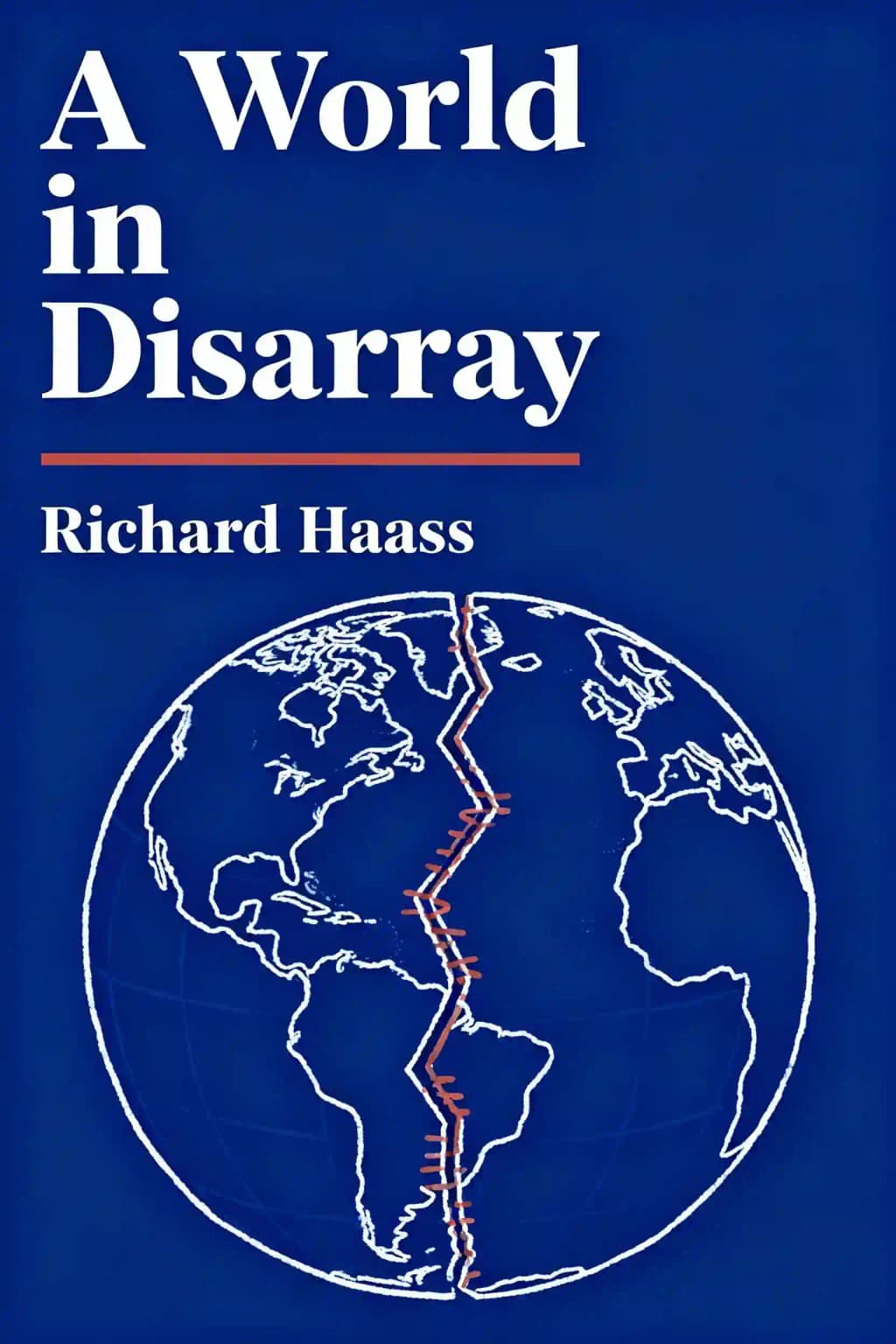
A World in Disarray
American Foreign Policy and the Crisis of the Old Order
《A World in Disarray》概述
Richard Haass's "A World in Disarray" unveils how the post-WWII global order is crumbling. The Council on Foreign Relations president's "World Order 2.0" concept sparked fierce debate among policymakers by redefining sovereignty as obligation - a blueprint for navigating our increasingly nonpolar world.
《A World in Disarray》核心主题
- westphalian sovereignty
- international power balance
- nuclear deterrence
- global diplomatic order
- post-cold war instability
《A World in Disarray》经典语录
The post-Cold War international order seemed to be crumbling before our eyes.
Stability over justice.
Nuclear weapons fundamentally altered great power competition.
The UN clearly discouraged force as a means of settling disagreements.
The world lost its way.
《A World in Disarray》主要人物
- Richard HaassAuthor and president of Council on Foreign Relations
关于作者
《A World in Disarray》作者介绍
Richard N. Haass, president emeritus of the Council on Foreign Relations and bestselling author of A World in Disarray, brings decades of diplomatic expertise to this analysis of global disorder. A Rhodes Scholar with a doctorate from Oxford University, Haass served as Director of Policy Planning under Secretary of State Colin Powell and led peace negotiations in Northern Ireland and Afghanistan.
His work blends firsthand experience in Republican and Democratic administrations with sharp insights into international relations, nationalism, and governance challenges.
Haass’s authoritative voice extends through fourteen books on foreign policy, including The Bill of Obligations: The Ten Habits of Good Citizens, a New York Times bestseller that reimagines civic responsibility in polarized times. A frequent commentator on NPR and major networks, he received the Presidential Citizens Medal and the State Department’s Distinguished Honor Award for public service.
A World in Disarray has become essential reading in political science curricula and think tanks, cementing Haass’s reputation as a clear-eyed strategist for an unstable era.
下载《A World in Disarray》摘要
免费获取《A World in Disarray》摘要的 PDF 或 EPUB 版本。可打印或随时离线阅读。
关于本书的常见问题
A World in Disarray analyzes the erosion of global order post-Cold War, tracing geopolitical shifts, regional instability, and failures in international cooperation. Haass proposes "sovereign obligation"—a framework where states regulate internal actions affecting others (e.g., terrorism, climate change)—and emphasizes U.S. leadership renewal to address crises like nuclear proliferation and cyber threats.
Policymakers, students of international relations, and readers interested in geopolitics will benefit from Haass’s analysis of modern disorder. Its blend of historical context, regional case studies (Middle East, Asia, Europe), and pragmatic solutions makes it relevant for those examining U.S. foreign policy or global governance challenges.
"Sovereign obligation" expands traditional sovereignty by requiring states to prevent internal actions (e.g., terrorism, cyberattacks) from harming other nations. Haass argues this principle could address transnational issues like climate change, blending respect for borders with collective responsibility. Critics note challenges in enforcement and achieving global consensus.
Haass critiques post-Cold War U.S. missteps, including overreach and inconsistency, but stresses that American leadership remains irreplaceable. He urges domestic reforms (e.g., reducing political polarization, fiscal discipline) to strengthen global influence, particularly in managing rising powers like China and Russia.
The book examines instability in the Middle East (e.g., terrorism, sectarian conflicts), Asia’s power struggles (China’s rise, North Korea), and Europe’s challenges (Brexit, Russia’s aggression). Haass highlights how regional dysfunctions exacerbate global disarray and require tailored diplomatic strategies.
Yes. Haass identifies climate change as a "global gap" issue where national actions (or inactions) disproportionately affect others. He advocates for "sovereign obligation" to enforce accountability, though acknowledges the difficulty of reconciling differing national interests.
"World Order 2.0" is Haass’s proposed system updating Westphalian principles. It combines sovereignty with obligations to mitigate cross-border threats (e.g., nuclear proliferation, pandemics). This framework relies on coalitions of states and institutions to enforce norms, though implementation hurdles persist.
Haass argues post-Cold War U.S. policies failed to integrate Russia and China into the international system, fueling their revisionist ambitions. He recommends balancing deterrence with cooperation, such as incentivizing China to uphold trade norms and countering Russian aggression in Europe.
Critics argue Haass underestimates non-state actors’ roles and overstates U.S. capacity to lead. The 2017 edition also lacks analysis of Trump-era policies, Brexit, or Syria’s bombing, which later reshaped global dynamics.
Yes. Its themes—resurgent nationalism, U.S.-China rivalry, and climate crises—remain urgent. However, Haass’s emphasis on multilateralism contrasts with recent trends toward unilateralism, prompting debates about adapting his solutions to current realities.
Unlike The Foreign Policy of Restraint, this book prioritizes proactive U.S. engagement tempered by domestic renewal. It shares themes with War of Necessity, War of Choice, analyzing decision-making in crises, but broadens focus to systemic global challenges.
Key lines include:
- “The world’s problems are increasingly transnational, but solutions remain national.”
- “Sovereignty is not a blank check.”
These underscore Haass’s argument for redefined state responsibilities in a globalized era.