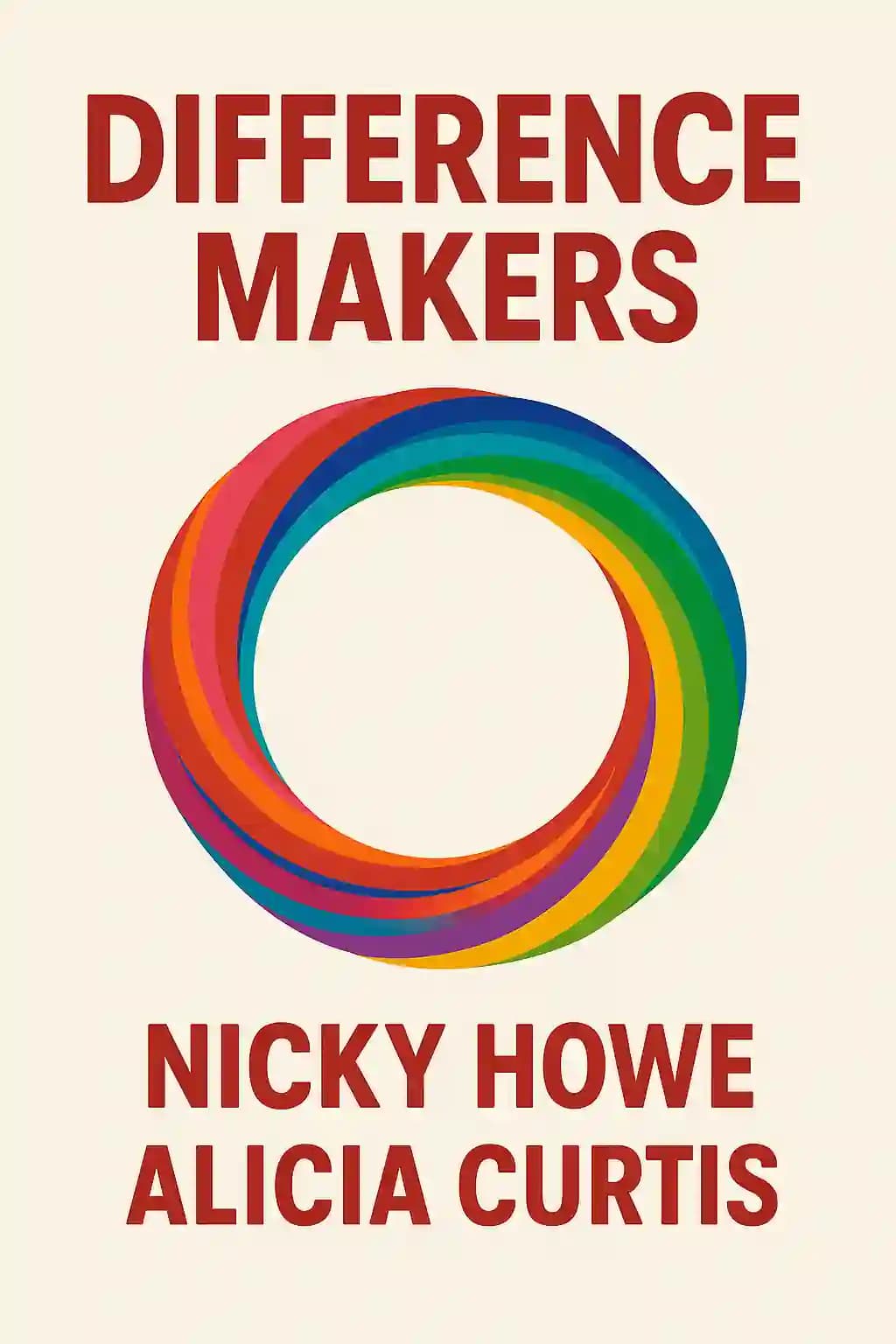
"Difference Makers" reveals how diversity of thought transforms leadership. Endorsed by industry leaders like Rabia Siddique and Professor David Gilchrist, this practical guide has become a cornerstone for inclusive governance. What's the one overlooked diversity strategy that transformed entire organizations overnight?
Dr. Nicky Howe and Alicia Curtis, co-authors of Difference Makers, are leadership experts specializing in organizational innovation and inclusive governance.
Howe is a CEO and adjunct professor with a doctorate in business administration. She previously authored Better Relationships with Those You Lead, a practical guide for managers.
Curtis is an award-winning social entrepreneur and co-founder of the 100 Women collective giving circle. She holds a master’s in business leadership and was named to the Australian Financial Review’s 2014 100 Women of Influence list.
Their book merges Howe’s governance research with Curtis’s community-driven initiatives, advocating for diversity in leadership to drive systemic change. Together, they designed the Engaging Young Leaders on Aged Care and Community Boards program, which trains emerging leaders in nonprofit governance.
Difference Makers has been praised as a “roadmap for better organizations” and endorsed by Rhys Williams, 2015 Young West Australian of the Year, for its actionable strategies to transform boardrooms through experiential and demographic diversity.
Difference Makers is a leadership guide focused on redefining diversity as a strategic asset for organizational success. It emphasizes diversity of thought, experiential attributes, and collaborative problem-solving to build inclusive boards and effective teams. The book provides actionable strategies for leaders to leverage differences in age, ideology, profession, and background to spark innovation and governance excellence.
Aspiring and experienced board members, CEOs, HR professionals, and social entrepreneurs seeking to foster inclusive leadership. It’s also valuable for advocates of workplace diversity and readers interested in governance reform, particularly in sectors like aged care, nonprofits, and corporate boards.
Yes—it combines research-backed frameworks, case studies, and practical tools like checklists for recruiting diverse directors. Endorsed by leaders like Rhys Williams and David Koutsoukis, it’s praised as a roadmap for creating “better organizations and a better society” through intentional collaboration.
A leader who actively champions underrepresented voices on boards, turning demographic, experiential, and ideological differences into drivers of innovation. Examples include young directors reshaping aged-care policies and professionals bridging cultural gaps in community organizations.
The “Three Diversity Attributes”:
The book argues balancing these layers creates resilient decision-making.
Yes. It tackles resistance to change, unconscious bias in director recruitment, and short-termism in governance. Solutions include term limits for board members and structured mentorship programs to onboard diverse talent.
While Lean In focuses on individual women’s career strategies, Difference Makers offers systemic solutions for organizational change, particularly in board governance. It emphasizes collective action over individual empowerment.
With remote work and AI reshaping team dynamics, its strategies for virtual collaboration and leveraging neurodiverse talent align with modern challenges. The book’s case studies on cross-generational leadership also resonate with today’s multigenerational workforce.
Some reviewers note it targets board-level audiences, which may limit accessibility for junior professionals. However, its actionable exercises (e.g., “Diversity Audit Template”) make concepts applicable across organizational tiers.
Yes. The authors’ “Engaging Young Leaders on Boards” program offers workshops, and their free “Board Competency Matrix” tool helps assess director capabilities—both detailed at Alyceum.com.au.
通过作者的声音感受这本书
将知识转化为引人入胜、富含实例的见解
快速捕捉核心观点,高效学习
以有趣互动的方式享受这本书
Diversity is a critical business imperative.
Diversity of thought [is] the true competitive differentiator.
Boards need broader perspectives to navigate complex challenges.
Younger directors bring intrinsically longer time horizons.
The problems boards are grappling with are too hard for any one person.
将《Difference Makers》的核心观点拆解为易于理解的要点,了解创新团队如何创造、协作和成长。
将《Difference Makers》提炼为快速记忆要点,突出坦诚、团队合作和创造力的关键原则。

通过生动的故事体验《Difference Makers》,将创新经验转化为令人难忘且可应用的精彩时刻。
随心提问,选择声音,共同创造真正与你产生共鸣的见解。

"Instead of endless scrolling, I just hit play on BeFreed. It saves me so much time."
"I never knew where to start with nonfiction—BeFreed’s book lists turned into podcasts gave me a clear path."
"Perfect balance between learning and entertainment. Finished ‘Thinking, Fast and Slow’ on my commute this week."
"Crazy how much I learned while walking the dog. BeFreed = small habits → big gains."
"Reading used to feel like a chore. Now it’s just part of my lifestyle."
"Feels effortless compared to reading. I’ve finished 6 books this month already."
"BeFreed turned my guilty doomscrolling into something that feels productive and inspiring."
"BeFreed turned my commute into learning time. 20-min podcasts are perfect for finishing books I never had time for."
"BeFreed replaced my podcast queue. Imagine Spotify for books — that’s it. 🙌"
"It is great for me to learn something from the book without reading it."
"The themed book list podcasts help me connect ideas across authors—like a guided audio journey."
"Makes me feel smarter every time before going to work"

免费获取《Difference Makers》摘要的 PDF 或 EPUB 版本。可打印或随时离线阅读。
A 14-year-old walks into a boardroom. Sounds like the setup to a joke, right? But Dr. Aron Ping D'Souza actually did this-and his presence wasn't a publicity stunt. He brought something the grey-haired executives around the table desperately needed: a perspective that extended decades beyond their retirement plans. This is the paradox modern organizations face. We've spent generations perfecting the art of finding leaders who fit the mold, when survival actually demands we shatter it entirely. The real question isn't whether your boardroom looks diverse in the company photo-it's whether the people in it actually think differently enough to see what's coming next. Think of diversity as your organization's operating system. The old version-where everyone graduated from the same three universities, played golf at the same clubs, and nodded in comfortable agreement-worked fine when the business world moved at a glacial pace. But three seismic shifts have rendered that system dangerously obsolete. Economic power is sprinting eastward while emerging markets rewrite the rules. Digital disruption isn't knocking politely anymore-it's kicking down doors. And millennials, with their radically different expectations about work and purpose, now dominate the workforce. Your boardroom either reflects these realities or becomes irrelevant to them. The numbers tell a story that should make every executive sit up straight. McKinsey found that ethnically diverse companies were 35% more likely to outperform their competitors financially. Gender-diverse leadership? That's a 15% advantage. Boston Consulting Group discovered that diverse management teams generated 19% more innovation revenue. These aren't feel-good statistics-they're competitive intelligence. When Microsoft, Mastercard, and Unilever diversified their leadership, they didn't just check boxes. They unlocked new markets, spotted emerging trends, and navigated crises that blindsided their competitors. Diversity isn't about fairness anymore, though that matters deeply. It's about survival. Here's what actually happens when diverse minds tackle the same problem: assumptions get challenged before they become expensive mistakes, blind spots shrink because someone in the room has lived a different reality, and solutions emerge that no single perspective could have imagined. Picture a product development team designing a voice-activated assistant. A homogeneous group might create something brilliant-for people exactly like them. Add diverse voices, and suddenly someone asks whether the system recognizes accents, works for users with speech impediments, or makes sense in cultures where talking to devices feels unnatural. That's not political correctness-that's millions in avoided redesign costs and expanded market access.