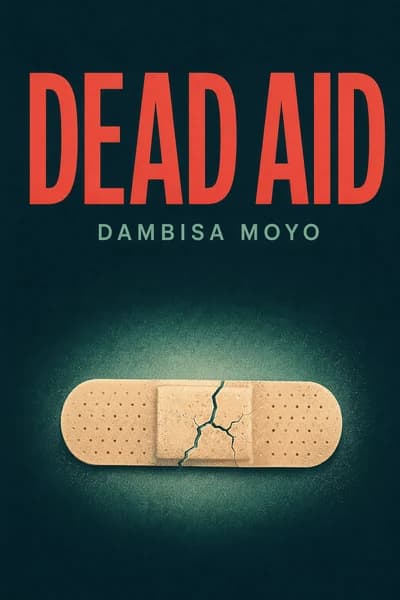
In "Dead Aid," Dambisa Moyo delivers a provocative bombshell: foreign aid is killing Africa. Called "a double-barrelled shotgun of a book" by The Daily Mail, this bestseller from the former Goldman Sachs economist challenges everything we thought about helping developing nations.
Dambisa Felicia Moyo, Baroness Moyo, is the Zambian-born economist and New York Times bestselling author of Dead Aid: Why Aid Is Not Working and How There Is a Better Way for Africa, a groundbreaking work in economic policy that challenges traditional approaches to international development.
With a PhD in Economics from Oxford University and an MPA from Harvard, Moyo draws on her experience at Goldman Sachs and the World Bank to advocate for market-driven solutions to poverty—a perspective informed by her upbringing in post-independence Zambia and her parents’ careers in academia. Her other influential works include How the West Was Lost and Winner Take All, which analyze global economic trends and resource competition.
A regular contributor to the Financial Times and Wall Street Journal, Moyo has been named one of Time magazine’s 100 Most Influential People and serves on corporate boards including Barclays Bank and Barrick Gold. Her TED Talks on global economics have garnered millions of views, amplifying her call for systemic reform. Dead Aid has been translated into 20 languages and remains essential reading in international development courses, cementing Moyo’s reputation as a bold critic of aid dependency and a champion of entrepreneurial empowerment.
Dead Aid argues that foreign aid to Africa has perpetuated poverty, corruption, and economic stagnation rather than solving it. Dambisa Moyo, an economist from Zambia, critiques six decades of aid dependency, advocating instead for market-driven solutions like bonds, microfinance, and foreign direct investment to foster sustainable growth.
This book is essential for policymakers, economists, and anyone interested in African development. It challenges conventional aid models, making it valuable for critics of traditional philanthropy and advocates of alternative economic strategies.
Yes, for its provocative analysis. Moyo’s data-driven approach and firsthand perspective offer a compelling case against aid, sparking critical debate on development policy. However, some argue her solutions oversimplify complex issues.
Moyo identifies aid as a catalyst for corruption, market distortion, and dependency cycles. She highlights how $1 trillion in aid over 60 years failed to spur growth, instead entrenching poverty and stifling local innovation.
The book advocates for financing through international bonds, micro-lending, and foreign investment. Moyo also emphasizes trade partnerships and leveraging remittances to reduce reliance on aid.
Unlike broader critiques, Moyo focuses on Africa’s unique context, blending economic analysis with policy prescriptions. Her work is often contrasted with Jeffrey Sachs’ The End of Poverty, which defends targeted aid.
Notable lines include: “Aid is not benign—it’s malignant” and “The more aid Africa receives, the poorer it gets.” Moyo also starkly states, “Aid has been, and continues to be, an unmitigated disaster.”
As a Zambian economist with Harvard and Oxford credentials, Moyo combines academic rigor with African lived experience, lending authenticity to her critique of aid’s real-world impacts.
Critics argue Moyo underestimates aid’s role in crises (e.g., pandemics) and overstates the feasibility of her alternatives in unstable regions. Some solutions, like bond financing, require infrastructure many nations lack.
The book reshaped conversations by challenging aid orthodoxy, influencing austerity advocates and prompting agencies to reevaluate effectiveness. It remains a cornerstone in critiques of top-down development.
Moyo’s call to end aid within five years sparked backlash from NGOs and policymakers who argue her approach risks abandoning vulnerable populations. Others praise her boldness in prioritizing systemic change.
Moyo argues aid incentivizes corruption by funneling unchecked funds to elites, diverting resources from public goods. This perpetuates governance failures and undermines accountability.
The book urges African nations to reject aid and embrace self-reliance through trade and entrepreneurship. Moyo frames this shift as essential for political and economic sovereignty.
通过作者的声音感受这本书
将知识转化为引人入胜、富含实例的见解
快速捕捉核心观点,高效学习
以有趣互动的方式享受这本书
Africa's economic history demonstrates that wealth in land and natural resources provides no guarantee of economic success.
Africa's problems involve multiple interacting factors, but one thing almost all African countries share is dependence on development aid.
Historically, countries with sea access and few natural resources performed better economically than resource-rich nations.
将《Dead Aid》的核心观点拆解为易于理解的要点,了解创新团队如何创造、协作和成长。
将《Dead Aid》提炼为快速记忆要点,突出坦诚、团队合作和创造力的关键原则。

通过生动的故事体验《Dead Aid》,将创新经验转化为令人难忘且可应用的精彩时刻。
随心提问,选择声音,共同创造真正与你产生共鸣的见解。

"Instead of endless scrolling, I just hit play on BeFreed. It saves me so much time."
"I never knew where to start with nonfiction—BeFreed’s book lists turned into podcasts gave me a clear path."
"Perfect balance between learning and entertainment. Finished ‘Thinking, Fast and Slow’ on my commute this week."
"Crazy how much I learned while walking the dog. BeFreed = small habits → big gains."
"Reading used to feel like a chore. Now it’s just part of my lifestyle."
"Feels effortless compared to reading. I’ve finished 6 books this month already."
"BeFreed turned my guilty doomscrolling into something that feels productive and inspiring."
"BeFreed turned my commute into learning time. 20-min podcasts are perfect for finishing books I never had time for."
"BeFreed replaced my podcast queue. Imagine Spotify for books — that’s it. 🙌"
"It is great for me to learn something from the book without reading it."
"The themed book list podcasts help me connect ideas across authors—like a guided audio journey."
"Makes me feel smarter every time before going to work"

免费获取《Dead Aid》摘要的 PDF 或 EPUB 版本。可打印或随时离线阅读。
Picture a trillion-dollar experiment that failed spectacularly. Over six decades, Western nations pumped more than $1 trillion into Africa-roughly $1,000 for every person alive on the continent today. The result? Poverty rates didn't fall; they tripled from 11% to 66%. This isn't just inefficiency-it's a catastrophic reversal. What if the very thing meant to save Africa has been slowly killing it? This uncomfortable question drives one of the most provocative economic arguments of our time: that foreign aid, far from being Africa's lifeline, has become its greatest curse. The idea sounds almost heretical. After all, we've been conditioned to believe that giving is inherently good, that more resources must lead to better outcomes. But what happens when generosity becomes dependency, when help becomes harm?