第 1 章
The Paradox of Success: Why Everything You Know Is Wrong
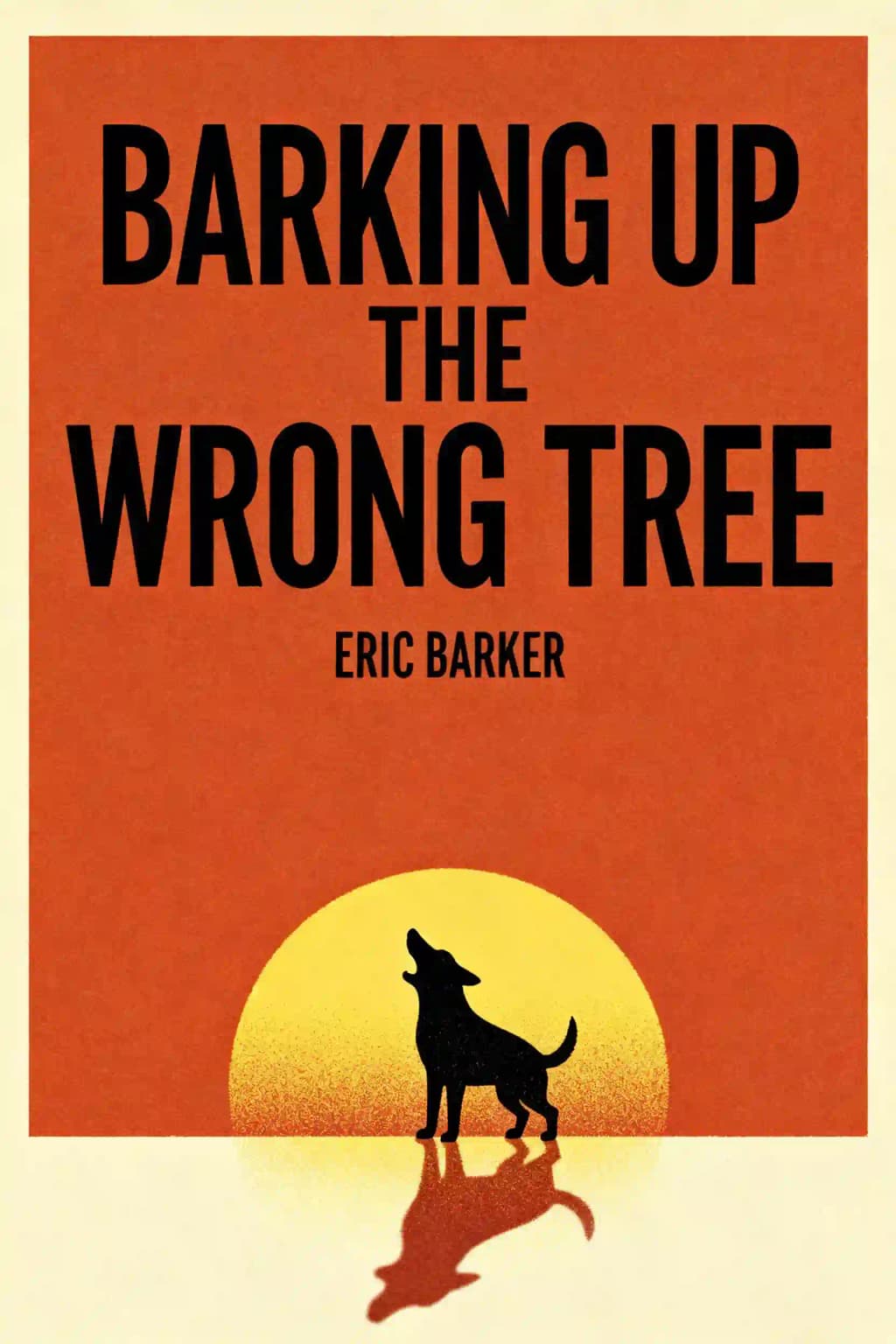
Ever wondered why the valedictorians rarely become visionaries? Or why some of the most successful people in history were considered troublemakers? Eric Barker's "Barking Up the Wrong Tree" challenges conventional wisdom about achievement with a refreshing blend of scientific research and captivating stories. The book has garnered praise from Adam Grant, who called it "a masterful guide to success," and Daniel Pink, who described it as "both practical and profound." Since its 2017 release, it has become a Wall Street Journal bestseller and been translated into 20 languages. Barker's unique approach-examining both sides of success principles rather than offering one-size-fits-all advice-has resonated with readers seeking authentic paths to achievement in an increasingly complex world.
第 2 章
When Breaking the Rules Leads to Extraordinary Success
School teaches us that following rules leads to success. Study hard, get good grades, and you'll excel in life. But research tells a different story. Valedictorians, while undeniably successful, rarely become visionaries or revolutionaries. They achieve conventional success-solid careers, comfortable incomes-but seldom change the world.
Why? Because schools reward conformity, not innovation. Valedictorians excel by pleasing teachers and following instructions rather than developing deep expertise or revolutionary ideas. As researcher Karen Arnold discovered, "Valedictorians aren't likely to be the future's visionaries... they've never been devoted to a single area in which they put all their passion." They become excellent generalists when the real world rewards passionate specialists.
This pattern extends beyond academics. Consider Winston Churchill, whose paranoia and maverick tendencies nearly destroyed his political career-until those same qualities made him uniquely qualified to recognize and confront Hitler when conventional leaders failed. His zealotry, once considered a liability, became Britain's salvation when the situation demanded it.
Gautam Mukunda's research on leadership explains this phenomenon through what he calls "filtered" versus "unfiltered" leaders. Filtered leaders rise through established channels, playing by rules and meeting expectations. They make predictable, approved decisions. Unfiltered leaders-like entrepreneurs or those thrust into leadership through unusual circumstances-make unpredictable choices that sometimes break institutions but occasionally transform them positively. His analysis of U.S. presidents confirmed this theory with 99% statistical confidence: unfiltered leaders produce more variance in outcomes, creating both spectacular failures and extraordinary successes.
Consider Glenn Gould, one of history's greatest pianists, whose eccentricities were legendary. This hypochondriac wore multiple gloves, carried countless medications, and would hang up if someone sneezed during a phone call. His playing style was equally strange-hunched over the keyboard with flailing arms and gyrating torso. Yet his neuroses-fueled obsessiveness produced sixteen-hour practice days and recordings that transformed classical music.
Modern genetics helps explain this pattern through what Swedes call "orchids and dandelions." Most children are dandelions-hardy plants that thrive almost anywhere. But some are orchids-fragile flowers that wilt without proper care yet become extraordinarily beautiful when nurtured. The same genes that create vulnerability in harsh environments can produce exceptional outcomes in supportive ones. The DRD4-7R gene variant, linked to ADHD and behavioral problems, also makes children more likely to share unprompted when raised in nurturing environments.
Michael Phelps represents what scientists call a "hopeful monster"-someone with physical traits that seem disadvantageous but create extraordinary ability in specific contexts. With his disproportionately long trunk, short legs, oversized hands and feet, and wingspan exceeding his height, Phelps wasn't built for land movement but was perfectly designed for swimming. These "mutations" helped him become history's most decorated Olympian.
The connection between creativity and mental illness further illustrates this principle. Very creative people tend to be more arrogant, dishonest, and disorganized. They get lower grades and fewer promotions despite their innovation. This reflects a fundamental statistical principle: when optimizing for extreme performance, averages don't matter-variance does. By filtering out negative traits to increase average performance, we inadvertently eliminate positive outliers.
Success, then, requires two critical steps: knowing yourself and choosing the right environment. First, understand whether you're a rule-follower or rule-breaker, then leverage your signature strengths accordingly. Second, pick contexts that value your specific abilities. When Toyota donated efficiency expertise rather than just money to food banks, they reduced wait times dramatically through their signature strengths.
第 3 章
The Nice Guy's Guide to Winning
Is kindness a liability in our competitive world? Evidence suggests that in the short term, being "bad" can be advantageous. People low in agreeableness earn significantly more money-men earn up to $10,000 more annually. Rude people have better credit scores. We unconsciously mistake kindness for weakness-80% of our evaluations come down to warmth and competence, which we perceive as inversely related.
Yet this advantage proves fleeting. Consider Moldova, which ranks dead last in the World Database of Happiness because its citizens simply don't trust one another. This distrust stifles cooperation in every area of life, with widespread bribery and a pervasive "not my problem" attitude creating a black hole of selfishness. Bad behavior spreads infectiously-research shows that seeing others cheat and get away with it increases cheating across the board. Teams with just one bad apple experience 30-40% performance deficits.
Criminals understand the value of trust better than most because they operate in environments where it can't be taken for granted. Prison gangs often function as welcoming committees, even providing gift baskets to new inmates from their neighborhoods. Contrary to popular belief, gangs don't create crime-crime creates gangs, with most prison gangs formed for protection rather than to further evil. Violence is actually counterproductive for criminal organizations; as one Corcoran State Prison inmate noted, "Without order, we have anarchy, and when we have anarchy, people die here."
Even pirates weren't the bloodthirsty savages of popular imagination-they were savvy businessmen who understood cooperation was essential for success. Blackbeard, despite his fearsome reputation, killed exactly zero people during his career. Pirate ships were remarkably democratic workplaces where captains could be deposed for any reason, rules required unanimous agreement, and pay differences between highest and lowest ranks were minimal. They offered disability plans for battle injuries and embraced diversity centuries before it was common-approximately 25% of pirate crews were black, with equal voting rights and pay shares in the early 1700s.
When Wharton professor Adam Grant studied success patterns, he found "Givers" (altruistic people) at both the bottom AND top of success metrics, while "Matchers" (who maintain balance) and "Takers" (who selfishly take more than give) clustered in the middle. The most productive engineers, highest-performing students, and top salespeople were often Givers. Charitable giving correlates with increased income-for every dollar donated, income rises by $3.75.
The difference between Givers who succeed and those who fail isn't random. Unsuccessful Givers exhaust themselves helping others and get exploited by Takers. Successful Givers set boundaries-like limiting volunteer work to two hours weekly and "chunking" their giving into dedicated time blocks rather than constant "sprinkling." Research shows 100 hours of giving annually is the magic number for happiness without burnout.
Mathematician Robert Axelrod's famous Prisoner's Dilemma tournaments provide the ultimate lesson. The simplest program-"tit for tat" (TFT)-won twice. TFT cooperates initially, then mirrors whatever the opponent did in the previous round. Despite early disadvantages against exploitative strategies, TFT thrived over time through four key principles: it showed initial goodwill by cooperating first; it punished betrayal immediately; it forgave quickly by responding to renewed cooperation; and it taught other programs how to play better.
To be both ethical and successful, follow six rules: First, pick the right pond-your environment shapes you more than you shape it. Second, cooperate first-all successful programs in Axelrod's competition initiated cooperation. Third, being selfless isn't saintly, it's silly-the most successful people rated themselves an 8 out of 10 on trust, not a 10. Fourth, work hard but ensure it gets noticed. Fifth, think long-term and make others do the same. Finally, forgive-occasional forgiveness prevents death spirals and accounts for life's complexity.
第 4 章
The Strategic Art of Quitting
"Winners never quit and quitters never win." This mantra is so deeply ingrained in our culture that we rarely question it. But what if strategic quitting is actually essential for success?
Dr. Alfredo Quinones-Hinojosa's journey from poor Mexican migrant worker to world-class brain surgeon at Johns Hopkins exemplifies extraordinary grit. Inspired by the comic book hero Kaliman, he crossed the border illegally, worked grueling jobs while learning English, attended community college, transferred to Berkeley, and eventually graduated from Harvard Medical School-all while facing discrimination and hardship.
Navy SEAL James Waters provides another example of persistence. After a broken hand shattered his All-American swimming dreams, he endured the brutal BUD/S training with its 94% attrition rate, including 110 hours without sleep and the dreaded "pool comp" test. Navy research revealed that positive self-talk-thinking like "The Little Engine That Could"-is crucial for mental toughness. When the Navy taught this skill, passing rates increased nearly 10%.
This explains why optimistic insurance salespeople outperform pessimists by 88%. Martin Seligman's research with dogs demonstrates how learned helplessness develops: when facing seemingly random shocks, dogs stopped trying to escape, having learned futility. Similarly, humans often give up when we believe we can't succeed. Yet interestingly, one-third of people never become helpless-they keep trying, viewing failures as anomalies rather than proof of their limitations.
It all comes down to the stories we tell ourselves. Pessimists say "I'm not cut out for this" while optimists say "I just need to keep working at it." Seligman discovered that pessimism kills grit, while optimism fuels it. Though depressed people are often more accurate in their predictions ("depressive realism"), optimists experience better health, longer lives, more successful negotiations, and create more opportunities through perseverance.
Beyond optimism, deeper stories about meaning can sustain us through the most horrific circumstances. Viktor Frankl observed in Auschwitz that those who survived weren't necessarily the strongest physically, but those who found meaning in their suffering. When we live for something greater than ourselves, we accept pain as sacrifice rather than fighting against it.
Our brains are wired to make sense of the world through stories. Like people with Cotard's syndrome who believe they're dead despite evidence to the contrary, we all construct narratives to explain our reality, often confabulating when faced with gaps in understanding. Stories aren't just how we communicate-they fundamentally shape our success. John Gottman discovered that how couples narrate their relationship predicts divorce with 94% accuracy.
Yet despite the value of persistence, sometimes quitting is the smarter choice. Spencer Glendon exemplifies this wisdom. Despite impressive accomplishments-Fulbright Scholar, Harvard Ph.D., charity work, and partnership at a major fund-what's truly remarkable is achieving this while chronically ill. His ulcerative colitis led to liver problems requiring a transplant, leaving him essentially without an immune system.
A therapist advised him to focus on accomplishing just one thing daily. Sometimes it was simply making dinner. This forced Spencer to confront what economists call "opportunity cost"-every choice means not choosing something else. By necessity, he learned to quit unimportant activities and focus limited energy on what truly mattered.
Peter Drucker, when invited to join Csikszentmihalyi's study of creative people, famously declined, explaining his productivity secret was "a very big waste paper basket" for such invitations. Jim Collins found successful companies focused less on new initiatives than on stopping unproductive activities.
Matt Polly's journey from Shaolin Temple to successful author wasn't just youthful craziness-it launched his writing career. This illustrates an important scientific truth: luck isn't random chance but often the result of our choices. Professor Richard Wiseman's research shows "lucky" people maximize opportunities by being open to new experiences, more extroverted, and less neurotic. Most importantly, they simply try more things.
The key is combining strategic quitting with personal experimentation: if you don't know what to be gritty at yet, try many things knowing you'll quit most of them. Once you find your focus, devote 5-10% of your time to experiments that keep you learning and growing.
第 5 章
The Power of Connection
Paul Erdos was perhaps the strangest mathematician who ever lived. He referred to children as "epsilon" (the mathematical symbol for a small quantity), couldn't butter his own bread, and lived nomadically with no permanent address. Yet he became legendary not just for his individual brilliance but for his extraordinary network of collaborations.
Born to mathematics teachers and homeschooled after his sisters died from scarlet fever, Erdos became a prodigy who could multiply triple-digit numbers by age three. As an adult, he produced an unprecedented number of academic papers while living out of a suitcase, showing up at colleagues' homes announcing "my brain is open" and collaborating with over 500 mathematicians worldwide.
Though he never won the Fields Medal himself, many he helped did. His legacy lives on through the "Erdos number"-a measure of collaborative proximity to him that correlates with mathematical achievement, influencing an estimated 200,000 mathematicians even after his death.
This raises a fundamental question: Does success depend more on what you know or who you know? Research suggests both matter, but in different ways. Extroverts typically earn more money and receive more promotions. Even drinking correlates with 10% higher earnings than abstaining, likely because it facilitates social connections.
However, the relationship between personality and success isn't straightforward. While extroverts thrive in sales and management, introverts often excel in creative and analytical roles. The most successful people are actually "ambiverts"-those in the middle of the personality spectrum who can adapt their approach to different situations.
Walter Green's gratitude journey illustrates the profound impact of relationships. He spent a year traveling across the country and even to Kenya to personally thank forty-four people who impacted his life. Rather than sending texts or emails, he expressed his gratitude face-to-face, discussing how they met, sharing memories, and asking for their perspective on who he was.
After each meeting, Walter recorded the conversation and later sent each person a gift-wrapped CD of their talk, along with a photo and letter. His gratitude journey inspired many recipients to reflect on their own relationships, with one even starting a program to educate children about honoring relationships.
Gratitude emerges as the cornerstone of lasting relationships. Research shows it's the quality that makes people want to spend more time with you. We often fail to express gratitude due to "hedonic adaptation"-taking things for granted.
第 6 章
The Confidence Paradox
In 1997, chess grandmaster Garry Kasparov faced IBM's Deep Blue supercomputer in a historic rematch. Having won their previous encounter, Kasparov was confident. But in the second game, Deep Blue made a move so puzzling that Kasparov couldn't understand it. What he didn't know was that the move resulted from a software bug that triggered a random action. Interpreting this random move as genius, Kasparov began doubting himself, becoming defensive rather than maintaining his signature aggressive style. This led to his eventual defeat.
This story illustrates a central paradox: confidence is essential for success, yet can lead to our downfall. Research shows that 80-85% of professionals rate themselves in the top 20% of their peer group-a statistical impossibility. Studies consistently demonstrate that confidence is at least as important as intelligence in determining earnings. Even physical attractiveness boosts income primarily because it increases confidence.
But overconfidence creates a dilemma: it makes you feel good, gives you grit, and impresses others-but can make you an arrogant jerk who doesn't improve. Low confidence drives expertise and likability but feels terrible and signals incompetence.
The solution? Throw out the confidence paradigm entirely. University of Texas professor Kristin Neff suggests replacing self-esteem with "self-compassion." Research shows self-compassion provides all the benefits of self-esteem without the downsides. People with self-compassion see themselves more accurately while forgiving their failures, unlike those focused on self-esteem who often delude themselves to feel good.
Self-compassion fosters genuine compassion for others rather than reducing empathy. Studies show it predicts better romantic partnerships than self-esteem does. It also increases happiness, optimism, and initiative while decreasing anxiety and depression. Unlike self-esteem, which is either delusional or contingent on constant achievement, self-compassion allows you to accept imperfection without judgment.
Contrary to concerns, self-compassion doesn't make you passive-it actually reduces procrastination and increases grit by removing fear of failure. It's easier to maintain than self-confidence because you don't need constant validation.
To develop self-compassion: talk to yourself kindly, accept your fallibility, and recognize failures without catastrophizing. Studies show writing self-compassionate thoughts and practicing meditation improves outcomes.
第 7 章
Finding Work-Life Balance in a Workaholic World
Despite popular myths about functioning on little sleep, research shows only 1-3% of the population are genuine "short sleepers" with a genetic mutation of the hDEC2 gene. These rare individuals are naturally upbeat and emotionally resilient. For everyone else, sleep deprivation causes serious cognitive impairment-as demonstrated by Randy Gardner who, after staying awake for eleven days, experienced slurred speech, hallucinations, and even believed he was someone else entirely.
Sleep deprivation fundamentally alters brain function. UC Berkeley research shows that when students stayed awake for 35 hours, their amygdala response to negative stimuli increased by 60%, making it nearly impossible to maintain positive emotions. Your morning mood affects your entire workday, with those first two hours (roughly 8:00-10:30 AM) typically being your most productive. Wasting this time being exhausted undermines performance dramatically.
The consequences extend beyond productivity-British research following white-collar workers found that reducing sleep from 6-8 hours increased mortality risk years later. Work is the primary "sleep thief," creating a dangerous paradox: companies that would fire you for being drunk allow conditions that effectively make you drunk through sleep deprivation.
The modern work-life balance dilemma resembles Spider-Man's symbiote costume-initially beneficial but secretly draining. Our jobs often start as exciting opportunities but gradually consume our lives, leaving us exhausted yet unable to break free.
In today's world, we face impossible expectations and constant choices. Technology has eliminated boundaries-work is always available, making every moment with family a deliberate choice rather than the default. As one executive noted about smartphones: "I love the thing and I hate it at the same time. The reason I love it is that it gives me so much power. And the reason I hate it is that it has so much power over me."
The solution isn't "sequencing"-postponing family for career then happiness later. As Clay Christensen notes, "By the time serious problems arise in relationships, it often is too late to repair them." Instead, we need personal definitions of success based on four metrics: Happiness (enjoying), Achievement (winning), Significance (counting to others), and Legacy (extending).
To achieve work-life balance, first track where your time actually goes-write down each hour's activities for a week. Note which hours contribute to the four key areas. Identify "hot spots" where you waste time or overemphasize one area at the expense of others. Look for patterns that produce disproportionate results.
Don't assume your boss won't allow changes for better work-life balance. Have a direct conversation about your role and expectations, framing it as a win-win. Ask for clarity on how much time should be spent on "shallow work" (emails, meetings) versus "deep work" that produces results.
To-do lists fail because they don't account for time constraints. Georgetown professor Cal Newport advocates "fixed schedule productivity"-deciding when to leave work and scheduling tasks by priority instead of making endless lists. This creates boundaries and forces efficiency.
第 8 章
The Alignment Theory of Success
Martin Pistorius's remarkable journey exemplifies the power of alignment and determination. After being "locked in" his own body for years due to a mysterious illness at age 12, he regained consciousness but remained trapped, aware of everything yet unable to communicate. When he finally regained some physical control and doctors discovered his consciousness at age 25, he pursued his dreams with extraordinary focus. Within two years, he secured an office job doing basic computer work, then taught himself web design through online courses. He launched his own successful web development company, completed a computer science degree, authored "Ghost Boy" - a memoir that reached international acclaim, mastered driving with adaptive controls, and found love with Joanna, whom he married in 2009. Despite continuing to rely on a wheelchair and computer-assisted speech, Martin's story demonstrates how alignment between personal capability and chosen direction can lead to extraordinary outcomes.
Success manifests in countless forms - from climbing Mount Everest to mastering origami, from building a billion-dollar company to raising well-adjusted children. Benjamin Bloom's groundbreaking research studying 120 elite performers across different fields revealed that innate talent rarely determines ultimate achievement. His studies showed that with proper instruction, practice conditions, and motivation, approximately 95% of people could reach high levels of competency in any field. This is exemplified by cases like Nigel Richards, who won the French Scrabble World Championship without speaking a word of French, simply by memorizing the French dictionary and understanding pattern recognition.
The fundamental principle of success is alignment - creating harmony between your authentic self and your chosen environment. This involves multiple dimensions: matching your skills and interests to your professional role, cultivating relationships with people who share your values and support your growth, crafting a personal narrative that resonates with others and motivates action, developing a network that opens opportunities, maintaining resilient confidence while learning from setbacks, and balancing what psychologists call the "big four" areas of life: work, relationships, health, and purpose.
The most vital alignment occurs in relationships, particularly with those closest to us who foster our growth and support our dreams. The Harvard Grant Study, which followed 268 men for over 75 years, found that those with strong relationships at age 47 earned an average of $141,000 more annually than their peers with weaker social connections. These relationships provide not just emotional support but also practical advantages through expanded networks, opportunities, and resilience during challenges.
The ancient wisdom of the Oracle at Delphi - "Know thyself" - remains the foundation of successful alignment. This self-knowledge must then be actively matched to environmental opportunities: choosing the right context for your abilities (your "pond"), leveraging your natural strengths rather than fixing weaknesses, developing a personal story that drives motivation, making calculated "little bets" to test possibilities, and using the WOOP method (Wish, Outcome, Obstacle, Plan) to transform aspirations into concrete achievements.