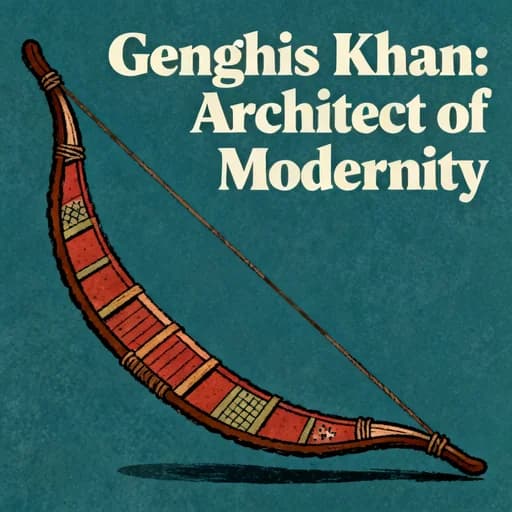
Genghis Khan: Architect of the Modern World
How did an outcast boy build history's largest empire? Explore the meritocracy and legal innovations that transformed a conqueror into a visionary.
Лучшая цитата из Genghis Khan: Architect of the Modern World
He wasn't just a conqueror—he was a master of meritocracy and a primary architect of the modern world who built a system where loyalty and talent mattered more than who your father was.
Generated with BeFreed
An audio lesson about the book Genghis Khan and the Making of the Modern World, covering its key ideas and takeaways.


Часто задаваемые вопросы
Temujin’s childhood was defined by extreme poverty and betrayal, particularly when his own tribe abandoned his family after his father’s death. These experiences taught him that traditional blood ties and kinship were often unreliable. Consequently, when he rose to power, he replaced the old aristocratic systems with a meritocracy, choosing to reward loyalty and talent rather than noble lineage. This shift allowed him to build a more stable and devoted following than the leaders who relied solely on family connections.
Centuries before such ideas became standard in the West, Genghis Khan established the Great Law, which included several radical reforms. He abolished slavery among the Mongols, forbade the kidnapping of women, and declared total freedom of religion. This religious tolerance created a sanctuary where Christians, Muslims, Buddhists, and shamans could coexist and trade peacefully under imperial protection, a stark contrast to the religious wars occurring in other parts of the world at the time.
During the period known as the Pax Mongolica, the Mongols created the world’s first true era of globalization. They established a sophisticated postal system for rapid communication and a Department of Monetary Affairs to standardize paper money. To ensure safety, they issued imperial passports that allowed travelers to move securely across vast distances. This infrastructure enabled a massive exchange of technology and knowledge, including the spread of printing, medical practices, and agricultural techniques between the East and the West.
Unlike many of his contemporaries, Genghis Khan viewed warfare as a series of problems to be solved with efficiency rather than just a quest for glory. He was a highly adaptable leader who conscripted local engineers to build siege machinery and used psychological tactics to minimize his own casualties. Furthermore, he broke the cycle of tribal vengeance by absorbing defeated enemies into his own tribe and treating them as equals, and he implemented a system where spoils of war were distributed based on need, including provisions for widows and orphans.
Создано выпускниками Колумбийского университета в Сан-Франциско
"Instead of endless scrolling, I just hit play on BeFreed. It saves me so much time."


"I never knew where to start with nonfiction—BeFreed’s book lists turned into podcasts gave me a clear path."


"Perfect balance between learning and entertainment. Finished ‘Thinking, Fast and Slow’ on my commute this week."
"Crazy how much I learned while walking the dog. BeFreed = small habits → big gains."
"Reading used to feel like a chore. Now it’s just part of my lifestyle."

"Feels effortless compared to reading. I’ve finished 6 books this month already."
"BeFreed turned my guilty doomscrolling into something that feels productive and inspiring."

"BeFreed turned my commute into learning time. 20-min podcasts are perfect for finishing books I never had time for."
"BeFreed replaced my podcast queue. Imagine Spotify for books — that’s it. 🙌"

"It is great for me to learn something from the book without reading it."
"The themed book list podcasts help me connect ideas across authors—like a guided audio journey."
"Makes me feel smarter every time before going to work"
Создано выпускниками Колумбийского университета в Сан-Франциско
"Instead of endless scrolling, I just hit play on BeFreed. It saves me so much time."
"I never knew where to start with nonfiction—BeFreed’s book lists turned into podcasts gave me a clear path."
"Perfect balance between learning and entertainment. Finished ‘Thinking, Fast and Slow’ on my commute this week."
"Crazy how much I learned while walking the dog. BeFreed = small habits → big gains."
"Reading used to feel like a chore. Now it’s just part of my lifestyle."
"Feels effortless compared to reading. I’ve finished 6 books this month already."
"BeFreed turned my guilty doomscrolling into something that feels productive and inspiring."
"BeFreed turned my commute into learning time. 20-min podcasts are perfect for finishing books I never had time for."
"BeFreed replaced my podcast queue. Imagine Spotify for books — that’s it. 🙌"
"It is great for me to learn something from the book without reading it."
"The themed book list podcasts help me connect ideas across authors—like a guided audio journey."
"Makes me feel smarter every time before going to work"
"Instead of endless scrolling, I just hit play on BeFreed. It saves me so much time."
"I never knew where to start with nonfiction—BeFreed’s book lists turned into podcasts gave me a clear path."
"Perfect balance between learning and entertainment. Finished ‘Thinking, Fast and Slow’ on my commute this week."
"Crazy how much I learned while walking the dog. BeFreed = small habits → big gains."
"Reading used to feel like a chore. Now it’s just part of my lifestyle."
"Feels effortless compared to reading. I’ve finished 6 books this month already."
"BeFreed turned my guilty doomscrolling into something that feels productive and inspiring."
"BeFreed turned my commute into learning time. 20-min podcasts are perfect for finishing books I never had time for."
"BeFreed replaced my podcast queue. Imagine Spotify for books — that’s it. 🙌"
"It is great for me to learn something from the book without reading it."
"The themed book list podcasts help me connect ideas across authors—like a guided audio journey."
"Makes me feel smarter every time before going to work"
"Instead of endless scrolling, I just hit play on BeFreed. It saves me so much time."
"I never knew where to start with nonfiction—BeFreed’s book lists turned into podcasts gave me a clear path."
"Perfect balance between learning and entertainment. Finished ‘Thinking, Fast and Slow’ on my commute this week."
"Crazy how much I learned while walking the dog. BeFreed = small habits → big gains."
"Reading used to feel like a chore. Now it’s just part of my lifestyle."
"Feels effortless compared to reading. I’ve finished 6 books this month already."
"BeFreed turned my guilty doomscrolling into something that feels productive and inspiring."
"BeFreed turned my commute into learning time. 20-min podcasts are perfect for finishing books I never had time for."
"BeFreed replaced my podcast queue. Imagine Spotify for books — that’s it. 🙌"
"It is great for me to learn something from the book without reading it."
"The themed book list podcasts help me connect ideas across authors—like a guided audio journey."
"Makes me feel smarter every time before going to work"