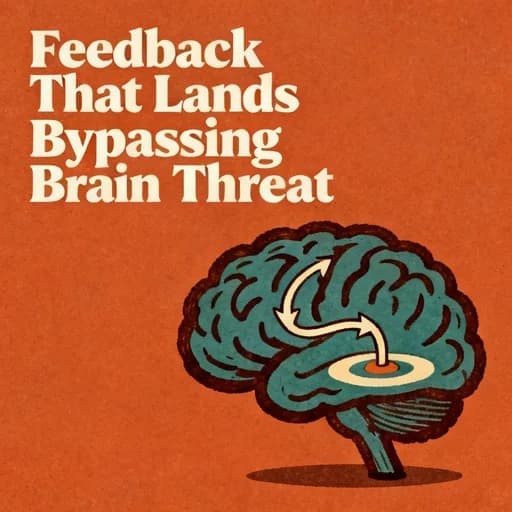
Feedback That Lands: Bypassing the Brain’s Threat Response
Critique often triggers a survival response that shuts down learning. Discover how to bypass the brain's defenses and deliver feedback that builds trust.
Лучшая цитата из Feedback That Lands: Bypassing the Brain’s Threat Response
The gap between 'I’m trying to help you' and 'I feel like I’m being hunted' is where most leadership fails. Real kindness is being clear, moving away from judgment and toward shared observation to bypass the brain's survival instincts.
Generated with BeFreed
How to Give Feedback That Lands






Часто задаваемые вопросы
When you hear a phrase like "Can I give you some feedback?", your brain’s amygdala—the area responsible for survival—triggers a threat response. This biological reaction causes blood flow to shift away from the prefrontal cortex, which is the part of the brain used for rational and logical thinking. Consequently, at the moment you need to process information most effectively, your brain is actually prioritizing survival and defense over learning and growth.
The feedback sandwich is a traditional method where a critique is placed between two compliments to soften the blow. While it feels polite, it often fails because the praise can feel insincere or like "bait" for the criticism. This approach frequently leads to confusion; the recipient may either focus entirely on the praise and miss the necessary correction, or ignore the praise altogether because they perceive it as a disingenuous cushion for the negative news.
The SBI model stands for Situation, Behavior, and Impact, and it is designed to anchor feedback in objective reality rather than personal judgment. By specifying a exact moment (Situation) and describing observable actions that a video camera could capture (Behavior), you prevent the recipient from feeling like their character is being attacked. Closing with the Impact explains the "why" by connecting the behavior to a specific result, which helps the individual understand the ripple effect of their actions without feeling judged.
Radical Candor is the "sweet spot" of feedback where a leader cares personally about an employee while challenging them directly with honest truths. In contrast, Ruinous Empathy occurs when a manager is so concerned about being nice or avoiding discomfort that they withhold necessary criticism. This ultimately damages the employee because they are denied the clear information they need to improve and succeed.
Asking about intent turns a one-way lecture into a two-way dialogue and prevents the manager from "psychoanalyzing" or assuming motives. By asking what the person was trying to achieve, you give them the benefit of the doubt and often uncover the root cause of an issue—such as a misunderstanding or a lack of resources—rather than simply labeling them as unproductive or difficult. This builds trust and makes the individual feel heard and understood.
Создано выпускниками Колумбийского университета в Сан-Франциско
"Instead of endless scrolling, I just hit play on BeFreed. It saves me so much time."


"I never knew where to start with nonfiction—BeFreed’s book lists turned into podcasts gave me a clear path."


"Perfect balance between learning and entertainment. Finished ‘Thinking, Fast and Slow’ on my commute this week."
"Crazy how much I learned while walking the dog. BeFreed = small habits → big gains."
"Reading used to feel like a chore. Now it’s just part of my lifestyle."

"Feels effortless compared to reading. I’ve finished 6 books this month already."
"BeFreed turned my guilty doomscrolling into something that feels productive and inspiring."

"BeFreed turned my commute into learning time. 20-min podcasts are perfect for finishing books I never had time for."
"BeFreed replaced my podcast queue. Imagine Spotify for books — that’s it. 🙌"

"It is great for me to learn something from the book without reading it."
"The themed book list podcasts help me connect ideas across authors—like a guided audio journey."
"Makes me feel smarter every time before going to work"
Создано выпускниками Колумбийского университета в Сан-Франциско
"Instead of endless scrolling, I just hit play on BeFreed. It saves me so much time."
"I never knew where to start with nonfiction—BeFreed’s book lists turned into podcasts gave me a clear path."
"Perfect balance between learning and entertainment. Finished ‘Thinking, Fast and Slow’ on my commute this week."
"Crazy how much I learned while walking the dog. BeFreed = small habits → big gains."
"Reading used to feel like a chore. Now it’s just part of my lifestyle."
"Feels effortless compared to reading. I’ve finished 6 books this month already."
"BeFreed turned my guilty doomscrolling into something that feels productive and inspiring."
"BeFreed turned my commute into learning time. 20-min podcasts are perfect for finishing books I never had time for."
"BeFreed replaced my podcast queue. Imagine Spotify for books — that’s it. 🙌"
"It is great for me to learn something from the book without reading it."
"The themed book list podcasts help me connect ideas across authors—like a guided audio journey."
"Makes me feel smarter every time before going to work"
"Instead of endless scrolling, I just hit play on BeFreed. It saves me so much time."
"I never knew where to start with nonfiction—BeFreed’s book lists turned into podcasts gave me a clear path."
"Perfect balance between learning and entertainment. Finished ‘Thinking, Fast and Slow’ on my commute this week."
"Crazy how much I learned while walking the dog. BeFreed = small habits → big gains."
"Reading used to feel like a chore. Now it’s just part of my lifestyle."
"Feels effortless compared to reading. I’ve finished 6 books this month already."
"BeFreed turned my guilty doomscrolling into something that feels productive and inspiring."
"BeFreed turned my commute into learning time. 20-min podcasts are perfect for finishing books I never had time for."
"BeFreed replaced my podcast queue. Imagine Spotify for books — that’s it. 🙌"
"It is great for me to learn something from the book without reading it."
"The themed book list podcasts help me connect ideas across authors—like a guided audio journey."
"Makes me feel smarter every time before going to work"
"Instead of endless scrolling, I just hit play on BeFreed. It saves me so much time."
"I never knew where to start with nonfiction—BeFreed’s book lists turned into podcasts gave me a clear path."
"Perfect balance between learning and entertainment. Finished ‘Thinking, Fast and Slow’ on my commute this week."
"Crazy how much I learned while walking the dog. BeFreed = small habits → big gains."
"Reading used to feel like a chore. Now it’s just part of my lifestyle."
"Feels effortless compared to reading. I’ve finished 6 books this month already."
"BeFreed turned my guilty doomscrolling into something that feels productive and inspiring."
"BeFreed turned my commute into learning time. 20-min podcasts are perfect for finishing books I never had time for."
"BeFreed replaced my podcast queue. Imagine Spotify for books — that’s it. 🙌"
"It is great for me to learn something from the book without reading it."
"The themed book list podcasts help me connect ideas across authors—like a guided audio journey."
"Makes me feel smarter every time before going to work"