The century between a thought and a ripple
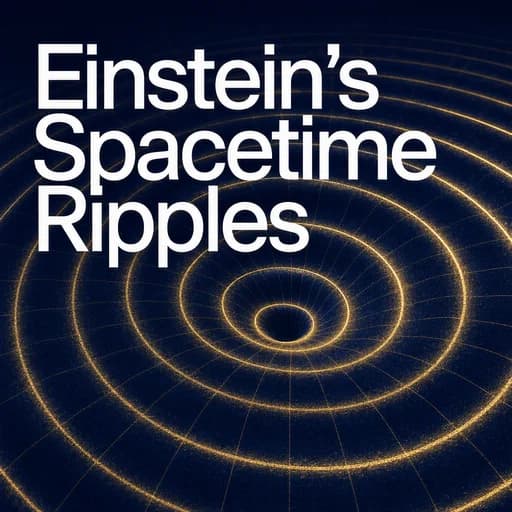
On September 14, 2015, two massive detectors—one in the swamps of Louisiana and the other on the high desert plains of Washington state—felt a vibration so slight that it was smaller than the width of an atomic nucleus. That tiny shudder was the first direct evidence of gravitational waves, ripples in the very fabric of spacetime that had traveled over a billion light years to reach us. For you, living in 2026, this might seem like settled science, a celebrated milestone of the past decade. But if you look back exactly one hundred years before that discovery, you find a world where this idea was nothing more than a mathematical ghost. In 1916, Albert Einstein was sitting in Berlin, staring at equations that seemed to suggest space itself could wobble like a bowl of jelly—and yet, he wasn't even sure if he believed it.
You might find it striking that the man whose name is now synonymous with this prediction actually spent decades trying to take it back. Einstein’s relationship with gravitational waves was a lifelong tug of war between his intuition and his math. One moment he was convinced they were as real as light waves; the next, he was writing papers claiming they were an illusion created by a bad choice of coordinates. This isn't just a story about a genius getting it right—it's a story about the messy, human process of trying to understand a universe that refuses to be simple. It’s about how a series of letters exchanged during the horrors of the First World War laid the foundation for a discovery that would eventually require the most precise machines ever built by human hands.
This matters to you because it changes how you see the world around you. We often think of space as a stage—an empty, static background where things happen. But Einstein’s theory tells you that the stage is actually a participant. It can stretch, it can squeeze, and it can carry information across the cosmos. When you look up at the stars, you aren't just seeing light; you are standing in a sea of invisible ripples created by the most violent events in existence. Understanding how Einstein first "saw" these ripples—long before we had the tools to hear them—is the first step in realizing that the universe is far more dynamic than our senses lead us to believe.
So let’s go back to that moment in 1916. While Europe was tearing itself apart in the trenches, Einstein was having a quiet revolution of the mind. He had just finished his General Theory of Relativity, a theory that redefined gravity not as a force pulling on objects, but as the curvature of space and time itself. But as he looked at the implications of his new masterpiece, he stumbled upon a weird possibility. If you move a mass—say, two stars circling each other—the curvature around them should change. And that change shouldn't just stay there; it should move outward, like a wave on a pond. This was one step in a concept that had been developing over many years that would take a century to prove, and it all started with a mistake and a letter from the front lines.



![[1610.08803] A brief history of gravitational wave research](https://d1y2du6z1jfm9e.cloudfront.net/assets/podcast/yellow.png)

![[1607.04202] Chapter 0 Theory of Gravitational Waves](https://d1y2du6z1jfm9e.cloudfront.net/assets/podcast/blue.png)